Cribbage is a card game for two that you score by moving pegs along a board. A game takes 20 minutes, and you can play it at a kitchen table or on a camping trip. Here's how to pick a board and cards, deal and discard to the crib, count fifteens, pairs and runs, peg to 31, and what to read once you want to win more.
By Colin B. · Published November 19, 2026 · Last reviewed November 19, 2026
A wooden 2-track folding board with pegs and a deck of paper cards is about $20. Add metal pegs, a deck of plastic cards and a strategy book for about $45.
We earn commission when you buy through links on this page, including
Amazon. See our affiliate disclosure.
Price tiers and budget totals shown above are editorial estimates;
actual prices vary.
At a glance
Our top pick in each category
The fastest path through this guide — each best-starter pick by category.
Scroll for the budget and upgrade alternatives.
Learn with two players. Two-handed cribbage is the standard game: six cards each, two go to the crib, first to 121 points wins. Three and four player games use the same scoring, so everything carries over.
Get a board with the right number of tracks. A 2-track board is for two players or two teams. A 3-track board lets three people play and still works for two. Continuous boards that run 121 holes in one long track are easier to read than ones you go around twice.
Any standard deck works. Cribbage uses a normal 52-card deck with no jokers. Plastic cards last years and shuffle better than paper ones, but a fresh paper deck is fine to start.
Expect counting to be slow at first. New players miss points, especially fifteens. Count out loud, in the same order every hand: fifteens, then pairs, then runs, then flush and nobs. After a few dozen hands it gets quick.
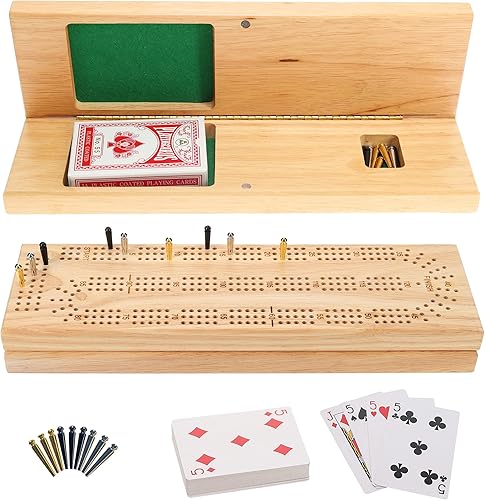
The board is just a scorekeeper. Each player moves a pair of pegs, leapfrogging the back peg past the front one, so you can always see the last score. Boards come in 2-track for two players and 3-track for three. Continuous boards run all 121 holes in one line, while classic boards make you go around twice. Folding boards with storage for pegs and a deck are easiest to keep together.
Best starter
WE Games
Travel Cribbage Board Set, Foldable 2-Track with Card Storage
$16.99 as of Nov 19, 2026
★★★★★Our rating· In Stock
A solid wood 2-track board that folds closed with a deck of cards and the pegs stored inside. Clear, evenly drilled holes and a latch that keeps everything together in a bag or drawer. Sold by Family Board Games. About $16.99, 4.3 stars from 870 ratings.
Three tracks laid out as one long continuous path, so you never lose your place going around twice. Three people can play, and it still works for two. A drawer underneath holds the pegs. Sold by Family Board Games. About $30, 4.7 stars from 1,569 ratings.
A board cut in the shape of the number 29, the best possible cribbage hand. Fun as a gift for someone who already plays, and it scores the same as any standard board. Sold by Family Board Games. About $19.99, 4.7 stars from 236 ratings.
Cribbage uses one standard 52-card deck with the jokers removed. Paper cards are cheap and fine to start, but they bend and get sticky after a few dozen games. Plastic cards cost more, shuffle smoothly and can be wiped clean, so one deck lasts years. Poker size cards are standard. Bridge size cards are a little narrower and easier to hold if you have small hands.
Best starter
Bicycle
Standard Playing Cards, 2 Pack
$5.34 as of Nov 19, 2026
★★★★★Our rating· In Stock
The deck most people grew up with. Air-cushion finish shuffles well, the faces are easy to read, and a two pack means you have a spare when one deck gets worn or a card goes missing. Sold by Amazon. About $5.34, 4.8 stars from 1,683 ratings.
Fully plastic cards that resist bending and spills and shuffle smoothly for years. The 1546 design has big, clear indexes. Comes as a two-deck set, often in red and blue. Sold by Copag USA Inc.. About $22, 4.7 stars from 1,893 ratings.
Most boards come with plastic or wood pegs, and they're the first thing to go missing. A spare set keeps the game going. Metal pegs feel nicer, sit firmly in the holes and are easier to grab. Check the peg diameter before you buy. Most boards use standard 1/8 inch holes, but some older or handmade boards are larger or smaller.
Best starter
WE Games
Standard Metal Cribbage Pegs with Velvet Pouch, Set of 9
$7.99 as of Nov 19, 2026
★★★★★Our rating· In Stock
Three colors of metal pegs, three of each, with one extra per color for the game-count hole. They fit standard 1/8 inch holes and stay put when someone bumps the table. Sold by Family Board Games. About $7.99, 4.3 stars from 291 ratings.
A big bag of plastic pegs in several colors for very little money. Keep a few in the board, a few in the junk drawer and you'll never stop a game because one rolled under the couch. Sold by Family Board Games. About $7.49, 4.6 stars from 1,357 ratings.
Cribbage looks complicated because of the board and the scoring words. It isn't. A month of a few games a week is enough to count hands fast, peg well and start making smarter discards. Here's a week-by-week plan.
Cribbage is two things: counting cards to 15 and deciding which two cards to give away. Learn to count first. Strategy comes once counting is automatic.
Week 1: Play open hands
Deal six cards each, face up, so both of you can see. Each player puts two cards in the crib. Cut a starter card. Count each hand out loud with the starter: every combination that adds to 15 is 2 points, every pair is 2, every run is 1 per card. Move your peg one hole per point. Play a few games this way before you hide your cards.
Play normal games now. Count every hand in the same order: fifteens, then pairs, then runs, then flush, then nobs. Point at each card as you count it. Common hands to memorize: a 5 and any 10-card is 2. Two pairs is 4. A double run like 4-5-5-6 is 8, plus the fifteens.
Pegging is where close games are won. Lead a 4 or lower so your opponent can’t hit 15 right away. Avoid leading a 5, since so many cards are worth 10. If they play a card, think about whether pairing it gives them a chance at three of a kind for 6. Count the total out loud every card, and don’t forget the 1 point for the last card.
When you deal, the crib is yours. Throw a pair, a 5 or two cards close in rank into it. When your opponent deals, throw cards far apart, like a king and a 2, and never a 5. Keep the four cards that score the most in your hand first, then think about the crib. Read a strategy book or find a local American Cribbage Congress club.
Get a 2 or 3 track wooden board with storage for pegs and a deck. · Buy
Deal a few open hands face up and count each one out loud. · Learn
Play five full games to 121 with a friend or family member. · Action
Practice pegging: play cards to 15 and 31 and take your points. · Action
FAQ
Common questions
How do you count a cribbage hand?
Use your four cards plus the starter card. Score 2 for every combination that adds to 15, 2 for each pair, 1 per card in a run of three or more, 4 for a flush in your hand, and 1 for nobs, the jack matching the starter's suit.
What is the crib?
Each player discards cards into a second hand, called the crib, that belongs to the dealer. It's scored after the hands. When you deal, throw good cards into it. When your opponent deals, throw cards that are unlikely to help it.
What is the highest possible hand?
29 points: three fives and the jack in your hand, with the fifth five as the starter card in the jack's suit. It's very rare. Most hands score between 4 and 10 points.
What is pegging?
After the discard, players take turns laying cards face up and calling the running total, never going over 31. You score for hitting exactly 15 or 31, for pairs and runs as you play, and 1 point for the last card played.
Do I need a 2-track or 3-track board?
If you only play with one other person, a 2-track board is enough. A 3-track board costs a little more but lets a third player join, and it works fine for two.
JustBeginning earns commission from affiliate programs. As an Amazon
Associate, we earn from qualifying purchases. This costs you nothing
extra and doesn't change our recommendations.
Prices and availability are accurate as of the date and time
shown and can change; the price on Amazon when you buy is what
applies.
How this works.
Our top pickTravel Cribbage Board Set, Foldable 2-Track with Card Storage


 Best starter