Homemade jerky costs less than store bags and tastes the way you want it. It's lean meat, sliced thin, marinated and dried. Here's how to pick a dehydrator, slice an eye of round to 1/4 inch, mix a marinade, heat the meat to a safe 160 F, tell when it's dry, and store it so it keeps.
By Colin B. · Published November 19, 2026 · Last reviewed November 19, 2026
A basic round food dehydrator runs about $50 to $70. Add an instant-read thermometer, a jerky seasoning and cure kit, and a box of wide mouth jars for storage for about $140 total. Add the meat, about $15 to $25 per batch.
We earn commission when you buy through links on this page, including
Amazon. See our affiliate disclosure.
Price tiers and budget totals shown above are editorial estimates;
actual prices vary.
At a glance
Our top pick in each category
The fastest path through this guide — each best-starter pick by category.
Scroll for the budget and upgrade alternatives.
Drying alone doesn't make meat safe. A dehydrator runs at 130 to 155 F, which is not hot enough to kill E. coli or salmonella on its own. USDA says to heat beef to 160 F and poultry to 165 F before drying. Most people steam or bake the marinated strips first, or finish them in a 275 F oven after drying.
Pick lean meat. Fat goes rancid fast and won't dry. Eye of round, top round and bottom round are cheap, lean and easy to slice. Trim every bit of visible fat. A 3 lb roast makes about 1 to 1.25 lb of jerky.
Slice it cold. Put the meat in the freezer for 1 to 2 hours until it's firm but not frozen solid. Then you can cut even 1/4 inch slices with a sharp knife. Slice with the grain for chewy jerky, across it for tender jerky that breaks apart.
You can start with your oven. Set it as low as it goes, prop the door open an inch and dry the strips on racks over sheet pans. It works, but it ties up the oven for 4 to 8 hours. A dehydrator is cheaper to run and holds a steadier temperature.
The gear
What you actually need
Dehydrators
A dehydrator blows warm air over stacked trays for hours at a steady temperature. For jerky you want an adjustable thermostat that reaches at least 155 F and a fan. Round stacking models are cheap and expand with extra trays, but the trays near the heater dry faster, so you rotate them. Box models with a rear fan dry more evenly and hold more meat. Four to six trays hold 2 to 3 lb of sliced meat.
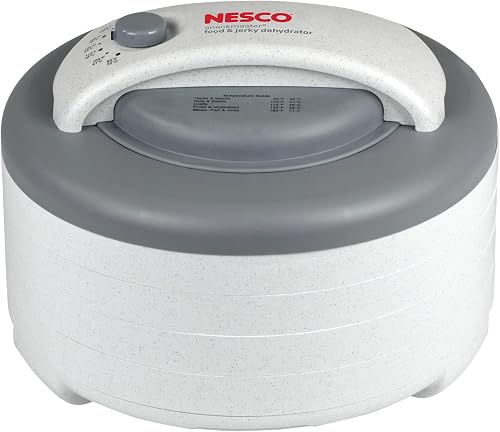
Four trays, a top-mounted fan and an adjustable thermostat that reaches 160 F. Nesco has been the default first jerky dehydrator for years, and you can add trays later as batches get bigger. Sold by Amazon. About $61, 4.5 stars from 1,411 ratings.
A box dehydrator with a rear fan, so air moves across every tray and you rarely rotate. Stainless trays, a digital timer and a thermostat up to 165 F. Holds about 3 lb of strips. Sold by Amazon. About $160, 4.7 stars from 24,146 ratings.
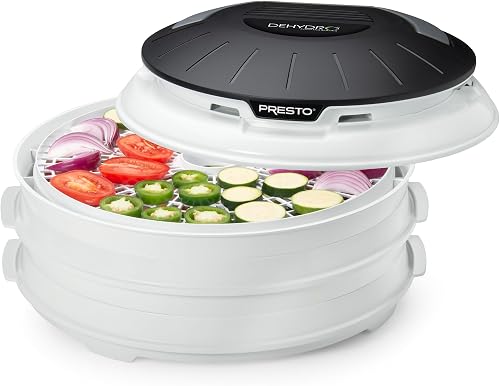
A simple six-tray round dehydrator that runs at a fixed 165 F with a bottom fan. Fine for jerky and cheap to try, but you can't turn it down for fruit or herbs. Sold by Amazon. About $38, 4.6 stars from 11,257 ratings.
Even slices dry evenly. A long, thin slicing knife cuts a half-frozen roast into 1/4 inch strips in one pass per slice, without sawing. Look for a 10 to 12 inch blade. A granton edge, the row of shallow dimples along the blade, keeps slices from sticking. A short chef's knife works but leaves more ragged strips. Electric slicers are worth it only once you make big batches every month.
Best starter
Victorinox
Fibrox Pro Slicing Knife, Granton Blade, 12 Inch
$75.49 as of Nov 19, 2026
★★★★★Our rating· In Stock
A long, thin, flexible blade with a dimpled edge that glides through a firm roast in one stroke. The grippy handle stays put with wet hands. Barbecue cooks use the same knife for brisket. Sold by az-boutique-us. About $75, 4.8 stars from 4,498 ratings.
A long, thin carving blade for much less money than the Victorinox. It isn't as refined, but it cuts clean 1/4 inch strips from partly frozen meat and holds a decent edge. Sold by Cutluxe Knives. About $33, 4.8 stars from 7,648 ratings.
This is the safety tool. USDA says jerky meat should hit 160 F, and poultry 165 F, before or after drying, because a dehydrator alone may not get the meat hot enough to kill bacteria. An instant-read probe in the thickest strip tells you when you're there. Fast readings matter, because you check several strips with the oven door open. Calibrate it in ice water once in a while: it should read 32 F.
Best starter
ThermoWorks
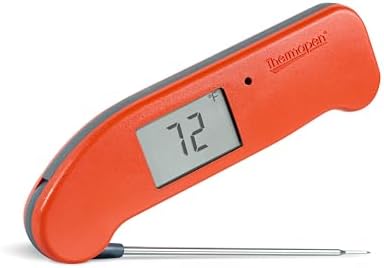
ThermoPop 2 Instant Read Thermometer
$37.60 as of Nov 19, 2026
★★★★★Our rating· In Stock
Reads in about 2 to 3 seconds, has a thin probe that fits in a 1/4 inch strip, and the display rotates so you can read it at any angle. Accurate and cheap enough to keep one in the kitchen drawer. Sold by ThermoWorks. About $38, 4.6 stars from 1,198 ratings.
Reads in about one second, with a folding probe and an auto-rotating backlit screen. It's the thermometer pros use, and it pays off if you also grill, smoke or roast a lot. Sold by ThermoWorks. About $100, 4.6 stars from 1,442 ratings.
A basic marinade is soy sauce, Worcestershire, brown sugar, garlic and black pepper. Seasoning kits make it easier and many include a cure packet of salt and sodium nitrite. Cure isn't required if you heat to 160 F, but it adds a margin of safety, gives jerky its pink color and its classic flavor. Always use the exact amount of cure the package lists for the weight of your meat. More is not better.
Best starter
Hi Mountain Seasonings
Original Blend Jerky Seasoning and Cure Kit
$12.99 as of Nov 19, 2026
★★★★★Our rating· In Stock
A seasoning packet and a separate cure packet, with a shaker and a chart for how much to use per pound. It does up to 15 lb of meat and takes the guesswork out of curing. Sold by Open Bay Trading Co.. About $12.99, 4.6 stars from 2,706 ratings.
Packets of seasoning with cure included, each one sized for a pound of meat, in three flavors. Cheap, easy to portion, and a good way to make your first few batches before you mix your own. Sold by PLEXSUPPLY. About $14.98, 4.6 stars from 1,567 ratings.
Store jerky only after it cools, in something airtight. Wide mouth glass jars are easy and let you see moisture. If drops form on the glass, put the jerky back in the dehydrator. Vacuum sealing keeps it longest, especially in the freezer. A jerky gun is for ground meat: you pack it with seasoned lean ground beef and press out flat strips. It's a fun second project once sliced jerky is easy.
Best starter
Ball
Wide Mouth Quart Mason Jars with Lids, 12 Pack
$41.99 as of Nov 19, 2026
★★★★★Our rating· In Stock
Wide mouth jars are easy to fill and empty with stiff strips, and the clear glass shows any moisture right away. One quart holds about half a pound of jerky. Reuse them for dried fruit and spices. Sold by NY Wholesale Group. About $42, 4.6 stars from 3,862 ratings.
A caulk-gun style press with flat strip and round stick tips. Pack it with lean seasoned ground beef and press strips straight onto the dehydrator tray. Comes with seasoning and cure packets. Sold by Amazon. About $18.24, 4.0 stars from 4,022 ratings.
Pulling the air out keeps jerky from going stale or rancid for months in the freezer. Seal it in single-serving bags so you only open what you'll eat. Useful for meat, cheese and leftovers too. Sold by Amazon. About $90, 4.5 stars from 9,300 ratings.
Jerky is simple once you've made one batch. The hard parts are slicing even strips, getting the meat hot enough to be safe and knowing when to stop drying. Four weekends gets you there. Here's a week-by-week plan.
Good jerky is lean meat, a salty marinade and patience. Get the slicing and the safety step right and every batch after that is just new flavors.
Week 1: Buy and slice the meat
Buy a 2 to 3 lb eye of round. Trim off every bit of fat and silver skin. Wrap it and put it in the freezer for 1 to 2 hours until it’s firm. Slice 1/4 inch thick with a long, sharp knife. Cut with the grain for chewy jerky, against it for tender. Try to keep every strip the same thickness so they finish at the same time.
Mix 1/2 cup soy sauce, 1/4 cup Worcestershire, 1 tablespoon brown sugar, 1 teaspoon black pepper, 1 teaspoon garlic powder and 1 teaspoon onion powder. That covers about 2 lb of meat. Marinate in a zip bag in the fridge overnight. Then lay the strips on a rack over a sheet pan and bake at 300 F until a thermometer in the thickest strip reads 160 F. For poultry, go to 165 F.
Pat the strips dry and lay them on dehydrator trays without overlapping. Dry at 145 to 155 F. Start checking at 3 hours. Pull a piece, let it cool for 5 minutes and bend it. It should crack on the surface but not snap. Rotate the trays every couple of hours if your dehydrator heats unevenly. Blot off any fat beads with a paper towel.
Try a seasoning kit with a measured cure packet and compare it to your first batch. Store cooled jerky in a jar with a loose lid for a day, then seal it. If moisture shows on the glass, it needs more drying. Once you’re comfortable, try venison, teriyaki or a pepper crust. Keep the 160 F step for every batch.
Buy a 2 to 3 lb eye of round and trim off all visible fat. · Action
Get a dehydrator with at least 4 trays and an adjustable thermostat. · Buy
Freeze the meat for 1 to 2 hours and slice it 1/4 inch thick. · Action
Marinate the strips in the fridge for 6 to 24 hours. · Action
Heat the strips to 160 F with an instant-read thermometer, then dry at 145 to 155 F. · Action
FAQ
Common questions
What temperature does jerky need to reach to be safe?
USDA says beef, pork and venison should reach 160 F, and poultry 165 F, before drying. Then dry at a steady 130 to 140 F or higher. Steaming or baking the marinated strips first is the easiest way to hit that number.
How do I know when jerky is done?
Take a piece out and let it cool for 5 minutes. Bend it. Done jerky bends and cracks on the surface but doesn't snap in half, and no moisture beads up. Most 1/4 inch beef strips take 4 to 8 hours in a dehydrator.
What's the best cut of beef for jerky?
Eye of round is the classic. It's lean, cheap and shaped like a log, so slices come out even. Top round and bottom round work too. Flank steak makes great jerky but costs more. Skip anything with marbling.
Do I need curing salt?
No, if you heat the meat to 160 F first and store the jerky cold or eat it within a couple of weeks. Cure with sodium nitrite adds a little more safety margin, the pink color and the classic flavor. Use exactly the amount on the package.
How long does homemade jerky last?
About 1 to 2 months in an airtight jar in a cool, dark pantry, and longer in the fridge or freezer. Blot off any fat before storing. If you see mold or it smells off, throw it out.
Can I use ground meat?
Yes, with a jerky gun that presses it into flat strips. Use 93 percent lean or leaner. Ground meat carries more bacteria through the whole piece, so the 160 F step is even more important.
JustBeginning earns commission from affiliate programs. As an Amazon
Associate, we earn from qualifying purchases. This costs you nothing
extra and doesn't change our recommendations.
Prices and availability are accurate as of the date and time
shown and can change; the price on Amazon when you buy is what
applies.
How this works.
Our top pickFD-60 Snackmaster Express Food Dehydrator, 4 Trays

 Best starter