A notebook and a pen. That's genuinely all you need to start — and unlike most hobbies, you can be good at journaling from day one. The challenge isn't technique; it's showing up. Here's what to buy, what to skip, and how to build the habit that sticks.
By Colin B. · Published June 4, 2026 · Last reviewed June 4, 2026
A quality notebook runs $15-25 and a good pen set $10-20. You can journal meaningfully for under $30 — the premium rabbit hole is optional, and enjoyable.
We earn commission on qualifying Amazon purchases — see our
affiliate disclosure.
Price tiers and budget totals shown above are editorial estimates;
actual Amazon prices vary.
At a glance
Our top pick in each category
The fastest path through this guide — each best-starter pick by category.
Scroll for the budget and upgrade alternatives.
You don't need a premium notebook to start. A $5 composition book used every day beats a $50 specialty notebook opened twice. That said, a notebook you actually want to open makes building the habit meaningfully easier — so buy something you like, not just something cheap.
Ruling style matters more than brand. Dot grid gives you the most flexibility: write in rows, sketch freely, draw columns, or set up a weekly spread — all in the same notebook. Lined is the familiar fallback if you just want to write. Blank works if you're a visual person. Don't spend more than five minutes on this choice. You'll develop a real opinion after finishing one notebook.
Keep the system simple at the start. You can always add structure later — date headers, color-coded sections, habit trackers. Beginners who start with elaborate systems tend to abandon them by week three. A dated entry and a few sentences is a journal. Everything else is refinement.
Your notebook is the most personal part of journaling — once you find one you love opening, the habit gets easier. Three things matter: paper weight (at least 80gsm so gel pens don't bleed through), cover style (hardcover stays flat on any surface), and ruling style (dot grid gives the most flexibility; lined is the most familiar). The Leuchtturm1917 has become the default recommendation because it gets all three right without charging a luxury price. Start there, finish it, then decide what you'd change.
Notebooks — what's the difference?
A few common shapes, each making a different trade.
Lined
Traditional ruled lines — the familiar format most journalers start with.
Line spacing
~6mm
Paper
80gsm
Best for Prose writers, daily diary format, anyone just starting out
Tradeoff Constrains layouts to rows — no room for sketches or columns
Dot Grid
Dots at 5mm intervals give structure without constraining your layout.
Dot spacing
5mm
Paper
80gsm
Best for Bullet journalers, mixed writing and sketching, flexible layout
Tradeoff Takes a session or two to feel natural if you've only used lined
No lines or dots — maximum freedom for sketching and visual journaling.
Ruling
None
Paper
80gsm
Best for Artists, sketch journalers, travelers who draw alongside text
Tradeoff Handwriting drifts on the diagonal without guide lines
Graph
5mm graph squares help with structured spreads and planning layouts.
Grid size
5mm
Paper
80gsm
Best for Planners, habit trackers, grid-based weekly layouts
Tradeoff More visual noise than dot grid for pure prose writing
Best starter
Leuchtturm1917
A5 Hardcover Notebook (Dotted)
$25.75 as of Jun 22, 2026
★★★★★Our rating· Only 1 left in stock - order soon.
The Leuchtturm1917 is the notebook most journalers settle on, and for good reason. 80gsm acid-free paper handles fountain pens and gel pens without bleed-through. The hardcover lies flat on a desk. Page numbers and a pre-printed table of contents are already there. Two ribbon bookmarks, an elastic closure, a back-cover pocket. It does everything a journaler needs from a notebook, nothing more.
What we like
80gsm paper handles fountain pens without ghosting or bleed
Pre-printed page numbers and table of contents — already there
Two ribbon bookmarks and a back-cover pocket included
What to know
Pricier than Moleskine — but the paper quality justifies it
Fills fast for daily writers — budget for 2 per year
Moleskine is available in every airport, bookstore, and office supply chain — and that ubiquity is genuinely useful when your last notebook is full at 11pm. The ivory paper handles ballpoints and fineliner pens well. Not as thick as Leuchtturm's paper, and the elastic closure gets floppy with heavy use, but it does the job for a first notebook.
What we like
Available everywhere — easy to replace when you finish one
Iconic, familiar format that's been working for 30+ years
What to know
70gsm paper ghosts under fountain pens and heavy gel ink
Elastic closure goes limp after heavy use — minor but real
★★★★☆Our rating· Only 1 left in stock - order soon.
The Hobonichi Techo Cousin is a dated daily planner with one page per day — the format obsessives use for writing, habit tracking, and sketching in the same place. Tomoe River paper (52gsm) is legendarily thin but handles fountain pen ink with almost no bleed-through. Ships from Japan in fall for the following year; plan ahead, and order from the official US distributor.
What we like
Tomoe River paper is fountain-pen-perfect at just 52gsm
One page per day — no pressure to fill blank spreads
What to know
Sold by calendar year — planning ahead required
Thin pages feel fragile to ballpoint users first time
Your regular journaling pen doesn't need to be fancy. What matters: comfortable grip during long sessions, ink that doesn't smear when your hand sweeps the page, and no bleed-through on notebook paper. Gel pens hit all three and cost almost nothing. A 12-pack of Pilot G2s means you never run low at the wrong moment — and the 0.7mm tip is the sweet spot between readability and detail.
Best starter
Pilot
G2 Premium Retractable Gel Pens, 0.7mm (12-pack)
$13.95 as of Jun 22, 2026
★★★★★Our rating· In Stock
The G2 is the most popular gel pen in the US for a reason — smooth, consistent ink, a retractable design that means no lost caps, and a 0.7mm tip that's thick enough to read easily while fine enough for longer passages. Refillable, so you swap the cartridge when it runs dry. The 12-pack price works out to under $2 per pen, which makes losing one irrelevant.
What we like
Smooth gel ink that doesn't skip or streak during long writing sessions
Retractable — no cap to lose, no drying out between sessions
12-pack makes losing one a non-event
What to know
Thin barrel feels slippery without a grip — long sessions can fatigue
Black only in standard packs — buy assorted if you want colors
The Triplus produces a precise 0.3mm line perfect for small handwriting, margin notes, and decorative headers. Dry-safe tip means leaving the cap off for days won't kill the pen. A 20-color set opens up color-coded sections, habit tracker fills, and mood-tracking spreads without committing to expensive brush markers.
What we like
0.3mm tip is precise enough for color-coded section headers
Dry-safe cap — leaving it off briefly won't ruin the pen
What to know
Fine tip wears under heavy pressure — not for fast, hard writers
EnerGel dries faster than almost any other gel ink on the market — a real advantage for left-handed writers who drag their hand through wet ink. The rubber grip is thicker than the G2's, which some writers prefer for long sessions. Slightly less smooth than the G2 at top speed, but a genuinely competitive alternative at the same price.
What we like
EnerGel ink dries faster than G2 — essential for left-handed writers
Thicker rubber grip is easier on hands during marathon sessions
What to know
Very slightly less smooth than G2 at top writing speed
Cartridge replacement feels flimsier than Pilot's mechanism
Fountain pens are a genuine rabbit hole inside journaling — entirely optional and genuinely enjoyable. The appeal: smoother, more consistent ink flow that makes handwriting feel better, a refillable design that reduces plastic waste, and an enormous world of inks to explore. The good news is that the beginner tier is legitimately excellent. A $30 LAMY Safari writes as well as many $200 pens for most purposes. Start there before spending more.
Best starter
LAMY
Safari Fountain Pen (Fine nib)
$33.51 as of Jun 22, 2026
★★★★★Our rating
The Safari is what the fountain pen community recommends to almost every beginner — and it's held that position for decades. The triangular grip teaches correct pen hold, the converter slot lets you use bottled ink once you're hooked, and Lamy's cartridge system is widely available in the US. Start with the standard-included black cartridge, then branch out once you're converted.
What we like
The community's default beginner recommendation — for good reason
The Metropolitan is Japan's answer to 'I want to try a fountain pen without spending real money.' Around $20, the nib writes smoothly out of the box, the metal barrel adds real weight and feel, and it uses standard international cartridges so you can try any ink brand. More refined than an entry-level Preppy, cheaper than a Safari — a genuine quality pen at an entry price.
What we like
Metal barrel adds satisfying weight and feel at an entry price
Standard international cartridges — compatible with any ink brand
What to know
Converter holds less ink than Lamy's — more frequent refills needed
Nib selection limited to fine and medium in most US retail stock
★★★★☆Our rating· Only 1 left in stock - order soon.
The TWSBI Eco is a piston-fill fountain pen with a large, visible ink reservoir — you can see exactly how much ink is left. The demonstrator barrel is satisfying to fill and refill, and the piston holds far more ink than any cartridge. When you're through your first pen and ready to commit to bottled ink, this is the natural next step at a still-reasonable price.
What we like
Piston fill holds 3-4x more ink than a cartridge
Clear barrel shows ink level at a glance — satisfying to use
What to know
Piston needs silicone grease every 6-12 months — minor maintenance
No cartridge backup option if you run out away from your inks
You don't need to decorate your journal. Plenty of people fill plain notebooks with plain handwriting and find it deeply satisfying. But if color, tabs, or structure makes you want to open the notebook more, washi tape and page flags are the cheapest way in — and both serve functional purposes too. Washi tape makes dividers, marks sections, and frames entries. Page flags mark the current date without bending a corner.
Best starter
Mr. Pen
Washi Tape Set (21 rolls)
$
★★★★★Our rating
Washi tape is the fastest way to add color and structure to a journal — use it for section dividers, date headers, framing entries, or just making a page worth opening. Japanese rice-paper tape is thin enough not to add bulk, sticks without damaging pages, and writes cleanly with most pens. A 21-roll sampler gives you enough variety to find what you actually use.
What we like
21 rolls gives enough variety to find your preferred patterns fast
Rice paper tape is thin, repositionable, and writable over with pens
What to know
Value set quality varies roll to roll — some patterns bleed color
You'll use 6-8 of 21 rolls regularly; the rest sit in a drawer
The smallest, most useful journaling accessory you'll buy. A page flag on today's entry means your notebook always falls open to the right place. Color-code by mood, type of entry, or month. The 200-count box lasts a full year for a daily journaler, and the adhesive holds without damaging pages when you remove them.
What we like
Opens your notebook to the right page every time — genuinely useful
Five colors enable color-coded entry types with no extra work
What to know
Standard flags are slightly wide for pocket notebooks
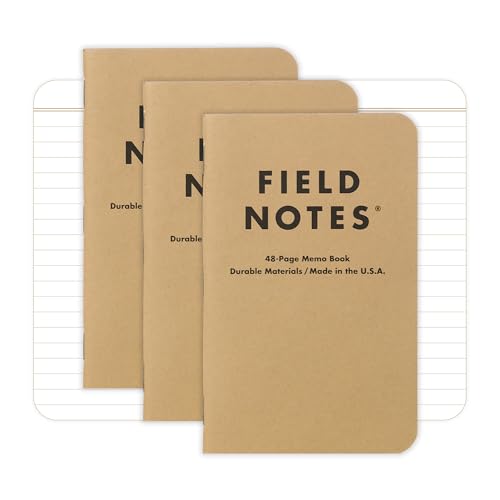
A pocket notebook lives in your back pocket, bag, or jacket — it captures ideas before they vanish. The best ones are the ones you'll actually carry: small enough to forget they're there, durable enough to survive it. Field Notes is the American classic, with a 3.5" x 5.5" form factor that fits comfortably next to your phone. Weatherproof versions exist if you spend time outdoors.
Best starter
Field Notes
Original Kraft Notebooks (3-pack)
$12.95 as of Jun 22, 2026
★★★★★Our rating· In Stock
Field Notes are the American pocket notebook standard. Kraft cardstock covers survive a back pocket. The 50# text stock paper bleeds under fountain pens, but for ballpoints and pencils it's exactly what you need. A 3-pack means one in your pocket, one on your desk, and one in your bag — the right quantity to make pocket journaling a real habit.
What we like
3.5" x 5.5" fits in any pocket — actually goes with you
3-pack lets you stash one everywhere without running out
What to know
50# paper bleeds badly under fountain pens — ballpoints only
No hardcover option in the Original — spiral or staple-bound only
If you write outside — hiking, fishing, construction sites, or any weather — Rite in the Rain is the only answer. The synthetic-coated paper sheds water completely, writes cleanly in rain, and survives being fully soaked in a bag. Ball-lock binding stays intact when wet. Throw it in your pack and stop thinking about it.
What we like
Synthetic paper is fully waterproof — survives rain and wet bags
Ball-lock binding won't pull apart when soaked
What to know
Requires a Fisher Space Pen or pencil — gel pens skip on the coating
Synthetic paper feels noticeably different from regular paper
Nobody tells you that journaling is hard to start. You open the blank page, you freeze, and you wonder what you're supposed to say. This guide covers the first four weeks honestly — what to expect, where it gets easier, and why week three is the one that counts.
Journaling has an unusual problem: the barrier to entry is almost zero (notebook, pen, sit down), but the barrier to continuing is surprisingly real. Most people who start journaling stop within a few weeks. Not because they ran out of things to say — but because nobody told them what the first month actually feels like.
This guide covers it week by week. Not what to write about. What to expect.
Week one: The awkward opening
The first entry is almost always awkward. You don’t know the register you’re supposed to write in — too formal feels stiff, too casual feels like a text to yourself. You write a few sentences, read them back, feel slightly embarrassed, and close the notebook.
This is normal. It happens to almost everyone.
The embarrassment goes away, but only through repetition. Don’t try to fix it by writing better — write more. Short is fine. “Had a long day. Dinner was good. Can’t stop thinking about the conversation I had at work.” That’s a journal entry. Date it and move on.
A few things that help in week one:
Set a time, not a word count. Five minutes every morning or evening beats “whenever I feel like it.” Journaling on a schedule means you never debate whether to do it — you just sit down at the time.
Start with what happened. If you freeze in front of a blank page, write what happened. Then ask yourself what you thought about it. The most useful journaling habit is asking “and how do I feel about that?” one level deeper than you’d normally go.
Don’t reread as you write. Rereading and editing is what makes journaling feel like a performance. Write forward. You can read it when it’s done — or not at all.
By week two, the format anxiety usually settles. You know roughly how long your entries run (a half-page is typical), you’ve found a time that works, and the blank page is less terrifying because you know you’ll fill it eventually.
This is when journaling starts feeling like a practice instead of a task. A few things that typically shift:
You start noticing things differently during the day. The journaling habit creates a gentle background awareness — you catch yourself thinking “I should write about that.” This is the function working. The journal doesn’t happen only when you sit down; it shapes how you move through the day.
You’ll miss a day. And when you do, you’ll either feel like you failed and spiral, or you’ll just write “Missed yesterday. Life happened.” and keep going. The second response is the right one. A journal with gaps in it is still a journal.
Experiment with format if plain prose isn’t working. Some people find their rhythm by switching to bullet points. Others use a simple template: three things that happened, one thing I’m grateful for, one question I’m sitting with. Both are fine. The format should disappear — if you’re thinking about the format, it’s getting in the way.
Week three: The wall
Most people who quit journaling quit in week three.
Week one has the novelty of starting. Week two has the early satisfaction of a forming habit. Week three has neither — it’s just a practice you’re maintaining, which is less exciting than launching it was.
The antidote is simple but requires deliberate effort: read your first week’s entries.
What you wrote two weeks ago looks different now. You can see things you were worried about that resolved. You can see patterns in what you keep returning to. You can see your own voice developing on the page — it almost certainly sounds better than it felt when you were writing it.
This is why people journal. Not the writing — the reading. The entries are letters to your future self. When you read them in week three, you get the first delivery.
If you can get past week three, the habit usually sticks.
Around week four, journaling stops being something you’re “trying to do” and becomes something you do. The decision overhead goes away. You sit down, you open the notebook, you write.
You’ll also start noticing what your journal is actually for. For some people it’s processing emotions — the act of writing clarifies what they feel in a way that just thinking doesn’t. For others it’s a record — they want to be able to look back at this period of their life later. For others it’s habit tracking or planning or creative thinking.
You don’t need to pick one. Most journals do several things at once. But by week four you’ll have a sense of what yours is doing.
At the end of month one, read the whole thing. Start to finish, if you can. Don’t judge the writing. Look for the things that surprise you — what you worried about, what you valued, what mattered to you in this month that you’d half-forgotten. This is the full payoff of the practice.
What to try next
Once the habit is established, a few things can deepen it:
Morning pages (Julia Cameron): Three handwritten pages every morning, no topic, no editing, no audience. The point is volume and consistency, not quality. Many people find this format unlocks creative thinking in a way that shorter, structured entries don’t.
Bullet journaling: Ryder Carroll’s system for combining tasks, events, and reflective notes in a dot grid notebook. Worth exploring after you’ve been journaling for a month — you’ll have enough experience to know which elements of it you’d actually use.
Reading about other people’s journaling practices: Susan Sontag, Virginia Woolf, Anaïs Nin — all serious diarists who wrote about the practice. Sontag’s notebooks (published posthumously) are worth reading if you find journaling crosses into writing.
Beginners get pressured to buy a lot of stuff that doesn't help them play
better. Here's what we'd skip on day one.
A $150+ luxury fountain pen — The LAMY Safari writes as well as most $200 pens for journaling. Upgrade after you know which nib width and ink properties you prefer.
A bottled ink collection — Start with included cartridges. Once you know which colors you actually use in a journal, buying a bottle makes sense — before then, it's just clutter.
A structured journaling system — GTD, bullet journaling, Zettelkasten — fine systems. The best system for starting is: open the notebook and write. Build the habit first, then add structure.
Two notebooks open at once — One notebook at a time. The discipline of finishing one before starting another is part of the practice, not a constraint on it.
Calligraphy or brush lettering supplies — A genuinely different hobby that often gets conflated with journaling. Beautiful on Instagram — a completely separate skill set to learn.
A leather journal cover — Adds weight and bulk without adding function. Wait until you know your preferred notebook size and format before committing to a cover.
First week
Your first seven days
A short, real plan to get from gear-on-doorstep to actually playing.
Buy a notebook you'll actually open — in person at a bookstore if possible, so you can feel the paper. · Buy
Anything you're actually thinking about: what happened today, what you're worried about, what you're looking forward to, what annoyed you, something you noticed. If you freeze, use a prompt — 'What am I thinking about right now?' almost always unlocks something. You don't need a topic. You need to start.
How is journaling different from a diary?
Terminology more than substance. A diary tends to mean a daily record of events; journaling is broader — it includes gratitude practices, morning pages, bullet journaling, travel logs, and reflective writing. Use whatever word makes you want to do it.
What's bullet journaling, and do I need it?
Bullet journaling is a specific system created by Ryder Carroll — a structured method of tracking tasks, events, and notes in a dot grid notebook. It's worth looking up once you've been journaling for a month. Starting with it before you've journaled at all is usually overwhelming.
What's the best notebook for beginners?
The Leuchtturm1917 A5 in dot grid. 80gsm paper that handles gel pens and fountain pens, pre-numbered pages, a table of contents, two ribbon bookmarks. It's not cheap, but it's the notebook most people stick with long-term. If you want to spend less to start, a Moleskine or any composition book works fine.
How much paper will I go through?
A standard A5 notebook (200-250 pages) lasts a daily writer 3-5 months at a half-page per entry. Heavy writers filling a page a day will finish two notebooks per year. Budget accordingly — Leuchtturm1917 is available in multi-packs that reduce the per-notebook cost.
Is fountain pen journaling expensive?
Only if you make it expensive. The LAMY Safari costs $30 and writes beautifully. A bottle of ink runs $15-20 and lasts for months. The expensive fountain pen rabbit hole is real, but entirely optional — plenty of journalers use the same $30 pen for years.
r/Journaling — Active community. Good for prompt ideas, notebook comparisons, and seeing how other people structure their practice. Skip the gear threads until you've filled your first notebook.
Bullet Journal Official — Ryder Carroll's official site for the Bullet Journal method. Start with 'Learn' section; the method video is under 5 minutes. Worth reading after your first month, not before.
r/fountainpens — The fountain pen community's main forum. Genuinely helpful for beginners — search 'recommendations under $50' or 'beginner ink' for curated starting points.
The Pen Addict Podcast — Weekly podcast covering notebooks, pens, and stationery. Good for discovering new gear once you have a foundation. Episode backlist is 10+ years deep.
Morning Pages (Julia Cameron) — Julia Cameron's three-pages-per-morning practice from The Artist's Way. The most-cited writing habit in the journaling world — worth reading if you want structure without a system.
As an Amazon Associate, JustBeginning earns from qualifying purchases.
We may also earn commission from other affiliate programs linked on this
page. Editorial recommendations are independent; we don't choose
products based on commission rates.
Product prices and availability are accurate as of the date and time
indicated and are subject to change. Any price and availability
information shown on Amazon at the time of purchase will apply.
Our top pickLeuchtturm1917 A5 Hardcover Notebook (Dotted)