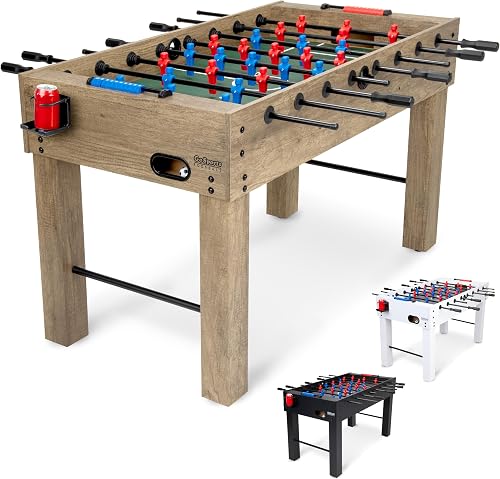
Foosball gets serious fast once you own a real table. Here's how to choose between a cheap home table and a Tornado or Warrior style tournament table, why one-goalie and through rods matter, which balls and rod lube to buy, how much room you need, and the first shots worth learning.
By Colin B. · Published November 18, 2026 · Last reviewed November 18, 2026
A GoSports 54-inch table, FoosJuice silicone lube and a pack of tournament balls come to about $275. The Barrington 58-inch competition table with the same add-ons and a set of handle wraps is about $450. A Tornado tournament table is $2,000 to $3,100.
We earn commission when you buy through links on this page, including
Amazon. See our affiliate disclosure.
Price tiers and budget totals shown above are editorial estimates;
actual prices vary.
At a glance
Our top pick in each category
The fastest path through this guide — each best-starter pick by category.
Scroll for the budget and upgrade alternatives.
Weight is the best quality test. A table under 100 pounds slides and shakes when you hit a hard shot, and that ruins ball control. Tournament tables like the Tornado weigh 200 to 300 pounds. A good home table should be at least 120 pounds with thick legs and leg levelers.
Pick one goalie, not three. Most US tournament tables have a single goalie with angled corners, so the ball can't get stuck. Cheap tables often have three goalies on the goal rod. That's easier for kids but teaches bad habits, because real defense comes from the two-man rod in front of the goalie.
Check the rods. Through rods (they stick out the far side) are standard on serious tables and slide smoothly. Telescoping rods don't stick out, so they're safer around kids, but they wobble and wear out sooner. Solid steel rods are a sign of a better table than hollow ones.
Measure your room. A full-size table is about 56 by 30 inches, and the rods add about a foot on each side. Plan on a space at least 8 feet long by 7 feet wide so players can stand and swing their arms without hitting walls.
The table is almost the whole budget. Cheap tables are light, have hollow telescoping rods and three goalies, and shake when you shoot. Better home tables are heavier and wider, with steel rods and leg levelers. Tournament tables like the Tornado weigh 250 pounds or more, have one goalie, angled corners and counterbalanced men, and last for decades. Buy the heaviest, largest table your room and budget allow, and read the assembly reviews: most home tables take two people and two to four hours to build.
Foosball tables — what's the difference?
A few common shapes, each making a different trade.
Budget home table
Light 48 to 54 inch tables for casual family play.
Price
$140 to $250
Goalies
Usually three
Weight
Light, may slide
Best for Kids, parties and finding out if you like it.
A 58-inch table with a 46.75 by 26.75 inch field, close to tournament size, and a sturdy wood-grain cabinet. It's the biggest table near $400 and a real step up from a 48-inch toy. Sold by Amazon. About $400, 4.1 stars from 160 ratings.
A full 54-inch table with steel rods and counterweighted players for about $240. It's lighter than the Barrington but plays well for casual games and learning to pin and pass. Sold by Amazon. 4.3 stars from 310 ratings.
The T-3000 is the classic US tournament table, built in the USA with a thick split cabinet, one goalie, counterbalanced men and 8-sided grippy handles. If you plan to play leagues, practicing on the same table they use is worth a lot. About $3,100, 4.6 stars from 84 ratings.
Foosballs vary more than you'd think. Textured balls grip the men, which makes pins, passes and the pull shot much easier to control. Smooth hard balls are faster and are used on some European tables. The balls that come with cheap tables are often light and bouncy. A pack of good balls is the cheapest upgrade you can make to any table. Use 35 or 36 mm balls on standard US tables.
Best starter
Tornado
Official Foosballs Tournament Table Soccer Balls
$23.99 as of Nov 18, 2026
★★★★★Our rating· In Stock
Tornado's textured tournament balls, made in the USA. They grip the men for clean pins and passes, and they're the ball used at US tournaments. About $24, 4.7 stars from 1,665 ratings.
A cheaper pack of 35 mm textured balls that grip much better than the balls that come with most home tables. Good as spares for a garage or party table. About $15, 4.6 stars from 230 ratings.
Two small things change how a table feels. Silicone rod lubricant makes the rods slide fast and quietly; put one drop on each rod near the bearing, and never use WD-40 or petroleum oil, which damages bearings. Handle wraps or new handles fix slippery or worn grips. Tournament players often wrap their handles for a tacky grip that doesn't need a tight squeeze.
Best starter
FoosJuice
100% Silicone Foosball Rod Lubricant with Dauber
$12.95 as of Nov 18, 2026
★★★★★Our rating· In Stock
Pure silicone lube with a dauber top, so you can wipe it on the rods without dripping on the field. A bottle lasts a home table a year or more. About $13, 4.7 stars from 1,426 ratings.
Foosball Wraps 8-Pack, Pro Tournament Handle Wraps
$18.95 as of Nov 18, 2026
★★★★☆Our rating· In Stock
Tacky wraps that slide over standard handles for a better grip with less squeezing. Useful when stock handles are hard and slippery. About $19, 4.4 stars from 31 ratings.
Replacement wooden handles for tables with 5/8 inch rods. They feel better than hollow plastic handles and fix cracked or wobbly ones. Measure your rods before ordering. About $20, 4.4 stars from 98 ratings.
Not everyone has an 8 by 7 foot space. A 48-inch table fits a smaller room, and a tabletop set sits on a dining table and goes in a closet afterward. Neither plays like a full-size table, but both are fine for kids and casual games, and they're an inexpensive way to find out if foosball sticks before you clear a room.
Best starter
Best Choice Products
48-Inch Foosball Table
$139.99 as of Nov 18, 2026
★★★★★Our rating· In Stock
A compact 48-inch table for small rooms and family play, with thousands of reviews. It is light, but at about $140 it's a low-risk way to start. 4.4 stars from 3,799 ratings.
A 32-inch tabletop set that sits on any table and stores in a closet. Good for apartments, kids and game nights. About $70, 4.6 stars from 317 ratings.
Foosball looks like wrist-flicking chaos until you see a good player pin the ball, wait, and score from the 3-bar before the goalie moves. Here's a four-week plan: set up the table, learn ball control, learn one real shot, then play other people.
Most people play foosball by spinning the rods and hoping. Serious players almost never hit a moving ball. They stop it, control it, and shoot when the defense guesses wrong. That is the whole skill, and you can start learning it in a week.
Week 1: Set up the table
Level the table first. Put a ball in the middle of the field. If it rolls, adjust the leg levelers until it stays still. A table that slopes toward one goal changes every shot.
Put one drop of 100% silicone lubricant on each rod where it goes into the bearing, then slide the rod in and out to spread it. Never use WD-40 or any oil with petroleum in it. It damages the plastic bearings. Clean the rods and re-lube about once a month.
Learn to pin the ball. Tilt a man forward and trap the ball against the table under his toe. Do it with the 5-bar (midfield) and the 3-bar (forwards). Then learn to pass from one man to the next on the same rod, and from the 5-bar to the 3-bar.
Hold the handles loosely, with your fingers, not your whole fist. A tight grip makes you slow and tires your wrist. No spinning: it’s against the rules and it hides bad technique.
Learn the pull shot from the 3-bar. Pin the ball with the middle man, slide the rod toward you, and strike the ball toward the goal as the man passes the open hole. Start slow and accurate. Speed comes later. Then add the push shot, which goes the other way. Having two options is what makes a shot hard to block.
The snake shot (a wrist roll from a pinned ball) is the famous power shot. It’s hard to learn, so wait until the pull shot feels natural.
Defense uses the 2-man rod and the goalie together. Keep them covering different parts of the goal and don’t chase the ball. Move to block the hole the shooter is aiming at.
Then find people to play. Bars with Tornado tables, local leagues and USTSF events are full of players who will happily show you a shot. Losing to good players teaches more than beating your friends.
One goalie if you want to play the way tournaments do. Three goalies are fine for kids and casual parties, but a one-goalie table with angled corners plays faster and teaches proper defense with the 2-man rod.
What's the difference between Tornado and Warrior tables?
Both are US tournament-style tables with one goalie, heavy cabinets and through rods. Tornado is the most common table in US bars and tournaments. Warrior is a little lighter and often cheaper. Either is a big step up from a department-store table.
Is spinning allowed?
No. Official rules ban spinning the rod more than 360 degrees before or after striking the ball. It's fun at parties, but it stops you learning real shots and can hurt the person next to you.
What ball should I use?
Use the ball your table was made for. Textured balls like the Tornado tournament ball grip the men better for pins and passes. Smooth, hard balls are faster and are used on some European tables like Bonzini.
What are the first shots to learn?
The pull shot and push shot from the 3-bar, then the snake shot later. On defense, learn to block with the 2-man rod and goalie working together. Passing from the 5-bar to the 3-bar comes next.
JustBeginning earns commission from affiliate programs. As an Amazon
Associate, we earn from qualifying purchases. This costs you nothing
extra and doesn't change our recommendations.
Prices and availability are accurate as of the date and time
shown and can change; the price on Amazon when you buy is what
applies.
How this works.
Our top pick58" Full Size Competition Foosball Table


 Best starter