Darts has a dedicated, passionate community and almost no decent beginner guides. Here's the fix: what gear actually matters (bristle board, tungsten darts, a proper surround), what you'll be tempted to overspend on, and how to mount your board correctly from day one.
By Colin B. · Published May 24, 2026 · Last reviewed June 14, 2026
A bristle board, a decent tungsten set, and a surround ring gets you to a proper setup for around $90-180. The gear lasts years if you buy it right the first time.
We earn commission on qualifying Amazon purchases — see our
affiliate disclosure.
Price tiers and budget totals shown above are editorial estimates;
actual Amazon prices vary.
At a glance
Our top pick in each category
The fastest path through this guide — each best-starter pick by category.
Scroll for the budget and upgrade alternatives.
The dartboard matters more than the darts. A $15 paper or coiled-wire board will shred within weeks, dull your points, and give you a warped read of where you're actually aiming. Buy a bristle board once and it'll last years.
Buy tungsten, not brass. Brass darts are thick, inconsistent, and crowd each other on the board, making tight groupings physically impossible. Tungsten darts in the 22-24g range are the universal beginner recommendation for good reason: they're thin, balanced, and what every serious player actually uses.
Mount your board correctly on day one. Standard UK/BDO/PDC regulation height is 5 feet 8 inches from floor to center of the bullseye. The toe line (oche) is 7 feet 9.25 inches from the face of the board. Use tape for the oche until you buy a mat. Getting this right from the start means your muscle memory trains on a legal setup.
Every serious darts player plays on a bristle board: sisal fibers that self-heal when a dart is removed, so the board lasts years instead of months. Anything with a wire coil surface or a paper face is a toy and will actively work against your development. Within bristle boards, the main differentiator is the wire divider between segments: thin, staple-free wires reduce bounce-outs dramatically. The Winmau Blade series has been the bristle-board benchmark for decades.
Best starter
Winmau
Blade 6 Bristle Dartboard
$$
★★★★★Our rating
The Blade 6 is the standard of the sport. Ultra-thin blade wires reduce bounce-outs, the sisal is dense and self-heals cleanly, and this is the board you'll see at pub leagues and BDO-sanctioned events. Buy this, mount it properly, and never think about dartboards again.
The cheapest bristle board we'd actually recommend. Sisal construction, removable bullseye for rotation, and staple-free wire on the bull area. Not as refined as the Winmau but a real bristle board, not the coiled-wire toy at the bottom of the category.
What we like
Under $40 and genuinely bristle, not a toy coiled-wire board
Removable bullseye lets you rotate for even wear
What to know
Thicker wires mean more bounce-outs than premium boards
Sisal density is lower; expect shorter lifespan than Winmau
Eclipse Pro 2 Bristle Steel Tip Dartboard with American Legend Dartboard Cabinets
$$$
★★★★☆Our rating
The Eclipse Pro 2 is Unicorn's tournament-grade board and the choice of the PDC (the organization that runs the World Championship). Extremely thin wiring, exceptional sisal density, and a staple-free bullseye. If you're playing regularly and want to eliminate bounce-outs as a variable, this is where you go.
What we like
PDC official board, the same spec used at the World Championship
Staple-free bullseye and thinnest wires available reduce bounce-outs
Highest sisal density of any consumer board for exceptional lifespan
What to know
Premium price: overkill until you're playing 2+ times a week
Virtually no difference versus Blade 6 for the first 100 hours
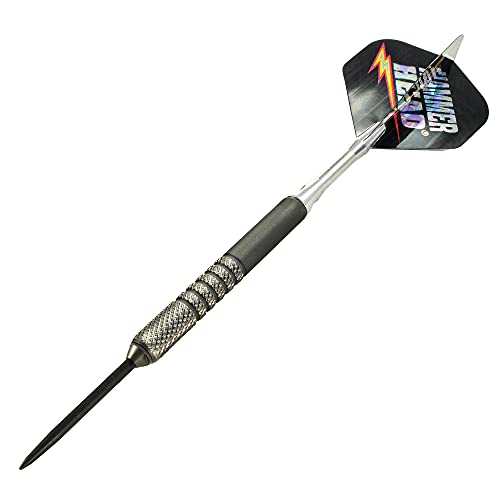
Your darts are your instrument. Brass darts are wide and cheap: avoid them. Tungsten has a much higher density, which means the same weight in a much slimmer barrel, letting darts group close together on the board without crowding. Weight is personal: 22-24g is where most beginners land. Flights (the wing shape) and shafts (the stem connecting barrel to flight) affect stability in the air and are cheap to replace. Buy a decent tungsten set and experiment with flights before you decide you need a new barrel.
Darts — what's the difference?
A few common shapes, each making a different trade.
18g–20g (Lightweight)
Fast release, less arm effort. Popular with players who have a quick, snappy throw.
Weight
18–20g
Best for
Fast, snap-release throwing style
Best for Players with a quick, snappy throw or lighter arm action
Tradeoff Less stable in flight; punishes inconsistent releases more than heavier darts
22g–24g (Standard)
The universal beginner starting weight. 90% of new players should start here.
Weight
22–24g
Best for
Most beginners and intermediate players
Best for First-time buyers and most recreational players
Tradeoff Middle of the road: won't reveal preference for heavy or light until you've thrown both
Dampen wrist movement. Good if your throw is loose or inconsistent.
Weight
25–28g
Best for
Players with loose throw mechanics
Best for Players who struggle with a consistent release, or prefer deliberate throw mechanics
Tradeoff Arm tires faster in long sessions; too heavy for players with a wristy action
Best starter
Cuesoul
22g 90% Tungsten Steel Tip Darts
$$
★★★★★Our rating
90% tungsten at a price that makes no sense for how good these are. Slim barrel, consistent machining, and they come with a case and spare flights. These are the darts we'd hand a friend on day one. Throw them for three months before deciding you need something different.
What we like
90% tungsten: genuinely thin barrel that groups tight on the board
Includes case and spare flights for an out-of-the-box ready kit
Consistent machining across the set, no wobble between barrels
What to know
Stock flights are standard shape; swap to slim if you prefer
No knurling variation; grip texture is fixed, and some prefer more bite
Under $25 for real tungsten. Not as slim as higher-percentage alloys, but a legitimate step up from brass. Bottelsen has been making darts for decades and the quality control is sound for the price. A good way in if you're not sure darts will stick.
What we like
Genuine 80% tungsten for under $25, a big step above brass
Bottelsen's decades-long reputation means consistent build quality
What to know
80% tungsten means slightly thicker barrel than premium sets
Fewer grouping options once your game improves; you'll outgrow these
Phil Taylor is the greatest darts player of all time, with 16 World Championship titles. The Power 9Five is what he helped design and what serious amateurs end up on. 95% tungsten, ultra-slim barrel, aggressive grip knurling, and exceptional balance. Buy once you've thrown for a few months and know whether you want more or less grip.
What we like
95% tungsten: the slimmest barrels you can get for tight groupings
Designed with Phil Taylor, 16-time world champion's input built in
Aggressive knurling gives consistent grip under pressure
What to know
Aggressive grip is polarizing; not for players who prefer smooth barrels
Premium price; only meaningful once you've developed consistent form
If your board is mounted directly on drywall, a missed dart will punch a hole in the wall within a session. A surround (sometimes called a catchring) is the ring of foam or rubber that circles the board and catches errant darts. Absolutely essential. Cabinet setups enclose the board and add aesthetic appeal, but you don't need one to start. A basic surround ring works fine and takes five minutes to install.
Best starter
Winmau
Dartboard Surround (Black)
$
★★★★★Our rating
Dense foam ring that mounts around any regulation board in minutes. Catches stray darts reliably, protects your wall, and doesn't look like an afterthought. Winmau's build quality is the standard: the foam holds its shape for years instead of compressing into uselessness after a month.
What we like
Dense foam catches stray darts without compression over time
Fits all standard 18-inch bristle boards, universal sizing
Winmau build quality that holds shape through years of use
What to know
No door or storage; just protection, no cabinet aesthetics
Black only in base version; colored options cost more
A cabinet encloses your board, protects your wall fully, adds chalk scoreboards on the inner doors, and looks like intentional decor instead of a dartboard hanging on your wall. The Metropolitan fits a standard board, holds your darts, and makes the whole setup feel permanent and complete. Worth it once you know darts is sticking around.
What we like
Full wall protection and dart storage in one clean package
Built-in chalkboard on inner doors for scoring without a separate board
Transforms a hanging dartboard into proper room decor
What to know
Heavy: needs a wall stud, not just a drywall anchor
30-60 minute assembly; cabinet doors need alignment adjustment
The oche (pronounced 'ockey') is the toe line behind which you throw. Most beginners tape a line on the floor and call it done, and that works fine at first. An oche mat rolls out to regulate distance (7 feet 9.25 inches from the board face), protects your floor, reduces thrower fatigue with a cushioned surface, and usually includes a raised toe-line so you always know exactly where your front foot belongs. Not essential on week one, but a nice upgrade once you're throwing regularly.
Best starter
Winmau
Compact Pro Oche Dart Mat
$34.95 as of Jun 22, 2026
★★★★★Our rating· In Stock
Rolls out to the exact regulation throwing distance, has a raised oche lip at the toe line, and the anti-slip backing stays put on any surface. The cushioned surface reduces fatigue if you're standing at the line for an extended session. This is the mat the serious home player ends up with. Buy it once.
What we like
Rolls to exact regulation distance, no measuring tape required
Raised oche lip gives your front foot a tactile reference point
Anti-slip backing holds on hardwood, tile, or carpet
Viper's padded floor mat cushions long sessions at the oche and includes a printed toe line so you always know where your front foot belongs. Rolls up for storage and the anti-slip backing stays put on hardwood or tile. A simple upgrade over a taped floor line once you're throwing regularly.
What we like
Padded surface reduces leg and back fatigue in long sessions
Printed toe line eliminates guesswork on your oche position
Anti-slip backing holds on hardwood, tile, or carpet
What to know
Does not extend to regulation throwing distance; measure separately
Rolls up for storage but takes a few days to lay flat when new
Three accessories are genuinely useful from day one: a dart case (to take your darts to a friend's or a pub without bending the flights), spare flights (they tear faster than you think), and a scoreboard for cricket and 501. Dart sharpeners exist but bristle boards keep points fine on their own, so skip it. An electronic scorer on your phone (the Darts Scoreboard app is free) is faster than chalk for most home games.
Best starter
Casemaster
Deluxe Dart Case
$
★★★★★Our rating
Holds two full sets, has individual flight slots to keep them from crumpling, and has a belt loop and zip-around closure that keeps everything secure in transit. If you ever take your darts anywhere (a pub, a friend's place, a league night), this is essential. The $15 you'll spend here saves your flights every single trip.
What we like
Individual flight slots prevent crumpling in transit
Holds two full sets; bring your backup darts every time
Belt-loop attachment keeps it accessible on league nights
★★★★☆Our rating· Only 3 left in stock - order soon.
Flights are consumables: they tear, crumple, and degrade after weeks of use and dramatically affect dart stability in the air. This assortment covers standard, slim, and kite shapes so you can experiment to find what makes your dart fly truest. A pack of 30 sets costs less than one premium dart and is the cheapest performance tuning available.
What we like
Multiple shapes let you tune dart stability without buying new barrels
30-set pack covers months of replacements for one-time cost
Winmau's flight material holds shape longer than generic brands
What to know
Some shapes won't fit your shafts; check compatibility first
Tuning by flight alone only gets you so far; shaft length matters too
Darts looks simple until you throw your first arrow. Here's what actually happens in your first month: the stance, the grip, the games that teach you fastest, and when it starts clicking.
Darts is deceptively deep. The mechanics look trivial (stand behind a line, throw a small metal object at a target) until the moment you actually try to hit a double 16 to win a leg of 501 and your arm betrays you completely.
The good news: darts is a sport you can enjoy immediately, even badly. Every session produces satisfying moments alongside the misses. And unlike tennis or golf, you don’t need a partner, a court, a tee time, or good weather. You need a wall, a board, and three darts.
Here’s what your first month actually looks like.
Week 1: Setup and first throw
Before you throw a single dart, get the setup right. Standard regulation height is 5 feet 8 inches from the floor to the center of the bullseye. The throwing line (called the oche, pronounced “ockey”) is 7 feet 9.25 inches from the face of the board. Tape a line on the floor. Calibrate once. Don’t move it.
Your first throw will almost certainly go somewhere embarrassing. That’s fine. Here’s what to focus on in week one:
Stance. Stand side-on or angled roughly 45 degrees to the board, dominant foot forward and on or near the oche. Your weight should be on your front foot. Don’t sway back as you throw; that’s the most common beginner error and it’s entirely about habit, not strength.
Grip. Hold the dart like you’re gripping a pen (three fingers, no death-grip). Most players use a three-finger grip (thumb, index, middle), some add the ring finger. The grip should feel secure but not tense. If your knuckles are white, loosen up.
The throw. Lift your elbow slightly, draw the dart back toward your face or ear level, release smoothly forward, and follow through: your throwing arm should finish pointing at your target. The common mistake is “dropping” the elbow before release, which sends the dart low.
Don’t throw hard. Darts is not about power. The barrel does the work. Your job is to deliver it consistently to the same point in space.
Spend your first week just throwing at the board. In week two, start playing 501.
501 is simple: each player starts at 501 and subtracts the score of each three-dart turn. You must finish exactly on zero, and your final dart must land in a double or the bullseye. First to zero wins the leg.
This format is brilliant for learning because:
You’re forced to aim at every number on the board, not just the 20
The requirement to “check out” on a double introduces strategy under pressure
The countdown teaches you the arithmetic of the board quickly
Play against yourself first. Set a target of finishing a 501 leg (it’ll take you more throws than you think) before challenging anyone else. When you do, don’t keep score to win: keep score to practice doubles.
Doubles are where 501 is won and lost, and they’re the hardest segment to hit because the pressure doubles. The double 20 (top, outer ring) and double 16 are the most popular checkout doubles because they’re in comfortable throwing zones. Practice them specifically, not just “the treble 20 as many times as possible.”
The standard beginner mistake is spending all their practice time hammering the treble 20 and never working doubles. You’ll develop a great 180 average and still lose every leg you should win.
Once 501 feels familiar, add cricket to your rotation. Cricket is the other major format and it teaches a completely different skill: strategic prioritization.
Cricket works like this: you must “close” the numbers 15 through 20 and the bullseye by hitting each three times (counting singles, doubles as two, trebles as three). Once you’ve closed a number, you score points every time you hit it until your opponent closes it too. First player to close all numbers and have equal or higher points wins.
Cricket teaches you:
Shot selection under pressure. You can’t just aim at the 20 every turn. Sometimes closing the 19 your opponent is scoring on is worth more than treble 20 points.
Reading your opponent. Their open numbers are threats; their closed numbers are dead weight to you.
That all sections of the board matter. The player who only practices the treble 20 gets destroyed at cricket by someone who can hit 15s and 16s on demand.
Alternate between 501 and cricket every session. They train different parts of your game and prevent the tunnel vision of pure 501 grinding.
Month 1 checkpoints
By the end of your first month, you should realistically be able to:
Finish a 501 leg from 501, even if it takes 20+ turns. Most beginners can do this within two weeks.
Hit the 20 segment (not necessarily treble) at least twice in most three-dart turns. This is basic aim. If you can’t do this yet, focus entirely on stance and follow-through before anything else.
Close a number in cricket within a reasonable number of turns (3-5 turns on your target number is a beginner benchmark).
Check out on a double at least occasionally. The double 20 and double 16 should start feeling like real targets, not miracles.
You won’t be throwing 180s. You won’t be finishing legs on a single turn. That’s not what month one is for. Month one is about developing a repeatable throw: one that puts your dart somewhere in your intended segment more often than not.
Around week three, most beginners hit a frustrating wall: their accuracy plateaus. They throw about the same as they did in week two, sometimes worse.
This is normal. It happens because your brain is starting to process consistency feedback. You’re beginning to feel when a throw is “off” in a way you couldn’t perceive earlier. That awareness comes before the correction. Push through it.
The fix: slow your throw down further and exaggerate your follow-through. Most mid-month plateaus are about a rushed release or a dropped elbow. Film yourself throwing from the side and check your elbow position at release. If it drops more than a few degrees before the dart leaves your hand, there’s your problem.
Things beginners waste time on
Changing dart weight obsessively. Throw 22-24g for at least three months before concluding you need a different weight. Most “weight issues” are technique issues in disguise.
Practicing treble 20 only. Your game will stall entirely. Work the doubles and the full board.
Watching YouTube tutorials for hours. One 10-minute video on stance and grip, done. The rest of your learning comes from throwing darts, not watching other people throw them.
Playing against someone much better too early. Find players close to your level for your first few weeks. Getting demolished by a skilled player teaches you almost nothing; it just makes you rush your throw.
What month two looks like
In month two, the goal is reducing your average “turns per leg” in 501. Count your turns each leg and track it loosely. Beginners typically take 25-40 turns to finish a 501 leg. Getting that to 15-20 turns is a meaningful month-two milestone.
Start practicing specific checkout routes. The three most common beginner checkouts: 40 (double 20), 32 (double 16), 36 (double 18). Know these cold before anything else. Then learn the common 2-dart finishes: 41 = 9 + double 16, for instance.
Find a regular playing partner or a local pub league. Playing against other people (especially players slightly better than you) compresses the learning curve faster than any amount of solo practice. The social element of darts is half the reason the hobby is so sticky.
Save your money
What you don't need yet
Beginners get pressured to buy a lot of stuff that doesn't help them play
better. Here's what we'd skip on day one.
Electronic dartboard — Soft-tip darts and plastic-point boards are for bar games and family rec rooms. Serious players use steel-tip darts on bristle boards. Don't start on electronic if you intend to improve.
A dart sharpener — Bristle boards naturally maintain point sharpness: sisal fibers don't dull steel. A sharpener is for players on concrete or wood, not your home board.
Premium dart case with built-in sharpener — Upsell bundles at the board game store. A basic nylon case does the same job at a third the price.
Dartboard lighting rig — Good overhead room lighting is all you need to start. Dedicated dart lighting is a nice quality-of-life upgrade around month three, not month one.
Multiple dart sets — Buy one good tungsten set and throw it for three months before trying a different weight or grip style. Most beginners rotate sets before learning anything about themselves.
An auto-scorer display — Your phone runs Darts Scoreboard or the Cricket app for free. A dedicated display is a luxury, not a learning tool.
First week
Your first seven days
A short, real plan to get from gear-on-doorstep to actually playing.
Order your bristle board so it arrives before the weekend. · Buy
Mount the board at regulation height: bullseye center 5 feet 8 inches from the floor. Tape your oche line 7 feet 9.25 inches from the board face. · Action
Learn 501 first. Each player starts at 501 and counts down to zero. You must finish on a double. It's the standard game and the format that teaches you every section of the board. · Learn
Throw at the 20 for your first two sessions. Don't play a full game yet. Just throw three darts at the 20, pick them up, repeat. You're building muscle memory, not a scorecard. · Action
Install a free darts scorer on your phone for cricket and 501 scoring. · Learn
Find your local darts league. Most UK pubs and many US bars run casual leagues with beginner divisions, since playing with other people accelerates improvement faster than solo practice. · Action
Watch one YouTube coaching video on throwing technique, specifically grip and stance. Mark Webster's beginner tutorial is the most watched for a reason. · Learn
Steel tip on a bristle board. Soft-tip darts on electronic boards are for casual bar games and family rec rooms. If you're serious about improving, start on bristle: it's the standard for every league and competition.
What weight dart should I start with?
22-24g is the universal beginner recommendation and where most players settle long-term. Don't agonize over it. Buy a 22g set, throw it for three months, then experiment with lighter or heavier if something feels off.
Do I need 90% tungsten or is 80% fine?
80% tungsten is genuinely fine to start. The practical difference is barrel diameter: 90% is slimmer, which helps tight groupings slightly. A 90% set at a reasonable price (like the Cuesoul ARES) is the better buy if the cost is similar, but 80% from a reputable brand won't hold you back.
Can I mount the board on drywall without a stud?
Yes, but use a proper drywall anchor rated for the weight (boards run 10-12 lbs). A stud is always preferred. If you're in an apartment, lean the board against a cabinet or build a freestanding stand rather than leaving holes.
How long does it take to get decent at darts?
Consistency in your throw and hitting your target segments regularly takes 2-3 months of practice a few times a week. Finishing 501 games reliably (ending on a double) takes 6-12 months. The good news: even at a low level you can play competitive cricket and have fun immediately.
Is there a cheaper alternative to buying new darts to try different weights?
Yes, many local pub leagues and darts clubs have loaner darts at different weights. Throw a few different sets before buying your own. The other cheap option is adjusting flights and shafts on your current darts; they affect in-flight stability significantly without changing the barrel.
What's the difference between cricket and 501?
501 is a countdown race to zero (finishing on a double). Cricket is a strategic territorial game where you 'close' numbers 15-20 and the bullseye by hitting each three times, then score points on open numbers. Both are worth learning: 501 teaches board geography, cricket teaches strategy.
Professional Darts Corporation (PDC) — The sport's top governing body. Watch PDC matches on YouTube free; the World Championship is genuinely compelling viewing even for beginners.
American Darts Organization (ADO) — US equivalent: find local affiliates, leagues, and tournaments. The ADO runs the US Open and is the entry point for competitive play in America.
Darts1.de — The most comprehensive darts information site on the internet. Equipment reviews, throwing technique guides, rule explanations. German-based but fully in English.
r/Darts — Active, knowledgeable community. The wiki has an excellent equipment guide. Gear recommendation threads are higher-signal than most hobby subreddits.
Dartoid's World (YouTube) — Long-running darts journalism and commentary. Good for tournament coverage and player profiles once you know the basics.
Target Darts Academy (YouTube) — Coaching tutorials from pros sponsored by Target. Technique-focused videos in plain language, a good first stop for throwing mechanics.
PDC World Championship (YouTube) — Free match replays and highlights. Watching Phil Taylor or Michael van Gerwen at the oche for 10 minutes teaches you more about stance and release than most written guides.
As an Amazon Associate, JustBeginning earns from qualifying purchases.
We may also earn commission from other affiliate programs linked on this
page. Editorial recommendations are independent; we don't choose
products based on commission rates.
Product prices and availability are accurate as of the date and time
indicated and are subject to change. Any price and availability
information shown on Amazon at the time of purchase will apply.
Our top pickCUESOUL 22g 90% Tungsten Steel Tip Darts