Ping pong (or table tennis, depending on how seriously you take it) is the most-played racket sport in the world and one of the cheapest hobbies to truly enjoy. The gear is simple: a paddle, a few balls, and a surface to play on. The trap is that the right paddle and the right table look almost identical to the wrong ones.
By Colin B. · Published May 8, 2026 · Last reviewed July 14, 2026
JOOLA Conversion Top
— If you don't own a table — a conversion top sits on a dining or pool table for one-tenth the cost.
Budget total
$60
Typical total
$220
If you have access to a table (rec center, office, friend's basement), you can be fully equipped for under $60. Buying your own table is the big cost — but a conversion top onto a dining table cuts that drastically.
We earn commission on qualifying Amazon purchases — see our
affiliate disclosure.
Price tiers and budget totals shown above are editorial estimates;
actual Amazon prices vary.
At a glance
Our top pick in each category
The fastest path through this guide — each best-starter pick by category.
Scroll for the budget and upgrade alternatives.
Don't buy the $20 two-paddle set from a department store. Those paddles use vulcanized rubber that doesn't grip the ball — you can't put any spin on the ball, can't return spin from your opponent, and the paddle quietly limits how good you can get. A real beginner paddle starts around $30 and uses ITTF-approved rubber (look for the 'ITTF' stamp). It's the single biggest gear upgrade in the sport.
Find a place to play before you buy a table. Tables are bulky (9 ft × 5 ft) and expensive ($300+). Most cities have public tables at rec centers, parks, libraries, breweries, and offices. Many bars and breweries have free tables. Play for a month somewhere else before you commit to owning a table.
If you do want to play at home but don't have room for a full table, a conversion top is the trick almost no beginner knows about. It's a folding tabletop that sits on top of a dining table, pool table, or sturdy surface. Around $100-200, far less than a real table, and you can stash it when not in use. Performance is meaningfully worse than a real table but absolutely playable.
The single most consequential gear decision. A paddle is built from a wooden blade and rubber sheets glued to each side, and the rubber matters enormously: it determines how much spin you can generate and return. Cheap department-store paddles use slick vulcanized rubber that physics-wise cannot grip the ball. ITTF-approved tournament rubber grips dramatically more. The difference is night and day — most beginners don't realize what they've been missing until they hold a real paddle.
Paddle — what's the difference?
A few common shapes, each making a different trade.
Pre-assembled — All-Round
Balanced for control. The default starter setup.
Speed
Medium
Spin
Medium
Control
High
Best for Beginners learning fundamentals — keeping rallies going beats hitting hard
Tradeoff Slower than offensive paddles; you'll outgrow it if you get serious
The most-recommended beginner-to-intermediate paddle in the sport. Pre-assembled, ITTF-approved rubber on both sides, balanced for control. Around $50. Will not be the paddle you have forever, but it'll teach you what real spin feels like and reveal whether you actually want to keep playing.
What we like
ITTF-approved rubber lets you generate and return real spin from day one
Balanced control is forgiving while you're still building your strokes
~$50 hits the sweet spot — serious rubber without serious money
What to know
Counterfeit risk is real — buy from Amazon direct only, check ITTF stamp
You'll outgrow it once you're past 6 months of regular play
Around $30. ITTF-approved rubber (the important part), slightly slower than the Stiga Pro Carbon, fine for casual play. A real upgrade from anything you'd find in a department-store box set.
What we like
ITTF-approved rubber at ~$30 — a real paddle for the least money
Slower speed makes it slightly more forgiving for raw beginners
What to know
Less spin ceiling than the Stiga Pro Carbon — worth the extra $20 if you're serious
A serious paddle for someone who's caught the bug. Around $200. The blade is the same one Timo Boll uses (heavily modified for the pro version, but the consumer model is excellent). Wait until you've played for a few months and your strokes are reliable.
What we like
Same blade family as a world-class pro — serious spin and speed ceiling
Tenergy 05 rubber is the gold standard for intermediate players
What to know
~$200 is only worth it once your technique is already consistent
Faster blade punishes footwork and timing errors mercilessly
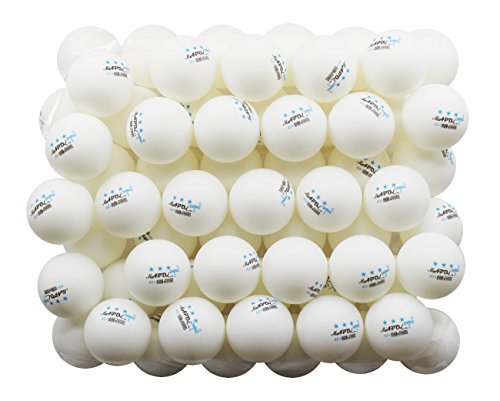
Ping pong balls are graded 1-star, 2-star, or 3-star. The number describes how round and how consistent the ball is. 1- and 2-star balls have visible defects that cause unpredictable bounces — fine for casual rec play, frustrating once you're trying to develop technique. 3-star balls are tournament-grade. Buy 3-star and never think about ball quality again.
Best starter
Butterfly
G40+ 3-Star Balls (12-pack)
$
★★★★★Our rating
Used in actual tournaments. Consistent bounce, durable, the brand the pros trust. Around $20 for 12. They'll last for months of regular play if you don't lose them — and you will lose them.
What we like
Tournament-grade consistency — no wobble or unpredictable bounces
Durable poly plastic holds up for months of regular rallies
What to know
You will lose them before they break — always buy a backup pack
The big infrastructure question. A real ping pong table is 9 ft long, 5 ft wide, and dominates a room. Most beginners don't (and shouldn't) own one. Three reasonable paths: play exclusively at a rec center / bar / friend's house, buy a conversion top that sits on a dining or pool table, or commit to a real table. Pricing roughly tracks effort: free → $150 → $400+.
Best starter
JOOLA
Conversion Top
$$$
★★★★★Our rating
Two-piece foldable tabletop that sits on top of a dining table or pool table. Around $150. Lets you play at home without committing 45 sq ft of floor space to a permanent table. Performance is meaningfully worse than a real table — slightly bouncier, slightly less stable — but absolutely playable.
What we like
Sits on any dining or pool table — no dedicated room required
Folds flat when done; two pieces store against a wall without fuss
What to know
Slightly bouncier and less consistent than a proper free-standing table
Underlying surface must be at least 108" × 60" or the top hangs over
A real, full-size table at a reasonable price. Around $400. Folds in half for storage, includes net and wheels. Not tournament-grade, but absolutely good enough for serious home play.
What we like
Full tournament dimensions — same size as any table you'd play on at a club
Folds in half and rolls on wheels; net and posts included
What to know
~150 lb assembled — you'll need two people and a permanent spot
At ~$400, it's a real commitment; make sure you'll actually use it
If you have a table or conversion top but the net is gone (or you found a free table without one), a clamp-on replacement net is around $25. Don't bother with a fancy one for casual play.
What we like
Clamp-on design fits any table edge — no tools or drilling required
~$25 is the cheapest fix for a table that's missing its net
What to know
Net tension loosens over time — tighten before play or balls fly under
Two small items that protect your investment in the paddle. A paddle case keeps the rubber clean and stops it from drying out (which slowly kills grip). A rubber cleaner kit extends rubber life by months. Total under $25.
Best starter
Killerspin
Hard Racket Case
$
★★★★★Our rating
Hard-shell case that protects the paddle in transit and keeps the rubber away from dust and air. Around $15. Worth it specifically because air exposure dries out rubber and reduces grip over time.
What we like
Hard shell prevents the compression and airflow that slowly dry out rubber
Slim enough to fit in a gym bag or backpack without adding bulk
What to know
Holds one paddle only — not for players who carry two rackets
A small bottle of cleaner and a sponge. Use after every few sessions to lift dust and debris off the rubber surface — extends paddle life by months. Around $10.
What we like
Lifts dust and debris off rubber that silently kills grip over time
Takes 30 seconds — easy to build into a post-session routine
What to know
Small bottle runs out faster than you'd expect; plan to reorder
Your first month of ping pong, from rec play to real spin
Almost everyone has played ping pong casually. Almost no one has actually trained. This is the gap — and what closing it actually feels like in your first month with a real paddle.
Ping pong is the most-played-yet-least-trained racket sport in the world. Almost everyone has hit a few balls at a basement table or a brewery; almost no one has spent a single deliberate hour learning to generate spin or read it. That gap is where every casual player lives, and crossing it is what makes the difference between “we played at the bar” and “I actually play ping pong.”
This is what crossing it looks like, in roughly the first month of real practice.
Day 1: The paddle changes everything
If you’ve only played with department-store paddles before, your first session with a real ITTF-rubber paddle is a small revelation. The ball grips the rubber in a way it didn’t before. You can feel the contact. You can put unintentional spin on the ball just by brushing instead of hitting flat.
Most beginners notice immediately that they can’t control the new paddle as well as the old one — because the old one couldn’t generate spin, the ball came off predictably. The new paddle is doing things, and you have to learn to drive it instead of bashing the ball.
Hold the paddle in a “shakehand” grip. Wrap your fingers around the handle like you’re shaking hands. This is what most Western players use; it covers forehand and backhand naturally. The penhold grip (holding it like a pen) is also valid but harder to learn from scratch.
Hit the ball at the top of its bounce. Beginners hit the ball on the way down, which is too late and produces awkward weak shots. Step in, take the ball at its peak height, and you’ll have far more time and control than you think.
Days 2–7: The serve unlocks
The first thing that improves dramatically with a real paddle is your serve. The new rubber lets you brush the ball and generate genuine spin — and a serve with spin is dramatically harder to return than a serve hit flat.
Spend ten minutes per session on serves alone. Two services to learn first:
The pendulum serve — paddle starts high on your right side, swings down across your body, brushes the ball with side-and-bottom spin. The ball curves on the way to your opponent and bounces low. This is the workhorse beginner serve.
The float serve — flat contact, no spin, deliberately. Useful as a contrast to the pendulum because your opponent can’t tell from your motion which is coming.
Just two serves. Master them. Don’t add a third until they both work consistently.
Days 7–14: Rallies start to feel different
Around session four or five, you stop bashing every ball and start placing them. The instinct to swing at full power gives way to a quieter, more controlled stroke that lands more shots in.
This is also when reading spin becomes the obstacle. Your opponent is now generating spin (because their paddle works too), and the spin makes the ball do unexpected things. A heavy backspin serve dropped short will fall off the table if you push it; a topspin serve will bounce up at you and fly long if you push the same way.
You’ll spend most of week two struggling with this. The spin is invisible until you’ve trained yourself to see the cues:
Watch the brush, not the ball. Where on the rubber is your opponent contacting? Bottom edge = underspin. Top edge = topspin. Side = sidespin.
Watch the bounce. A heavy underspin ball bounces lower than expected and skids; a topspin ball jumps forward off the table.
Until about week three, beginners stand still. They reach for balls outside their natural arm extension and play awkward, off-balance shots. The realization that you have to move your feet is week three’s main breakthrough.
The footwork pattern is small, fast steps. Not big lunging strides — table tennis happens in a meter of space around you, and the difference between a great rally and a missed ball is often six inches of repositioning. The drill that teaches this fastest: have your partner alternate balls between your forehand and backhand corners. You’ll discover quickly that you can’t reach both without moving your feet.
End of week 3: Find a club, take a lesson
The fastest way to improve in week four and beyond is to spend one hour with a coach at a local table tennis club. USATT clubs exist in most American cities, often unmarked and unknown to casual players. A drop-in fee is usually $5-10. The room will be full of people two or three levels above you who will rotate through games happily.
A coach there will spot two things in five minutes that you wouldn’t catch in months on your own — usually grip details and stroke length. The cost-benefit ratio of a single $40 lesson at month one is enormous.
Month 2 and beyond
By the end of your first month with a real paddle, daily-practice partner, and a few coached sessions, you’ll be a noticeably different player than the rec-table version of yourself. You’ll generate intentional spin. You’ll read spin coming back. You’ll move your feet without thinking about it.
The path from there gets long quickly:
Months 2-3: Learning to loop (the topspin power shot that defines modern table tennis)
Months 4-6: Tactics — placement, pace changes, reading patterns in your opponent’s game
Year one: You can play in a club league and not be the worst player in the room.
The ceiling in table tennis is genuinely as high as any sport. World-class players are training their entire lives for it. Your goal in month one is just to get past the basement-rec-table version of the game and feel what real table tennis is like. After that, the addiction takes over on its own.
Coming from pickleball or tennis? The hand-eye coordination transfers but the swing doesn’t — table tennis is far more wrist-driven than either. The first session will feel like learning to write with the wrong hand.
Save your money
What you don't need yet
Beginners get pressured to buy a lot of stuff that doesn't help them play
better. Here's what we'd skip on day one.
A robot / ball machine — Fun but expensive. A friend who'll feed you balls or a wall to rebound off is more useful in the first six months.
Custom blade + rubber assembly — Pre-assembled paddles cover everything you need until you've played 3+ months and developed clear preferences.
Multiple paddles — One paddle, well-cared-for, lasts a year of regular play. Backups are for tournament players.
Tournament-grade flooring — If you've seen YouTube videos of pros on dedicated rubber-mat courts, ignore them. A garage floor or a clear concrete area is fine.
Specialty apparel — Athletic shorts and a t-shirt. Ping pong shoes (yes, they're a thing) only matter at the competitive club level.
First week
Your first seven days
A short, real plan to get from gear-on-doorstep to actually playing.
Find a public table. Most cities have several at rec centers, parks, breweries, or libraries. · Action
Find a regular partner. Ping pong is fast and unforgiving solo — you need someone to feed you the ball. · Action
Practice serving for ten minutes per session. The serve is where you can put more spin than anywhere else, and it's the most underused part of every beginner's game. · Action
FAQ
Common questions
How much should I spend on my first real paddle?
$30-50 covers everything you need for the first 6+ months. The Killerspin JET200 at the budget end is a real upgrade from a department-store paddle; the Stiga Pro Carbon at the upper end is what most coaches hand new students. Don't spend $150+ until you have specific preferences.
Do I really need a 9-foot table at home?
No. A conversion top that sits on a dining or pool table is roughly one-third the cost, plays acceptably, and disappears when not in use. Most home players never own a real table — they use conversion tops or play at clubs.
What's the difference between ping pong and table tennis?
They're the same sport — 'ping pong' is the casual / brand-name term, 'table tennis' is the formal name. The Olympic version is called table tennis; your basement game is called ping pong. Same rules, same scoring, same paddles.
Why do my paddle's rubber sheets feel sticky/grippy on top?
That's the point. ITTF-approved rubber has a tacky surface that grips the ball, letting you generate spin. Cheap paddles use vulcanized rubber that's slick — much more durable but produces almost no spin. The grippy rubber is fragile by comparison; that's why the case and cleaner matter.
How often do I need to replace the rubber?
For casual play, the rubber on a pre-assembled paddle should last 6-12 months. You'll know it's time when the surface stops feeling tacky and ball spin gets harder to produce. Most players replace the whole paddle rather than just the rubber at the casual level.
Should I learn ping pong before pickleball or tennis?
If you're choosing among racket sports, pickleball is fastest to feel competent at, ping pong is cheapest to set up, tennis has the longest ceiling. Many ping pong players cross over to pickleball easily because the wrist-driven motion is similar. Tennis transfers less directly.
PingSkills (YouTube) — Alois and Jeff Plumb. The most-recommended beginner-to-intermediate instructional channel. Patient, technical, free.
Tom Lodziak (YouTube) — British coach who breaks down adult-improver topics that most coaching content skips. Watch after PingSkills.
WTT (YouTube) — Official World Table Tennis broadcasts. Watching a Ma Long or Fan Zhendong match is genuinely educational once you've played a bit.
Megaspin — The biggest American table tennis specialty retailer. Their equipment guides and rubber/blade reviews are bookmark-worthy. Bias: they sell the gear; transparent about it.
r/tabletennis — Active subreddit. Use the wiki and search for 'beginner setup' threads; ignore the latest equipment debates.
As an Amazon Associate, JustBeginning earns from qualifying purchases.
We may also earn commission from other affiliate programs linked on this
page. Editorial recommendations are independent; we don't choose
products based on commission rates.
Product prices and availability are accurate as of the date and time
indicated and are subject to change. Any price and availability
information shown on Amazon at the time of purchase will apply.


 Best starter