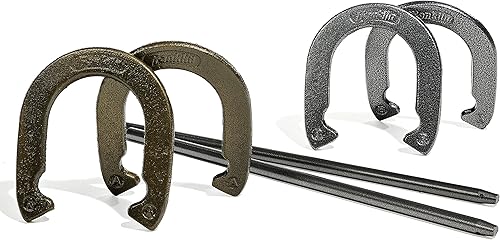
Horseshoes is a backyard game you can play for life, and it has real rules and leagues behind it. Here's what a good set of shoes looks like, how to build a pit with the right stake height and distance, how scoring works, how to grip and release a shoe so it opens toward the stake, and when to look for a club.
By Colin B. · Published November 19, 2026 · Last reviewed November 19, 2026
A basic steel horseshoe set with stakes comes to about $45. The typical setup is a forged regulation set, two 36 inch steel stakes, a few bags of play sand, a long tape measure and a rake to keep the pit level.
We earn commission when you buy through links on this page, including
Amazon. See our affiliate disclosure.
Price tiers and budget totals shown above are editorial estimates;
actual prices vary.
At a glance
Our top pick in each category
The fastest path through this guide — each best-starter pick by category.
Scroll for the budget and upgrade alternatives.
Buy forged or drop-forged steel shoes. Cheap cast shoes can chip or break when they hit a steel stake. Regulation shoes weigh up to 2 lb 10 oz. Most adults like a full-weight shoe because it lands flat and stays put.
Know the distances. Under NHPA rules the stakes are 40 feet apart. Women, juniors and older pitchers may throw from 30 feet. Backyard players often start closer, so pick a distance and keep it the same so your practice adds up.
Plan the pit before you dig. Each stake sits in a pit about 3 feet wide and 4 to 6 feet long, filled with moist sand or clay. The stake sticks up 14 to 15 inches and leans about 3 inches toward the other stake. Leave room behind the pits, since shoes bounce.
Learn the scoring first. A ringer is worth 3 points. A shoe within 6 inches of the stake is worth 1. In cancellation scoring, ringers and points cancel out, and games usually go to 21 or 40.
The gear
What you actually need
Horseshoe sets
Regulation horseshoes weigh up to 2 lb 10 oz and are at most 7 1/4 inches wide and 7 5/8 inches long, with an opening no wider than 3 1/2 inches. Forged or drop-forged steel holds up to hitting a steel stake. Cheap cast shoes can chip or crack. Most sets come with four shoes in two colors so each side can tell their shoes apart, and some include stakes.
Best starter
St. Pierre
American Professional Horseshoe Set
$79.95 as of Nov 19, 2026
★★★★★Our rating· In Stock
Forged steel shoes from a maker that has supplied pitchers for decades. Full regulation weight, so they land flat and don't hop out of the pit. A set you won't need to replace. Sold by VirVentures. About $80, 4.7 stars from 955 ratings.
A complete backyard set with four steel shoes and two stakes in a carry case. Fine for picnics and learning the game before you spend more on forged shoes. Sold by Amazon. About $38, 4.5 stars from 1,381 ratings.
A regulation stake is 1 inch steel, set so 14 to 15 inches stick out of the pit and the top leans about 3 inches toward the opposite stake. A 36 inch stake leaves about 21 inches in the ground, which keeps it from loosening. Use a long tape to set the stakes exactly 40 feet apart, or 30 feet for the shorter line, measured front to front at ground level.
Best starter
St. Pierre
Tournament Regulation Stakes, 1 x 36 Inch
$60.46 as of Nov 19, 2026
★★★★★Our rating· In Stock
A full-size 1 inch steel stake that matches NHPA specs. The extra length below ground keeps it tight after thousands of hits. Buy two, one for each pit. Sold by VirVentures. About $60, 4.7 stars from 212 ratings.
A 100 foot open reel tape that one person can stretch across the yard. Set your stakes at the right distance once, then check them again each spring after the ground thaws. Sold by Amazon. About $16.55, 4.6 stars from 534 ratings.
A short, heavy hammer that drives a steel stake without the swing of a full sledge. One-piece forged steel, so the head won't work loose. Useful for tent stakes and fence posts too. Sold by Amazon. About $22, 4.8 stars from 11,279 ratings.
Each pit is about 31 to 36 inches wide and 43 to 72 inches long around the stake. Moist sand is the easiest backyard fill. It softens landings and keeps shoes from bouncing out. Clubs use blue or potter's clay because shoes stick where they land. Whatever you use, keep it damp and rake it level between games so every shoe lands on the same surface.
Best starter
Quikrete
Play Sand, Screened and Washed
$29.39 as of Nov 19, 2026
★★★★★Our rating· In Stock
Washed, screened sand with no rocks to deflect a shoe. Four to six bags fill a shallow backyard pit. Wet it down before you play and it packs just right. Sold by ChrisP products. About $29, 4.4 stars from 3,623 ratings.
A steel bow rake to loosen and level the pit between games. Shoes dig holes fast, and a level pit keeps every landing fair. It does double duty in the garden. Sold by UnbeatableSale, Inc. About $34, 4.5 stars from 139 ratings.
Close calls decide a lot of games. A shoe within 6 inches of the stake scores 1 point, and when two shoes look equal you measure. A ringer is a shoe that circles the stake so a straight edge touching both open ends clears it. A small tape measure settles most arguments, and a horseshoe measure makes ringer calls fast.
Best starter
Stanley
PowerLock Tape Measure, 16 Foot
$16.70 as of Nov 19, 2026
★★★★★Our rating· In Stock
A pocket tape that checks the 6 inch scoring range and settles which shoe is closer. The locking blade holds steady while you read it. Keep it in your shoe bag. Sold by EstBuy Trading. About $16.70, 4.6 stars from 7,575 ratings.
A small tool that settles close shoes and doubles as a pick-up hook, so you're not bending over all afternoon. Made in the USA. Leagues use measures like this so nobody argues over who's closer. Sold by HorseshoesOnline. About $24, 4.7 stars from 148 ratings.
Horseshoes looks simple until you try to land a ringer from 40 feet. A month is enough to build a pit, pick a grip, find a smooth release and play your first scored games. Here's a week-by-week plan.
Good pitchers aren’t strong. They do the same thing every time. Spend this month on a release you can repeat.
Week 1: Build the court
Pick a flat spot with about 50 feet of room. Measure 40 feet between stake fronts, or 30 feet if that’s your distance. Drive each 1 inch steel stake until 14 to 15 inches stick up, leaning about 3 inches toward the other stake. Dig a pit around each stake about 3 feet wide and 4 to 6 feet long, then fill it with moist sand and rake it level.
Try the flip first. Hold the shoe by the side with the open end facing the stake and let it turn end over end. Then try the 1 1/4 turn, holding the shoe by one shank so it spins flat in the air. Pitch 20 of each and keep the one that lands flatter. Stick with it for the rest of the month.
Stand to the side of the stake and step forward with the foot opposite your throwing hand. Swing your arm straight back and straight through like a pendulum. Let go at about eye level and follow through toward the stake. Aim for shoes that land flat and stop just short of the stake. Pitch 50 to 100 shoes a session.
Play games to 21 with cancellation scoring: ringers are 3, shoes within 6 inches are 1, and matching scores cancel. Keep track of your ringer percentage. Most backyard players land under 10 percent. Then look up a club on the NHPA site. Most leagues welcome new pitchers and will handicap you so games stay close.
Buy a set of forged steel shoes and two steel stakes. · Buy
Measure 40 feet (or 30 feet) between stakes and drive them in at 14 to 15 inches tall with a slight lean toward each other. · Action
Fill each pit with moist sand and rake it level. · Action
Pitch 50 shoes with a flip grip, aiming for every shoe to land flat and short of the stake. · Action
FAQ
Common questions
How far apart are horseshoe stakes?
40 feet stake to stake under NHPA rules. Women, juniors and older pitchers may pitch from 30 feet. Measure from the front of one stake to the front of the other at ground level.
How high should a horseshoe stake be?
14 to 15 inches above the pit surface, with the top leaning about 3 inches toward the opposite stake. A 1 inch diameter steel stake about 36 inches long leaves enough in the ground to stay solid.
How does scoring work?
A ringer, a shoe that circles the stake, is 3 points. A shoe within 6 inches of the stake is 1 point. In cancellation scoring, matching ringers or points cancel and only the difference counts. Backyard games usually go to 21, sanctioned games often to 40.
What is the best grip for a beginner?
Many people start with a flip, where the shoe turns end over end with the open end landing toward the stake. Others learn a 1 1/4 turn, where the shoe spins flat. Pick one, keep your release the same every time, and work on landing the shoe flat.
What should I fill a horseshoe pit with?
Moist sand is the easiest backyard fill and keeps shoes from bouncing too much. Clubs use blue or potter's clay, which holds shoes where they land. Keep the fill damp and rake it between games.
Wikipedia: Horseshoes — A short overview of the game's history, court layout and scoring systems.
JustBeginning earns commission from affiliate programs. As an Amazon
Associate, we earn from qualifying purchases. This costs you nothing
extra and doesn't change our recommendations.
Prices and availability are accurate as of the date and time
shown and can change; the price on Amazon when you buy is what
applies.
How this works.

 Best starter