Go has the simplest rules of any strategy game — and the deepest play. Four rules. Infinite complexity. The gear is beautiful: inky black stones, pale white, wooden bowls, a clean grid. You can start playing real games this weekend. Here's what to buy first and what to skip.
By Colin B. · Published June 3, 2026 · Last reviewed June 3, 2026
Play free online forever, or start for $35 with a vinyl set. A proper wooden board, yunzi stones, and a book runs about $160.
We earn commission on qualifying Amazon purchases — see our
affiliate disclosure.
Price tiers and budget totals shown above are editorial estimates;
actual Amazon prices vary.
At a glance
Our top pick in each category
The fastest path through this guide — each best-starter pick by category.
Scroll for the budget and upgrade alternatives.
Play online first. OGS (online-go.com) is free, runs in any browser, and lets you play 9×9 games in ten minutes. Five online games will tell you more about whether you like Go than any gear review can.
Start on a 9×9 board, not 19×19. A full-size game takes 1-2 hours and requires reading skills you won't have yet. A 9×9 game takes 15-20 minutes and teaches the same fundamentals — capturing, territory, life and death.
The gear is a ritual, not a requirement. You can play Go for free your entire life. Buy the physical set because you want the experience — the feel of stones, the click on the board, the wooden bowls — not because you need it to play.
The gear
What you actually need
Board (Goban)
The board is the center of everything. A 19×19 grid is the standard; most beginners should start on a 9×9 to learn faster and cheaper. For your first board, the choice isn't brand — it's format. Vinyl roll-up boards cost under $35 and get you playing immediately. Wooden boards cost more and feel dramatically better. If you're unsure Go will stick, start vinyl. If you already know you love deep strategy games, skip straight to wood.
Board (Goban) — what's the difference?
A few common shapes, each making a different trade.
Roll-Up / Vinyl
Portable and affordable; the lowest-friction way to start.
Material
Vinyl
Price range
$20–40
Portability
Rolls into tube
Best for Beginners on a budget; players unsure if Go will stick
Tradeoff No satisfying stone-click; feels plastic, not traditional
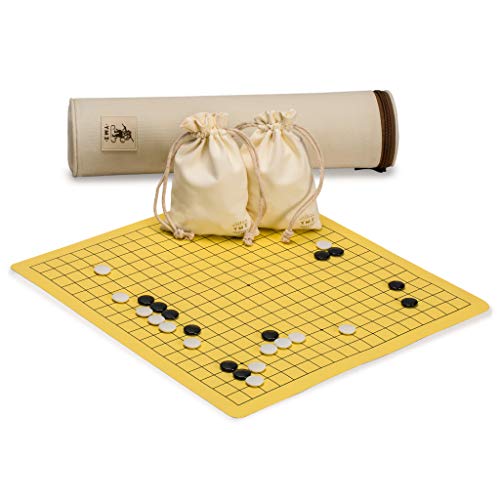
The fastest way to get a real game on the table. Yellow Mountain's magnetic roll-up board comes with single convex plastic stones that attach to the surface — handy for travel and storage. It's not the romantic wooden setup, but it's functional and complete. Upgrade to wood later once you know Go has you.
What we like
Magnetic stones won't roll off the board during travel
Complete starter kit — board, stones, and bag in one box
Under $35 — lowest-risk way to try the physical game
What to know
Magnetic single convex stones are basic compared to yunzi or glass
Vinyl surface lacks the sound and resonance of wood
A real wooden board changes the game. Lines are crisp, stones settle with a satisfying thud, and the whole thing looks like what you imagined when you first heard about Go. This 0.6-inch dark cherry pattern board is the classic mid-range choice — not tournament kaya, but a step up you'll notice immediately.
What we like
Real wood — stones click and settle rather than skid on vinyl
Traditional grid lines and clear star points (hoshi)
Table height for comfortable seated play
What to know
0.6-inch thickness is thinner than premium boards — less resonant
Shin Kaya 2-Inch Go Game Board (Reversible 19×19/13×13)
$$$$
★★★★☆Our rating
The thickest board Yellow Mountain Imports sells — 2 inches of shin kaya with a warm grain and a resonant thud when stones land. The reversible surface gives you both 19×19 and 13×13. This is the right call when you want a board that feels permanent — something that improves with use and looks good on a shelf.
What we like
Two inches of shin kaya — noticeably thicker and more resonant
Reversible 19×19 / 13×13 — two board sizes in one
Warm shin kaya grain improves with years of use
What to know
Table board only — no legs for the traditional floor-seated setup
Significantly more expensive than the 0.6-inch option
Stones are the playing pieces — 181 black and 180 white per set. They come in three main materials: plastic (bundled with cheap sets, functional but charmless), yunzi (a Chinese natural resin composite with real weight and a slight translucency — the smart upgrade), and slate and shell (traditional Japanese luxury, $200–500+, worth every penny once you're committed). Most beginners play with their set's plastic stones and upgrade to yunzi after 50 games.
Best starter
Yellow Mountain Imports
Yunzi Go Stones (Size 33)
$$
★★★★★Our rating
Yunzi stones are the gold standard for affordable Go stones. Made from a natural Yunnan composite, they have real weight, a subtle translucency, and settle onto the board with a satisfying click. They're what serious club players in China use. This is the first upgrade worth making after your starter set.
What we like
Natural Yunnan resin — real weight and a satisfying click
Slight translucency in black stones catches the light beautifully
The stone used by serious club players in China
What to know
More expensive than glass stones
Can chip if dropped on hard floors — keep them in their bowls
Jangstone glass stones are a meaningful step up from the plastic pieces that come in beginner sets. They're heavier, smoother, and look traditional on the board. The click when you place them is sharper than yunzi but more satisfying than plastic. A good middle option if budget is a consideration.
What we like
Noticeably better than plastic — real heft and smooth surface
Glass looks clean and traditional on the board
What to know
Lighter than yunzi — less satisfying to pick up and place
Stone bowls hold your playing pieces before and after each game — you draw from them as you play, and captured stones go into your opponent's bowl. The ritual of reaching into a bowl of smooth stones is half of what makes physical Go feel different from online play. Most bowls sold in the US are jujube (Chinese date tree) wood — dense, smooth, and traditionally used for this purpose. The main choice is between plainer and fancier versions of the same excellent material.
Best starter
Yellow Mountain Imports
Jujube Wood Go Stone Bowls (Pair)
$
★★★★★Our rating
Jujube (Chinese date tree) wood is the traditional material for Go stone bowls — dense, smooth, and nicely finished. This YMI pair comes with a carrying bag and holds a full 361-stone set. Clean, functional, and the right choice for a first proper bowl setup.
What we like
Jujube wood is dense and smooth — the traditional bowl material
Comes with a carrying bag for tidy storage between games
A well-regarded upgrade from the basic jujube option, with a traditional dragon design carved into the lid and slightly heavier construction. If you want bowls that look as good as they function — a real set-piece beside a wooden board — these are the pick.
What we like
Heavier jujube construction than the basic YMI option
Traditional dragon design carved into the lid
What to know
Pricier than plain jujube bowls for mostly aesthetic reasons
Dragon motif may not suit all tastes — go plainer if you prefer minimal
Go has more instructional literature than almost any game in history. The problem: most of it is useless until you can capture reliably and read simple sequences ahead. Start with one good beginner book, play 20-30 games, then move to tactical problems (tsumego). The advanced strategy books — opening theory, joseki dictionaries, endgame — can wait until you've played for a year.
Best starter
Good Move Press
Learn to Play Go Vol. 1 (Kim & Jeong)
$17.04 as of Jun 22, 2026
★★★★★Our rating
The best beginner Go book in English, by a wide margin. Janice Kim's five-volume series starts from absolute zero and builds systematically. Volume 1 covers the rules, capturing, and the concept of territory — the three things you need to play your first real game. It's visual, patient, and right.
What we like
Starts from absolute zero — no assumed knowledge whatsoever
Diagram-heavy format makes the rules immediately clear
Part of a five-volume series that scales with your game
What to know
Out of print in some editions — prices can vary widely
Later volumes get harder fast; Vol. 1-2 are the key beginner range
Written in 1978 and still one of the most recommended Go books for breaking through beginner plateau. Kageyama is direct, sometimes brutal, and consistently right. This book won't teach you joseki — it'll expose why your moves are vague. Read after 30 games; it hits differently once you've played enough to feel the criticisms.
What we like
Cuts through vague beginner play with direct, practical advice
Timeless — written 1978 and still the standard recommendation
Short chapters; easy to read in between games
What to know
Assumes you can already play a complete game
Old production — diagrams are hand-drawn and small
Tsumego — life-and-death problems — are the fastest way to improve tactical reading in Go. Kano's four-volume beginner series starts easy (30-kyu level) and scales well. Solving a few problems daily is the closest thing Go has to a training shortcut, and this collection gives you months of material.
What we like
Starts at true beginner level — no experience required
Four-volume series keeps scaling as your reading improves
Daily problem habit is the single fastest way to get better
What to know
Problems look simple and still stump beginners — that's the point
Physical book means no auto-grading of your answers
Go has four rules and infinite depth. Here's what actually happens between your first stone and the moment the game clicks — week by week, game by game.
Go is described as the world’s most complex game, but its rules fit on an index card. That gap — between the simplicity of the rules and the depth of what follows — is the whole thing. Understanding that gap is the key to learning Go without getting lost in it.
This is what your first twenty hours actually look like, and more importantly, what to do when you get stuck.
Before you play: the four rules
Most people spend too long studying rules before they touch a stone. Don’t. Here’s everything you need:
Capture by surrounding. A stone (or group of stones) is captured when all of its adjacent empty intersections — its liberties — are occupied by the opponent. Remove captured stones from the board.
Suicide is illegal. You can’t place a stone if it would have no liberties immediately after placement (unless it captures opponent stones in the process).
Ko. A position cannot be immediately repeated. This prevents infinite loops in certain capture-recapture situations.
Passes and the end. When neither player wants to make another move, both pass. The game ends. Count territory.
That’s it. Everything else — joseki, fuseki, ko threats, life and death — is built on those four rules. You don’t need to understand it all before you play. You need to understand what capturing means and how territory works.
Hours 1–5: Playing on 9×9
Start on a 9×9 board. Not 13×13. Not 19×19. Nine by nine.
A 9×9 game between beginners takes 20-30 minutes. A 19×19 game between beginners takes 1-2 hours and the middle 90 minutes will feel like chaos. You need the smaller board to see the whole picture at once — where territory is forming, who’s capturing whom, when the game is actually over.
OGS (online-go.com) is free and runs in any browser. Sign up, set it to 9×9, and start playing. The site will match you to other beginners. Each game comes with a full record you can replay move by move.
In your first five hours, you’re learning to see liberties. Count them. Every time you place a stone, ask yourself how many adjacent empty points it has. Every time you play near an opponent’s stone, ask yourself how many they have. This habit — automatic liberty-counting — is the entire foundation of Go tactics.
You will lose a lot. That’s correct. You’re learning to see a board that has no familiar patterns yet. Win or loss doesn’t matter in these early games; finishing the game matters.
Hours 6–10: Territory becomes visible
Around hour six, something shifts. You stop seeing a board full of isolated stones and start seeing groups, connections, territories. This is when Go starts feeling like a game instead of a puzzle you’re losing.
The key concept in this phase: connection and cut. Connected groups share liberties. Cut groups die separately. Most beginner mistakes come from not noticing when stones have been cut off from each other.
The second concept to grasp here is life and death. A group is “alive” if it has (or can make) two separate internal empty areas — called eyes. A group that can’t make two eyes is dead; it will eventually be captured. This sounds abstract. After ten games on 9×9, you’ll feel it intuitively.
Play slower in these hours. It’s tempting to move fast. Resist. Before placing a stone, identify what it does: does it connect two of your groups, cut opponent groups, extend toward territory, or defend against a threat? If you can’t answer that question, it’s probably a bad move.
This is also when you should pick up Learn to Play Go Vol. 1. The book covers the same concepts you’re developing through play, but more systematically. Reading a chapter and then playing a game is more efficient than either alone.
Hours 11–20: Moving to 19×19
Around hour ten or eleven, the 9×9 board starts to feel small. You’ve played enough to see the whole board, and the games resolve too quickly for the patterns you’re starting to recognize to fully develop.
Move to 19×19. Expect to feel lost again for the first few games — and that’s fine. The center of a 19×19 board is genuinely different from 9×9; early stones in the center feel disconnected from everything else.
Three concepts anchor 19×19 play at beginner level:
Corner, side, center — in that order. A stone in the corner needs only two sides defended instead of four. Efficient. A stone on the side needs three sides. A stone in the center needs all four. This is why most games start in the corners — the same territory is cheaper to secure there.
The fuseki (opening). The opening of a Go game is about staking claims — large moves that establish frameworks for territory. Beginners tend to play locally (responding to whatever the opponent just played), and better players play globally (making moves that build toward a plan). You won’t have an opening plan yet, and that’s fine. Just try to play on the third and fourth lines, mix corners and sides, and avoid the center too early.
Counting. This is when you start asking “who is winning?” at the midpoint of games. Count territory roughly: estimate how many intersections are inside each player’s secure area. This is hard at first but becomes faster with practice. It tells you whether to play aggressively (if you’re behind) or consolidate (if you’re ahead).
Join a Go club if you haven’t already. The American Go Association’s club finder covers most US cities. Playing in person is qualitatively different from online play — the physical stones, the shared board, the social learning — and club players are almost always willing to review a game afterward. A 15-minute post-game review from someone two ranks above you is worth more than ten games against peers.
Things you’ll fail at — and that’s normal
Every beginner in Go fails at the same handful of things. You will too:
Playing too fast. Go rewards patience. A slow, deliberate move you can defend beats a fast, intuitive move you can’t.
Ignoring threats. A threat you don’t respond to will kill a group. Beginners learn to spot threats about two moves too late for the first several weeks.
Chasing influence into the middle. Influence (stones that face the center, building toward control) is advanced. Early on, territory (secured intersections) is more reliable. You can build influence once you can reliably make two eyes.
Resigning too early. Don’t resign in the first hundred games. Games between beginners swing wildly; you’ll lose groups you thought were dead and save ones you thought were gone. Play to the end.
Nobody watching you cares about your mistakes. The good players are interested in how you develop, not in how many you lose.
What to do at hour twenty-one
Go is a skill that compounds. The best things you can do after your first twenty hours:
Start a tsumego (life-and-death problem) habit. Even ten problems a day, starting from the easiest level, builds reading speed faster than anything else. Graded Go Problems for Beginners Vol. 1 is the right starting collection.
Find a regular opponent at your level. Consistency beats quantity. Playing the same person twice a week for a month teaches you more than twenty random online games.
Get one game reviewed. Post a 19×19 game to r/baduk and ask for a beginner review. The community is generous with beginners and you’ll get more useful feedback than from any book.
You’re not a beginner at hour twenty. You’re an improving player who can see the board — which is a much more interesting thing to be.
Save your money
What you don't need yet
Beginners get pressured to buy a lot of stuff that doesn't help them play
better. Here's what we'd skip on day one.
Slate and shell stones — Beautiful and worth having eventually — but wait until you're playing regularly. They cost $200–500+ and you won't notice the difference until your hands have spent real time with yunzi.
A genuine kaya leg board — Genuine kaya boards start at $500 and run into the thousands. Shin kaya is a legitimate substitute for life. A kaya board is a once-in-a-decade decision, not a beginner purchase.
Advanced joseki dictionaries — Joseki is opening theory. You need to understand why moves are good before memorizing sequences. Most beginners who buy joseki books end up more confused than when they started.
A dedicated Go clock — For casual and club play, any chess clock or phone app works fine. A dedicated Go clock with byo-yomi functions is only worth buying when you're playing in serious tournament settings.
AI commentary software — Katago and Leela Zero commentary are genuinely useful tools — but not until you understand why moves are bad. AI analysis at beginner level usually just generates confusion.
First week
Your first seven days
A short, real plan to get from gear-on-doorstep to actually playing.
Create a free account on OGS and play five 9×9 games. Nine-by-nine teaches the core concepts in 20 minutes instead of two hours. · Action
Online Go Server · Free, runs in any browser — the most beginner-friendly online Go platform
Learn the four rules: capture by surrounding, suicide is illegal, ko prevents infinite loops, the game ends when both players pass. · Learn
Order your starter board set so it arrives by the weekend. · Buy
Play one slow untimed game on a 19×19 board — finish it even if you feel lost. You'll learn more from a complete game than a dozen abandoned ones. · Action
FAQ
Common questions
What size board should I start on?
Start on 9×9. A 9×9 game takes 15-20 minutes and teaches the same core concepts as a full 19×19 game — capturing, territory, life and death — without the 1-2 hour time commitment. Most beginners who jump straight to 19×19 get lost and never finish their first game.
Can I play Go for free?
Yes. OGS (online-go.com) is completely free, runs in any browser, and has a large active player base at all levels. You can play Go your entire life without buying anything. The physical gear is about the experience — the feel of stones and wood — not a requirement.
How long does a game of Go take?
A 9×9 game with a beginner takes 15-20 minutes. A full 19×19 game between beginners takes 1-2 hours; between advanced players, 3-4 hours. Most club games use timed formats (30 minutes each, with byo-yomi overtime) to keep things moving.
Is Go harder to learn than chess?
The rules of Go are simpler — four rules vs. chess's six piece types each with different moves. But the strategic intuition takes longer to develop. Most beginners can play a complete game of Go after 30 minutes; getting competent takes months of regular play, same as chess.
What's the difference between Go, Baduk, and Weiqi?
Nothing — they're the same game. Weiqi is the Chinese name, Baduk is Korean, Go is Japanese. The rules are identical. Online, you'll find players from all three traditions on the same servers.
When should I upgrade my stones?
After 50-100 games on whatever stones came with your starter set. At that point, if you're still playing, yunzi stones are a meaningful upgrade — real weight, better sound, more beautiful. Slate and shell is a commitment you make after years, not months.
American Go Association — The US governing body. Club finder, ratings, tournaments, beginner resources. Start here if you want to find local players or a formal rating.
Online Go Server (OGS) — The most beginner-friendly online Go platform. Free, browser-based, large active community. This is where you should play your first hundred games.
Sensei's Library — The Go wiki. Authoritative definitions, joseki, game records, rule variations. Overwhelming at first — search specific terms rather than browsing.
Nick Sibicky (YouTube) — The most-recommended English-language beginner Go channel. Clear explanations, no assumed knowledge, consistent posting. Start with his lecture series.
In Sente (YouTube) — Game reviews and commentary at intermediate level. More useful after 50+ games when you're ready to analyze your own patterns.
r/baduk — Active community. Good for specific questions, game reviews, and equipment discussion. The wiki has a solid beginner resource list.
As an Amazon Associate, JustBeginning earns from qualifying purchases.
We may also earn commission from other affiliate programs linked on this
page. Editorial recommendations are independent; we don't choose
products based on commission rates.
Product prices and availability are accurate as of the date and time
indicated and are subject to change. Any price and availability
information shown on Amazon at the time of purchase will apply.
Our top pickYellow Mountain Imports Magnetic Roll-Up Travel Go Set

 Best starter


