Whether you're painting Warhammer, D&D figures, or just cool models you found online — the choice that trips up every new painter isn't technique, it's the paint aisle. Citadel vs. Vallejo vs. Army Painter: each has fans who'll argue forever. This guide tells you which to start with, what else you need, and what to ignore for now.
By Colin B. · Published May 22, 2026 · Last reviewed June 3, 2026
A solid starter setup — paints, brushes, primer, and your first minis — runs $55–100. The ongoing cost is paint pots and new models, not a major restock.
We earn commission on qualifying Amazon purchases — see our
affiliate disclosure.
Price tiers and budget totals shown above are editorial estimates;
actual Amazon prices vary.
At a glance
Our top pick in each category
The fastest path through this guide — each best-starter pick by category.
Scroll for the budget and upgrade alternatives.
Don't start on Warhammer 40K or Age of Sigmar army boxes. They're multi-part plastic kits that need assembly, and they're expensive enough that ruining one feels bad. Start on Reaper Bones or a Learn to Paint kit — they're cheap, beginner-tolerant, and you'll know you love the hobby before you've spent $150.
Pick one paint brand and stay with it for your first 20 models. Citadel, Vallejo, and Army Painter are all genuinely good. They're slightly different to work with, but any one of them teaches you everything you need to know. The brush habits and dilution instincts you build transfer perfectly when you eventually try another brand.
You need fewer colors than you think. Twelve to sixteen covers most fantasy and sci-fi schemes. Don't buy 50 pots on day one — buy a starter set, figure out what you're missing, then add exactly those.
Paint brand is the first debate every new painter falls into, and it runs hot. The honest answer: they're all good, they're all slightly different, and you should pick one and learn it. Citadel is the GW house brand — enormous tutorial support, wide distribution, great coverage, but expensive per pot and comes in flip-top pots that dry at the lip. Vallejo is a Spanish brand beloved by military modelers — dropper-bottle delivery is more precise, slightly better consistency, better value per ml. Army Painter is the affordable entry with a compatible ecosystem (primer, washes, brushes that all work together). We recommend Vallejo for value. If your first tutorial is a Citadel paint-by-paint walkthrough, use Citadel — the skill transfers when you eventually switch.
Paints — what's the difference?
A few common shapes, each making a different trade.
Vallejo
Dropper bottles, excellent consistency, best value per ml.
Format
17ml dropper
Coverage
Thin — layers easily
Tutorial support
Good (YouTube)
Best for Most beginners, value-focused painters, layering and blending
Tradeoff Fewer in-store tutorials; GW staff won't know it
Compatible ecosystem — primer, washes, and brushes all designed together.
Format
18ml dropper
Coverage
Medium
Tutorial support
Moderate
Best for Beginners who want one brand for everything
Tradeoff Paints are good, not great — most painters eventually switch brands as their preferences develop
Best starter
Vallejo
Game Color Introduction Set (16 colors)
$$
★★★★★Our rating
Sixteen essential colors in 17ml dropper bottles — way more precise than Citadel pots, and better pigment-to-price ratio across the board. The range covers every base color you need for fantasy and sci-fi painting. Slightly thinner consistency than Citadel means they layer and blend with less effort.
What we like
Dropper bottles deliver precise drops — no more overloading your brush
Better pigment-to-price ratio than Citadel across the whole range
Slightly thinner consistency makes layering and blending easier
What to know
Pigment settles — shake the bottle before each session
Less tutorial support than Citadel; GW staff won't know it
The most beginner-friendly entry in terms of ecosystem — Army Painter sells matching primer, washes, and brushes designed to work together. The paints are solid without being exceptional. If you want a complete, color-matched system for the lowest dollar and don't want to think about compatibility, this is it.
What we like
Full ecosystem — primer, washes, and brushes designed to work together
Lowest dollar entry; no guessing about compatibility between tools
What to know
Paints are solid but not exceptional; most painters eventually switch brands
Citadel's base paints are the thickest, most opaque in the range — designed to cover primer in a single coat. If you're following GW tutorials step by step, or if you're in a GW store with staff who can help, this is the native language. Every color is dialed in for one purpose.
What we like
Thick, opaque base paints cover primer in a single coat reliably
Largest tutorial ecosystem; Warhammer TV walks through every color scheme
What to know
Most expensive per ml; flip-top pots dry out at the rim if left open
Brushes matter more than most beginners expect, and bad brushes are a frustrating invisible tax on your work. You don't need expensive kolinsky sable for your first model, but you do need brushes that hold a point. Sizes 0, 1, and 2 cover 90% of miniature work — a size 1 for most painting, a size 0 for fine detail, and something larger for base-coating big surfaces and dry-brushing. Buy a purpose-built miniature brush set, not general craft store brushes.
Best starter
Army Painter
Hobby Starter Brush Set
$
★★★★★Our rating
A purpose-built miniature brush set with sizes specifically chosen for base-coating, detail work, and dry-brushing — not a generic art set repackaged. Synthetic, so they last a reasonable amount of time even with rough treatment. Much better than hardware-store brushes at the same price point.
What we like
Purpose-built for minis — includes the exact sizes you'll actually use
Synthetic bristles hold up well to heavy beginner use and rough cleaning
What to know
Synthetic tips lose their point faster than kolinsky sable over time
Cheap enough to buy without guilt and run hard while learning technique. Triangular ergonomic handles, a full range of sizes including sizes 0 through 3, and marketed specifically for miniature painting. Good for someone who wants variety before they know which sizes they actually use.
What we like
Full range of sizes for under $15 — good for figuring out what you use
Triangular ergonomic handles don't roll off the desk
What to know
Tip consistency varies across the set; plan to replace sooner than premium brushes
The upgrade everyone eventually makes. Kolinsky sable, legendary point retention, holds significantly more paint than synthetics — which means fewer reloads and smoother lines. A single Series 7 size 1 outperforms a set of cheap brushes for detail work. When you're serious, this changes your output.
What we like
Kolinsky sable holds a sharp point longer than any synthetic at this price
Holds significantly more paint — fewer reloads and smoother lines
What to know
Dried paint in the ferrule destroys the point; needs careful brush care
Buy one first to confirm your preferred size before buying a full set
Primer is non-negotiable for hard plastic and metal minis. Paint won't stick to bare plastic — it'll rub off within days. Black primer is the classic for dark armor and grim-dark schemes; grey is more forgiving for colorful fantasy minis; white gives you the brightest colors but shows every mistake. Spray primer gives you the most even coverage and is the right call outdoors on a mild day. The one exception: Reaper Bones (soft PVC) can be painted directly without primer.
Best starter
Army Painter
Color Primer — Matt Black
$22.00 as of Jun 22, 2026
★★★★★Our rating· In Stock
The go-to spray primer in the miniature painting community. Consistent, thin coverage that bonds to plastic and metal without obscuring fine detail. Dries fully matte. One can primes 30–50 infantry models. Black is the default for fantasy and sci-fi — it speeds up shading because the recesses are already dark.
What we like
Thin, consistent coverage that bonds without obscuring fine model detail
Dries fully matte; one can primes 30–50 infantry models
What to know
Weather-sensitive — don't spray below 50°F or in high humidity
GW's house primer — slightly pricier than Army Painter but available at every GW store and most local hobby shops. Excellent thin coverage, works seamlessly with the Citadel paint range. If you're buying Citadel paints and want the guaranteed-compatible primer, this is it.
What we like
Available at every GW store; guaranteed compatible with Citadel paints
Reliable thin coat coverage on hard plastic, resin, and metal
What to know
Noticeably pricier per can than Army Painter for essentially the same result
Don't start on expensive army boxes. Start on minis you won't feel bad about ruining. Reaper Bones — soft PVC fantasy miniatures — are the gold standard beginner choice: cheap, wide variety, forgiving of imprecise brushwork, and they don't need primer (which makes them even easier to start). Once you've finished 5–10 Bones minis, you'll know whether you want to step up to hard plastic (GW boxes) or metal models — and you'll have the fundamentals to do it well.
Best starter
Reaper Miniatures
Learn to Paint Kit: Core Skills
$$
★★★★★Our rating
Three Bones minis, paints chosen for them, brushes, and an illustrated step-by-step guide — all in one box. The most zero-decision way to start. The minis are well-chosen for beginner practice, and the guide is a real walkthrough, not a promotional brochure. Most beginners who start here finish all three minis and immediately want more.
What we like
Minis, paints, brushes, and a real step-by-step guide in one box
Minis chosen to teach specific techniques; removes all first-session decisions
What to know
Only 3 minis included; palette won't extend to most future projects
★★★★☆Our rating· Only 2 left in stock - order soon.
Ten classic Bones monsters (bugbear, orc, skeleton, gnoll, kobolds, goblins) at a price low enough that ruining one feels inconsequential. The variety of body shapes and equipment gives you different surfaces to practice: robes for soft folds, armor for edge-highlighting, faces for skin tones. The right second purchase after the Learn to Paint Kit.
What we like
Ten varied monsters give you different surfaces to practice in one purchase
Cheap enough to experiment freely — ruining one costs almost nothing
What to know
Soft PVC Bones can warp slightly; some detail softer than hard plastic
Warhammer Age of Sigmar: Spearhead — Stormcast Eternals
$124.59 as of Jun 22, 2026
★★★★☆Our rating· In Stock
Once you've painted 5–10 Reaper minis and want the real thing, Stormcast Eternals are the entry point. Beautifully detailed hard plastic, a strong online community, and a gold-blue color scheme that teaches edge-highlighting and contrast work. More rewarding than Bones when finished.
What we like
Beautifully detailed hard plastic that rewards careful highlighting technique
Huge online community and official tutorials covering every step
What to know
Multi-part kits require assembly before painting — not for day one
Expensive enough that ruining a model stings; earn it with 5–10 Bones first
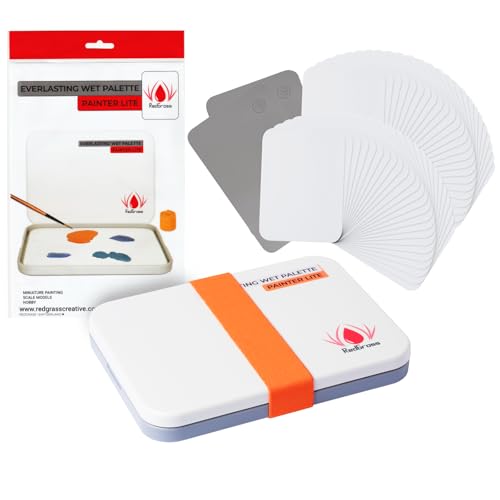
A wet palette is the single upgrade with the biggest impact on your day-to-day painting. Paint on a wet palette stays workable for hours instead of drying in minutes on a tile — you'll waste less, mix more precisely, and paint smoother. You also need sprue cutters to remove minis from their sprues cleanly (scissors crush the plastic), and a wash (like Agrax Earthshade) to add instant depth to any base-coated model. Washes are the beginner superpower: base coat a model, apply wash, suddenly you have shading that would otherwise take hours.
Best starter
Redgrass Games
Everlasting Wet Palette (Painter Lite)
$29.99 as of Jun 22, 2026
★★★★★Our rating· In Stock
The wet palette the entire community recommends. A foam insert saturated with water under hydration paper keeps paint workable for full sessions. You'll use dramatically less paint, mix colors on the fly, and stop finding dried-out puddles at the end of every session. The Painter Lite is the right size for most painting setups.
What we like
Keeps paint workable for hours instead of drying in minutes on a tile
Dramatically reduces paint waste; mix colors on the fly without rushing
What to know
Needs weekly cleaning to prevent mold; replacement paper is an ongoing cost
The industry-standard sprue cutter for miniature assembly. The flat-blade design means one side sits flush against the model — you get clean gate removal without the white stress marks you get from side-cutters or scissors. Under $15 and will outlast fifty boxes of minis.
What we like
Flat blade cuts flush against the model — no white stress marks on plastic
Under $15 and outlasts dozens of model boxes
What to know
Only useful once you're cutting sprue-based kits; irrelevant for Bones minis
★★★★☆Our rating· Only 2 left in stock - order soon.
The single most useful pot in any miniature painter's collection. Apply it over a base-coated model and it flows into the recesses, creating instant depth and shadow. Works on leather, skin, wood, stone, and earth tones — anything brown-adjacent. Combine with Nuln Oil (the black equivalent for metal and dark surfaces) and you have two washes that cover 80% of everything you'll ever paint.
What we like
Flows into recesses automatically, creating instant depth on any warm surface
Covers leather, skin, wood, and stone — handles most beginner color schemes
What to know
Dries with a slight sheen if it pools in flat areas; thin slightly before wide use
Most first-time painters overthink paint brands and underthink actually finishing a model. Learn the three-step loop — base coat, wash, highlight — and your first month takes care of itself.
Miniature painting has a reputation for being the complicated hobby. The one where you need to know what NMM and OSL and zenithal priming are before you can start. That reputation is wrong, and it’s keeping people from a genuinely satisfying craft.
Here’s the truth: you can paint a complete, good-looking miniature in your first session with three techniques. Everything else is optional expansion, not prerequisite.
The three-step loop that covers 80% of everything
Experienced painters talk constantly about glazing, wet-blending, NMM (non-metallic metal), object source lighting. All real skills, all learnable. None of them matter in your first month.
What matters is the base-coat-wash-highlight loop:
Base coat. Cover the miniature’s surface with flat, solid colors. Skin is skin-tone. Cloth is whatever color the outfit is. Metal is silver or gold. No shading yet. Just flat coverage. This is harder than it sounds — getting full, even coverage without losing detail takes practice.
Wash. Apply a thin, dark liquid (Agrax Earthshade for warm tones, Nuln Oil for dark metal) over the entire model. It flows into the recesses and dries there, creating automatic depth and shadow. This is the beginner superpower. A model that looked flat and wrong will suddenly look like it has dimension. The transformation is genuinely startling the first time.
Highlight. Take your base color, mix in a little white or a lighter version of the same color, and paint along the raised edges and highest points of the model. You’re simulating where light would hit. Start broad, then go tighter with a brighter mix.
That’s it. That’s the whole loop. It produces results that look real, it teaches you to see form and light on a three-dimensional surface, and it scales — every advanced technique is an elaboration of this loop, not a replacement for it.
The number-one mistake first-time painters make is switching projects before finishing anything. You start a model, decide the base coat looks rough, and start a new one. Then you have fifteen half-finished primed models and have learned almost nothing.
Finish your first model. Even if the base coat is uneven. Even if the wash pooled wrong in one spot. Even if the highlight is too bright. Finished is the teacher; abandoned is the trap.
Here’s the concrete sequence:
Day 1: Open your Learn to Paint kit, watch a 20-minute beginner tutorial (Miniac’s “How to Start Painting Miniatures” is the one to start with), and prime your mini if it’s not Reaper Bones.
Day 2–3: Base coat every surface. Don’t rush. Two thin coats are better than one thick one. Thin the paint slightly with water — it should flow like skim milk.
Day 4: Apply Agrax Earthshade over the whole model. Let it dry fully (30 minutes). Then look at what happened.
Day 5: Highlight the raised edges. Start with a 50/50 mix of your base color and a lighter tone. Go around every edge you can see. Then go back with a 25/75 mix (more light) on just the highest points.
Day 6–7: Finish the details — eyes, metal bits, any small areas you skipped. Paint the base. Call it done.
Your first model will look rough. That’s fine. Finishing it means you now know what rough looks like, and you know specifically what to fix on the second one.
The things that actually make a difference
Thin your paints. This is the advice that appears in every tutorial for a reason. Thick paint obscures detail, dries with brush strokes, and looks wrong. One part paint to half a part water is a reasonable starting ratio. On a wet palette, the paper does some of this thinning automatically.
Clean your brushes constantly. Rinse every few strokes. The biggest killer of brushes — and of paint quality — is letting paint dry in the belly of the brush, where it works its way up toward the ferrule and destroys the point over time. Rinse, blot, reload. Rinse, blot, reload.
Work in thin layers. It takes two or three thin coats to get full coverage, and that’s normal. Beginners try to cover everything in one pass and get thick, globby results. Multiple thin coats give you control.
Let things dry. Washes especially — if you start highlighting over a wet wash, you’ll pull the wash out of the recesses and lose the shading. Wait 20–30 minutes. Go make a coffee.
What’s actually hard, and when it clicks
The genuinely hard parts of miniature painting aren’t the techniques — they’re the patience and observation skills. Learning to see shadow and highlight on a three-dimensional object, then recreate what you see with a brush, is the real skill. That takes time.
Most painters hit a clarity moment somewhere around their fifth or sixth model. Not a breakthrough exactly — more like the techniques stop being a foreign language and start feeling like tools. The base coat goes down cleaner. The wash settles where you wanted it. The highlights land in the right place.
That moment comes from completing models, not from reading more tutorials. Put in the reps.
If you start with the Reaper Learn to Paint Kit and work through it in order:
Week 1: First model (the skeleton is a good start — simple shapes, no complex textures). Finish it.
Week 2: Second model. Same techniques, different color scheme. Pay attention to what you want to fix from week one.
Week 3: Third model. Add one new technique you didn’t use before — edge highlighting, or trying a two-color highlight on something.
Week 4: Pick your next mini — either a Reaper Bones of your choice or a simple GW starter model if you’ve decided you want to go that direction.
By the end of month one, you’ll have four finished miniatures and a very specific list of what you want to get better at. That list is worth more than any tutorial.
What to do at month two
Join r/minipainting and post your work. The community is genuinely encouraging — beginners are celebrated, not criticized. You’ll get specific, useful feedback.
Try contrast or speed paints. Citadel Contrast paints and Army Painter Speed Paints are single-coat paints that do the base-coat and wash in one step. They’re not a substitute for learning the full loop, but they’re faster on bulk units and worth experimenting with.
Pick one technique to improve. Eyes, edge highlighting, smooth blending — one thing at a time. Trying to improve everything simultaneously improves nothing.
You’re not a beginner after month one. You’re an enthusiastic newcomer with rough habits — which is a much more interesting thing to be.
Save your money
What you don't need yet
Beginners get pressured to buy a lot of stuff that doesn't help them play
better. Here's what we'd skip on day one.
An airbrush — Opens up smooth gradients and fast base-coating, but it's a $200+ setup with its own learning curve. Get 20 painted models under your belt first.
50+ paint colors — You can paint almost anything with 12–16 colors and some mixing. Buying a hundred pots before you have preferences is just buying dried-out lids.
A magnification visor or camera arm — Nice gear for advanced detail work, irrelevant for your first models. Your eye is better than you think without magnification.
A resin 3D printer for minis — A separate hobby that happens to produce things you can paint. Satisfying eventually, but it doubles your learning curve before you've painted anything.
A full Warhammer army box — 100+ models before you know if you love the hobby, all needing assembly, at $200+. Start with 5–10 minis and scale up when you're sure.
First week
Your first seven days
A short, real plan to get from gear-on-doorstep to actually playing.
Order the Reaper Learn to Paint Kit — it has everything in one box and removes all first-session decisions. · Buy
Watch one full beginner tutorial before opening the box. · Learn
Prime your mini (or skip primer for Reaper Bones — they can be painted directly). · Action
Base coat every surface with flat colors before adding any detail. Flat first, depth second. · Action
Apply Agrax Earthshade over the whole model and watch depth appear. This is the moment most people get hooked. · Action
Finish the model completely, even if it looks rough. Completion teaches more than abandonment. · Action
FAQ
Common questions
Do I need Citadel paints to paint Warhammer miniatures?
No — Citadel paints are Games Workshop's house brand with enormous tutorial support, but Vallejo and Army Painter are completely compatible and cheaper. If you're following a Citadel-specific tutorial step by step, Citadel is convenient. Otherwise, Vallejo is the better value.
How long does it take to paint a miniature?
A simple infantry model (like a Reaper Bones skeleton) takes 1–3 hours as a beginner. A centerpiece model (a dragon, a hero) can take 5–20 hours. Most people's first model takes about 3–4 hours including drying time.
Should I prime Reaper Bones miniatures?
No — Reaper Bones are soft PVC and can be painted directly. Primer can actually clog fine detail on Bones. For hard plastic (GW models) and metal minis, primer is mandatory — paint won't stick without it.
What's the best way to thin paints?
Water works fine, but distilled water is better than tap (no minerals to affect adhesion). The general rule: thin until the paint flows like skim milk, not cream. On a wet palette, the paper naturally thins your paint slightly, which is part of why it's so useful.
Is miniature painting expensive to start?
Less than most people expect — $55–100 gets you properly started. The ongoing cost is paint pots and new minis, but $20–30 a month keeps you fully active in the hobby.
Where do beginners share work and get feedback?
r/minipainting on Reddit is one of the most encouraging hobby communities on the internet — beginners are celebrated, not criticized. Also r/Warhammer if you're going the GW route, and #miniaturepainting on Instagram for inspiration.
Miniac (YouTube) — The gold standard beginner channel. Fast, opinionated, beautifully produced. Start with his 'How to Start Painting Miniatures' series — the best 30 minutes you can spend before picking up a brush.
Goobertown Hobbies (YouTube) — Calmer and more conversational than Miniac. Great for brush technique, brush care, and learning to slow down. Pairs well with Miniac as a second resource.
Warhammer TV (YouTube) — GW's official channel. Free full tutorials for specific models and techniques — paint-by-paint walkthroughs for every faction's signature look. Essential if you're painting GW miniatures.
r/minipainting — The most beginner-friendly community in the hobby. Post your first attempts — the feedback is constructive, the encouragement is genuine, and the wiki has solid technique resources.
Reaper Miniatures — Best source for cheap, beginner-tolerant practice minis. The Learn to Paint kits are where most people start. Individual Bones minis are cheap enough to buy without overthinking it.
Warhammer Community — GW's content hub. Free painting guides, step-by-step articles for every faction's color scheme, and technique breakdowns. Useful even if you're not playing GW games.
As an Amazon Associate, JustBeginning earns from qualifying purchases.
We may also earn commission from other affiliate programs linked on this
page. Editorial recommendations are independent; we don't choose
products based on commission rates.
Product prices and availability are accurate as of the date and time
indicated and are subject to change. Any price and availability
information shown on Amazon at the time of purchase will apply.
Our top pickVallejo Game Color Introduction Set (16 colors)


 Best starter