The banjo sounds intimidating. It isn't — not to start. You'll be making real music in your first session, and those first rolls will hook you faster than you expect. But there's one real decision before you buy: which kind of banjo. Here's how to make it clearly, and what to get once you have.
By Colin B. · Published May 24, 2026 · Last reviewed June 11, 2026
A decent starter banjo runs $200–$300. Add fingerpicks, a strap, and a tuner and you're in for around $320 total.
We earn commission on qualifying Amazon purchases — see our
affiliate disclosure.
Price tiers and budget totals shown above are editorial estimates;
actual Amazon prices vary.
At a glance
Our top pick in each category
The fastest path through this guide — each best-starter pick by category.
Scroll for the budget and upgrade alternatives.
The most useful thing you can do before ordering is decide what music you want to play. Bluegrass and old-time folk = 5-string banjo. Irish traditional or Dixieland jazz = 4-string tenor. The two instruments share a name but use completely different techniques — a 5-string tutorial won't help you on a tenor.
Within 5-string, open-back vs. resonator is a sound question, not a skill question. A resonator banjo has a metal back that bounces sound forward — louder, snappier, the classic bluegrass tone. An open-back is quieter and mellower, preferred for old-time folk and clawhammer. If you're picturing Earl Scruggs or Steve Martin, get a resonator.
Don't worry about tone wood, head material, or pot diameter on your first banjo. Those differences are real but audible at $800 and up, not at $250. Buy from a real brand (Gold Tone, Deering, Oscar Schmidt), play for six months, then have opinions.
The gear
What you actually need
Banjos
The two questions — 5-string vs. 4-string tenor, and open-back vs. resonator — reduce to one practical one: what music do you want to play? Five-string covers bluegrass and old-time folk. Tenor covers Irish traditional and Dixieland. Within 5-string, open-back is quieter and mellower (best for folk and clawhammer); a resonator adds a metal reflector plate that produces the loud, snappy sound you know from bluegrass. Start with a 5-string open-back if you're uncertain about style — you can always buy a resonator later, and the technique transfers completely.
Banjos — what's the difference?
A few common shapes, each making a different trade.
5-String Open-Back
Lighter and quieter. Best for old-time folk and clawhammer style.
Tuning
gDGBD
Style
Old-time / clawhammer
Sound
Mellow, woody
Best for Old-time folk, clawhammer picking, home practice, campfires
Tradeoff Less volume than a resonator — won't cut through a loud bluegrass jam
Tuned CGDA for Irish traditional, Dixieland, and jazz.
Tuning
CGDA
Style
Irish trad / jazz
Sound
Punchy, chordal
Best for Irish sessions, Dixieland jazz, players coming from mandolin or fiddle
Tradeoff Completely different technique from 5-string — tutorials don't cross over
Best starter
Gold Tone
CC-50RP Cripple Creek Resonator Banjo
$649.99 as of Jun 22, 2026
★★★★★Our rating· Only 8 left in stock - order soon.
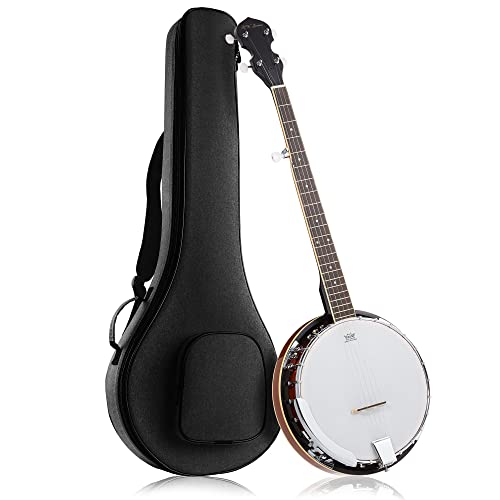
Gold Tone is the brand working players and teachers consistently name-check for beginners, and the CC-50RP is their classic entry-level resonator. It ships factory-setup with correct bridge height and head tension, so you can play it out of the box. The resonator gives you the full bluegrass projection — if you're learning Scruggs style 3-finger picking, this is your instrument.
What we like
Gold Tone is the brand teachers recommend by name — serious beginner pedigree
Resonator delivers full bluegrass projection right from the first session
Ships factory-setup; bridge and head tension are already dialed in
What to know
At 8 lbs, it's heavier than a guitar — invest in a padded strap
Under $150 and genuinely playable. The Jameson ships with a gig bag, fingerpicks, and a clip-on tuner — everything you need to start, in one box. Setup quality varies unit to unit, so you may need a bridge adjustment, but a local luthier can fix that in 20 minutes for under $20. The right answer if you're not certain banjo will stick.
What we like
Under $150 with gig bag, picks, and tuner included — a real starter kit
Playable out of the box; good enough to learn rolls and chord shapes
What to know
Setup quality varies — budget a luthier visit if the action feels off
You'll outgrow it in a year if you play more than twice a week
★★★★☆Our rating· Only 2 left in stock - order soon.
Deering is the most respected American banjo brand, and the Goodtime 2 is their entry-level resonator — made in Spring Valley, California with the same craftsmanship as their $2,000 instruments. The maple rim and resonator produce real sustain and clarity that budget banjos can't touch. Buy the Goodtime 2 once you're sure bluegrass is your path and you're ready to stop compromising.
What we like
Made in the USA by Deering — the most trusted name in production banjos
Maple rim and resonator give sustain and tone budget models can't match
Holds resale value better than any other banjo at this price point
What to know
At $450+, it's a real commitment — earn it after 3 months on a starter
★★★★☆Our rating· Only 5 left in stock - order soon.
The open-back sibling of the CC-50RP — same Gold Tone quality, but with the resonator removed. Quieter, lighter (about 5 lbs), and the right choice for clawhammer and old-time folk players. If you're drawn to Appalachian music rather than bluegrass, start here.
What we like
About 3 lbs lighter than a resonator — comfortable for long practice sessions
Mellow, woody tone that old-time and clawhammer players specifically seek
What to know
Won't project at a loud jam without amplification
If you later want bluegrass tone, you'll need to buy a resonator banjo
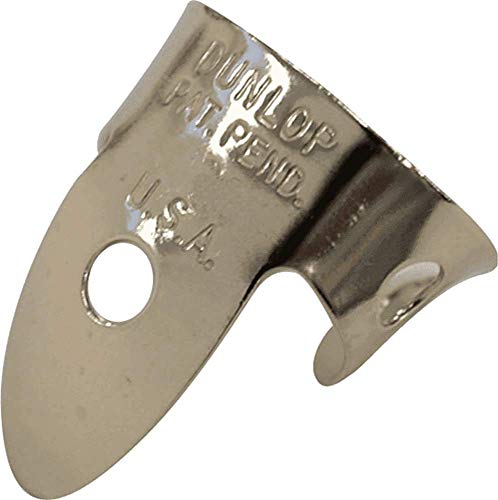
Most 5-string banjo players use metal fingerpicks on the index and middle fingers plus a plastic thumbpick on the thumb. Together they drive the Scruggs roll and give the banjo its characteristic brightness. They feel awkward for the first week, then completely natural. Clawhammer players use no picks — the nail does the work — so if that's your path, skip this category entirely.
★★★★★Our rating· Only 3 left in stock - order soon.
This Player's Pack bundles nickel silver fingerpicks and a plastic thumbpick together — everything you need to start rolling in one small order. Dunlop nickel picks are what you'll see on most working banjo players' fingers: rigid enough for clear attack, smooth enough that they don't snag on strings.
What we like
What most working banjo players actually use — proven across decades
Rigid enough for clear attack without snagging or slipping on strings
12-pack gives spares while you figure out gauge and fit preference
What to know
Thumbpick in the pack is basic plastic — upgrade to Fred Kelly once you know your fit
Metal conducts cold — briefly uncomfortable in winter practice sessions
★★★★☆Our rating· Only 16 left in stock - order soon.
The thumbpick is its own purchase — fingerpick sets rarely include a good one. Fred Kelly's Delrin thumbpick is the most-recommended in banjo communities, with a curved blade that angles naturally toward the strings and a snug fit that doesn't spin or slip mid-roll.
What we like
Most-recommended thumbpick in banjo communities — the standard answer
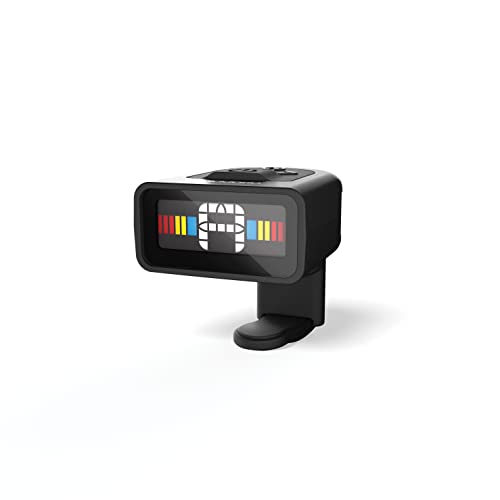
The banjo's floating bridge and tensioned drum head make it sensitive to temperature and humidity — it drifts out of tune more than almost any other string instrument, especially in the first month while the head breaks in. A clip-on chromatic tuner attaches to the headstock and reads vibration directly, which works in noisy rooms where a phone app doesn't. You will use this every single time you play.
Best starter
Snark
SN-8 Super Tight Chromatic Tuner
$
★★★★★Our rating
The Snark SN-8 is the most common clip-on tuner you'll see at open mics and jams — reliable, fast, and cheap enough to leave clipped on the headstock permanently. The 'Super Tight' mode narrows the tolerance window, which matters because a slightly flat G string kills the chord tone on an open-tuned banjo.
What we like
The most common clip-on at every open mic — proven and universally trusted
Fast display response; you can tune between songs without losing pace
Chromatic mode handles open G and any alternate tuning you explore
What to know
Display washes out in direct sunlight — a minor outdoor inconvenience
Plastic clip loosens over time; replace after a year of heavy use
Smaller than a quarter and nearly invisible on the headstock. The NS Micro reads as accurately as the Snark at half the bulk, and doesn't stick out past the tuning pegs. Ideal once you're performing and don't want a bright yellow clip ruining the photo.
What we like
Smaller than a quarter — nearly invisible on the headstock while performing
Just as accurate as the Snark at half the visual footprint
What to know
Tiny display is harder to read across a dimly lit practice room
Takes a session to dial in the rotation angle for best viewing
You need a strap from your first session. A 5-string resonator banjo weighs 7–8 pounds — significantly more than a guitar — and an hour of practice without support will wreck your left arm and shoulder. Banjo straps hook to the brackets on the pot (the drum body), not to strap buttons like a guitar, so any strap labeled for banjo will work. Get one with padding if you plan to practice standing up.
Best starter
Levy's Leathers
MC10 Cotton Banjo Strap
$16.99 as of Jun 22, 2026
★★★★★Our rating
Levy's has been making instrument straps for decades and the quality shows. Their 2-inch woven cotton banjo strap has the right width to distribute the banjo's weight comfortably, metal hardware that won't corrode, and an adjustable length that works whether you're sitting or standing. Simple, durable, no complaints.
What we like
2-inch width distributes the banjo's 8-lb weight across your shoulder evenly
Levy's metal hardware won't snap or corrode — it'll outlast the banjo
What to know
Cotton needs a few sessions to soften — hooks feel stiff initially
No padding; fine for 90-minute practice, less comfortable for 3-hour gigs
If you're playing long sessions or have shoulder issues, Neotech's padded strap is the upgrade that matters. The neoprene padding noticeably reduces shoulder fatigue over longer sets, and a non-slip backing keeps it anchored on your shoulder. Popular with players who gig regularly.
What we like
Neoprene padding makes a real difference in 2+ hour playing sessions
Non-slip backing keeps the strap from sliding off your shoulder mid-song
What to know
Overkill for a first-year player who mostly practices sitting down
Bulkier than a simple fabric strap — adds visible profile under a jacket
The banjo's open drum head and exposed metal hardware are vulnerable in transit — even a moderate bump can shift the bridge or snap a hook. If you ever carry your banjo anywhere — to lessons, jams, or a friend's porch — a case is not optional. A padded gig bag is the minimum. A hard case makes sense once you're flying or gigging regularly.
Best starter
Crossrock
5-String Banjo Padded Gig Bag
$$
★★★★★Our rating
Padded gig bags give you real protection at guitar-bag prices. Crossrock's banjo bag has 20mm foam padding, a fleece-lined interior that won't scratch the finish, and backpack straps so you have both hands free. A necessary purchase if your banjo didn't come with one.
What we like
20mm foam padding protects the drum head and exposed hardware in transit
Backpack straps free both hands — practical for bikes, buses, and stairs
What to know
Soft case only — doesn't protect against a direct drop or airline baggage
Check pot diameter before ordering; resonator banjos may not fit all bags
★★★★☆Our rating· Only 1 left in stock - order soon.
When you're flying with a banjo or checking it at a venue, you need a hard case. SKB's injection-molded shell survives baggage handling, locks for airline security compliance, and holds its shape when stacked under other luggage. Overkill for lessons; essential for touring and flights.
What we like
Injection-molded shell survives airline baggage handling and direct drops
Lockable and TSA-compliant for checked luggage on domestic flights
What to know
Adds 7 lbs of carry weight — overkill for a weekly lesson commute
Significantly more expensive than a gig bag; buy when you start gigging
The banjo has a steeper learning curve than most string instruments — but the early wins come fast, and the sound is addictive. Here's what actually happens in your first month.
Most people pick up the banjo expecting something like guitar — a few chords, a strum, a song. The banjo doesn’t work that way. The 3-finger Scruggs roll is a coordination puzzle that takes real weeks to solve. But here’s what nobody tells beginners: the sound is immediately satisfying. Even an awkward forward roll sounds like banjo. You’ll be hooked faster than you expect.
This is what your first month actually looks like.
Week 1: Tuning, rolls, and frustration
Before you play anything, you need to be in tune. The banjo drifts more than almost any other string instrument — the drum head is sensitive to temperature and humidity, and new strings stretch constantly. Tune before every session, no exceptions. Open G tuning (gDGBD, low to high) is standard for 5-string; every beginner resource assumes it.
Put on your fingerpicks now. They’ll feel like wearing oven mitts. Your attack will be clumsy and you’ll want to take them off. Don’t. The metal picks are what produce the banjo’s characteristic brightness — playing without them on a resonator is like trying to drive a car with the parking brake on. Push through the awkward first week.
The forward roll is your first real goal: thumb strikes the 3rd string, index strikes the 2nd string, middle strikes the 1st string, repeating in a continuous loop. That’s it. That’s the building block of most bluegrass banjo you’ve ever heard. Practice it slowly — so slowly it sounds ridiculous — until the hand position feels automatic.
By the end of week one, you should be able to roll somewhat cleanly at 60–70 bpm on open strings. You probably won’t be there yet. That’s fine.
Once you can roll without thinking too hard about right-hand coordination, it’s time to add your left hand. Start with three chord shapes in open G tuning:
G (open): no fingers down. You already know this one.
C chord: index on 1st string at the 2nd fret, middle on 2nd string at 1st fret. It sounds harder than it is.
D7 chord: a three-finger shape you’ll find in any beginner tab. Worth drilling separately.
Then play Cripple Creek. This 19th-century Appalachian fiddle tune is the traditional first banjo song — short (two 4-bar phrases), uses only G and C, and sounds unmistakably like real music within a day or two of practice. Every banjo player learned it first. Learn it too.
The goal at the end of week two: Cripple Creek at slow but steady tempo, rolls reasonably clean, chord changes arriving before the note they’re supposed to be on. You will miss chord changes. You’ll skip beats recovering. This is week two. It’s supposed to be messy.
Week 3: Rhythm and finding the groove
Here’s the thing about week three that nobody warns beginners about: the rolls get worse before they get better.
In weeks one and two you were concentrating hard on each note. In week three, you start trying to play faster and more fluidly — and suddenly the rolls that felt solid feel shaky again. The technical term for this is normal. You’re in the process of moving the motion from conscious control to muscle memory, and it’s rocky in the middle.
Two things help: slow down (seriously — use a metronome at 80% of the speed you think you should be at), and play with other people. If there’s a bluegrass jam or old-time session within driving distance, go. You’ll be nervous. Go anyway. Experienced players are universally patient with beginners at jams, and playing with a rhythm section behind you teaches timing that solo practice never will.
By week three you should also learn the backward roll (middle-index-thumb) and the alternating thumb roll (thumb-index-thumb-middle). These three rolls together — forward, backward, alternating — are the vocabulary you’ll use for the next several years.
Week 4: Songs and getting musical
In week four, the goal shifts from technique to music. Pick a second song — something short, something you like. Foggy Mountain Breakdown (the Bonnie and Clyde theme) is iconic but technically demanding; Old Joe Clark or Boil Them Cabbage Down are more approachable. Any of these on BanjoHangout’s tab library will have beginner arrangements.
This is also when you start listening more intentionally. Put on Earl Scruggs recordings. Listen to Pete Seeger. Watch live bluegrass on YouTube. You’re training your ear to know what you’re aiming for, and it’s surprisingly effective — students who listen a lot tend to develop cleaner tone faster than students who only drill technique.
By the end of month one, a realistic benchmark: two or three songs you can play cleanly at moderate tempo, rolls that sound like rolls and not like accidents, and an understanding of when you’re in time and when you’re not. You’re not good yet. You sound like a beginner playing banjo. And crucially — you sound like someone playing banjo, not someone learning an instrument. That’s the month-one win.
Things that will trip you up
Every banjo beginner struggles with the same handful of things:
The 5th-string thumb. The short drone string is struck by your thumbpick on the off-beats in many rolls, and it’s easy to accidentally omit it or hit it too hard. It provides rhythmic backbone — you’ll hear immediately when you’re missing it.
The floating bridge. Unlike a guitar, the banjo bridge isn’t glued down — it’s held in place by string tension. Check its position if your intonation goes weird. A pencil line marked lightly at the correct position helps you reset it if it shifts.
Fingerpick fit. Picks that are too loose rattle; too tight and they cut off circulation. Metal fingerpicks can be gently bent to fit. This takes an embarrassing amount of fiddling in month one. You’ll get it.
Playing too loud. New players tend to attack the strings too hard, which creates a harsh, clanky sound. The best banjo tone comes from consistent, relaxed hand position. Softer than you think. Cleaner than you think.
What comes after month one
Once you’re through the first-song phase, the most important thing you can do is find a regular playing partner or group. Banjo is a social instrument — it evolved to play with fiddles, mandolins, and guitars, and it sounds and feels different in that context. Playing with other people teaches rhythm, listening, and the unwritten conventions of session etiquette that no tutorial covers.
A single lesson around the two-month mark is also worth the money. Not before — you don’t have enough playing vocabulary yet to use a teacher’s feedback effectively. After eight or ten weeks, a one-hour lesson from a competent local teacher will identify the two or three mechanical things holding you back and give you specific fixes. That’s a better return than six months of self-teaching with a bad habit baked in.
Save your money
What you don't need yet
Beginners get pressured to buy a lot of stuff that doesn't help them play
better. Here's what we'd skip on day one.
A $1,000+ custom banjo — The skill that justifies a premium banjo takes 1–2 years to develop. Start on the Gold Tone; your technique will tell you when to upgrade.
A capo — Useful for playing in different keys without retuning, but you won't need one until you're playing songs alongside other instruments.
Premium strings — Factory strings are fine for the first few months. Swap them when they sound dull or feel rough — usually after 40–60 hours of play.
A second banjo in a different style — Open-back and tenor banjos are genuinely different instruments. Earn one style before splitting your attention.
A head-tension gauge — Head tension matters for tone, but you'll learn to hear it by ear first. The tension tool is useful after a year, not at the start.
First week
Your first seven days
A short, real plan to get from gear-on-doorstep to actually playing.
Order your banjo — allow 3–5 days for shipping; check the bridge position when it arrives. · Buy
Should I get a 5-string or a tenor (4-string) banjo?
Five-string for bluegrass and old-time folk — this is what most people picture when they imagine banjo. Four-string tenor for Irish traditional or Dixieland jazz. The techniques and tunings don't transfer between them, so pick based on the music you want to play, not the instrument that looks cooler in photos.
Open-back or resonator banjo?
Resonator if you're drawn to bluegrass — louder, snappier, the Earl Scruggs sound. Open-back if you want old-time folk or clawhammer — mellower, lighter, quieter for home practice. When in doubt, start with a resonator. It's more versatile at jams, and if you later decide you prefer clawhammer, the technique is learnable on either.
How long does it take to play a real song?
Cripple Creek — the classic first banjo song — is playable within a day or two of learning the forward roll. A recognizable full song takes a few weeks of regular practice. The early wins come fast; the hard part is smoothing out the rolls at tempo.
Do I need to play with fingerpicks?
For Scruggs-style bluegrass, yes. The picks produce the bright, snappy attack — bare fingers sound quieter and muddier. Clawhammer players use no picks; the nail does the work. Pick the style first and the picks question answers itself.
Is banjo harder to learn than guitar?
The basic shapes are learnable faster than guitar — open G tuning means simple chord positions from day one. But the 3-finger Scruggs roll is genuinely hard to coordinate, and good tone comes slower. Expect 3–6 months before you sound fluent rather than mechanical.
Gold Tone vs. Deering — which should I buy?
Both are excellent brands made by people who play banjo. Gold Tone is better value at entry level ($200–$300); Deering's Goodtime line is marginally better quality and holds resale value better. The Gold Tone CC-50RP is our top pick because it's what most teachers have at lessons and it plays well right out of the box.
BanjoHangout — The main online community — forums, jam calendar, lesson videos. Every technique question has been asked and answered. Start in the lessons section.
BanjoHangout Tablature Library — Banjo tab is the notation system you'll use — learning standard notation is not required. Search any song title here first.
Deering Banjo (YouTube) — Free beginner lessons from the Deering team. Covers open G tuning, basic rolls, first songs. An excellent free starting point before you pay for anything.
Murphy Henry (YouTube) — The Murphy Method teaches by ear rather than tablature. Popular with absolute beginners who want to play songs before studying technique.
ArtistWorks — Tony Trischka (Banjo) — Subscription video lessons from Tony Trischka, who taught Béla Fleck. Worth the investment after your first month when you have questions a YouTube video can't answer.
American Banjo Fraternity — The oldest banjo organization in the US. Festival listings, style guides, and history of 4-string styles (plectrum, tenor). Worth bookmarking even if you play 5-string.
Smithsonian Folkways — Banjo — Historical archive of banjo recordings — Pete Seeger, Earl Scruggs, old-time fiddlers. Free streaming with liner notes. Essential listening context for where the instrument came from.
As an Amazon Associate, JustBeginning earns from qualifying purchases.
We may also earn commission from other affiliate programs linked on this
page. Editorial recommendations are independent; we don't choose
products based on commission rates.
Product prices and availability are accurate as of the date and time
indicated and are subject to change. Any price and availability
information shown on Amazon at the time of purchase will apply.
Our top pickGold Tone CC-50RP Cripple Creek Resonator Banjo

 Best starter