Drums are one of the most satisfying instruments alive — the moment a beat locks in and your body knows the groove before your brain does is something no other instrument replicates. You don't need a massive kit or a soundproofed room to start. Here's exactly what a new drummer needs first.
By Colin B. · Published May 15, 2026 · Last reviewed June 1, 2026
Evans RealFeel 12" Practice Pad
— Evans RealFeel 12" practice pad — gum rubber feels close to a real drumhead. Practice your hands silently anywhere.
Budget total
$200
Typical total
$450
A practice pad and sticks ($45) is the smart entry if you're unsure. An entry electronic kit with throne runs $350-500. Acoustic kits cost similar but demand space and tolerant neighbors.
We earn commission on qualifying Amazon purchases — see our
affiliate disclosure.
Price tiers and budget totals shown above are editorial estimates;
actual Amazon prices vary.
At a glance
Our top pick in each category
The fastest path through this guide — each best-starter pick by category.
Scroll for the budget and upgrade alternatives.
The most important question before you buy anything: where will you play? An acoustic kit at full volume is genuinely one of the loudest things you can do inside a house — around 90-100 dB, louder than a lawnmower. If you live in an apartment or have neighbors within earshot, an acoustic kit is a neighbor problem waiting to happen. An electronic kit with mesh pads brings practice volume down to near-conversation levels. This is not a preference — it's a constraint.
Start with a practice pad and sticks before committing to a full kit. A $35 pad and $12 stick pair gives you enough to learn basic hand technique, paradiddles, and simple rudiments. Two weeks of pad work makes your first hour on an actual kit dramatically more productive, and it costs less than a dinner out.
Electronic kits are not inferior to acoustic — they're different. For a beginner practicing in a home, an electronic kit with mesh pads is often the smarter tool: quieter, built-in metronome, headphone output for silent practice, and easier to record. The touch is slightly different from acoustic, but this matters more at intermediate level than at beginner.
The gear
What you actually need
Drum Kit
Your kit is the biggest decision of your drumming life so far — and the first question isn't which brand, it's electronic or acoustic. For most beginners in apartments or shared housing, an electronic kit with mesh pads is the right answer. For beginners with a garage, basement, or unusually tolerant household, an acoustic kit has a more natural feel. Either way, avoid kits under $150 that look like a deal — the hardware fails fast, the pads feel wrong, and they teach bad habits. Buy a known brand at the entry tier and you'll play it for years.
Drum Kit — what's the difference?
A few common shapes, each making a different trade.
Electronic (Mesh Pads)
Quiet, apartment-safe. Mesh pads feel close to real drumheads. Headphone output for silent practice.
Volume
~55-65 dB (conversation level)
Feel
Mesh = close to acoustic; rubber = stiffer
Included
Module, rack, pads, kick pedal, hi-hat controller
Recording
Direct USB/MIDI or headphone out
Best for Apartments, shared housing, anyone who needs to practice without disturbing others
Tradeoff Slightly different dynamics from acoustic; kick tower vibration can still transmit through floors
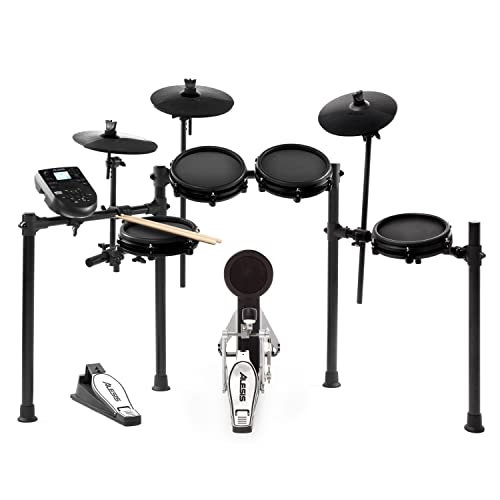
The Nitro Mesh is what most drum instructors hand beginners: mesh snare and toms (dramatically quieter than rubber pads), a fully featured drum module with hundreds of sounds, and a solid rack. It includes kick pedal, hi-hat controller, and everything you need to play. The mesh heads feel closer to real drumheads than anything else in this price range — that's the detail that matters.
What we like
Mesh pads dramatically quieter than rubber — genuinely apartment-safe
Full-featured module with hundreds of sounds and a built-in metronome
Complete kit: pads, kick pedal, hi-hat controller, and rack all included
What to know
Stock kick pad gets mixed reviews; some swap in a mesh kick head later
Kick tower vibration still transmits through floors in multi-story buildings
★★★★☆Our rating· Only 1 left in stock - order soon.
The entry point into the Alesis lineup. Rubber pads rather than mesh — louder and stiffer than the Nitro Mesh, but it includes a real bass drum pad and a serviceable module. The right pick if you're not yet sure drumming will stick and want to minimize the financial commitment. Upgrade path is clear: sell it, step up to Nitro.
What we like
Lowest cost entry into a real electronic kit with a proper bass drum pad
Includes drum module with multiple sounds and headphone output for silent practice
What to know
Rubber pads are louder and stiffer than mesh — real noise and feel trade-off
Limited module features; no coaching functions compared to higher-tier kits
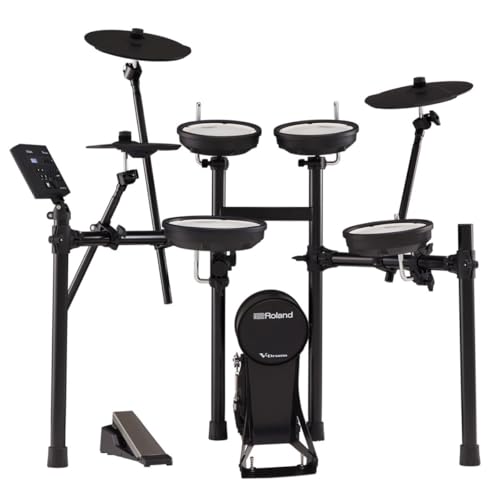
When you're ready for the next level, Roland is the brand. The TD-07 has Roland's best mesh pads in its tier — the snare has three zones for realistic rim shots — and the TD-07 module has coaching functions and Bluetooth. You'll notice the improvement in feel immediately coming from an Alesis. Buy this once you've been playing six months and know you're committed.
What we like
Roland's mesh pad feel is noticeably better than Alesis at this tier
3-zone snare supports realistic rim shots and cross-stick technique
TD-07 module has Bluetooth and coaching functions that accelerate progress
What to know
Significant price jump over Alesis — only justified after six months of consistent playing
If your living situation allows acoustic drumming — garage, basement, tolerant household — this is the complete beginner acoustic kit. Comes with hardware, cymbals, bass pedal, and a drum throne. Pearl makes quality drums at every level, and the Roadshow is genuinely good for the money. You'll be playing real sessions on this from week one.
What we like
Natural acoustic feel that no electronic kit fully replicates
Complete kit — hardware, cymbals, bass pedal, and throne included
What to know
90-100 dB is genuinely extreme noise; not viable in most apartments
Included cymbals are serviceable but will want replacing within six months
Drumsticks are consumables — they chip, splinter, and eventually break. Buy at least two pairs before your first session. The 5A is the universal beginner stick: medium weight, medium taper, hickory wood that absorbs shock well. Most drummers start with 5A and stay there for years. The 5B is heavier (more power, more arm fatigue); the 7A is lighter (good for jazz or smaller hands). Ignore specialty sticks until you know what you actually want.
Best starter
Vic Firth
5A Hickory Drumsticks (12-pair)
$143.99 as of Jun 22, 2026
★★★★★Our rating· Only 7 left in stock - order soon.
Vic Firth 5A is the industry standard for a reason — consistent diameter, good balance, and hickory that absorbs shock without transmitting vibration up your arms. The 12-pair box is the smart buy: you'll go through sticks faster than you expect, and having spares means you're never interrupted by a broken pair. Every drum teacher will recognize these and not argue with your choice.
What we like
Industry-standard balance and diameter — no adjustment period for new technique
Hickory absorbs shock well; less vibration traveling up your arms than cheaper wood
12-pair box means you'll never stop a practice session for a broken stick
What to know
Wood tips are slightly warmer-sounding on cymbals than nylon — minor preference call
Zildjian's take on the 5A — same weight class, nylon tip gives a slightly brighter, crisper sound on cymbals than wood tips. A solid alternative if you want to compare nylon vs wood tips and see which you prefer. Buy a pair alongside your Vic Firth box.
What we like
Nylon tip delivers a brighter, crisper attack on cymbals than wood
Same 5A weight class as Vic Firth — easy direct comparison buy
What to know
Sold in smaller quantities than the Vic Firth bulk box — more frequent reorders
ProMark's LA Special is a pro-spec 5A in bulk — same hickory, same weight class as Vic Firth, different feel under the hand. Buying a 12-pack from a second brand at once is smart: you'll discover which manufacturer's balance you prefer, and you'll have plenty of sticks to get through.
What we like
Pro-spec feel in bulk — same weight class as Vic Firth but slightly different balance
12-pack value matches Vic Firth; a good way to discover your preferred manufacturer
What to know
Slightly different taper than Vic Firth — takes a session or two to adjust
A practice pad is not a substitute for a drum kit — it's a complement to one. You practice hands (snare patterns, rudiments, stick control) on a pad. You can't practice foot technique or full beats. But hand technique is 60% of drumming, and a pad lets you practice it silently at your desk, on a kitchen table, or in a hotel room. If you don't have a kit yet, this is where to start. If you do have a kit, keep one on your desk for daily 15-minute hand sessions.
Best starter
Evans
RealFeel 12" Practice Pad
$39.99 as of Jun 22, 2026
★★★★★Our rating· In Stock
The RealFeel is the pad most drum instructors keep on their desk. The gum rubber surface has a rebound feel that's genuinely close to a tuned snare drumhead — closer than foam or hard plastic. The 12" diameter is large enough to practice any standard rudiment pattern. Sits firmly on a table or clamps onto a snare stand.
What we like
Gum rubber rebound is genuinely close to a real tuned snare drumhead
12" diameter is large enough for any standard rudiment pattern without errors
What to know
Single surface only — can't replicate the dynamic range variation of a real kit
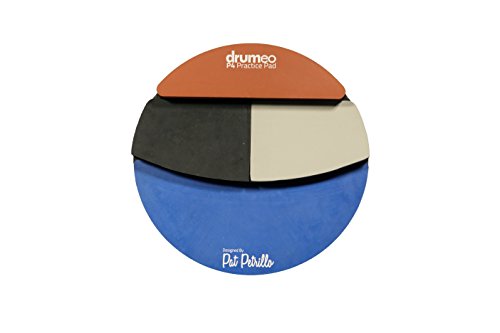
The P4 has four distinct surface zones — standard, soft, hard, and muffled — each with different rebound characteristics, so you can practice the full dynamic range of drumming without switching pads. It's a training tool, not just a pad. Intermediate drummers rave about it; worth the upgrade once you're doing serious daily hand practice.
What we like
Four distinct zones train full dynamic range in a single pad
Rebound variations across zones build realistic touch and control
What to know
Higher price than a standard pad — only justified with serious daily practice
The drum throne — your seat — is the most overlooked purchase in drumming, and it directly affects how long you can practice and whether you develop back problems. A bad throne (wobbly, wrong height, too hard) destroys your posture and tilts your hips wrong, which misaligns your foot technique. Electronic kits usually don't include one. Acoustic kits sometimes include one that's barely adequate. Buy a real throne. You'll spend hundreds of hours sitting on it.
Best starter
Gibraltar
9608 Double-Braced Drum Throne
$105.59 as of Jun 22, 2026
★★★★★Our rating· In Stock
Gibraltar makes hardware that working drummers actually use, and the 9608 brings that quality to a beginner price point. The double-braced tripod base doesn't wobble, the height adjusts smoothly, and the round cushioned seat is firm enough to support posture without being punishing in long sessions. Significantly better than any included throne in a budget kit.
What we like
Double-braced tripod base is rock-solid — no wobble during energetic playing
Height adjusts smoothly to dial in the exact hip-knee angle for your frame
What to know
Round seat is firm — comfortable for shorter sessions, less so past two hours
★★★★☆Our rating· Only 16 left in stock - order soon.
The minimum viable throne — lightweight, double-braced base, padded seat, and much better than sitting on a kitchen chair. Handles normal practice loads fine for a beginner. When you're playing 30+ minutes daily, step up to the Gibraltar.
What we like
Double-braced base and padded seat at a genuinely low price point
Meaningfully better than a kitchen chair — correct height changes your whole posture
What to know
Light construction — adequate for occasional practice, not extended daily sessions
The throne of choice in countless professional drum rooms. The gas-shock height adjustment is silky, the round seat is genuinely comfortable for multi-hour sessions, and it feels rock-solid at full height. Once you're practicing 30+ minutes daily, the difference from a budget throne is immediately apparent.
What we like
Gas-shock height adjustment is silky and precise — set it once and forget it
Genuinely comfortable for multi-hour sessions; a real quality-of-life upgrade
What to know
Premium price — hard to justify until you're practicing 30+ minutes daily
This is not optional. Acoustic drumming is 90-100 dB. Electronic drumming is quieter, but cymbal hits and live sessions add up. Noise-induced hearing loss is permanent — there is no fixing it, and drummers lose their hearing faster than almost any other musicians. Good ear protection doesn't muffle music; it reduces volume while preserving frequency balance so you can still hear what you're playing. The $20 investment pays off for the rest of your life.
Best starter
Vic Firth
dB22 Isolation Headphones
$$
★★★★★Our rating
22 dB of attenuation in a headphone form factor — you can plug them into your electronic kit's headphone output and hear your practice mix while protecting your ears. They're not audiophile headphones, but as drum practice headphones they're the standard for good reason: effective, durable, comfortable for hour-long sessions.
What we like
22 dB passive attenuation in a headphone form factor — monitors and protects at once
Plugs directly into electronic kit's headphone output; one tool does two jobs
What to know
Passive only — no active noise cancellation; not audiophile-grade monitoring
High-fidelity earplugs tuned for musicians — they reduce volume evenly across frequencies so music still sounds balanced at lower volume, unlike foam earplugs that muffle highs and make everything sound dull. Keep a pair in your stick bag for live sessions, band practice, or anytime you're drumming without headphones.
What we like
Flat frequency response preserves music quality at lower volume — unlike foam plugs
Compact enough to keep in your stick bag for every session and live gig
What to know
Less attenuation than over-ear options — better for live sessions than loud practice
The first week of drumming is humbling. You have four independent limbs that have spent decades doing whatever the brain tells them — and suddenly they need to do four different things at once, on time. It's harder than it looks. It also clicks faster than you'd expect, if you practice the right things in the right order.
Drumming is the one instrument where you can sound like music within the first week and still be completely humbled by the instrument five years later. The early wins are real. The plateau is also real. Knowing what you’re working toward — and in what order — makes the first month a lot less frustrating.
Week 1: One hand at a time
Start on a practice pad, not on the kit. A practice pad gives you the feel of a drumhead with almost no noise, and it forces you to focus entirely on your hands — which is where most of the work actually is.
The core exercise: single-stroke roll. Right-right-right. Left-left-left. Then alternating: R-L-R-L-R-L. Do this slowly with a metronome at 60 BPM until it’s boring, then speed it up slightly. The goal in week one isn’t speed; it’s evenness. Both hands landing with the same volume and the same timing. This takes longer than you think.
The grip: matched grip is the default for modern drumming. Hold the stick the way you’d hold a thick pencil — thumb and index finger as the fulcrum, remaining fingers loosely wrapping around. The stick should bounce off the head, not be pushed into it. Let the rebound do half the work. This is called the bounce stroke and it’s the foundation of all efficient drumming technique.
Don’t squeeze. Beginners squeeze the stick when they’re tense or when they’re trying to play faster. Tension destroys speed and causes repetitive stress injury over time. Your grip should feel relaxed. If your forearm is sore after five minutes, you’re working too hard.
Now you go to the kit. Your right foot goes on the kick drum pedal. Your left foot controls the hi-hat pedal. Your right hand goes on the hi-hat cymbal. Your left hand goes on the snare drum. That’s the basic setup for a right-handed player.
The hi-hat exercise: right hand plays steady eighth notes on the hi-hat while your left hand does nothing and your right foot does nothing. Just the hi-hat. Boring on purpose. Get the timing locked in.
Now add the kick: still playing eighth notes on the hi-hat, add the kick drum on beats 1 and 3. Hi-hat counts out: “1 and 2 and 3 and 4 and.” Kick lands on the numbers 1 and 3.
This is where independence starts to feel strange. Your feet want to stop when your hands get confused. Your hands want to rush when your feet slow down. This is normal. Drop the metronome to 50 or 60 BPM — embarrassingly slow. That’s the right speed for learning independence. Speed comes after accuracy, not before.
Week 3: The basic rock beat
This is the beat behind 80% of rock, pop, and country music you’ve ever heard:
Hi-hat: every eighth note (“1 and 2 and 3 and 4 and”)
Kick: beats 1 and 3
Snare: beats 2 and 4
Play it at 60 BPM until it’s automatic. Then 70. Then 80. At 80 BPM it starts to feel like music. When you hit 90-100 BPM and it feels locked, you have the foundation of drumming.
Don’t rush this step. Most beginners try to speed up before the pattern is actually automatic, which means their beat gets sloppy at tempo. A drummer who plays a clean beat at 80 BPM sounds better than one who plays a ragged beat at 120. Keep the metronome on and let it be the judge.
Pick a song with a clear, simple beat — something mid-tempo, not too fast, with obvious kick and snare placement. Tom Petty’s “I Won’t Back Down,” The Beatles’ “Come Together,” Green Day’s “When I Come Around.” Play along to the recording on repeat.
Playing to music teaches you things a metronome can’t: groove, feel, how to stay in the pocket when a song naturally pushes and pulls. You’ll immediately notice your beat rushing or dragging relative to the recording. That gap between “I think I’m in time” and “I can hear that I’m late” closes fast when you’re playing to real tracks.
At the end of week four, if you can play through a simple song’s verses and chorus with a reasonably steady beat, you’ve met the month-one benchmark. You’re not playing cleanly. You’re not playing with feel. But you’re drumming — which puts you ahead of everyone who’s still just thinking about it.
Rushing the tempo. Drumming is about time, not speed. Play slower than feels comfortable and the beat stays steady. Rush ahead and you’re practicing inconsistency — which is the hardest habit to unlearn.
Squeezing the sticks. Tension in your grip travels up your arms and causes soreness within minutes. Loosen up — the stick should feel like it wants to bounce off the head on its own.
Watching your hands instead of counting. You can’t look at all four limbs at once. Counting out loud forces your brain to track time instead of trying to visually monitor movement.
Skipping the metronome. The metronome is not optional. It is the most important tool in drumming and the one beginners skip because it makes the problem visible: it shows exactly when you rushed and when you dragged. Your internal clock develops from using it, not from avoiding it.
Trying to add fills too early. A fill is a rhythmic break between sections of a song. Fills look impressive and feel fun. They are also wrong to practice in month one. Lock the basic beat first. Fills are a month-two problem.
What to work on in month two
Once the basic rock beat is comfortable at 80+ BPM, the next steps in order:
Eighth-note hi-hat variations — open hi-hat on the “and” of beat 4, quarter-note hi-hat pattern instead of eighths
The basic fill — four sixteenth notes on the snare going into a new section, then back to the beat
Ghost notes — very quiet snare hits between the main backbeats. What separates a drummer who can play beats from one who can feel them.
Find a teacher for month two. Not for month one — you don’t yet have enough context to know what to ask. After four weeks of playing, one 60-minute lesson will identify the two or three things actively holding you back, and you can work on those specifically for the next month.
Save your money
What you don't need yet
Beginners get pressured to buy a lot of stuff that doesn't help them play
better. Here's what we'd skip on day one.
Upgraded cymbals — Acoustic beginner kits include serviceable cymbals. Electronic kits don't use real cymbals at all. Once you've played six months and can hear the difference, a better hi-hat or ride is a real upgrade. Not before.
An acoustic kit for your apartment — 90-100 dB of drumming is genuinely extreme noise. An electronic kit with mesh pads is the right answer for most living situations — not as a compromise, but as the correct tool.
A drum rug — Useful once your kick pedal starts creeping across the floor mid-session. That usually happens after a few weeks of real playing. Not needed day one.
New drum heads — Replacing heads is a real upgrade when you're ready — better heads dramatically change how a kit sounds and feels. But it's a month-three project, after you've learned basic tuning and know what feel you're after.
A full recording setup — Electronic kits record directly into a computer via USB, which is genuinely useful for simple practice recordings. For capturing an acoustic kit properly, you're looking at multiple mics, an audio interface, and learning a DAW. None of that belongs in the first month.
First week
Your first seven days
A short, real plan to get from gear-on-doorstep to actually playing.
Buy sticks and a practice pad before anything else. Spend 15 minutes a day on a basic single-stroke roll. · Buy
Learn the basic rock beat: kick on beats 1 and 3, snare on 2 and 4, hi-hat on every eighth note. It's the foundation of most popular music you've ever heard. · Learn
Drumeo — Basic Rock Beat · YouTube · Drumeo's beginner series is the best free resource for new drummers
Set up a metronome and practice at 60-70 BPM. Slow is not optional — it's how timing develops. · Action
Take a single beginner lesson within the first two weeks. One lesson with real feedback beats two weeks of self-teaching incorrect technique. · Learn
Drumeo · The best online drum instruction platform — structured beginner lessons from world-class teachers
FAQ
Common questions
Should I start with an electronic or acoustic drum kit?
For most beginners, electronic is the right answer — specifically mesh-head kits like the Alesis Nitro Mesh. They're dramatically quieter than acoustic, have built-in metronomes and sounds, include headphone output for silent practice, and cost roughly the same as a comparable acoustic starter kit. If you have a garage, basement, or very tolerant household, acoustic has a more natural feel. But acoustic kits are genuinely very loud — around 90-100 dB.
How long does it take to learn drums?
A basic rock beat (kick, snare, hi-hat) takes most people one to three sessions to play consistently. Playing through a simple song takes a few weeks. Sounding like you know what you're doing takes two to three months of regular practice. Playing with real feel and dynamic control takes years. The learning curve is steep at the start and flatter later — most beginners make noticeable progress faster than they expect.
Do I need to read music to play drums?
Not to start. Most beginner drum content uses simple notation diagrams or video instruction you can follow by ear and sight. Learning to read drum notation becomes genuinely useful as you advance — it lets you learn songs faster and communicate with other musicians — but it's not a prerequisite. Learn the feel first.
How loud are electronic drum kits?
Mesh-head electronic kits produce around 55-65 dB of playing noise — roughly normal conversation level. The kick pedal mechanism is the loudest part and transmits vibration through the floor, which can be an issue in multi-story buildings. A drum riser or foam mat under the kit significantly reduces floor vibration transfer.
Do I really need ear protection?
Yes. Acoustic drumming is 90-100 dB — sustained exposure causes permanent hearing loss. Electronic kits are quieter, but live sessions, band practice, and concerts add up quickly. Noise-induced hearing loss is irreversible. Vic Firth dB22 headphones for electronic practice, high-fidelity earplugs for acoustic or live settings. Build the habit from day one.
What's the difference between 5A and 5B drumsticks?
5A is the standard: medium diameter, medium weight, good for most styles from rock to pop to jazz. 5B is heavier and slightly thicker — more power and volume, but more arm fatigue over long sessions. Start with 5A unless you know you play heavy. 7A is lighter and thinner, great for jazz or smaller hands. The number-letter system is industry standard — once you know your preferred weight, every brand's version is comparable.
Drumeo — The best structured online drum education platform. Free YouTube content is excellent for beginners; the paid membership is worth it if you're committed. Teachers include world-class session drummers who teach clearly and practically.
Drumeo — YouTube — Drumeo's free channel. The beginner series is the single best free resource for new drummers — start with 'Beginner Drum Lessons.' Also covers technique, theory, and play-alongs with popular songs.
Stephen Taylor (YouTube) — Practical, encouraging teaching style. Particularly good for 'how do I play this specific song' content and building independence between hands and feet.
Mike Johnston (YouTube) — One of the most respected drum educators online. His videos on technique, practice methodology, and feel are valuable from beginner to advanced. More technical than Drumeo, but worth the challenge once you have the basics.
r/drums — Active community. The wiki has a solid beginner FAQ. Good for gear questions, recording advice, and motivation. Post a video of your playing for feedback — the community is genuinely helpful to beginners.
Vic Firth Drum Education — Free rudiment library and educational resources from the leading stick manufacturer. Their rudiment video explanations are the clearest free reference for learning standard patterns.
Stick Control — George Lawrence Stone — The most important drum book ever written. 72 pages of hand-coordination exercises. Every serious drummer works through this. Don't buy it day one — wait until you've been playing two to three months and ask your teacher when to start.
As an Amazon Associate, JustBeginning earns from qualifying purchases.
We may also earn commission from other affiliate programs linked on this
page. Editorial recommendations are independent; we don't choose
products based on commission rates.
Product prices and availability are accurate as of the date and time
indicated and are subject to change. Any price and availability
information shown on Amazon at the time of purchase will apply.

 Best starter