Ballet-inspired, deceptively intense, and completely doable at home — barre is the workout that hooked a generation of pandemic-era exercisers and never let go. No dance background required. The full starter setup — portable barre, sticky socks, resistance bands, and props — runs $200–400 and fits in a corner of any room.
By Colin B. · Published May 30, 2026 · Last reviewed August 7, 2026
A budget freestanding barre plus socks and bands runs around $150. Add a barre ball, quality leggings, and a mid-tier barre, and you're at $300.
We earn commission on qualifying Amazon purchases — see our
affiliate disclosure.
Price tiers and budget totals shown above are editorial estimates;
actual Amazon prices vary.
At a glance
Our top pick in each category
The fastest path through this guide — each best-starter pick by category.
Scroll for the budget and upgrade alternatives.
Vita VibeVita Vibe - USA Made - Prodigy Series Ash Wood Ballet Barre - Portable Double Bar with Carry Bag - Freestanding Stretch/Dance Bar - 4 FT - 5 FT
Don't buy a streaming subscription before you know if barre will stick. YouTube has enough free beginner content — Ballet Beautiful, Barre3, Pure Barre's free library — to run your first 30 days without paying for a membership.
The right height matters more than the brand. A barre should sit at roughly hip height — around 42–44 inches for most people. If you're over 5'10" or under 5'3", check the adjustability range before buying.
Hardwood or tile works best. Carpet reduces grip for sticky socks. If your space is carpeted, lay a yoga mat down for floor work sequences.
The barre is the centerpiece of any home setup — you need something at hip height (roughly 42–44 inches) that's stable enough to lean into without wobbling. A freestanding barre is the default: no installation, moves where you need it, works on most floor types. Wall-mounted barres are more stable and take up zero floor space when not in use, but require drilling into studs. For most beginners renting or setting up a first home studio, freestanding is the right call.
Portable Barre — what's the difference?
A few common shapes, each making a different trade.
Freestanding
Portable, no installation. The default for home use.
Height range
32–47″ adj.
Bars
1–3
Installation
None
Best for Most home users, renters, apartment dwellers
Tradeoff Wobbles slightly under heavy lateral load
Cheapest entry point. No tools, but noticeably less stable.
Price
$30–60
Stability
Light use only
Installation
No tools needed
Best for Testing barre before committing, tight budgets
Tradeoff Too wobbly for anything beyond basic balance holds
Best starter
Vita Vibe
USA Made - Prodigy Series Ash Wood Ballet Barre - Portable Double Bar with Carry Bag - Freestanding Stretch/Dance Bar - 4 FT - 5 FT
$169.95 as of Jun 22, 2026
★★★★★Our rating· In Stock
Vita Vibe makes the most popular home ballet barres in the US. Height adjusts from 32 to 47 inches — covers practitioners from 4'10" to 6'2" — and the double-bar design gives you two working heights in one piece. Wide foot spread keeps it from tipping during aggressive lateral work.
What we like
Adjusts 32–47 inches — fits practitioners from 4'10" to 6'2"
Double bars give two working heights (hip and low) in one piece
Wide base spread prevents tipping during lateral barre work
What to know
More expensive than budget barres — a real investment
Slides slightly on smooth tile without a grip mat underneath
Under $60 and perfectly usable for beginner practice. Single-bar, narrower base than the Vita Vibe, but it adjusts to the right height and holds up for light home use. The practical entry point for testing barre before committing to serious equipment.
What we like
Under $60 — the lowest-stakes way to try home barre
Ships partially assembled with minimal setup required
What to know
Narrower base wobbles under heavy lateral pressure
Single bar only — no low-bar option for calf and hip work
VITA Barre Wall-Mounted Single Ballet Barre, Archos, 3 Ft Bar, Wood | Fixed Height
$$
★★★★☆Our rating
Once barre is a permanent part of your routine, a wall-mounted bar is strictly better — zero wobble, no floor footprint, and it doubles as a grab bar for static stretching post-workout. Requires drilling into studs. If you're renting, stick with freestanding.
What we like
Zero floor footprint when not in use — no tripping hazard
More stable than any freestanding barre for heavy lateral work
What to know
Requires drilling into studs — not renter-friendly
Fixed position means you can't rearrange the space once installed
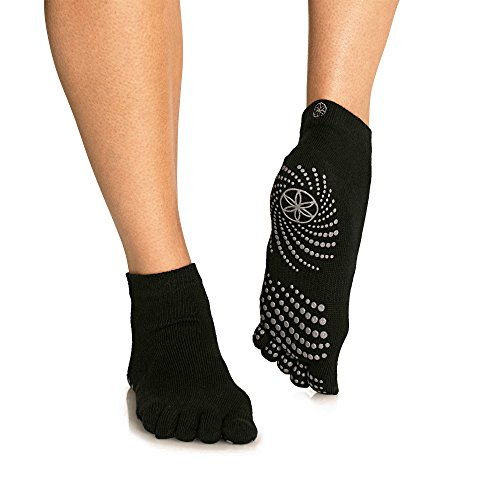
Sticky socks are non-negotiable for barre. They grip the floor so your feet don't slide during relevés and pulses, and they protect you from blisters on hardwood. Open-toe (half-toe) designs are the barre standard — they let you point and flex naturally without the restriction of a full-coverage sock. Budget socks work fine to start; once you're practicing three or more times a week, invest in a pair that survives the washing machine.
Best starter
ToeSox
Half Toe Low-Rise Grip Socks
$16.00 as of Jun 22, 2026
★★★★★Our rating· Only 6 left in stock - order soon.
Half-toe socks expose the front of your foot for natural pointe and flex while keeping grip on the heel and ball. ToeSox is what most boutique barre studios sell at their front desk — they wash reliably for dozens of cycles without losing grip.
What we like
Open-toe lets you point and flex fully — key for barre technique
Grip dots hold equally on hardwood, mat, and studio floors
Holds grip for 30+ wash cycles without fading
What to know
Runs small — order half a size up if you're between sizes
Open-toe takes a class or two to feel normal if new to it
A solid pair for under $15. Grip dots aren't as dense as ToeSox, but they hold on hardwood and yoga mat alike. The right call if you want to try a class before committing to premium socks.
What we like
Under $15 — right test-drive before investing in premium socks
Tavi Noir's socks are thicker, more cushioned, and more breathable than budget options — noticeable during long classes with sustained standing sequences. Available in open-toe and full-foot styles. A legitimate upgrade once barre is a confirmed regular habit.
What we like
Thicker cushioning makes long standing sequences more comfortable
Both open-toe and full-foot styles available — pick your preference
What to know
More expensive than most studio socks
Thicker fabric runs warm during intense cardio barre segments
Resistance bands show up in almost every barre class — wrapped around thighs for seat work, held during arm sequences, looped around the barre for bicep curls and rows. You want at least three resistance levels. Long flat bands and short loop bands serve different exercises, so ideally you have both. At $10–25 for a set, this is the cheapest high-impact category in any home barre kit.
Best starter
TheraBand
Resistance Band Set (3 Levels)
$11.50 as of Jun 22, 2026
★★★★★Our rating· In Stock
TheraBand's flat bands have been physical therapy staples for decades. The three-level set gives you light, medium, and heavy resistance — yellow is right for most arm work, red for leg exercises. Long flat bands loop around your barre for exercises that loop bands simply can't do.
What we like
Physical therapy-grade resistance calibration — trusted for decades
Long flat format loops around the barre for exercises loops can't do
Three levels covers barre arm work through heavier leg exercises
What to know
Flat band format takes practice to anchor correctly mid-exercise
Sold by color — order the variety pack (yellow/red/green) to start
Five resistance levels for under $15. The loop format stays put around thighs during seat work better than flat bands, and it's the most common format in typical barre classes. Not a replacement for long flat bands, but the most-used prop in a standard class.
What we like
Five resistance levels for under $15 — best value in the category
Loop format stays put around thighs better than flat bands
What to know
Short loops don't work for long-band barre exercises at the barre
Can snap if stretched beyond their rated resistance range
The small 9-inch barre ball shows up in almost every class — squeezed between your inner thighs during pliés and seat work. Light wrist and ankle weights let you add intensity once bodyweight alone stops challenging you. Neither is required on day one, but you'll want both within your first month of consistent practice.
Best starter
ProBody Pilates
Mini Exercise Ball 9 Inch
$
★★★★★Our rating
The 9-inch ball is the barre standard — squeezed between inner thighs during pliés, held at the small of the back, or used as a balance prop during one-legged sequences. ProBody's version has the right firmness and a smooth surface that stays put during sweaty classes.
What we like
9-inch size is the barre standard for inner-thigh and seat work
Textured grip surface prevents slipping during sweaty movement
What to know
Ships under-inflated — needs a hand pump before first use
Only useful for barre-specific exercises; limited crossover otherwise
Weighted cuffs that add resistance to barre arm sequences and leg lifts without holding dumbbells. One pound per side sounds trivial until minute 20 of a barre arm series. The magnetic closure stays put through class — no sliding or adjusting mid-exercise.
What we like
Magnetic closure stays put through a full class — no slipping
1 lb sounds trivial; genuinely challenging by minute 20 of arms
What to know
Expensive at $55 for what is essentially a 2-lb weight set
Fixed load — can't progress heavier without buying another pair
Fitted leggings matter more for barre than for most workouts — you need to see your alignment, hip position, and knee tracking. Baggy shorts hide the work. High-waist compression is the standard: it holds your core during tuck sequences and stays put through a 60-minute class. Any quality high-waist legging works; barre-branded apparel is mostly a markup.
Best starter
CRZ Yoga
Butterluxe High Waist Leggings
$$
★★★★★Our rating
CRZ Yoga's Butterluxe fabric is the Amazon alternative to Lululemon Align at a third of the price. High-waist compression, four-way stretch, and a 25-inch inseam — everything you need for barre's deep pliés and floor work. Wash cold and they hold their shape.
What we like
Butterluxe fabric matches Lululemon Align quality at a third the price
High-waist band holds during deep pliés and tuck sequences
Four-way stretch survives aggressive hip-fold floor work
What to know
High-waist band rolls on XS/S frames — size up if between sizes
Under $25 and perfectly functional. Amazon's performance legging has mid-compression and holds up to regular washing without pilling. Not as luxe as CRZ Yoga, but it gets the job done if you're testing the hobby before spending more.
What we like
Under $25 — the no-regret pick before you know barre will stick
Holds up to regular machine washing without pilling or fading
What to know
Less compression hold than premium leggings
Mid-waist band sits lower than stated on some body types
The Alo Airbrush leggings are what you see in every serious home studio and most Peloton barre classes. Firm compression that doesn't restrict deep movement, and a thick waistband that stays put through a full 60 minutes. Worth it once you're going three times a week.
What we like
Firm compression stays put for a full 60-minute class
Thick waistband is the reference standard for barre-style workouts
What to know
Expensive at $90–110 — check Alo's own site for frequent sales
Runs a half-size small — order up if between sizes
Barre has a fast setup and a slow reveal — you'll feel it immediately, but the real changes show up around week three. Here's what to expect, and what not to worry about.
Barre has a reputation for being gentle. That reputation is wrong, or at least incomplete. The movements are small — no jumping, no sprinting, no heavy weights — but the intensity is real and arrives fast. Most people are surprised to feel their thighs shaking by minute ten of their first class.
That shake is the whole point. Here’s what your first month actually looks like.
Week one: Learn the vocabulary, survive the burn
Barre borrows ballet terminology, but don’t let that intimidate you. You don’t need to know what a “grand plié” is before your first class. You just need to know a few things:
Relevé means rising onto the balls of your feet. You’ll do this constantly — during thigh work, during calf raises, during arm sequences. Engage your core every time.
Plié means bending your knees while keeping your torso upright. The barre version is usually a small bend, not the deep squat a ballet student would do. Keep your knees tracking over your toes, not caving inward.
Turnout is rotating your heels together and toes apart to form a V or a wider angle. You don’t need a dancer’s full 180-degree turnout — 45 degrees is fine. Just let your hips open naturally rather than forcing your feet into position.
The tuck is the most distinctive barre cue. From standing or seated, you posteriorly tilt your pelvis — think of pulling your navel toward your spine while bringing your tailbone slightly forward. Most instructors cue this by saying “tuck your pelvis” or “find your neutral spine.” It activates your deep abdominals and seat in a way that makes everything else harder. You’ll be doing it constantly.
Your first class will feel chaotic. The transitions are fast, the positions are unusual, and your balance will be off. This is normal and universal. By the third class, the format will feel familiar, and your energy will shift from following along to actually doing the exercises.
Somewhere in the middle of week two, you’ll start feeling muscles that never registered before. The deep hip flexors. The inner thighs. The seat muscles that fire during a small lifted-leg pulse — not the big gluteus maximus, but the smaller muscles underneath it.
This is the specific gift of barre training. Most fitness modalities — running, weight training, even yoga — work the primary movers. Barre’s tiny, isolated movements recruit the stabilizers and deep muscles that everything else overlooks.
A few things will likely happen in week two:
Your balance will improve. Standing on one leg during arabesque holds or single-leg pliés is genuinely hard for most beginners. By the end of week two, you’ll feel the small adjustments your ankle and hip are making automatically that they couldn’t do in week one.
The arm series will surprise you. Barre arm work uses very light weights (or no weights) for very high reps. Three-pound weights held at shoulder height for 60 tiny pulses will make your arms shake in a way that bench pressing can’t. This isn’t a sign of weakness — it’s the point.
Floor work will start making sense. The mat sequences — lying on your side, lifting and pulsing one leg — feel random until you understand they’re targeting the outer hip and inner thigh in ways the standing barre work can’t reach. Trust the transitions. They’re deliberate.
Week three: The shake becomes a conversation
If you’ve been practicing two to three times a week, week three is when something shifts. The shake you’ve been fighting starts to feel useful rather than embarrassing. You start interpreting it as feedback: when you shake, you’re working the right muscle group.
This is also when form corrections start to pay off. The two most common beginners get:
Sinking into the barre. Gripping the barre for balance rather than using it as a light fingertip support is the most common beginner habit. The barre is there to steady you, not to hold you up. If you’re white-knuckling it, take one hand off and put it on your hip — you’ll immediately feel how much work your core was avoiding.
Shortening the range. Barre exercises use small ranges of motion, but many beginners unconsciously make them even smaller when they’re fatiguing. A two-inch pulse should be two inches, not a half-inch wobble. When your instructor says “bigger,” they mean it even when it burns more.
Week four: You belong here
By week four, the positions are automatic. You no longer spend mental energy figuring out where your feet go during a first position plié — your body knows. You can follow along and actually focus on the quality of the movement instead of the mechanics.
A few things worth noting at the one-month mark:
You’ll start to see changes in specific places. The seat and inner thighs are usually first — that’s where barre concentrates its attention. Some people notice changes in arm definition and core tone too, but the seat and thighs almost always respond first.
Your flexibility has probably improved. Barre classes always include stretch sequences, and after four weeks of consistent practice, hip flexors and hamstrings are typically noticeably longer. This carries over into other activities — sitting at a desk hurts less, hiking feels easier.
You’ll have opinions about instructors and platforms. Different barre styles exist — Pure Barre is slow and highly controlled, Physique 57 is faster and more cardio-oriented, Ballet Beautiful is closer to actual ballet conditioning. By month one, you’ll know which pace and style fits your body and schedule.
The two most common month-one mistakes
Doing too much too fast. Barre is low-impact but not low-demand. Starting with daily classes in week one leads to overuse soreness in hip flexors and the iliotibial band. Two to three times a week is the right starting cadence.
Skipping the stretch sequences. Most barre classes end with 10 minutes of stretching that feels like a cooldown. It isn’t — it’s the part where you consolidate the range of motion gains you worked for during the rest of class. Stay for all of it.
At one month, you’re past the hardest part. You know the format, you know your body’s patterns, and you have a real foundation to build on. The results that motivated you to start are just beginning to show.
Save your money
What you don't need yet
Beginners get pressured to buy a lot of stuff that doesn't help them play
better. Here's what we'd skip on day one.
Ballet slippers or pointe shoes — Barre fitness is done barefoot or in sticky socks. Actual ballet footwear is for technique classes, not home workouts.
A paid streaming class subscription — YouTube has hundreds of free beginner barre classes from Ballet Beautiful, Barre3, and others. Subscribe once you know the format works for you.
A dedicated wall mirror — Helpful for form checks eventually, but not a day-one purchase. A phone propped on a shelf tells you the same thing for now.
Ankle weights heavier than 2 lbs — Barre uses very light resistance for high-rep endurance work. Heavier weights shift the exercise type entirely and usually compromise form.
A thick gymnastics mat — A standard yoga mat is all you need for barre's floor work. Thick mats actually make balance exercises harder, not easier.
First week
Your first seven days
A short, real plan to get from gear-on-doorstep to actually playing.
Watch a free 30-minute beginner barre class on YouTube before you buy anything — confirm the format resonates with you. · Learn
Set up your space: clear 6 feet in front of and beside your barre, and push it against a wall for extra stability. · Action
Do your first 30-minute class without stopping to fix form. Just move. Alignment comes in week two. · Action
Note where you're shaking most — seat, thighs, or arms. That's where you'll feel the fastest improvement. · Action
FAQ
Common questions
Do I need any dance experience to start barre?
None at all. Barre fitness borrows ballet's vocabulary — plié, relevé, turnout — but teaches everything from scratch. The movements are small and repetitive, and good instructors build you up over several classes. Most beginners feel completely lost for the first two sessions, and then it clicks.
How much space do I need for a home barre setup?
About 6×6 feet of clear floor space, with your barre near a wall for stability. You'll step back from the barre for floor work, so the space behind it matters. A corner of a bedroom or living room with furniture pushed back is usually enough.
Can I do barre without an actual barre?
Yes — a sturdy chair back, countertop, or doorframe works as a balance point for most exercises. The barre is for stability and light resistance, not load-bearing. That said, once you're practicing three times a week, a real barre at the right height is noticeably better.
What makes barre different from yoga or Pilates?
Barre is about small, repetitive contractions — the intentional burn and shake you feel after 30 tiny pulses. Yoga prioritizes stretch and breath; Pilates prioritizes core and deep stabilizers. All three overlap, but barre is the most overtly fitness-oriented of the three.
How often should I do barre as a beginner?
Two to three times a week is the right starting point. Daily barre is possible, but beginners are typically sore in unfamiliar muscles — hip flexors, inner thighs, the deep seat — after the first week. Give those muscles a recovery day between sessions.
Is barre effective for toning and weight loss?
Very effective for toning. Barre reliably builds definition in the seat, thighs, and arms with consistent practice. Most classes burn 200–350 calories per hour — solid, but not cardio-dominant. Pair it with walks or cycling if fat loss is a primary goal.
Ballet Beautiful (YouTube) — Mary Helen Bowers' channel — former ABT dancer, trained Natalie Portman for Black Swan. One of the best free home barre libraries available.
Barre3 — Studio chain with an excellent on-demand platform. Free YouTube classes are a solid intro. Known for being genuinely beginner-friendly and modification-heavy.
Pure Barre — The largest barre studio chain in the US. Consistent format nationwide. Their app is worth it if there's no studio near you.
Physique 57 — NYC-born on-demand platform. Technically sharp, fast-paced, and the origin of the barre-ball-in-every-class format. More intermediate-friendly.
r/barre — Small but active community. Good for comparing streaming platforms, asking about form cues, and finding home setup advice.
As an Amazon Associate, JustBeginning earns from qualifying purchases.
We may also earn commission from other affiliate programs linked on this
page. Editorial recommendations are independent; we don't choose
products based on commission rates.
Product prices and availability are accurate as of the date and time
indicated and are subject to change. Any price and availability
information shown on Amazon at the time of purchase will apply.
Our top pickVita Vibe - USA Made - Prodigy Series Ash Wood Ballet Barre - Portable Double Bar with Carry Bag - Freestanding Stretch/Dance Bar - 4 FT - 5 FT


 Best starter