3D archery means walking a wooded course and shooting foam animal targets at unknown distances — same bow as target archery, completely different vibe. The gear list is shorter than you think, and you can enter a beginner class at an ASA or IBO club shoot with basic equipment. Here's exactly what to buy first, what the rangefinder debate is about, and what you can skip.
By Colin B. · Published June 1, 2026 · Last reviewed June 22, 2026
A starter compound package, arrows, and a basic release runs $350-400. Add a rangefinder and you're around $550.
We earn commission on qualifying Amazon purchases — see our
affiliate disclosure.
Price tiers and budget totals shown above are editorial estimates;
actual Amazon prices vary.
At a glance
Our top pick in each category
The fastest path through this guide — each best-starter pick by category.
Scroll for the budget and upgrade alternatives.
Get fitted before you buy a bow. Draw length is the single most important measurement in archery — a bow that doesn't fit your arm span will fight your form from day one. Any archery pro shop will measure you for free in five minutes. Don't order online before this step.
Don't buy for hunting poundage. Beginners load up on 60-70 lb draw weight because that's what deer hunting requires. For 3D archery with field tips, 40-55 lbs shoots the same score with less fatigue. Start light, let your form develop, and raise weight when it feels like nothing.
Know your class before your first shoot. ASA and IBO have beginner (sometimes called 'cub') divisions with no rangefinder required and targets at closer, kinder distances. You don't need expensive gear to compete — just show up and declare beginner class.
Your bow is the only purchase that truly matters on day one. A compound bow is the dominant choice at club shoots — faster, more consistent, and easier to tune for accuracy at varied distances. Recurve has its own dedicated divisions and a devoted following, but start compound unless you specifically want the traditional challenge. Budget $250-400 for a legit starter package from a real archery brand, properly set up at a pro shop. That setup session is what makes the difference.
Bow — what's the difference?
A few common shapes, each making a different trade.
Compound
Most 3D archers shoot compound. Easier to learn, more forgiving, strong club support.
Let-off
65–80%
Draw weight
40–70 lb typical
Speed
280–340 fps
Best for Beginners, competitive club shooting, virtually all ASA/IBO divisions
Tradeoff More moving parts to tune; rely on a pro shop for setup
No let-off, raw form. Steeper curve, separate IBO/ASA divisions.
Let-off
None
Draw weight
25–55 lb typical
Speed
150–220 fps
Best for Archers drawn to the traditional challenge and feel
Tradeoff Harder to learn accurate distance shooting; fewer beginner resources
Best starter
Diamond Archery
Edge XT Ready-to-Shoot Compound Bow
$378.00 as of Jun 22, 2026
★★★★★Our rating· In Stock
The Edge XT is Diamond's do-everything starter bow, and the one most pro shops hand a new archer. It adjusts 7 to 70 lb draw weight and 19 to 31 inch draw length, so it fits almost any body and grows with your form for years. It ships with sight, rest, and stabilizer mounted. Buy it through a pro shop so they set your draw length and tune the peep. That fitting is what makes it group.
What we like
Adjusts 7 to 70 lb, one bow from first day to serious shooter
Ships with sight, rest, and stabilizer already mounted
Huge dealer network makes pro-shop fitting and service easy
What to know
Needs a pro-shop fitting, online setups usually miss draw length
Heavier package, smaller-framed shooters should check the specs
The Cruzer G3 is the other popular starter compound, and it often runs $30 to $50 less than the Edge XT. Same 5 to 70 lb draw weight range, same wide draw length range, same ready-to-shoot package. Cam movement is a touch rougher but perfectly functional for a first 3D season. A solid pick to confirm the sport sticks before buying a premium kit.
What we like
Often $30 to $50 cheaper than comparable starter compounds
5 to 70 lb draw weight range fits almost any adult or youth shooter
RTF package is genuinely shoot-ready with basic tuning
What to know
Cam movement a touch rougher than the Edge XT at this price
Lower resale value makes trading up to a performance bow harder
When you are ready to spend real money, the Alaskan Pro is Bear's step up to a genuine performance platform. The dual cam gives a crisper back wall and more consistent release than any starter bow, and the riser sits dead in the hand on long unknown-distance shots. It ships ready to hunt with sight, rest, and quiver. Shoot a full season on your starter bow before making this jump.
What we like
Dual cam gives a crisp back wall and consistent, repeatable release
Riser stays dead in the hand and quiet on long shots
Ships ready to hunt with sight, rest, and quiver included
What to know
Premium price, only worth it after a full starter season
Draw length changes need a bow press and a pro shop
In 3D archery you shoot field tips — blunt practice points, not broadheads. What matters is spine stiffness matched to your draw weight and length, and shaft-to-shaft consistency. Carbon arrows are the standard at every level; aluminum works but bends on bounceouts from tough targets. Buy a matched dozen, not just six — you will lose arrows in grass, brush, and the occasional miss that skips past a target.
Best starter
Carbon Express
Maxima Red SD 250 Arrows (6-Pack, Blazer Vanes)
$119.99 as of Jun 22, 2026
★★★★★Our rating· In Stock
The Maxima Red SD is one of the most consistent carbon shafts you can buy for the price, and this pack comes fletched with Blazer vanes so you shoot straight out of the box. The Dual Spine Weight Forward design keeps the shaft stiff near the tip, exactly what you want shooting field points at varied distances. Match spine to your draw weight on the Carbon Express chart before ordering.
What we like
Dual Spine Weight Forward keeps the shaft stiff near the field tip
Comes fletched with Blazer vanes, ready to shoot out of the box
Tight spine tolerance keeps your groups consistent all season
What to know
Spine chart required, the wrong spine costs accuracy and arrows
Six-pack is pricier per arrow than bare shafts, buy what you need
★★★★☆Our rating· Only 12 left in stock (more on the way).
The 6.5 Bowhunter is Easton's workhorse field arrow — well-made, consistent, and $15-20 cheaper per dozen than premium shafts. For a first season of 3D where you're still finding arrows in the grass and learning to read targets, these are the smart starting point. Step up to tighter-tolerance carbon once you're shooting competitively and losing fewer.
What we like
Easton quality at a budget shaft price — consistent spine per dozen
Smart choice for a first season when arrow losses are still common
What to know
Heavier than premium hunting shafts — slightly different trajectory curve
Not competition-grade tolerance; upgrade after your first full season
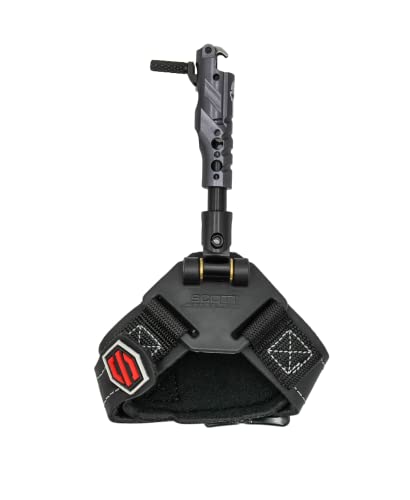
Compound bow shooters use a mechanical release instead of fingers — it's more consistent and reduces grip torque. Wrist-strap trigger releases are the standard starter choice: strap it to your wrist and squeeze the trigger. As you get serious, back-tension (handheld) releases eliminate the flinch reflex called target panic that creeps into competitive archers. Start with a wrist release and add a back-tension release later if your groups start going sideways under pressure.
Best starter
TruFire
Patriot Buckle Wrist Strap Release
$29.99 as of Jun 22, 2026
★★★★★Our rating· In Stock
The Patriot is the most popular beginner wrist release in 3D archery and the one most pro shops will hand you on day one. Simple trigger, adjustable trigger travel, and a secure buckle wrist strap. Teaches the right trigger-pull habit without overwhelming a first-year shooter with back-tension technique. Every archery instructor knows it.
What we like
Wrist-strap design — on and off in seconds, no fussing mid-round
Adjustable trigger travel grows with your form
Standard club-shoot choice; instructors and coaches all know it
What to know
Trigger pull can develop into a flinch over time — expected and fixable
Wrist strap bulk occasionally interferes with some shooting gloves
★★★★☆Our rating· Only 3 left in stock - order soon.
When your groups go sideways under competition pressure, the cause is usually target panic, a flinch from anticipating the shot. The Ghost is a hinge release that fires on rotation instead of a trigger pull, which breaks that anticipation reflex and cleans up your execution. Most serious 3D shooters move to a hinge eventually, and the Ghost is one you will not outgrow.
What we like
Fires on rotation, not a trigger pull, killing the anticipation flinch
Smooth, adjustable hinge you will not outgrow as you improve
What to know
Hinge releases take practice, budget a month of range time
Not for competition until the surprise release is second nature
3D archery runs in two formats: Known Yardage (KY), where distance markers are posted and no rangefinder is needed, and Unknown Yardage (UY), where estimating distance is half the skill. Most IBO events and many club shoots are unknown-distance format — and in those, a rangefinder is essential, not optional. Budget $100-150 for a reliable starter unit; the difference between $100 and $250 shows primarily in speed and optical clarity at distance.
Best starter
Bushnell
Bone Collector 1000 Laser Rangefinder
$139.90 as of Jun 22, 2026
★★★★★Our rating· In Stock
The Bone Collector 1000 is Bushnell's budget hunting rangefinder with Angle Range Compensation, so it gives the adjusted horizontal distance instead of raw line-of-sight, the number that matters on an uphill or downhill 3D shot. It ranges well past any 3D distance, reads fast, and holds zero. A smart first rangefinder for Known-Yardage club shoots.
What we like
Angle compensation gives true shot distance, not line-of-sight
Ranges well beyond any 3D distance and reads fast
Affordable entry point with reliable Bushnell glass
What to know
Glass is dimmer than the $250-plus rangefinders in low light
Only legal in Known-Yardage formats, check your class first
When you're competing in upper divisions and ranging targets in dense brush or low light, the Ranger 1800 earns its price with noticeably cleaner glass and sub-second readings at distances most 3D courses never approach. Angle-compensating HCD mode is precise and fast. Vortex's lifetime warranty is also the best in the category.
What we like
Significantly cleaner glass vs. budget rangefinders in wooded low-light conditions
Sub-second readings and excellent ranging through brush and grass
What to know
Overkill for beginners shooting under 60 yards on club courses
2-3x the cost of the Bushnell; earn the upgrade through competition
On a 3D course you walk between targets through brush and timber, so you want a hip or thigh quiver that keeps arrows accessible without catching on branches. Most club archers carry 3-4 arrows per round and walk the course in a small group. A basic hip quiver is all you need; resist the romance of a back quiver — they're impractical on wooded courses and prone to losing arrows on slopes.
Best starter
Easton
Flipside 4-Tube Hip Quiver
$44.99 as of Jun 22, 2026
★★★★★Our rating· In Stock
The Flipside holds four arrows in individual tubes, so they do not knock together, do not fall out on rough terrain, and stay quiet on the walk between targets. The belt clip adjusts for left or right-hand shooters. It is the quiver most club 3D shooters settle on after trying a few, durable and quiet at a fair price.
What we like
Individual tubes separate arrows, no rattling or vane damage
Adjustable belt clip fits left and right-handed archers
Holds up to a full season of wooded 3D courses
What to know
Holds four arrows, no spare capacity for long range days
Open tubes can collect debris in heavy brush, clear between rounds
★★★★☆Our rating· Only 12 left in stock (more on the way).
Under twenty dollars, this Allen hip quiver holds your arrows plus a few accessories and clips to any belt. Nothing flashy, but if you are not sure which carry style you prefer yet, it is a low-stakes way to try hip carry before spending real money on a tube quiver or a field pack. It holds up fine for a casual first season.
What we like
Under twenty dollars, a zero-regret way to try hip carry
Clips to any belt and swallows oversized field tips
What to know
Open compartment lets vanes rub and occasionally tangle
Less rugged than tube quivers in heavy brush and wet weather
Most beginners think 3D archery is about shooting far. It isn't — it's about reading distance, breathing through pressure, and trusting a shot process that takes a whole season to build.
3D archery is one of those sports that sounds technical from a distance and feels completely natural the moment you’re standing in front of a foam elk in the woods, trying to figure out whether you’re looking at 32 or 41 yards of hillside. The bow matters less than the reading. The reading matters less than the process.
Here’s what your first season actually looks like — and what separates the beginners who stay from the ones who don’t.
Before you shoot: the fitting that changes everything
The single most important thing you’ll do before your first shot is walk into an archery pro shop and get measured for draw length. This takes five minutes. An archer with the wrong draw length will fight their own bow every single session; an archer with the right draw length will have a baseline form that works.
Draw length is not adjustable by feel. It’s calculated from your wingspan, and starter compounds like the Diamond Edge XT or Bear Cruzer G3 can be dialed to match it exactly. Every serious 3D archer you’ll meet started this way. The ones who skipped it, who bought something online without being measured, almost all eventually went back to the shop for a fitting anyway.
While you’re there, ask what draw weight to start at. The answer is almost certainly 40–50 lbs. Not 60–70 lbs. Beginners consistently overbuy poundage because hunting-weight bows get all the attention. For 3D archery with field tips, you’re not punching through anything — you’re lobbing a carbon arrow into a foam target at 20–45 yards. Lower poundage means less fatigue over a 20-target round, better form under pressure, and a much faster learning curve.
The first range sessions: building an anchor
Before your first club shoot, you need two things locked in: a consistent anchor point and a reliable shot process.
Anchor point means the same spot on your face every single draw. Right-handed shooters typically anchor with the string touching the corner of their mouth or the tip of their nose, with the thumb of the bow hand on the back of the jaw. Whatever works anatomically for your face, it has to be the same every time. Without a repeatable anchor, you’re not shooting — you’re guessing.
Shot process is the sequence you run before every release: stance, grip, draw, anchor, aim, trigger. When it becomes automatic — when you don’t have to think about it step by step — your groups will tighten on their own. Don’t rush this. Beginners want to shoot a lot of arrows fast. Shooting 20 arrows slowly and correctly builds more skill than shooting 80 arrows badly.
Start at 20 yards. Stay there until you’re grouping five arrows inside a 6-inch circle consistently. Then move to 30. The temptation to push yardage before your form is stable is real and universal; resist it.
The release you use matters here. Most beginners start with a wrist-strap trigger release like the TruFire Patriot — strap to wrist, aim, pull trigger. The key is not to punch the trigger on command. You want the release to “go off” as a surprise, the result of gradually increasing back tension, not a deliberate flinch. This is harder than it sounds and is the most common early form problem. If your groups are inconsistent or scattered randomly, it’s almost always the trigger.
Most ASA and IBO-affiliated clubs welcome beginners and have defined beginner or “cub” divisions with shorter distances and friendly scoring. Sign up before you go, declare your class at check-in, and walk with a small group of 3–4 shooters through the course.
Each target is a foam animal replica — deer, elk, black bear, turkey, wild boar — placed in natural terrain at an unknown distance. Your job is to estimate that distance and put an arrow in the scoring ring. Most targets have concentric scoring rings: a large outer ring (8 or 10 points), an inner ring (10 or 12), and a high-value vitals circle (12 points for ASA, or an 11/12 ring for IBO).
In beginner class, you’re often shooting from a stake that’s already been adjusted to kinder distances. Don’t worry about score on your first shoot. Your only job is to go through your shot process correctly on each animal. Everything else — distance reading, wind, terrain — layers on top of form that already works.
The social structure at club shoots is relaxed and helpful. The person in your group with 20 years of 3D experience will almost certainly coach you between shots. Let them. This is one of the most welcoming competition formats in archery.
Reading distances: the skill that separates 3D from everything else
In unknown-yardage format — the dominant competitive format at IBO events and many clubs — you estimate the distance to the target before each shot, then aim for the right hold. This is the skill that makes 3D archery its own thing.
The human eye is remarkably bad at judging distance in natural terrain without practice. Uphill angles make targets look farther. Downhill angles make them look closer. Open meadows compress distance; dense brush extends it. You will be wrong, confidently and frequently, for your entire first season. That’s normal.
The most reliable method beginners learn is to subdivide — estimate a known reference (say, 20 yards to a nearby tree) and then count how many of those fit between you and the target. With enough repetitions, you’ll calibrate to common 3D distances (most club targets land between 15 and 55 yards) and start trusting your eye.
Some classes allow a rangefinder. If yours does, the Bushnell Prime 1300 with angle compensation (ARC mode) is the right entry-level tool — it reads the adjusted horizontal distance rather than line-of-sight, which is the number your holdover chart is built around. But don’t lean on a rangefinder as a crutch even in KY class. The mental skill of reading terrain is what makes the sport addictive.
What your first full season looks like
By the end of a full season — roughly 8–12 club shoots and consistent range practice — most beginners have:
A stable shot process they run automatically
Consistent anchor and draw that produces repeatable groups
A feel for club distances (20–45 yards) that’s usually within 3–5 yards
One or two mechanical adjustments — a different release, a sight tweak, poundage bump — that moved their game forward
The progression is never linear. You’ll have a shoot where everything clicks and a shoot two weeks later where nothing works. Both are normal. The form you build in year one is what every subsequent improvement layers on top of.
One more thing: resist the gear upgrade itch for your first full season. The bow you bought at a pro shop with correct draw length and weight is not your limiting factor. Your form is. No equipment change will fix a punchy trigger or an inconsistent anchor. Shoot the starter bow until you’ve finished a full season of club events, then evaluate.
Save your money
What you don't need yet
Beginners get pressured to buy a lot of stuff that doesn't help them play
better. Here's what we'd skip on day one.
A bow-mounted quiver — These attach to the bow for hunting. For 3D courses you walk between shots — a hip quiver is far more practical.
Broadheads — 3D archery uses field tips only. Broadheads are for hunting, not foam targets, and they'll destroy targets and get you ejected from a club shoot.
A carbon fiber stabilizer system — The stabilizer that comes with a starter package is fine for your first season. Long rods and side bars are competition upgrades, not beginner gear.
A lighted nock — Useful for hunting to find arrows in brush, but most 3D clubs don't allow them in competition classes. Check rules before buying.
Peep sight magnifier lens — Magnifier lenses in peep sights are legal in some classes and banned in others. Don't add one until you understand your division's rules.
A target butt or practice backstop — Club ranges and 3D courses provide everything. You only need your own target if you're building a backyard setup.
First week
Your first seven days
A short, real plan to get from gear-on-doorstep to actually playing.
Find your nearest ASA or IBO club affiliate — most hold regular club shoots and welcome first-timers. · Action
Practice at a range or backstop before your first club shoot. Focus on a consistent anchor point — same spot on your face every draw. Twenty arrows a day is plenty. · Action
Sign up for Beginner (or Cub) class at your first club shoot. These divisions use closer distances and no rangefinder required. · Action
FAQ
Common questions
How is 3D archery different from target archery?
Target archery is shot at flat paper or foam targets at fixed, marked distances — you always know exactly how far you're shooting. 3D archery uses foam animal replicas (deer, elk, bear, turkey) placed at unmarked distances on a wooded course, and you walk from target to target between shots. The bow and arrows are the same; the mental game and scoring system are completely different.
Do I need a hunting license to do 3D archery?
No. 3D archery is a sport, not hunting, and no license is required. You're shooting foam targets, not animals. Some 3D ranges are located at hunting clubs, but the sport itself has no licensing requirement.
What draw weight do I need for 3D archery?
Less than you think. 40-55 lbs is plenty for 3D archery at any distance you'll shoot at a club event. Don't start at 60-70 lbs because that's what hunting requires — heavy draw weights build bad form in beginners and cause fatigue over a full round of 20-40 targets. Start at 40-50 lbs, build your form, and raise poundage when it feels effortless.
What's the difference between ASA and IBO?
Both are major 3D archery league structures, but they run slightly different formats. ASA (Archery Shooters Association) is known for its national tour and strict equipment classes. IBO (International Bowhunting Organization) has a more bowhunting-oriented culture and is common in the eastern US. Both have beginner divisions. Check which organization your nearest club is affiliated with and start there.
Do I need a rangefinder to start 3D archery?
Not necessarily. ASA and IBO both have Known Yardage (KY) classes where distances are posted and no rangefinder is needed. Unknown Yardage is the dominant competitive format where estimating distance is part of the skill, and for those classes a rangefinder is allowed in some divisions. As a beginner, start in KY class — learn your form first, worry about distance estimation later.
Can I use the same bow for hunting and 3D archery?
Yes — most 3D archers do exactly that. The difference is the arrows (field tips for 3D, broadheads for hunting) and a few accessory swaps. A bow setup for 3D is essentially the same bow you'd hunt with. Just change the arrows and verify field tips are on before you walk onto the course.
Archery Trade Association (ATA) — Industry body that promotes all forms of archery. Their Find an Archery Range tool is a good starting point.
Levi Morgan YouTube Channel — Multiple-time ASA and IBO world champion. His instruction videos are practical and beginner-accessible.
John Dudley — Nocked and Loaded — Technically rigorous archery instruction from a former pro 3D competitor. Great for form fundamentals.
r/Archery — Active community covering all archery disciplines including 3D. Form-check threads are particularly useful for beginners.
As an Amazon Associate, JustBeginning earns from qualifying purchases.
We may also earn commission from other affiliate programs linked on this
page. Editorial recommendations are independent; we don't choose
products based on commission rates.
Product prices and availability are accurate as of the date and time
indicated and are subject to change. Any price and availability
information shown on Amazon at the time of purchase will apply.


 Best starter