The saxophone is one of the most rewarding instruments an adult can pick up. A month of practice and you're playing recognizable melodies. The gear advice is the problem: cheap knockoffs flood Amazon, stock mouthpieces need replacing immediately, and nobody tells you that a $70 mouthpiece upgrade matters more than a $200 horn upgrade. Here's what actually matters.
By Colin B. · Published May 24, 2026 · Last reviewed June 12, 2026
Budget for a real horn, a replacement mouthpiece, and your first box of reeds. The stock mouthpiece that ships in the case needs replacing right away.
We earn commission on qualifying Amazon purchases — see our
affiliate disclosure.
Price tiers and budget totals shown above are editorial estimates;
actual Amazon prices vary.
At a glance
Our top pick in each category
The fastest path through this guide — each best-starter pick by category.
Scroll for the budget and upgrade alternatives.
Start on alto, not tenor. Alto is physically smaller, takes less air pressure to produce a sound, and nearly all beginner method books are written for it. Tenor sounds more cinematic, but it fights beginners harder in the first six months. Unless a teacher specifically tells you tenor, start alto.
The mouthpiece that comes in the box is probably garbage. Every student saxophone ships with one, and almost every stock mouthpiece is a low-grade plastic piece that limits your tone and makes the horn harder to play in tune. Budget $35-70 to replace it on day one. It's the highest-ROI purchase you'll make.
Reeds are a consumable. They wear out in 2-6 weeks of regular practice, and a chipped or waterlogged reed sounds terrible. Buy a 10-pack the same day you order the horn. Strength 2 is the standard starting strength. Don't go higher until a teacher says you're ready.
The gear
What you actually need
Saxophones
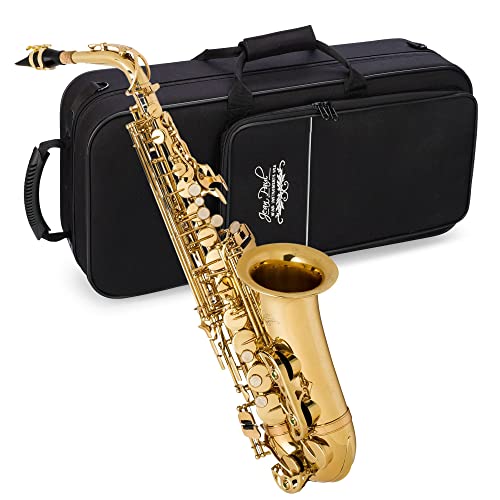
Alto saxophone is where beginners start. The instrument is smaller than tenor, the mouthpiece takes less air pressure to produce a sound, and nearly all beginner method books are written for alto. Budget $300-500 for a real student horn. The price gap between a credible student saxophone and a cheap Amazon knockoff is the difference between learning saxophone and fighting broken equipment. Buy Yamaha if you can swing it; Jean Paul if the budget is tight.
Saxophones — what's the difference?
A few common shapes, each making a different trade.
Alto
The standard beginner choice. Smaller, easier to control.
Key
E-flat
Size
Compact
Best for
Beginners, all styles
Best for Beginners, classical, jazz, pop. The default starting point
Tradeoff Less of that deep, cinematic tone you may be imagining
Yamaha's student saxophone has been the benchmark recommendation for 30 years. Consistent intonation, reliable pads, and key action that doesn't fight beginners. Most teachers will nod approvingly when you show up with one. Used Yamahas also hold value well (resell for 60% of what you paid if saxophone doesn't stick).
What we like
Intonation is consistent and reliable across the full register
Smooth key action that doesn't fight beginners learning fingerings
Holds resale value well if you decide saxophone isn't for you
What to know
Included mouthpiece is functional but a real upgrade is worth $40-70
At ~$450 new, the entry price stings. Check Reverb for used models
If the Yamaha is out of budget, the Jean Paul is the next credible student option. Real progress happens on these. Build quality isn't as tight as Yamaha. Some units have slightly stiffer key action, but it's a real saxophone, not a toy. Inspect the pads carefully out of the box.
What we like
$150-200 cheaper than the Yamaha entry point
Plays in tune across the register, the core student requirement met
Widely available with fast shipping
What to know
Pad consistency varies unit to unit. Inspect on arrival
Key action can feel stiffer than comparable Yamaha models
★★★★☆Our rating· Only 3 left in stock - order soon.
After a year or two on a student horn, the YAS-480 is where most intermediate players land. The handcrafted neck produces noticeably richer tone, and the improved key action reveals itself once your technique is there to hear it. Don't buy this as your first horn. You won't be able to tell the difference yet.
What we like
Handcrafted neck produces noticeably richer tone than student models
Improved key action; the gap from the YAS-280 is real and audible
Adjustable thumb hook accommodates different hand sizes
What to know
Near $900 price tag. Wait until 6+ months before considering
Won't reveal its advantages until your technique catches up to it
★★★★☆Our rating· Only 7 left in stock - order soon.
If you specifically want the deep, dark tenor sound from jazz and R&B, the TS-400 is the budget-friendly way in. Tenor is physically larger and harder to control than alto, but the sound is unmistakable. Know what you're getting into. All accessories are tenor-specific and nothing is interchangeable with alto.
What we like
That unmistakable deep, dark tenor sound from jazz and R&B
Full B-flat tenor range at budget student pricing
What to know
Larger body demands more breath support, harder for beginners
All accessories are tenor-specific; nothing is interchangeable with alto
The mouthpiece is the single highest-ROI upgrade you can make, more impactful dollar for dollar than the difference between a $300 and $500 horn. Every beginner saxophone ships with a mouthpiece, and almost all stock mouthpieces need replacing. A proper hard-rubber mouthpiece from Yamaha or Vandoren costs $35-70 and immediately improves your tone and intonation. Budget for this from day one.
Best starter
Vandoren
V16 Hard Rubber Alto Saxophone Mouthpiece A7
$$
★★★★★Our rating
The most universally recommended beginner mouthpiece by teachers. Medium chamber, plays in tune across the register, and handles every style from classical to jazz. Put it on whatever saxophone you have and immediately notice the difference over the stock piece. This $70 upgrade matters more than a $200 horn upgrade.
What we like
Medium chamber works for jazz, classical, and everything between
Widely recommended by teachers; your instructor will approve
Hard rubber construction lasts decades with basic cleaning
What to know
More expensive than the Yamaha 4C budget alternative
The improvement over stock reveals itself over weeks, not minutes
The budget-conscious upgrade from whatever plastic piece came in the box. A real step up in tone and intonation control, stocked at most music stores, and under $40. If you're not sure how much saxophone will stick, start here and upgrade to Vandoren in a few months.
What we like
Under $40, a low-risk first upgrade from the stock mouthpiece
Hard rubber plays reasonably in tune across the register
Stocked at most music stores for easy in-person comparison
What to know
Slightly bright tone; less warmth than pricier rubber mouthpieces
The step up to Vandoren is noticeable at 3-6 months in
Once you've been playing 6-12 months and have your embouchure together, the Optimum is the most flexible upgrade available. Three interchangeable ligatures are included so you can tune resistance and feel to your style. Tone is noticeably fuller than the V16. Standard at music school level.
What we like
Interchangeable ligature system lets you tune feel and response
Noticeably fuller tone than the V16; the gap is clearly audible
Standard at music school level; teachers recognize it
What to know
$120+ requires real commitment to saxophone; not a starter pick
Overkill until embouchure is settled. Wait at least 6 months
Reeds are the element every beginner underestimates. They're not optional (no reed means no sound), and they're a consumable that lasts 2-6 weeks of regular practice. Reed strength is measured on a 1.5-4 scale; beginners start at 2 or 2.5. Too soft and the tone is thin and airy; too hard and you'll fight for every note while your embouchure muscles are still developing. Buy a 10-pack from the start.
Best starter
Rico by D'Addario
D'Addario Woodwinds Rico Alto Sax Reeds Strength 2 (10-pack)
$30.75 as of Jun 22, 2026
★★★★★Our rating· Only 7 left in stock - order soon.
The most widely used beginner reed, made by D'Addario. Strength 2 is the most common starting strength: easy enough to produce a sound before your embouchure muscles are built up. Buy a 10-pack; you'll use them. Most teachers and method books default to Rico when they don't specify otherwise.
What we like
Easy to blow; critical while embouchure muscles are still building
D'Addario manufacturing keeps consistency high pack to pack
Most teachers and method books default to Rico for beginners
What to know
Softer reeds produce a slightly thinner tone than Vandoren
You'll progress past strength 2 in a few months. Re-buy at 2.5
Traditional Alto Sax Reeds, Strength 2.5 (10-pack)
$39.00 as of Jun 22, 2026
★★★★☆Our rating· In Stock
Most serious student players migrate to Vandoren Traditional within the first year. Slightly more resistance than Rico means your embouchure develops faster, and the fuller, darker tone becomes audible as you progress. Start on Rico, then switch here at the 2-3 month mark when your teacher says you're ready.
What we like
Slightly more resistance than Rico; develops embouchure faster
Fuller, darker tone becomes noticeable as technique progresses
Consistent batch quality; fewer duds per box than competitors
What to know
Harder to blow than Rico 2.5; can frustrate very new players
About $10 more expensive per box than equivalent Rico packs
Synthetic reeds last months instead of weeks. The Légère Signature is as close to a cane reed feel as synthetic gets. Used by professionals who can't risk a bad reed night. If you're tired of tossing cane reeds or play in humid environments, the $30 upfront cost pays for itself within two boxes of cane.
What we like
Lasts months not weeks; pays for itself over several boxes of cane
Not affected by humidity or temperature; consistent every session
Used by professional saxophonists who can't risk a bad reed night
What to know
$30 upfront vs $15 for 10 cane reeds; higher initial cost
Slightly different feel than cane; allow one session to adjust
Three essentials that aren't optional for keeping your saxophone playable: a real neck strap (the included strap is too thin), a silk swab to remove moisture after every session (skip this and pay for pad replacements in a year), and a stable stand so the horn doesn't fall over. Total under $60, total impact substantial. The neck strap matters the moment you hold the horn for more than 20 minutes.
Best starter
BG France
S10ESH Elastic Comfort Saxophone Neck Strap
$
★★★★★Our rating
BG makes the most widely recommended student neck straps, and the Comfort series upgrades the thin strap in most instrument cases. The wider neoprene padding distributes the horn's weight, and the difference after a 30-minute practice session is immediate. The metal snap-hook doesn't slip like plastic alternatives.
What we like
Wide neoprene padding distributes horn weight; no neck fatigue
Metal snap-hook is secure and durable vs. plastic alternatives
Adjusts precisely and doesn't slip during a practice session
What to know
More expensive than the generic strap included in the case
Overkill for very short sessions. Matters most after 20+ minutes
Swab the inside of the saxophone after every session. Moisture sits in the neck and destroys pads over time, and pad replacements cost serious money. The Hodge silk swab is what most teachers recommend: the weight pulls through the neck easily, and silk is gentler than cotton on the pads. Takes 30 seconds.
What we like
Silk is gentle on pads; won't abrade like cotton alternatives
Weighted end pulls through the neck easily every time
Takes 30 seconds after every session; no excuse to skip
What to know
Silk requires gentle hand-washing to keep it clean
Must dry outside the horn between sessions; can't store inside
★★★★☆Our rating· Only 4 left in stock (more on the way).
Don't lean your saxophone against the wall. It will fall and the keywork will bend. The Hercules folding stand is the most widely used among students: rock stable, collapses small, rubber-tipped pegs protect the lacquer, and it fits both alto and tenor with no adjustment needed.
What we like
Rock stable; won't tip from a bag bump or a pet walking by
Rubber-tipped pegs protect lacquer from scratches
Folds flat and fits in a backpack side pocket for lessons
What to know
Adds another item to carry to lessons (minor but real)
Not secure against theft; only use in supervised spaces
The first month is about making real sounds instead of honks. Here's what actually happens, session by session, when you pick up the horn for the first time.
Most people start saxophone expecting it to be easy and quit when it isn’t. The truth is more interesting: saxophone has a very specific first obstacle (the embouchure), and once you clear it (usually in the first 2-4 sessions), progress accelerates fast. A month in, you’re playing recognizable melodies. Two months in, people are asking what you’re learning.
Here’s what that first month actually looks like, week by week, with the sticking points named in advance so they don’t blindside you.
Week 1: Getting a tone
The single goal of your first week is simple: produce a clear, stable tone on a single note. Not a song, not a scale. Just one note that sounds like a saxophone instead of a goose.
This is harder than it sounds, and here’s why: embouchure. Your mouth has to form a specific shape around the mouthpiece to control the reed. The muscles involved have never been used this way before. They’re weak and uncoordinated, and the reed feels strange against your lower lip.
The quickest way to develop embouchure is to practice with the mouthpiece alone before attaching it to the horn. Put the mouthpiece in your mouth, tighten slightly around the sides (like you’re saying a long “oh”), and blow a steady stream of air. You’re aiming for a clear, focused tone: not squeaky, not airy, not a honk. When you get it, it’ll feel obvious and you’ll be able to repeat it.
Once you can produce a tone on the mouthpiece alone, attach it to the saxophone. Your first note is B-flat (middle finger of the left hand, nothing else). Breathe from your diaphragm (not from your chest) and blow steadily. Long tones: hold each note for four counts, rest, repeat. Do nothing else for the first two sessions. This is the work.
What’s normal in week one: a lot of squeaks, inconsistent tone, your face getting tired after 10 minutes. All of that is expected. The embouchure muscles are new. They’ll build faster than you think.
What to avoid: over-blowing. More air pressure doesn’t help. If anything, a steady medium pressure gives better tone than blasting. Squeeze from the sides, not by biting down. Biting cuts off the reed and produces a thin, closed tone.
Weeks 2–3: Your first scale and first song
By week two, your embouchure is starting to stabilize. Notes come out more consistently, the squeaks happen less often, and you’re starting to feel where the tone lives in your body.
This is when to learn the B-flat major scale: B-flat, C, D, E-flat, F, G, A, B-flat. Eight notes, all reachable with standard fingerings, and the building blocks of more music than you’d expect. Learn the fingering from any beginner chart (the Yamaha fingering chart that comes in the case is fine, or search “alto saxophone fingering chart” online). Slow is correct: play each note in the scale as a long tone first before trying to chain them.
Your first song lives in this scale. “Mary Had a Little Lamb,” “Hot Cross Buns,” or “Jingle Bells” are achievable in week two. Pick one and learn it by memory, slowly, checking each note against a tuner app (Tonal Energy is free and accurate). The goal isn’t speed; it’s every note in tune.
Two things will frustrate you in week two:
Register breaks. The saxophone has a lower register and an upper register, separated by the octave key. When you lift the octave key (your left thumb), the same fingerings produce notes an octave higher. Until your embouchure is solid, crossing between registers produces honks and squeaks. This is normal. It goes away with practice. Don’t force it. Let your embouchure tell you when it’s ready.
Intonation. Some notes will sound sharp or flat even when you’re doing the fingering correctly. This is partly embouchure (experiment with loosening your bite slightly if notes are sharp) and partly normal saxophone physics. Notes like high C# and low B are notoriously sharp or flat on student horns. Adjust your jaw and air pressure rather than assuming the saxophone is broken.
Week 4: Playing music
Around week three or four, something clicks. Scales become automatic, your tone is consistent, and you’re playing your first real song from beginning to end. This is when saxophone starts being fun instead of just being work.
A few things to focus on at this stage:
Dynamics. Can you play the same note loud and soft without the pitch changing? Can you crescendo smoothly across a long tone? These are the building blocks of musical expression, and they’re more impressive than speed.
Articulation. The tongue controls when notes start and stop. Say “tah” silently against the reed to start a note cleanly; hold the air flowing between notes for a slurred sound. Most beginners either tongue every note (sounds choppy) or slur everything (sounds blurry). The right answer is a mix. Start learning the difference now.
Sight-reading a simple piece. A beginner method book (Alfred’s Basic Alto Sax Method or Rubank Elementary Method are the standards) will have 20-30 short pieces at your level. Pick up the book if you don’t have one. Reading music slowly is a skill that develops the same way playing does, with reps.
Every beginner hits the same walls. Knowing what they are before you hit them makes them less discouraging:
Squeaky high notes. Embouchure isn’t firm enough, or the reed is too soft for where your technique is now. If high notes consistently squeak, try a reed at strength 2.5 instead of 2 after about a month.
Airy, thin tone. The reed isn’t vibrating fully. Either your embouchure isn’t closing around the mouthpiece enough, or the reed is damaged. Check the reed tip for chips or warping, and focus on closing the sides of your mouth around the mouthpiece.
Finger stumbling between notes. Normal. Saxophone fingerings require some independent finger control, and the muscle memory isn’t there yet. Slow down to a pace where you can play cleanly, then gradually increase. Speed follows accuracy, not the other way around.
Jaw fatigue and soreness. Your embouchure muscles are literally new muscles firing for the first time. 15-20 minutes of focused practice is enough in the first two weeks; more isn’t better. Like any muscle group, they build with rest between sessions.
What changes everything: lessons and listening
Two things accelerate progress more than any amount of self-study:
One lesson with a real teacher. Even 4-6 lessons in your first two months will identify the 2-3 things your embouchure is doing wrong before they become habits. Bad habits on a wind instrument are genuinely hard to unlearn. A teacher’s eye catches them immediately. If in-person lessons aren’t possible, BetterSax on YouTube (Neal Vonk) is the best online substitute: patient, technically accurate, built around adult beginners.
Listening actively. Pick one saxophonist you love and listen to them obsessively. Your body starts to internalize tone before your technique can produce it. Sonny Rollins for jazz, Clarence Clemons for rock, Charlie Parker if you’re ambitious. The sound you’re aiming for gets clearer when you’ve heard it hundreds of times.
At the end of month one, you’re not a saxophonist yet, but you’re not a beginner anymore, either. You’re a player who knows what they’re learning and can hear themselves improving. That’s the inflection point. Most people who reach it don’t stop.
Save your money
What you don't need yet
Beginners get pressured to buy a lot of stuff that doesn't help them play
better. Here's what we'd skip on day one.
A professional-grade mouthpiece — Your embouchure needs to develop enough to hear what the mouthpiece is doing. At 3 months in, you can't yet. The V16 is the ceiling for now.
A leather neck harness — Harnesses are for long gigs and players with back issues. The BG strap handles everything a student needs.
A clip-on digital tuner — Free apps (GuitarTuna, Tonal Energy) do the same job. Get the app first, buy hardware when a teacher recommends it.
Reeds in multiple strengths — Start with strength 2 and master one strength before experimenting. Jumping between strengths trains inconsistency.
A preemptive repad — Pads on a new saxophone are fine. Let a teacher diagnose the instrument before spending $100-200 on a repad that isn't needed.
First week
Your first seven days
A short, real plan to get from gear-on-doorstep to actually playing.
Order your saxophone: Yamaha YAS-280 if budget allows, Jean Paul AS-400 if not. · Buy
Download a free tuner app (Tonal Energy or GuitarTuna). You'll use it every session. · Action
Tonal Energy · The tuner app most teachers recommend; accurate and clear
Learn to make your first sound: blow through the mouthpiece alone before attaching it to the horn. A clear, focused tone is the goal: not loud, just centered. · Learn
Swab the inside of the saxophone after every single session. Moisture destroys pads. This habit starts day one. · Action
FAQ
Common questions
Should I start on alto or tenor saxophone?
Alto, almost always. It's smaller, requires less air pressure to produce a sound, and nearly every beginner method book and online lesson is written for alto. Tenor is a great instrument, but it fights beginners harder in the first six months. Learn the fundamentals on alto; switch to tenor later if that's where your heart is.
How long until I can play a real song?
With consistent practice (20-30 minutes a day), most adult beginners play their first recognizable melody in 2-4 weeks. Simple tunes like 'Mary Had a Little Lamb' or 'Hot Cross Buns' are achievable in the first week once your embouchure is producing a stable tone. A full song with multiple notes and rhythms typically clicks around the one-month mark.
Can I teach myself saxophone, or do I need lessons?
You can go pretty far self-teaching with YouTube and apps, but lessons are the single fastest way to develop correct embouchure and breathing. Bad habits form fast and are harder to unlearn than to learn correctly. Even 4-6 lessons with a real teacher in the first two months will pay dividends for years. If lessons aren't possible, BetterSax on YouTube is the best free alternative.
What reed strength should I start with?
Strength 2 for most beginners. It's easy enough to produce a tone before your embouchure muscles are built up, but not so soft that it sounds airy and thin. Strength 2.5 is the next step after 2-3 months when your teacher says you're ready. Don't rush to harder reeds. Too much resistance too early builds bad habits.
How much does it cost to get started with saxophone?
Budget $310-550 for a real starter setup: a student horn ($280-450), a replacement mouthpiece ($35-70), and a first box of reeds ($15). Add a neck strap ($20) and a stand ($25) and you're fully equipped. The cheap 'starter kits' under $200 on Amazon typically include instruments with poor intonation and unreliable pads that will fight you the whole time.
BetterSax (YouTube) — Neal Vonk's channel is the best free saxophone instruction on YouTube. Beginner-friendly, technically sound, and entertaining. Start here before any other YouTube channel.
Saxophone.org (NARAS) — North American Saxophone Alliance. Primarily for serious students and professionals, but the resources section has solid foundational material.
Vandoren Reed Selector — Vandoren's official tool for matching reed strength and cut to your mouthpiece and style. Useful once you're 2-3 months in.
Sax on the Web Forum — The largest saxophone community online. Deep archives on gear, technique, and repair. Search before posting; most beginner questions have been answered in detail.
JazzAdvice.com — Focused on jazz saxophone specifically. Technical guides on tone, improvisation foundations, and practice methodology. More useful at 6+ months than on day one.
r/saxophone — Active subreddit with a helpful wiki. Good for specific gear questions and 'is this a normal problem' checks. The weekly thread is worth reading before making a gear purchase.
As an Amazon Associate, JustBeginning earns from qualifying purchases.
We may also earn commission from other affiliate programs linked on this
page. Editorial recommendations are independent; we don't choose
products based on commission rates.
Product prices and availability are accurate as of the date and time
indicated and are subject to change. Any price and availability
information shown on Amazon at the time of purchase will apply.

 Best starter