Few outdoor hobbies have a quieter, more immediate reward than canoeing. You're moving under your own power, reading the water, covering real distance. The overhead is real (a canoe is a genuine investment), but the learning curve is gentle, the basics click in a single afternoon, and a beginner can comfortably cover 8 to 10 miles by the end of their first season.
By Colin B. · Published May 23, 2026 · Last reviewed June 3, 2026
A canoe is the big variable; buy used for $200–400 and your total first-kit cost drops to under $600. Buy new entry-level and budget $1,000. Everything else (paddle, PFD, transport, dry bags) runs under $200 combined.
We earn commission on qualifying Amazon purchases — see our
affiliate disclosure.
Price tiers and budget totals shown above are editorial estimates;
actual Amazon prices vary.
At a glance
Our top pick in each category
The fastest path through this guide — each best-starter pick by category.
Scroll for the budget and upgrade alternatives.
Rent before you buy. A full day of canoe rental runs $40–80 at most outfitters. That's cheap tuition for confirming you love it, and for figuring out whether you want a solo or tandem, and what water you'll actually paddle.
Buy used if you can. Canoes are tough to destroy. A 20-year-old polyethylene canoe that's been stored under a tarp will paddle just as well as a new one. Craigslist and Facebook Marketplace are the right first stop. Budget $200–400 for a solid used canoe.
Tandem vs. solo is the most important decision you'll make. Two people almost always want a tandem (14–17 ft). One person paddling alone should get a solo canoe. A tandem paddled from the center is manageable but inefficient and harder to control in wind.
For beginners on flatwater (lakes, slow rivers, meandering streams), any entry-level polyethylene canoe from a reputable brand works fine. Polyethylene is durable, inexpensive, and correct for beginners. Kevlar and carbon boats are lighter and faster but crack on rocks and cost twice as much. Avoid them until you know exactly what you want and where you're paddling.
Canoes — what's the difference?
A few common shapes, each making a different trade.
Tandem (14–17 ft)
Two paddlers, side by side. Wider, more stable, and the obvious choice for partners or families.
Length
14–17 ft
Width
35–38 in
Capacity
700–900 lbs
Best for Couples, families, paddlers who almost always go out with a partner
Tradeoff Harder to paddle solo efficiently; you end up in the center or reversed in the bow seat, which is awkward
Old Town is the most trusted name in canoes, and the Discovery 158 is what they've sold to beginners for decades. Multi-layer polyethylene hull: indestructible for flatwater use, tracks reasonably well, and stable enough to give beginners real confidence. At 16 ft it handles two adults plus gear with no drama. The most popular beginner tandem on the market for a reason.
What we like
Virtually indestructible poly hull takes rocks and dock scrapes in stride
Carries two adults plus a full day's gear without drama at 16 ft
Old Town's reputation holds resale value better than off-brand canoes
What to know
At 74 lbs, loading solo takes real effort or a canoe cart
Pelican makes the most accessible entry-level canoes on the market. The Explorer 146 DLX is a 14'6" tandem in RAM-X poly, durable enough for bumps, about 52 lbs (lighter than the Discovery), and usually a few hundred dollars cheaper. The right call if you're not yet sure this will become a regular hobby or if budget is the priority.
What we like
Several hundred dollars cheaper than the Discovery with real poly durability
52 lbs is meaningfully lighter than most entry-level tandems
Good starting point if you're not sure canoeing will stick long-term
What to know
Shorter at 14.5 ft, so capacity and open-water tracking are less than the Discovery
A step up from the Discovery: better seats, better thwarts, and a more refined hull that tracks noticeably better on open water. The three-layer polyethylene is still bulletproof. This is the canoe to buy if you know flatwater paddling is a serious long-term hobby and you want something that lasts two decades without a second thought.
What we like
Three-layer poly hull runs 20-plus years without structural worry
Better seats and thwarts noticeably reduce all-day fatigue
Tracks noticeably better on open water than the Discovery
What to know
Price premium is real; the Discovery is fine for most beginners forever
The Discovery 119 is Old Town's solo workhorse: under 12 feet, 43 lbs, and purpose-built for one paddler. Easy to cartop solo, highly maneuverable on tight streams and ponds, and light enough to portage without misery. It also pairs well with a double-blade kayak paddle if you prefer. If you'll be paddling alone most of the time, this beats wrestling a tandem by yourself.
What we like
43 lbs is light enough to cartop and portage by yourself
Highly maneuverable on ponds and tight streams
Works with a double-blade kayak paddle if you prefer that style
What to know
At 11.9 ft, wind pushes it around on open water; stick to sheltered lakes
Canoe paddles are single-bladed: you pull on one side and use a J-stroke to keep the boat straight. Most beginner paddles use wood or synthetic shafts with plastic or composite blades. For length: seated in your canoe, the top grip should reach roughly your chin with the blade at the waterline. A properly sized paddle reduces fatigue dramatically. When in doubt, go slightly longer rather than shorter.
Best starter
Bending Branches
BB Special Performance Wood Canoe Paddle
$$
★★★★★Our rating
Bending Branches has made canoe paddles for over 40 years, and the BB Special is their sweet spot for everyday paddlers. Hardwood shaft, fiberglass-reinforced blade, durable, balanced, and comfortable all day on the water. Not so cheap you'll hate it, not so expensive you'll flinch when you tap a rock. Available in a range of lengths to fit any paddler.
What we like
Hardwood shaft and fiberglass blade balance durability and feel perfectly
Available in enough lengths to fit any paddler correctly
Comfortable for all-day paddling without hand fatigue
What to know
Not as light as carbon paddles, but that's a year-three concern
Bending Branches' entry-level wood paddle. Slightly shorter shaft laminate than the BB Special, but still a real canoe paddle from a respected brand. Good for a second paddle when you're bringing along a friend who doesn't own gear yet, or as a starter if you want to spend as little as possible before deciding this hobby sticks.
What we like
Real canoe paddle from a respected brand at an entry-level price
Works well as a loaner for guests who don't own gear yet
What to know
Simpler construction than the BB Special; the difference shows on long days
The Expedition Plus is Bending Branches' most robust paddle: 18-laminate hardwood shaft, fiberglass-wrapped blade, and a design built for extended wilderness trips. Noticeably stiffer and more responsive than the BB Special; you'll feel every stroke connect cleanly. When you're planning multi-day canoe trips, this is the paddle to carry.
What we like
18-laminate shaft is noticeably stiffer and more responsive per stroke
Built for multi-day wilderness trips; designed to last decades
What to know
Sizing is critical; read Bending Branches' sizing guide before ordering
You need a USCG-approved Type III PFD for every person in the canoe, legally and practically. The key for paddlers: a PFD you'll actually wear is one that fits comfortably seated. Paddling-specific PFDs move foam away from the lower back so you're not sitting on hard foam panels. If the life jacket is uncomfortable, it ends up on the floor of the canoe. Don't buy a PFD that you'll take off.
Best starter
Stohlquist
Fit Adult Life Jacket
$$
★★★★★Our rating
Stohlquist has been making paddling safety gear for over 40 years. The Fit is their most accessible model: USCG Type III, good coverage, open mesh back panel for comfort in heat, and a lower-cut front that doesn't restrict your paddle stroke. The PFD we'd put on a beginner without a second thought. Available in a full size range including children's versions.
What we like
Open mesh back panel keeps you comfortable paddling in summer heat
Low-profile front doesn't restrict your paddle stroke at all
Full size range including children's versions in the same line
What to know
Costs more than basic life jackets, but the paddling-specific fit is worth it
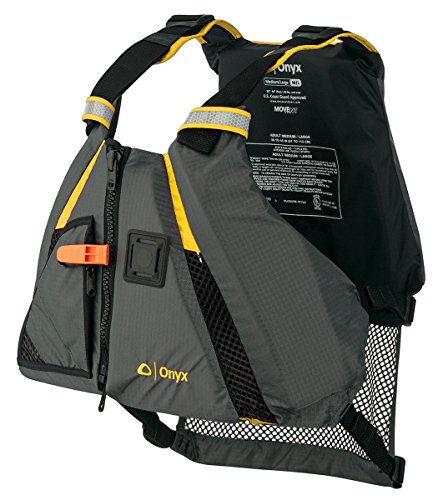
U.S. Coast Guard and Transport Canada Approved MoveVent Dynamic Paddle Vest For Adults For Kayaking, Canoeing, Stand Up Paddleboarding
$
★★★★☆Our rating
Onyx's MoveVent series uses segmented foam instead of one solid panel, noticeably more comfortable than a basic life jacket and easier to move in. USCG Type III, available in a full range of sizes, and usually under $50. The no-drama choice for someone who wants safe and comfortable without spending on premium outfitting.
What we like
Segmented foam is noticeably more comfortable than a one-panel life jacket
Usually under $50, making it easy to outfit the whole crew
What to know
Less paddling-specific fit than the Stohlquist; more restrictive at the top of the stroke
When you start paddling Class II moving water or above, the Stohlquist isn't enough. The NRS Zen is a paddling-specific rescue PFD: integrated tow belt pocket, knife attachment point, secure fit for dynamic water. Overkill for flatwater beginners. Worth every dollar once you're running rivers.
What we like
Integrated tow belt pocket and knife attachment point for moving water safety
Secure fit stays in place during swims and rescues
What to know
Total overkill for flatwater beginners; buy this when you're running Class II or above
Getting the canoe to the water is the part nobody talks about and everybody eventually struggles with. A typical beginner canoe weighs 50–75 lbs. Roof rack or no roof rack defines your options. No rack: foam block carriers work on almost any car and are under $50. With a rack: a proper canoe cradle is more secure and much easier to load alone. Either works; the foam blocks are the logical starting point.
Best starter
Malone Auto Racks
Malone Standard Canoe Carrier with Tie-Downs
$
★★★★★Our rating
Malone's canoe-specific foam block kit is the simplest car-topping solution: four 6-inch foam blocks hold the hull, heavy-duty straps secure it to the car, and bow/stern tie-downs keep the nose from lifting on the highway. Works on any car, no roof rack required, under $40. The logical starting point before you invest in a full rack system.
What we like
Works on any car with no roof rack required, under $40
Complete kit with foam blocks, straps, and bow/stern tie-downs included
What to know
Requires careful strapping each trip; less secure at highway speeds than a rack system
If you have a crossbar system, Yakima's gunwale brackets clamp directly to the canoe's gunwales and attach to your roof bars (no straps through the car doors, no foam slipping). Far more secure at highway speeds and noticeably easier to load solo. The upgrade to make once you're paddling most weekends.
What we like
Clamps directly to gunwales for a far more secure highway attachment
Much easier to load solo than foam blocks with straps
What to know
Requires an existing Yakima or Thule crossbar system to work
A canoe is an open boat: any splash, capsize, or rain soaks everything. A dry bag is non-negotiable if you're carrying anything that can't get wet (phone, car keys, food, a change of clothes). For day trips, a 10L handles most needs. For overnight trips, one 30–60L dry bag per person is standard. Round out your kit with a few cam straps: you'll use them constantly, for car-topping, for lashing gear in the boat, and for securing to a campsite tree.
Best starter
Sea to Summit
Lightweight Dry Sack
$$
★★★★★Our rating
Sea to Summit makes the benchmark dry bags. The Lightweight series rolls tight, compresses small, and keeps water out at every splash level a flatwater canoe produces. Get a 10L for day-trip valuables or a 35L for overnight gear. The roll-top closure is foolproof and more reliable than zipper-style bags under actual use.
What we like
Roll-top closure is more reliable than zippers under real-use conditions
Available from 10L to 65L to match any trip length
Compresses small when empty; doesn't waste space in the canoe
What to know
Costs more than no-name alternatives; the quality difference is real but noticeable
Earth Pak's 20L dry bag costs under $25 and handles everything a beginner will throw at it. Welded seams, roll-top closure, IPX8 rating. It's not as packable as the Sea to Summit, but for a beginner on a budget, there's no reason to spend more.
What we like
Under $25 for a welded-seam IPX8 bag that handles real splashes
20L size covers most day-trip loads including a change of clothes
What to know
Thicker and less packable than Sea to Summit; not a problem unless space is tight
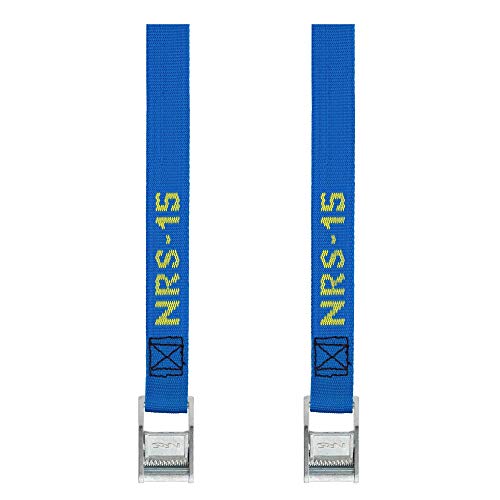
You'll use cam straps constantly, for the roof rack, for lashing gear in the canoe, and for securing to a tree at camp. NRS's straps are the paddling industry standard: the buckle locks cleanly, doesn't vibrate loose at highway speeds, and the webbing holds up to years of UV exposure. Buy a 2-pack of 15-footers and keep one in the car as a backup.
What we like
Buckle locks cleanly and doesn't vibrate loose at highway speeds
Webbing holds up to years of UV and saltwater exposure
What to know
Any decent cam strap works for foam blocks; upgrade to NRS once you paddle regularly
The canoe doesn't reward strength — it rewards patience. Let the paddle do the work, read the water before you fight it, and find your rhythm with a partner. Here's what your first weekend on the water actually looks like.
Canoeing has a reputation for being straightforward — and it is, mostly. A few hours on a calm lake and you’ll be competent. But “competent” and “comfortable” are different things, and the gap between them closes faster if you know what’s actually going on underneath the simplicity.
This is what your first weekend actually looks like: the two strokes you need on day one, the things that will go wrong, and the moments when the boat stops feeling like an obstacle and starts feeling like an extension of you.
Day one: Get in and start paddling
The instinct is to read about paddling before you paddle. Resist it. A canoe on flat water is stable enough for most adults to figure out in the first ten minutes, and the mistakes you’ll make on day one teach you more than any YouTube video.
Here’s the minimum to know before you push off:
How to sit: In a tandem canoe, the stronger or more experienced paddler takes the stern (back seat) — they control direction. The bow paddler (front) sets the power pace. Both of you sit upright, not hunched. If you lean too far to one side, you’ll tip — but you have to lean hard. Canoes are more stable than they look.
The forward stroke: Plant the blade fully in the water, pull it straight back alongside the hull, and exit cleanly before it passes your hip. That’s it. Don’t scoop water backward — you want a clean, efficient pull, not a splash. The paddle enters the water quietly and leaves quietly.
The J-stroke: This is the stern paddler’s most important tool. Without correction, every forward stroke causes the canoe to turn away from the paddle side. The J-stroke adds a small outward push at the end of the stroke — tracing a J shape — that corrects the direction without switching sides. It takes a session to feel intuitive and a few sessions to look clean. Start practicing it immediately.
Nobody gets through day one without these. Know them in advance and they’ll bother you less:
Paddling on the same side: In a tandem, the natural instinct is for both paddlers to switch sides when the canoe starts turning. This works but is exhausting and inefficient. The stern paddler should be using the J-stroke to maintain direction so the bow paddler rarely has to switch. If you’re switching every 10 strokes, the stern paddler’s technique needs work — not the boat.
Fighting the wind instead of angling into it: Wind is the main adversary on open lakes. A canoe broadside to the wind turns like a weather vane and drifts sideways. The fix is to angle slightly into the wind — 10 to 20 degrees — and paddle diagonally across. You’ll cover the same distance and fight far less.
Overloading the stern: If the stern paddler is significantly heavier, the bow lifts and catches wind. Try to balance weight or add a small amount of ballast (a dry bag of gear) in the bow. A balanced canoe tracks better and responds faster.
Stopping to argue about technique: Two people in a canoe will have opinions. Agree in advance: the stern paddler calls direction and the bow paddler calls obstacles. Everything else can wait until you’re on shore.
Day two: Paddling strokes worth knowing
Once the forward stroke and J-stroke feel automatic — which usually happens mid-day-two — two more strokes open up a lot of maneuverability:
The draw stroke: Plant the blade flat in the water about two feet to the side of the canoe, then pull the blade directly toward the hull. This moves the canoe sideways without turning it — exactly what you need to sidle up to a dock, avoid a rock, or park next to another canoe. Both paddlers doing a draw stroke on the same side moves the canoe smoothly sideways.
The pry stroke: The opposite of the draw. Place the blade against the hull, angle it outward, and push it away. This pushes that end of the canoe away from the blade side. Useful when you’re pressed against a dock or bank and need to push off cleanly.
You won’t use the draw and pry constantly, but the first time you’re trying to land cleanly without bumping into something, you’ll be glad you know them.
Most people have a specific moment on day two when the canoe stops being a thing they’re managing and starts being something they’re driving. It usually happens when the J-stroke starts to feel unconscious — you stop thinking “push out at the end” and just do it, and the canoe tracks straight without intervention.
When that happens, you start noticing other things: the water’s color changing over shallow sandbars, the way the canoe responds to a slight lean, the difference between dead flat water and water with a barely perceptible current. The boat quiets down and becomes transparent.
This is when canoeing becomes addictive for most people. You stop thinking about the mechanics and start thinking about where you’re going.
A few things that accelerate this transition:
Paddle a solo canoe, even briefly. Sitting in a solo canoe for an hour — responsible for all the correction yourself — teaches you more about boat control than six hours in a tandem. You’ll come back to the tandem feeling dramatically more in control.
Find a gentle current. Even a slow river is a different experience than a lake. Current requires you to read the water and make decisions — where to point, how to ferry across, when to back-paddle. This turns a pleasant float into an actual skill session.
Pick a destination. Paddling to a specific spot — an island, a campsite, a lunch beach — changes your relationship with distance. You stop counting strokes and start reading the map.
After a weekend you’ll be functional. After a month of regular paddling, you can be genuinely good at flatwater canoeing. The things worth focusing on:
Consistent J-stroke: If you can hold a straight line for 10 minutes without switching sides, you’re there. If you’re still switching every 30 seconds, the J-stroke needs more reps.
Reading water: Even on flat lakes, there’s texture — wind shadows, current lines near inlets, color changes over sandbars. Learning to read it is half the joy of the sport.
Loading and landing: Getting in and out of a canoe cleanly, loading gear without destabilizing the hull, and pulling up to a bank without drama. These are daily skills and they get smooth with practice.
Planning a longer trip: Once you can comfortably paddle 4–6 miles, start planning your first overnight trip. Canoe camping is one of the great outdoor experiences. The BWCA, Quetico, Adirondacks, and countless state parks all have established canoe routes with water-access campsites.
Save your money
What you don't need yet
Beginners get pressured to buy a lot of stuff that doesn't help them play
better. Here's what we'd skip on day one.
A Kevlar or carbon fiber canoe — Lighter and faster, but they crack on rocks and cost $2,000+. Start on poly, learn what you like, then decide.
A canoe cart — Useful for long carries, but most beginners launch within 50 yards of the car. Add this when you find your regular put-in is a quarter-mile haul.
A bilge pump — On flatwater you won't ship enough water for a pump to matter. A sponge handles any splash. Pumps are for whitewater.
An anchor — Unless you're fishing from the canoe, you'll just pull to shore when you stop.
A canoe sail kit — Genuinely fun on big lakes when the wind cooperates. Year two, maybe.
Expensive composite paddles for your whole group — One good paddle for the stern paddler makes sense. Buy cheap paddles for guests and occasional bow paddlers; nobody on day one can tell the difference.
First week
Your first seven days
A short, real plan to get from gear-on-doorstep to actually playing.
Rent a canoe for a half-day before you buy anything. · Action
Look up local paddling clubs; most ACA-affiliated clubs run beginner paddle days where you can try boats and get free instruction. · Action
Pick your first water carefully: a calm lake or slow river with no current. Save moving water for after you're comfortable. · Action
Search Facebook Marketplace and Craigslist for used canoes before buying new. A solid used canoe is usually $200–400. · Action
FAQ
Common questions
Is canoeing hard to learn?
On flatwater, no; most beginners feel comfortable within the first couple of hours. The J-stroke (keeping the canoe tracking straight) takes a session or two to get intuitive. Moving water is a genuinely different skill set and should wait until you're confident on flatwater.
Solo vs. tandem: how do I decide?
90% of beginners want a tandem. If you'll almost always paddle with a partner or family, get a tandem. If you'll paddle alone most of the time, a solo canoe is worth the investment. A tandem solo-paddled from the center is doable but inefficient and frustrating in wind.
Do I need a roof rack to transport a canoe?
No; foam block carriers work on any car and cost under $50. They require careful strapping, but thousands of paddlers use them successfully for years. A proper roof rack makes loading easier and is more secure at highway speeds, but it's not required to start.
How much does it cost to get started?
Buy used and you can be paddling for $400–600 all in. Buy new entry-level and budget $800–1,100. The canoe itself is the variable: everything else (paddle, PFD, transport, dry bags) runs under $200 combined.
Is canoeing safe for kids?
Yes, with properly fitted PFDs and calm water. A child's PFD must fit them; an adult PFD on a child can flip them face-down. Get a correctly sized kids' PFD and seat kids low in the center of the canoe. Most kids take to canoeing immediately.
What's the difference between a canoe and a kayak?
Canoes are open-top with bench seating; you use a single-bladed paddle and kneel or sit upright. Kayaks have a cockpit, you sit low, and use a double-bladed paddle. Canoes carry more gear and are more family-friendly; kayaks track better in wind and are more efficient on open water.
American Canoe Association — The national governing body for paddling sports. Find local clubs, certified instructors, safety courses, and water trail information here first.
Paddling.com — Trip reports, gear reviews, and the most comprehensive canoe route database in North America. Essential for finding water near you.
Canoe & Kayak Magazine — Long-running publication with gear reviews and trip planning content. Gear reviews skew experienced, but technique and route content is broadly useful.
National Water Trail System — NPS database of designated water trails across the US. Good for finding established canoe routes near you with public put-in access.
r/canoeing — Active community with honest gear advice, route recommendations, and trip reports. Check the wiki before posting a beginner question.
Boundary Waters Canoe Area Wilderness — The BWCA in northern Minnesota is the most iconic canoe country in North America. If you fall in love with the hobby, this is the trip you plan toward.
As an Amazon Associate, JustBeginning earns from qualifying purchases.
We may also earn commission from other affiliate programs linked on this
page. Editorial recommendations are independent; we don't choose
products based on commission rates.
Product prices and availability are accurate as of the date and time
indicated and are subject to change. Any price and availability
information shown on Amazon at the time of purchase will apply.


 Best starter