Genealogy rewards curiosity more than money. A $99 DNA kit and a free FamilySearch account will unlock more family history than most people find in a lifetime. Here's what to buy, in what order, and what you can skip until year two.
By Colin B. · Published June 14, 2026 · Last reviewed June 14, 2026
A DNA kit alone is $99. Add six months of Ancestry.com and you're at $250 — that covers most of what a first-year researcher needs.
We earn commission on qualifying Amazon purchases — see our
affiliate disclosure.
Price tiers and budget totals shown above are editorial estimates;
actual Amazon prices vary.
At a glance
Our top pick in each category
The fastest path through this guide — each best-starter pick by category.
Scroll for the budget and upgrade alternatives.
Talk to your oldest living relatives before you spend a dollar. The names, birth towns, and family stories they carry — and might never say unless asked — are the foundation of everything. Write it down. Ask them to check your spelling of names.
FamilySearch.org is free and has digitized billions of historical records. Sign up and poke around before deciding what paid subscription you need. Many people find their great-great-grandparents on FamilySearch without spending anything.
Buy one DNA kit, not three. AncestryDNA is the right default for most people (largest database). After you receive your raw data, you can upload it to MyHeritage and FamilyTreeDNA for free — no need to test separately with each company.
Your DNA test is the foundation of modern genealogy. AncestryDNA, 23andMe, and MyHeritage all use autosomal DNA — testing across all your family lines, not just one parent's side. The differentiator that matters most is database size: Ancestry has 25+ million testers, 23andMe has ~15 million, MyHeritage has ~7 million. More testers means more cousin matches, and more cousin matches means more documented trees to connect to. Test once with Ancestry, then upload your raw data to other services for free.
DNA Test Kits — what's the difference?
A few common shapes, each making a different trade.
Autosomal DNA
Tests all your family lines at once. The default starting point for every new genealogist.
Who can test
Anyone
Cousin range
1st–5th cousins
Family lines
All branches
Best for Most beginners — the default approach for finding cousins and ethnicity
Tradeoff Results thin past 5th cousins; can't isolate a single family line
Traces only your direct paternal line (father's father's father...). Males only.
Who can test
Biological males
Line traced
Direct paternal
Best use
Surname research, paternal haplogroup
Best for Deep surname research or confirming a specific paternal lineage
Tradeoff Only one line of your family; FamilyTreeDNA is the main provider, not on Amazon
mtDNA
Traces only your direct maternal line (mother's mother's mother...). Anyone can test.
Who can test
Anyone
Line traced
Direct maternal
Best use
Ancient migration, maternal haplogroup
Best for Tracing maternal ancestry or researching specific ethnic migration paths
Tradeoff Mostly useful for deep ancient ancestry; fewer genealogy-era cousin matches
Best starter
AncestryDNA
Genetic Testing Kit
$99.00 as of Jun 22, 2026
★★★★★Our rating· In Stock
The largest DNA matching database in the world — 25+ million testers, compared to ~15 million at 23andMe. More matches means faster cousin finds and more documented family trees to connect to your own. The ethnicity estimate is accurate and updates automatically as the reference panel expands. If someone in your family has already tested anywhere, it was probably here.
What we like
Largest DNA database, 25+ million testers worldwide
Ethnicity estimates update as Ancestry expands its reference panels
DNA matches link directly to family trees and Ancestry's record database
What to know
Meaningful cousin features require a paid Ancestry subscription
6-8 week turnaround, the longest of the major providers
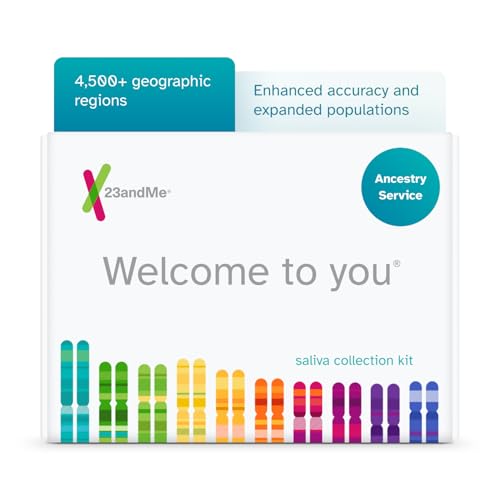
The second-largest database with the most polished interface for exploring results. The chromosome browser and haplogroup reports are included in the base Ancestry + Traits tier — features Ancestry charges extra for. If health information matters to you alongside family history, 23andMe's health upgrade is available at any time from the same kit.
What we like
Chromosome browser and haplogroup reports included in base tier
Second-largest database with excellent result visualization
Optional health upgrade available from the same DNA sample
What to know
Smaller cousin matching pool than AncestryDNA for genealogy
Data sharing policy involves third-party opt-ins; read consent carefully
MyHeritage has disproportionately strong European coverage — especially Eastern Europe, Scandinavia, and the Mediterranean. If your family roots are there, many cousins in those regions tested exclusively here. You can also upload raw DNA from AncestryDNA or 23andMe for free and immediately access MyHeritage's matching database without buying a second kit.
What we like
Strongest matching database for Eastern and Southern European lineages
Free raw DNA upload from AncestryDNA or 23andMe
Access to their 20+ billion historical record collection
What to know
Smaller overall database than AncestryDNA or 23andMe
Most genealogy features require a paid MyHeritage subscription
You won't need a scanner on day one — most records are online. But once you start finding original documents worth preserving, a flatbed scanner produces far better copies than a phone camera: flat, color-accurate, no shadows or lens distortion. A portable wand scanner is for visits to archives, libraries, and county courthouses where flatbeds aren't available. The Epson V39 handles most needs at $60; the wand scanner travels with you to the sources.
Best starter
Epson
Perfection V39 Color Photo and Document Scanner
$126.00 as of Jun 22, 2026
★★★★★Our rating· Only 1 left in stock - order soon.
Scans at 600 dpi — archival-quality for photos, certificates, and handwritten letters. USB-powered with no separate power brick, compact enough to leave on a desk. The image quality genuinely outperforms a phone camera for flat documents, and at around $60 it's the standard recommendation in genealogy communities.
What we like
600 dpi produces archival-quality images of photos and documents
USB-powered, no separate power brick — stays on a desk ready to use
Noticeably better than a phone camera for flat documents and old photos
What to know
Max scan size 8.5x11; larger items need stitching or a different tool
Slow at high resolution — not for scanning boxes of 100+ documents
Battery-powered and handheld — take it to a county courthouse, historical society, or library archive where flatbed scanners aren't available. Scans directly to a microSD card at up to 900 dpi. Genuinely useful for on-location genealogy research you can't do from home.
What we like
Battery-powered, no outlet needed — true on-location scanning
Saves directly to microSD card, no computer required
300-900 dpi adjustable for different document types
What to know
Scan quality varies with hand speed; takes practice to scan straight
MicroSD card fills quickly at high res; bring a backup card
When you inherit a box of 200 family photos, the FastFoto handles the job in a fraction of the time a flatbed would take — up to 45 seconds per batch photo at 300 dpi. Designed specifically for photos (not just documents), with an automatic feeder built not to crease prints. Worth the investment if you're processing a large family photo collection in one sitting.
What we like
Automatic feeder handles batch photo scanning at high speed
Purpose-built for photos; gentler than standard document feeders
What to know
Expensive ($400+); only justified for large photo collection projects
Auto-feeder can snag fragile or curled originals; test first
Every original family document — birth certificates, old photographs, letters, military papers — is irreplaceable. Standard paper and plastic are acidic and will yellow and degrade on their own over decades. Acid-free archival materials neutralize that process. Photo sleeves handle pictures; page protectors in a 3-ring binder organize loose records; archival boxes protect fragile or oversized items. The cost is small. The alternative is watching things that can't be replaced for any price slowly crumble.
Best starter
Pioneer
Photo Albums Archival Quality 4x6 Photo Album
$22.99 as of Jun 22, 2026
★★★★★Our rating· Only 17 left in stock (more on the way).
A slip-in photo album in acid-free, PVC-free pockets — the straightforward answer for protecting family photographs. Holds 500 4x6 prints. If your primary archive materials are photographs, this is where to start. Refill pages are available separately so you don't need a new album when your collection grows.
What we like
Acid-free and PVC-free construction, safe for long-term photo storage
500 4x6 photo capacity in slip-in pockets
Refill pages available separately as your collection grows
What to know
4x6 only; 5x7 and larger prints need a different album
Slip-in pockets hide photo backs; must remove photos to read annotations
Acid-free, archival-safe page protectors for standard 8.5x11 documents — birth certificates, marriage records, census printouts, anything you'd put in a binder. Fits any standard 3-ring binder so you can organize records chronologically by family line. The cheapest effective start for protecting paper records.
What we like
Archival-quality, acid-free material protects documents for decades
Fits any standard 3-ring binder for easy chronological organization
What to know
Top-loading only; documents slide if binder tips forward
Letter size only; oversized documents need separate archival boxes
Most beginners start with a DNA kit and no plan. Here's how to actually build a family tree in your first four weeks — what to search, who to call, and when records start talking back.
Genealogy has a problem other hobbies don’t: it looks like it starts with buying something, when it actually starts with a phone call. The best genealogical research in the world begins with the living people who already have the answers you’re paying a database to find.
Before you order a DNA kit, call the oldest person in your family. Ask them where their grandparents were from. Ask for maiden names. Ask what languages were spoken in the house. Ask what they were told and never told anyone else. Write everything down.
You’re not ready to research until you’ve done this. Go make the call.
Week 1: Build the foundation for free
Once you have what your living relatives know, start with the tools that cost nothing.
FamilySearch.org is the most underrated resource in genealogy. It’s completely free, run by the LDS Church as a public service, and has digitized billions of records across 100+ countries. Census records, vital records, immigration documents, church registers — often indexed and searchable by name. Set up an account, enter your grandparents’ names, and search. Many beginners find their great-great-grandparents on FamilySearch without spending a dollar.
Start with yourself and work backward: your parents, their parents, their parents. Enter every name you know with birth years and locations. Leave blanks where you don’t know — the blanks are what research fills in.
The most common mistake in week one is building wide instead of deep. Don’t chase 50 distant cousins. Chase your direct line — one person at a time — as far back as you can go.
Week 2: Order your DNA kit and start the paper trail
Order your AncestryDNA kit at the start of week two. Results take 6-8 weeks, so the sooner it’s in the mail, the sooner the data starts working for you.
While you wait, start building in the documented record systems:
U.S. Census records are the backbone of American genealogy research. Every ten years from 1790 to 1940 (the 1950 census was released in 2022), the federal government recorded every person in every household, with names, ages, relationships, and birthplaces. The 1940 census is often the starting point for working backward on 20th-century families.
Look for your grandparents’ parents in the 1900, 1910, or 1920 census. The age, birthplace, and “mother tongue” fields will tell you things nobody in your family may know they forgot.
Vital records — birth, marriage, and death certificates — are held at the state level and vary by accessibility. Many have been scanned and uploaded to FamilySearch or Ancestry. When online records run out, county clerks and state archives often have the paper originals.
Military records are available through NARA (archives.gov) and often through Ancestry. The WWI draft registration cards (1917-18) cover nearly every male in America between 18 and 45, and the information density is remarkable: employer, physical description, nearest relative.
Week 3: DNA results arrive — here’s what to do with them
Your AncestryDNA results land with a lot of information. Here’s the order that actually matters:
Ignore the ethnicity estimate for now. It’s interesting and will become more useful over time, but it’s not actionable for genealogy research in week three. The percentages shift as Ancestry updates its reference panel, and beginners frequently misread them as definitive.
Go straight to DNA matches. Your closest matches — first cousins, second cousins, half-siblings — are real, living people who share your ancestors. Many of them have built trees, and their trees contain your ancestors too.
Find a close match with a large, detailed tree. Look for the common ancestor you share. That common ancestor has descendants (including you and your match), and those descendants have a tree. Follow it back.
The chromosome browser matters eventually. If you care about pinpointing which specific ancestor you share DNA with, the chromosome browser (available on 23andMe and GEDmatch) lets you see exactly which segments of DNA you share with each match. Don’t worry about it in week three. Understand your matches first.
If you’re not finding first or second cousin matches right away — common for people with smaller extended families or ancestors from populations with thin database coverage — don’t panic. The match pool grows every day as more people test.
Week 4: Break your first brick wall
By week four you’ll almost certainly have hit a wall: a missing record, an ancestor who appears from nowhere, a surname spelled three different ways across different documents. This is where genealogy earns its reputation as a mystery to be solved, not a form to fill out.
A few tools for breaking through:
Name variants matter enormously. Before 1900, spelling was not standardized. “Schmidt” and “Smith” might be the same family. Vowels shift in transcription. Search for phonetic variants, not just exact matches.
Cluster research — looking at the neighbors, witnesses, and church members who appear alongside your ancestors in multiple records — often reveals extended family connections. People emigrated together, settled together, and served as witnesses for each other.
GEDmatch (gedmatch.com) is a free platform where people from different testing companies upload their raw DNA for cross-company matching. Useful when a relative only tested at 23andMe and you’re at Ancestry.
Local genealogical societies are still valuable. County societies often have indexes, transcriptions, and local knowledge that isn’t online anywhere. Most have email lists and welcome beginner questions.
Most beginners find three things in their first month: one ancestor they didn’t know existed, one record that contradicts what the family believes, and one wall they can’t get through yet.
The contradiction is actually a good sign. It means you’re finding real records, not just confirming what you already know. Family oral history is often wrong on specific dates, correct on relationships, and silent on the things that were shameful or hard. The records tell a different story.
The wall is just the work. Every genealogist has lines that go cold in a particular generation, in a particular place, for a particular reason — a destroyed courthouse, a country with poor civil registration, an ancestor who changed their name at the border. Learning to recognize when you’ve genuinely exhausted a source, versus when you haven’t looked hard enough, is the core skill.
At the end of month one, you’ll have a tree that’s at least partially documented, a DNA match or two you’ve corresponded with, and a list of exactly what you don’t know yet. That list is the research.
Save your money
What you don't need yet
Beginners get pressured to buy a lot of stuff that doesn't help them play
better. Here's what we'd skip on day one.
A second DNA kit from a different company — Upload your raw data from AncestryDNA to MyHeritage and FamilyTreeDNA for free. No need to test twice.
GEDmatch Tier 1 paid subscription — The free tier of GEDmatch gives you the most useful tools. Tier 1 is for advanced chromosome work you won't need for months.
A professional genealogist — At $75-200/hr, hire one only after you've genuinely exhausted online records and DNA matches yourself.
An international genealogy research trip — The records you'd travel to find are increasingly digitized and searchable from home. Plan the trip after you know exactly what you're looking for.
Photo restoration software — Free AI tools now handle most restoration work. Don't buy Photoshop or specialized software until you have a specific project that requires it.
First week
Your first seven days
A short, real plan to get from gear-on-doorstep to actually playing.
Call or visit your oldest living relatives this week. Ask for names, birth years, and birth towns — especially on the lines you know least about. Write everything down. · Action
Set up a free FamilySearch.org account and search for every name you just collected. · Action
FamilySearch · Free, billions of records, no subscription needed
Order your AncestryDNA kit so it arrives early in the week. · Buy
Start a free 14-day Ancestry trial while you wait for your DNA results. Enter what you know — start with yourself and work backward to grandparents. · Action
Check Find A Grave and BillionGraves for any relatives you've identified — obituaries often contain names, dates, and family relationships that aren't in other records. · Action
Find A Grave · Free memorial database, searchable by name and location
Join r/Genealogy. Post a 'where do I start?' question if you're stuck — the community is excellent with beginners. · Action
r/Genealogy · Active community, weekly beginner threads
FAQ
Common questions
Which DNA test is best for beginners?
AncestryDNA. It has the largest database by a significant margin — 25+ million testers compared to 23andMe's ~15 million. More testers means more cousin matches, and cousin matches are how you break through genealogy brick walls. After you receive your AncestryDNA results, upload your raw data to MyHeritage and FamilyTreeDNA for free to expand your reach.
Do I need a paid subscription to get started?
No. FamilySearch.org is completely free and has billions of records. Start there, enter what you know, and see how far free resources take you. Add a paid Ancestry subscription when you've hit walls that free records can't break through — which usually happens within the first month of active research.
How far back can I trace my family tree?
With a combination of DNA and documentary records, many people can reach the 1700s or earlier in well-documented lines. In practice, most researchers hit brick walls in the mid-1800s on at least one line — either because records weren't kept, were destroyed, or haven't been digitized. Immigrant ancestors who came through Ellis Island are often easier to trace than families who stayed in rural areas with sparse records.
What if I'm adopted or don't know my biological family?
DNA testing is especially powerful in this situation. A DNA kit through AncestryDNA will match you with biological relatives who have tested, often including first or second cousins who can identify your biological family. The Search Squad and DNA Detectives Facebook groups specialize in helping adoptees navigate this process.
Is my genetic information safe with DNA testing companies?
Each company has different policies. AncestryDNA and 23andMe both let you opt out of research sharing and delete your DNA sample after testing. Read the consent form before submitting — specifically look for what happens if the company is acquired. FamilyTreeDNA is the most researcher-transparent about data use.
Can my relatives see my family tree on Ancestry?
By default, Ancestry trees are private to you and anyone you invite. You can make a tree public, which allows other researchers to see it and attach it to their own — helpful for collaboration, but it means others can see living-relative data you've entered. Living individuals are automatically hidden in public trees, but review your privacy settings before going public.
FamilySearch — Free, run by the LDS Church, with billions of digitized records across 100+ countries. The first place to search for any ancestor.
National Archives (NARA) — The definitive U.S. source for military records, naturalization papers, census records, and federal court documents. Many available online; some require mail requests.
Find A Grave — Searchable memorial database with headstone photos and obituaries. Often contains names and relationships not found anywhere else.
r/Genealogy — Very active community. Excellent for brick-wall problems and 'where do I look for X records' questions. Check the wiki before posting a common question.
The Genealogy Do-Over (Thomas MacEntee) — YouTube series for researchers who want to build a solid, evidence-based research practice from scratch. Particularly useful if you've accumulated a messy tree and want to restart with better habits.
Ancestry.com Learning Center — Ancestry's own tutorials, organized by record type. Underrated as a starting point — the guides on reading census records and interpreting DNA results are genuinely clear.
As an Amazon Associate, JustBeginning earns from qualifying purchases.
We may also earn commission from other affiliate programs linked on this
page. Editorial recommendations are independent; we don't choose
products based on commission rates.
Product prices and availability are accurate as of the date and time
indicated and are subject to change. Any price and availability
information shown on Amazon at the time of purchase will apply.


 Best starter