Ice skating is one of those sports where the first session is genuinely awkward and the fifth is genuinely fun. The gear decision most beginners get wrong: which type of skate to buy. Here's how to pick right, what to grab for safety, and what to skip.
By Colin B. · Published May 23, 2026 · Last reviewed June 4, 2026
Decent recreational skates run $80–120. Add a helmet and wrist guards and you're at $150–200 total.
We earn commission on qualifying Amazon purchases — see our
affiliate disclosure.
Price tiers and budget totals shown above are editorial estimates;
actual Amazon prices vary.
At a glance
Our top pick in each category
The fastest path through this guide — each best-starter pick by category.
Scroll for the budget and upgrade alternatives.
Rent before you buy. Seriously. Most beginners aren't sure they'll love skating until they've been three or four times. Rink rentals run $5–8 per session and let you figure out what kind of skating you want to do before committing to $150 of gear.
Recreational skates, not figure skates. The white lace-up boots you picture when you think 'ice skates' are figure skates (stiff leather, designed for jumps and spins, with a painful 10–15 hour break-in). For casual skating and learning to glide, soft-boot recreational skates are more comfortable and easier from day one. Most beginners who buy figure skates wish they'd started with recreational.
Fit is everything. A skate that's even half a size too big will never feel right. Try on skates with thin athletic socks (not thick winter socks, which rob you of ankle feel). Your heel should be locked in place; your toes should have about a thumb-width of room. Ice skate sizes typically run 1.5–2 sizes below your street shoe size.
Skate selection is where beginners go wrong, and the wrong choice is almost always figure skates. Unless you're planning to take lessons in jumps and spins, recreational skates (soft-boot) are the right call. They break in within two sessions, are comfortable for multi-hour rink sessions, and the blade geometry is designed for forward gliding rather than edge work. Figure skates are better once you've committed to lessons; hockey skates are better if that's your path. Both are the wrong default first choice.
Skates — what's the difference?
A few common shapes, each making a different trade.
Recreational (Soft-Boot)
Comfortable, quick to break in. The right default for casual skating.
Boot
Soft foam/synthetic
Break-in
1–2 sessions
Blade
Flat, no toe pick
Best for Casual rink skating, fitness skating, beginners
Tradeoff Not appropriate for jumps, spins, or hockey skating
Jackson is the most respected name in recreational skating, and the Softec Vista is their workhorse beginner skate. Soft boot breaks in within two sessions. Mounted with a stainless Mark II blade, not the carbon-steel on cheap skates that rusts after one wet session. For most recreational skaters, this is the only skate they'll ever need.
What we like
Soft boot breaks in within two sessions, no agonizing break-in period
Mark II stainless blade won't rust after one wet session
Jackson's build quality is trusted by rink instructors nationwide
What to know
Less ankle support than leather figure boots; not for jumps or spins
Runs 1.5 sizes below street shoe; check the sizing chart before ordering
Riedell is one of the oldest American skate manufacturers, and the Soar is their beginner-friendly soft-boot recreational skate. Insulated, foam-backed velvet lining, smooth stainless steel blades, and a PVC outsole that holds up to rink wear. If the Jackson Softec is a 9 out of 10, the Riedell Soar is a solid 7 at a lower price, a sensible step before committing to the premium option.
What we like
Insulated lining, warm enough for cold outdoor rinks
Stainless steel blades standard: won't rust after one wet session
What to know
Sizes close to street shoe (not the usual 1.5 down); double-check their chart
Less structural support than the Jackson Softec for longer sessions
If you've decided you want to learn actual figure skating (axels, spins, footwork), this is the right beginner figure skate. Leather boot for real ankle support, mounted with a blade that has a toe pick for jump technique. More expensive and much harder to break in than recreational skates, but the right tool for the actual sport.
What we like
Leather boot provides real ankle support for jump and spin training
Toe pick blade geometry designed for actual figure skating technique
What to know
10–15 session break-in period with real blisters; budget for it
Wrong tool if your goal is casual rink skating rather than lessons
Falls on ice are different from falls on pavement: the surface is hard, unforgiving, and cold, and beginners fall a lot. A helmet is not optional. Any ASTM F1492 or CE EN 1077 certified helmet covers you; you don't need a specialty 'ice skating helmet.' A hockey or multi-sport helmet works perfectly. Look for one with ear coverage, since rinks are loud.
Best starter
Bauer
IMS 5.0 Hockey Helmet
$$
★★★★★Our rating
Bauer makes helmets for ice hockey players, and the IMS 5.0 is their proven entry-level bucket. HECC and CSA certified, solid protection, comfortable enough for two-hour sessions. The adjustable dial-fit system sizes precisely to your head. A no-fuss buy from a brand rinks trust.
What we like
HECC and CSA certified, overbuilt for recreational skating
Adjustable dial-fit system locks precisely to your head shape
Ear coverage standard (rinks are louder than most people expect)
What to know
Heavier than skate-park helmets, noticeable in a long session
No visor included; buy separately if you want face protection
Triple Eight's Sweatsaver is a well-regarded multi-sport helmet, ASTM certified for ice skating, under $45. The comfort liner lives up to its name. If you're also roller skating or inline skating, this helmet covers all three, one less piece of gear to buy.
What we like
ASTM certified for ice skating, inline, and roller; one helmet covers all three
Sweatsaver liner is genuinely comfortable for multi-hour sessions
What to know
Less ear coverage than hockey helmets; louder rinks are more noticeable
Plastic shell rather than composite; lower impact protection ceiling
You will fall. The two injuries beginners sustain most often are wrist fractures (from catching themselves) and hip bruises (from sitting down hard on the ice). Wrist guards are non-negotiable for your first ten sessions. Padded shorts are optional but genuinely useful if you're nervous (they hide under regular pants and absorb the falls that really hurt).
Best starter
187 Killer Pads
Pro Wrist Guards
$
★★★★★Our rating
187 makes the wrist guards trusted by aggressive inline skaters and skateboarders, offering a higher protection spec than most 'ice skating' branded guards at the same price. The double-splint design (palm and back of hand) is what actually prevents wrist fractures. If you're going to fall with your hands out (and you will), these are the guards to have on.
Hip and tailbone padding built into shorts that wear under regular pants. The falls that hurt most on ice aren't the dramatic wipeouts; they're the slow-sit-downs that drop you straight onto your hip bone. These absorb that impact without looking like hockey gear at the rink.
What we like
Hip and tailbone pads built in, targeting the most common painful fall
Wear under normal pants; nobody at the rink can tell you have them on
What to know
Run warm after 45+ minutes of active skating
Not a substitute for wrist guards; different injury, different tool
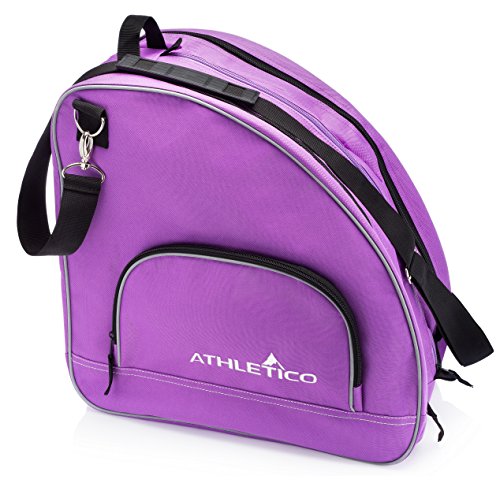
Your skates need to breathe after a session. Putting wet skates in a sealed gym bag is how blades rust and liners grow mildew. A dedicated skate bag has mesh ventilation, blade pockets, and room for your pads. You can also use a regular backpack; just let the boots air out at home before storing.
Best starter
Athletico
Ice Skate Bag
$25.00 as of Jun 22, 2026
★★★★★Our rating
Under $30, mesh ventilation panels on both sides, dedicated blade pockets, and enough room for a pair of skates plus guards and gloves. It's not glamorous, but it does the job. Athletico's skate bags punch above their price point.
What we like
Under $30 with actual mesh ventilation, prevents rust cheaply
Blade pockets keep guards separate from the boot liner
What to know
Carry handle only; no shoulder strap for longer walks
Zuca's rolling ice skate bag is what you see at every serious rink: it doubles as a seat at the boards, holds a full pair of skates plus pads and extras, and the open frame design lets your boots breathe. Not cheap, but if you're skating more than once a week, you'll use this bag for years.
What we like
Doubles as a seat at the rink boards, a feature skaters love
Frame design lets skates breathe in transit, no mildew risk
What to know
Expensive for a bag; overkill if you skate once a month
Two accessories every skate owner needs from day one: hard guards (plastic blade covers for walking on non-ice surfaces) and soakers (soft cloth covers that absorb moisture in the bag). Rule: hard guards on your feet while walking around the rink, soakers in the bag between sessions. Never swap them. Using hard guards on ice will instantly ruin your blade edge.
Best starter
Guardog
Spring-Loaded Blade Guards
$15.71 as of Jun 22, 2026
★★★★★Our rating· Only 1 left in stock - order soon.
Guardog makes the most widely used hard blade guards at rinks. Spring-loaded so they stay on without adjustment. The rubber-lined interior protects blade edges from cement, tile, and rubber flooring. Available in every size. The kind of thing you buy and forget about for years.
What we like
Spring-loaded; stays on without fumbling with buckles before your session
Rubber lining protects blade edge on cement, tile, and rubber surfaces
What to know
Never use on ice; guards will instantly ruin your blade edge
Size by blade length, not shoe size; measure before ordering
Terry cloth absorbs moisture from the blade after a session. Your blade's biggest off-ice enemy is moisture sitting on bare steel. A&R's soakers are the standard at hockey and figure skate shops: inexpensive, durable, the right tool for the job.
What we like
Terry cloth wicks blade moisture, preventing rust between sessions
The standard accessory at every hockey and figure skating shop
What to know
Need replacing when absorbency fades, typically after a full season
Easy to forget to swap; make it part of your post-skate routine
The first session is all falling and gripping the boards. The fifth feels like a different sport. Here's what actually happens in between, and what to focus on so you improve faster.
Ice skating has an unusual learning curve: the first hour is the worst it ever gets, and it improves fast from there. Most beginners who quit do so after a single bad first session that would have become a good fourth session if they’d just come back. The goal of this guide is to make sure you come back.
Session 1: Survive and observe
Your first goal is not to skate. It’s to stand on skates without holding the wall the entire time.
Lace your boots tight, especially around the ankle. Loose lacing is the #1 cause of wobbly ankles, and wobbly ankles make everything harder. Lace as tight as you can get them without cutting off circulation, and tie a double knot.
Step onto the ice and immediately put both hands on the boards. That’s fine. Everyone does this. Shuffle sideways along the wall for the first five minutes to get used to the blade-on-ice feeling. Then: push off gently with one foot, glide, regain balance. Push with the other foot. This is skating. You don’t need to do anything else in session one.
How to fall correctly: when you feel yourself going down, don’t fight it. Bend your knees, tuck your chin, and aim to land on your side rather than putting your hands out. Wrist guards make catching yourself with outstretched hands safer; the side fall is still better. To get back up: roll onto your hands and knees, put one skate flat on the ice between your hands, then push up. Don’t try to stand straight from a squat; you’ll just fall again.
The goal of session two is to make it from one end of the rink to the other without touching the boards.
Here’s the basic stride: push off the inside edge of one skate at roughly a 45-degree angle while gliding on the other. Your weight should always be over your gliding foot. The common mistake is pushing straight back (like walking) instead of out to the side. Think of it as pushing away from yourself, not behind yourself.
Keep your knees bent. Straight-legged skating is the beginner tell, and it’s also why you’ll lose your balance. Bent knees act as shock absorbers and keep your center of gravity lower and more stable.
Don’t worry about speed. Slow and controlled is the goal. Faster comes automatically once the balance improves.
By the end of session two, most people can cross half the rink without touching the boards. That counts as real progress.
Session 3: Your first stop
The T-stop is the first stop most beginners learn, and the one worth drilling before anything else.
To do a T-stop: glide on both feet, then drag the back foot sideways with the blade flat against the ice (forming a T shape behind your lead foot). The drag creates friction that slows you down. It’s not elegant. It works.
The other stop you’ll see is the snowplow: push both toes outward (pigeon-toed) to create resistance. Better for slower speeds, awkward above walking pace.
What you should NOT try yet: the hockey stop. The hard sideways skid where ice sprays dramatically. That’s a Session 10+ skill that requires edgework you haven’t built yet. Trying it early means falling hard on your hip.
Session 4: Turning and crossovers
By session four you can move in a straight line and stop. Now it’s time to turn.
The basic turn is a curve: just lean your body slightly in the direction you want to go, and your blades will follow. Ice skate blades have an edge, and leaning onto that edge naturally steers you. This feels strange at first but becomes instinctive within a session.
Crossovers are the move that makes skating feel like skating: to curve left, swing your right foot over your left and set it down outside your left foot, then bring your left foot back to the inside. It sounds complex; on ice, it’s a flowing rhythm. Most beginners get a rough version of crossovers by session five or six just from watching other skaters and trying it slowly.
One practical drill: skate in a large oval (most public session rinks have a track direction). Doing oval laps forces you to practice the same direction of crossovers repeatedly, exactly the repetition you need.
Session 5: When it clicks
Around session five, something shifts. The blades stop feeling like foreign objects under your feet and start feeling like extensions of your legs. You stop thinking about each individual motion and start feeling the ice.
You’ll have your first moment where you’re genuinely going somewhere (not just surviving) and enjoying it.
A few things that’ll cement the progress:
Find a rhythm. Skating to music (public sessions almost always play it) is genuinely useful, not just pleasant. The beat helps you regulate your stride cadence and stops you from taking frantic, off-balance steps.
Go slightly faster than comfortable. Counter-intuitively, a little more speed creates stability. Very slow skating requires more active balancing; a smooth glide lets momentum do some of the work.
Watch other skaters. Public sessions mix beginners with people who’ve been skating for years. Watch how a competent skater holds their arms (slightly out, relaxed, not flailing), how their knees stay bent in a slight athletic squat, how smoothly they shift weight. Watching for 60 seconds gives you more information than reading for ten minutes.
Looking down at your feet. Your balance point is your eyes: where you look is where you go. Look ahead, not at the ice.
Standing straight-legged. Bent knees cure most balance problems. If you feel wobbly, the first fix is always “bend your knees more.”
Trying to hockey stop too early. It looks cool; it’ll put you on your hip. Wait.
Skates that are too loose. Re-lace at the boards every few sessions. Boots stretch as they warm up.
Thick socks. Counter-intuitive, but thin athletic socks give you more ankle feel and better control inside the boot.
What to do after session five
You’ve got the basics. Here’s what actually accelerates progress from here:
One beginner group lesson. Learn to Skate USA programs (run at most rinks) cost $10–15 per session and are taught by certified instructors who will identify the two or three specific things holding you back. One lesson around session 6–8 is worth more than six solo sessions.
Find a regular time slot. Rinks have different session types: public skate (crowded, mixed levels), adult skate (less chaotic), and sometimes dedicated beginner ice. If your rink offers adult or beginner sessions, those are better learning environments.
Keep falling on purpose. Controlled practice falling (on carpet or off-ice) and getting up quickly removes the fear. The fear of falling is what keeps skaters stiff and stiff skaters fall more. Embrace the falls; they’re part of the sport.
Save your money
What you don't need yet
Beginners get pressured to buy a lot of stuff that doesn't help them play
better. Here's what we'd skip on day one.
A custom heat-molded boot — Heat molding is for competitive skaters. Standard sizing works fine for the first year or two.
A blade sharpening machine — Rinks sharpen blades for $8–15. You don't need your own until you're skating four-plus days a week.
A jump/spin harness — Relevant only for learning axels and lutzes under a coach; not relevant until structured figure lessons.
Figure skating dress or tights — Any athletic wear that moves freely works. Invest in skating-specific clothes once you're committed.
A Zuca bag — Worth it eventually, but the $30 Athletico bag does the same job until you're skating twice a week.
First week
Your first seven days
A short, real plan to get from gear-on-doorstep to actually playing.
Find your nearest indoor ice rink and check their public skate schedule. · Action
Practice one session on rentals, then switch to your own skates. Your own skates should feel noticeably better if you sized right. · Action
FAQ
Common questions
Should I buy figure skates or recreational skates to start?
Recreational (soft-boot) skates for almost everyone. Figure skates have a painful 10–15 hour break-in and are designed for jumps and spins, not casual gliding. Unless you're taking formal figure skating lessons, recreational skates are more comfortable and easier to learn on from day one.
How do I know what size ice skates to buy?
Ice skate sizes run 1.5–2 sizes below your street shoe. If you wear a men's size 10, start with a size 8–8.5 skate. Always use the manufacturer's sizing chart, since brands vary. When in doubt, try on in-store or order two sizes and return the one that doesn't fit.
Do new skates need to be sharpened?
Most skates from real brands come pre-sharpened and are ready to skate. After 10–15 hours of use, get them sharpened at a rink for $8–15. You'll notice when it's needed: turns feel harder and you sense you're slipping more than usual.
Is ice skating hard to learn?
The first session is humbling. Within three or four sessions, most people can glide, turn, and stop with reasonable confidence. The basic forward-skating skill curve is gentle; jump and spin skills take structured lessons and years of practice.
What should I wear ice skating?
Layers you can remove, since you'll warm up faster than you expect. Athletic pants (not jeans, which are miserable when wet from a fall), a light jacket or hoodie, and thin athletic socks. Thick ski socks fill the boot wrong and reduce ankle feel.
Can I use a bike helmet for ice skating?
Technically no: bike helmets are rated for single-impact and aren't certified for ice skating's slip-and-fall impact pattern. A multi-sport helmet (ASTM certified for ice skating) or a hockey helmet is the correct call.
Learn to Skate USA — US Figure Skating's beginner program, running at hundreds of rinks nationally. The best way to find structured beginner lessons near you.
US Figure Skating — The national governing body for figure skating. Includes a Learn to Skate rink locator and basic skills curriculum.
r/FigureSkating — Active community for recreational and competitive skaters. Good gear discussion and a wiki with boot recommendations.
r/iceskating — The more casual/recreational skating subreddit. Better for beginner questions that aren't figure-skating-specific.
As an Amazon Associate, JustBeginning earns from qualifying purchases.
We may also earn commission from other affiliate programs linked on this
page. Editorial recommendations are independent; we don't choose
products based on commission rates.
Product prices and availability are accurate as of the date and time
indicated and are subject to change. Any price and availability
information shown on Amazon at the time of purchase will apply.
Our top pickJackson Ultima Softec Vista Recreational Skate