Card and coin magic is one of the most rewarding skills you can learn, and one of the most underserved by beginner guides. You need almost nothing to get started, but what you buy and what you learn first matter enormously. Here's exactly what to buy, what to practice, and what to ignore.
By Colin B. · Published May 24, 2026 · Last reviewed June 18, 2026
Scotch and Soda Coin Set
— Scotch & Soda: the most astonishing two-coin effect you can learn and perform in a single afternoon.
Budget total
$40
Typical total
$90
A 12-pack of Bicycle cards and one good beginner book is under $30. Add Scotch & Soda coins and a close-up mat and you're fully equipped for around $90.
We earn commission on qualifying Amazon purchases — see our
affiliate disclosure.
Price tiers and budget totals shown above are editorial estimates;
actual Amazon prices vary.
At a glance
Our top pick in each category
The fastest path through this guide — each best-starter pick by category.
Scroll for the budget and upgrade alternatives.
Don't buy a toy store magic kit. The plastic gimmicks are cheap, teach you nothing about real technique, and impress nobody past age 10. The craft of magic is in sleight of hand and presentation, not in plastic props with visible seams.
Start with cards. A $6 deck of Bicycle cards is the single best magic investment you'll make. Every hour you put into card handling pays dividends across everything you learn afterward. You don't need fancy decks yet.
Learn one effect completely before moving to the next. The biggest mistake beginners make is learning the mechanics of ten tricks and performing none of them convincingly. One polished routine genuinely astonishes people. Ten half-baked ones do not.
Bicycle Standard is the professional choice, not because of any magic quality, but because it's what every professional has trained with. The paper stock handles well, ages predictably, and every sleight you learn was almost certainly developed on a Bicycle deck. Buy a 12-pack so you never ration practice because you're worried about wearing out your deck. When you're ready to perform for real audiences, Tally-Ho and Theory11 handle the same but look more intentional.
Card Decks — what's the difference?
A few common shapes, each making a different trade.
Practice Deck
Beat them up daily. Replace them often. No regrets.
Stock
Bicycle / Air-Cushion
Price per deck
~$3 in bulk
Best use
Daily drilling
Best for Beginners who need to practice for hours daily
Tradeoff Looks ordinary; deliberate for many effects
Bicycle Rider Back is the global professional standard for card magic, the deck every tutorial assumes you're using. Buy in bulk. You should be riffle-shuffling, overhand-shuffling, and false-cutting these so often that you wear out one or two decks before you perform. The 12-pack means you won't ration your practice.
What we like
The global professional standard, every tutorial uses these
12-pack lets you practice without rationing
Consistent stock and finish across packs
What to know
Nothing flashy, they look ordinary, which is intentional for some effects
Humidity softens the stock; store in a cool, dry spot
Tally-Ho has a slightly stiffer stock than Bicycle and fans more cleanly, the choice for many professionals when appearance matters. The Circle Back design reads as intentional rather than found-in-a-drawer. Once you have solid technique, these are the decks you bring to real performances.
What we like
Slightly stiffer stock fans and spreads cleaner than Bicycle
Circle Back design looks deliberate on camera and in person
What to know
Higher cost makes burning through practice decks feel expensive
Harder to find locally, primarily an online purchase
The Monarchs are where aesthetics and handling meet. Printed on Cartamundi stock, they feel excellent and look dramatic, especially on video. When you're shooting content or performing for someone who will notice the deck, these make a real impression. Same price as a coffee; the production values are miles ahead.
What we like
Cartamundi stock handles as well as Tally-Ho but looks far more dramatic
Gold foil court cards photograph strikingly on video content
What to know
Too precious for daily practice, you'll hesitate to crease them
Ships from online only; not available at local stores
Magic is one of the few skills where books remain the definitive learning format. The great texts (Royal Road, Expert at the Card Table, Card College) contain more usable technique per page than almost any video. Start with Royal Road: it teaches real sleights in the right order for a beginner, and graduates you smoothly from easy-but-impressive to techniques that take real work.
Best starter
Dover Publications
Royal Road to Card Magic
$13.93 as of Jun 22, 2026
★★★★★Our rating
Written by Jean Hugard and Frederick Braué, Royal Road has been the definitive entry point for card magic since 1948. It teaches the overhand shuffle control, the Hindu shuffle force, the double lift, and the pass, in the right order, with the right context. Every trick it teaches is actually worth performing. Read it cover to cover. Then read it again.
What we like
The definitive beginner text since 1948, every pro has read it
Teaches real sleights in the correct order for a beginner
Every included routine is actually worth performing
What to know
Formal, dated prose takes some adjustment
No video supplement, you must figure out positions from illustrations
Joshua Jay's book is the most complete starter magic resource in print, covering cards, coins, mentalism, and stage illusions. Where Royal Road goes deep on card sleights, Jay goes broad. Use this as a companion: Royal Road for card depth, Jay for everything else. The included DVD (some editions) is worth its weight for coin and rope effects that are hard to follow from illustrations alone.
At over 460 pages and under $25, Mark Wilson's compendium covers more effects than any other single beginner book. Dated in some respects but the fundamentals are timeless. Good as a second book after Royal Road, you'll recognize the techniques you already know and discover dozens you haven't tried.
What we like
Over 2,000 illustrated techniques across all magic disciplines
Under $25, the most pages per dollar of any magic book
What to know
Overwhelming for beginners, breadth over depth
Illustrations are black-and-white; some moves are hard to follow
Coin magic is the other pillar of close-up magic, and in some ways more visual than card work, because there's nowhere to hide. Gimmick coins are not cheating; they're how professional magicians achieve effects that would otherwise require superhuman sleight of hand. Start with Scotch & Soda: two ordinary-looking coins that transpose visually. Then add an expanded shell half dollar when you're ready for vanishes.
Best starter
Magic Makers
Scotch and Soda Coin Set
$$
★★★★★Our rating
Scotch & Soda is the classic two-coin transposition: a half dollar and a copper English penny that seem to change places, penetrate each other, and vanish. The effect is visually baffling and requires minimal sleight of hand. Most beginners can learn a basic Scotch & Soda routine in a single afternoon. This is the single best magic purchase that isn't a book or a deck of cards.
What we like
Learnable in one afternoon, impressive effect with minimal practice
Classic professional effect, not a toy-store gimmick
Compact; always in your pocket for impromptu performances
What to know
Cheap versions have loose fits that rattle, buy from a real magic store
Limited angles; audiences to the side may spot the gimmick
An expanded shell is a hollowed-out half dollar that fits over a real coin, enabling the classic vanish, production, and coin-through-hand effects. It's the most versatile individual gimmick in coin magic. Once you've worn out Scotch & Soda routines and want to go deeper, an expanded shell set opens up an entire catalog of effects.
What we like
Enables dozens of classic vanish and production effects
Machined to precise tolerances, good versions look identical to a real coin
What to know
Higher skill floor than Scotch & Soda, needs real technique to look clean
Angle-sensitive; crowds that surround you are challenging
Gimmick decks let beginners perform seemingly impossible effects (mind reading, impossible predictions, card revelations) with no sleight of hand. They're not a shortcut past fundamentals; they're a way to get into performing immediately while you're still developing real technique. The Svengali deck is the most versatile starter gimmick. The Invisible Deck produces one of magic's greatest reactions.
Best starter
Bicycle
Svengali Magic Deck
$9.99 as of Jun 22, 2026
★★★★★Our rating· Only 7 left in stock - order soon.
A Svengali deck alternates between normal cards and duplicate gimmick cards, letting you force any card, control any selection, and perform clean prediction effects with almost no technical skill. The most versatile single-effect deck in magic, and it looks and handles like a regular Bicycle deck. Buy one and learn three to five routines with it before moving on.
What we like
Most versatile gimmick deck, dozens of routines from one purchase
Looks and handles like a normal Bicycle deck in hand
What to know
Audible riffle if handled carelessly, requires deliberate practice
Advanced spectators have seen Svengali decks; serious performers move past it
The Invisible Deck is possibly the greatest single effect a beginner can perform. The spectator names any card they're thinking of, you fan the face-up deck, and their card is the only one reversed. The reaction is instant and overwhelming. It requires almost no sleight of hand and about five minutes to learn. Keep one in your bag at all times.
What we like
One of magic's most powerful effects; spectator names a card, it's reversed
Learnable in five minutes, performance-ready same day
What to know
Gimmick wears with heavy use; budget for occasional replacements
Effect works once per audience, memorable enough to warrant it
A Stripper deck is cut with tapered edges, any card returned to the deck can be stripped back out, even when the deck is shuffled by the spectator. It looks and feels like a normal deck and costs almost nothing. The go-to gimmick for 'find the selected card' effects that require zero technique.
What we like
Spectator can genuinely shuffle and you still control the card
Looks and costs the same as a normal Bicycle deck
What to know
Detectable to spectators who handle it attentively
Limited to locating/revealing effects, narrower than Svengali
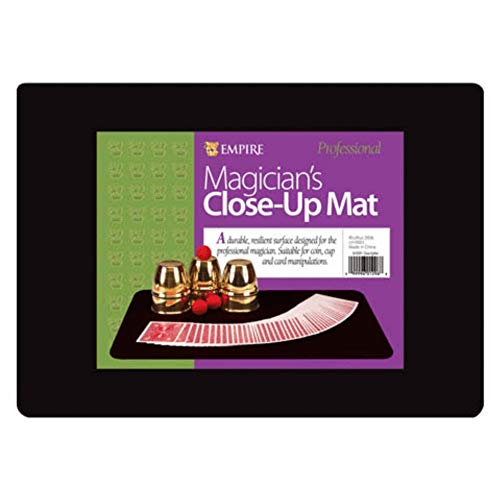
A close-up mat transforms your performance surface from slippery tabletop to a controlled stage. Cards don't slide, coins don't skitter, and the mat signals deliberateness, you came prepared. It's the difference between juggling on ice and juggling on carpet. Get one before you start performing for people.
Best starter
Magician's Supply
Close-Up Magic Performance Pad
$13.60 as of Jun 22, 2026
★★★★★Our rating· In Stock
The go-to close-up mat in magic supply stores. High-quality felt surface, non-slip rubber backing, and the right size for working cards and coins side by side. The black surface makes every prop and sleight more visible and controlled. Once you've practiced on a mat, bare tables feel impossible.
What we like
Felt surface grips cards and coins, eliminates sliding and scattering
Non-slip rubber backing means the mat stays put on any table
A card guard keeps your performance deck under pressure between sessions, preventing warping and maintaining the flat, crisp edges that make spread and fan work look clean. Professional card workers use these obsessively. It's a $6 piece of aluminum that dramatically extends the life of a $15 deck.
What we like
Prevents warping in humidity, extends premium deck life significantly
Slim and pocketable; takes zero space in a magic bag
What to know
Cheap versions bow the center of the deck if overtightened
Not necessary for practice Bicycle decks, buy this for performance decks only
Most people try to learn ten tricks and can't perform any of them. Here's how to actually get good: one effect at a time, with real technique from day one.
Close-up magic has a deceptive reputation. It looks like something you either have the hands for or you don’t. That’s wrong. The magicians you’re watching on YouTube spent three months learning one move, then six months learning to perform it naturally. The only difference between you and them is that they started.
This is what the first month actually looks like, week by week.
Week 1: One deck, one move, nothing else
Buy a 12-pack of Bicycle Standard cards and Royal Road to Card Magic. Put everything else on hold.
Spend the first week on a single skill: the overhand shuffle control. This is the ability to shuffle a deck and secretly return the top or bottom card to its position. It looks like an honest shuffle. It isn’t. This one move appears in a hundred different routines.
Here’s how to approach it:
Read the instructions in Royal Road once.
Do the move slowly in front of a mirror. You’re looking for angles: can you see the card returning to position? If you can, so can your spectator.
Practice for 15 minutes. Then put it down. Come back tomorrow.
The cardinal rule of learning magic: never practice past the point of fatigue. The moment your hands start getting sloppy, stop. Sloppy repetitions create sloppy habits. Fifteen focused minutes beats two hours of mindless shuffling.
By day five, you should be able to do an overhand shuffle control without thinking about it. That’s your goal for week one.
The Double Lift is magic’s most important move. You push two cards as one, the audience sees one card, you’re holding two. It enables an enormous number of effects: color changes, card transpositions, ambitious card routines.
Royal Road teaches it. Follow the book exactly on grip and angle.
The common mistake: rushing the lift. New students lift too fast, hoping speed compensates for a sloppy move. It doesn’t. A slow, confident Double Lift at the right angle is invisible. A fast, sloppy one is obvious regardless of speed.
Practice this in front of a mirror until you can’t see the second card. When it looks clean to you, it almost certainly looks clean to an audience. Spectators aren’t watching your hands as carefully as you think.
Your first real effect: Once you have the overhand shuffle control and the Double Lift, you can perform a card-to-pocket routine: the spectator names a card, you appear to shuffle it away, but it’s actually in your pocket. This is a complete, standalone piece of magic. Learn it from Royal Road and perform it for someone this week.
Not for a crowd. For one person. The nervousness of performing for a real human is something you can only train by actually doing it.
Week 3: Add coin magic
By week three, card technique is starting to settle in your hands. This is a good time to add Scotch & Soda coin work so your practice sessions rotate between the two.
Scotch & Soda is a gimmick, two specially constructed coins that enable a transposition effect requiring minimal sleight of hand. The basic effect: you show two coins, they change places, one appears to vanish. The reaction you’ll get is completely out of proportion to the skill required. That’s why it’s worth learning.
One important thing about coin magic: angles matter more than with cards. The audience must be in front of you. Practice in front of a mirror specifically looking to your left and right to find the angle where the gimmick is no longer invisible. Then perform only within that angle.
You don’t need to become a coin specialist. Learn one complete Scotch & Soda routine, about five to seven minutes of material, and perform it alongside your card work.
A “set” in magic is a sequence of two or three effects you perform together. By week four, you should have:
An opener, something visual that establishes you’re doing real magic. The Invisible Deck works well here; the spectator names any card, you fan the deck, their card is the only one reversed. It requires almost no technique and hits immediately.
A middle piece, your best card effect with genuine technique. The ambitious card is a classic: the spectator’s card rises to the top repeatedly, seemingly no matter where it’s placed. It showcases your sleight of hand.
A closer, something that leaves a final image. Scotch & Soda, well performed, ends with a coin visually changing into a different coin. It’s a strong visual button.
Three effects. Approximately eight to twelve minutes of material. That’s a set.
Now perform it. Perform it for a friend, a family member, a stranger at a party. The first few times will be rough. That’s expected and normal. Magic is learned in performance, not just in practice. The feedback you get from a live audience, where they look, when they react, what they miss, is worth ten hours of mirror work.
Every beginner hits the same walls. Here’s what they are and what to do:
You can’t stop thinking about the move. This is normal in the first two weeks. You’re in “conscious competence” (you know how to do it, but you have to think about it). The fix is repetition. The move needs to become automatic before you can think about your patter and your audience at the same time. Keep practicing until the move disappears from your conscious attention.
Your patter (what you say) is terrible. Most beginners say nothing, or they narrate what they’re doing (“now I’m putting the card in the middle”). That’s exactly wrong. Your patter is misdirection: it’s what you say to direct attention away from what your hands are doing. Talk about anything except the method: ask the spectator a question, comment on the card they chose, tell a one-sentence story. Watch professional magicians on YouTube specifically to study what they say, not just what they do with their hands.
The trick works, but the reaction is flat. Magic’s reaction comes from build and release: the audience needs to be invested before the reveal lands. If you’re doing the effect too quickly, add structure: have the spectator name their card, put it in their pocket, let them feel it in their own pocket before they look. Slow the reveal down. Give it a moment.
What to do at week five
Tighten your set. Every effect should be performable in your sleep. If you’re still thinking about the move, it’s not ready to perform.
Watch professional close-up magic. Ricky Jay, Lennart Green, and Juan Tamariz are the names to know. Watch them not to steal material, but to absorb what polished, unhurried magic looks like.
Find one other person who’s learning magic. Progress accelerates enormously when you have someone to show work to and get real feedback from. The Magic Café and local IBM rings are where to find them.
Save your money
What you don't need yet
Beginners get pressured to buy a lot of stuff that doesn't help them play
better. Here's what we'd skip on day one.
A toy-store magic kit — Plastic props with visible seams teach you nothing about real technique. Skip entirely.
Expert at the Card Table — S.W. Erdnase's 1902 masterwork on card cheating is the advanced technical bible. Read it after 200 hours, not before.
Expensive stage illusions — Sawing boxes and levitation rigs cost thousands and require an assistant. Close-up magic is more impressive in most social settings anyway.
Fanning powder — Looks impressive in videos, genuinely improves one-handed fans. Buy after you can already do a passable fan without it.
A custom gaffed card set — Double-face, double-back, and blank-face cards are endlessly useful, but only once you know what routines you're building toward.
First week
Your first seven days
A short, real plan to get from gear-on-doorstep to actually playing.
Buy a 12-pack of Bicycle Standard cards and Royal Road to Card Magic. · Buy
One solid effect is enough to perform for someone. Most beginners can learn the Double Lift and a clean card revelation in a week of consistent practice. The goal is to perform one thing well, not ten things passably. If you're practicing 20 minutes a day, you're ready for real performances within two weeks.
Do I need to learn sleight of hand, or can I just use gimmicks?
You can perform real magic exclusively with gimmicks, many professionals do. But sleight of hand is what allows you to perform with borrowed, ungimmicked objects, which is when reactions are most powerful. Royal Road teaches the essential sleights. Start there alongside your gimmick work.
What's the first card sleight I should learn?
The Double Lift (secretly turning two cards as one). It unlocks a huge number of effects and appears in most beginner routines. After the Double Lift, learn the overhand shuffle control. Both are covered in Royal Road in the correct order.
How much does it cost to get started?
Under $40 for a meaningful start: a 12-pack of Bicycle cards (~$20), Royal Road to Card Magic (~$12). Under $90 for a full starter kit that includes coin magic (add Scotch & Soda) and a performance surface (add a close-up mat).
Are gimmick tricks cheating?
No. Every professional magician uses gimmicks. The Invisible Deck, Scotch & Soda, and Svengali deck have all been used in professional, televised performances. The craft is in the performance, the patter, the experience you create, not in the method. Using good gimmicks is like using a sharp knife: the right tool for the job.
Where can I find a magic community or learn from other magicians?
The Magic Café (themagicafe.com) is the largest online magic forum. Vanishing Inc. has a free learning section alongside their store. Locally, many cities have a magic club through the International Brotherhood of Magicians (magician.org). Attending one is the fastest way to find a community and get real feedback on your work.
Vanishing Inc. Magic — The leading premium magic retailer with an extensive free learning section. Their 'Study' area has tutorials for many techniques. If you're buying coin gimmicks or gaffed cards, buy here for quality assurance.
52Kards (YouTube) — The best beginner card magic YouTube channel. Clear technique instruction for real sleights, not just tricks. Start here.
The Magic Café — The largest online magic discussion forum, active since 1997. Every technique, effect, and prop has been discussed in depth. Use Search before posting a question, it's almost certainly been answered.
Chris Ramsay (YouTube) — Excellent close-up magic and cardistry content. Shows what skilled performance looks like, useful for calibrating where you want to end up.
International Brotherhood of Magicians — The world's largest magic organization. Local rings in most cities host monthly meetings, attending one is the fastest way to find a community and get feedback on your work.
Conjuring Archive — Searchable database of magic books and periodicals by effect. When you're looking for the best source to learn a specific technique, start here.
As an Amazon Associate, JustBeginning earns from qualifying purchases.
We may also earn commission from other affiliate programs linked on this
page. Editorial recommendations are independent; we don't choose
products based on commission rates.
Product prices and availability are accurate as of the date and time
indicated and are subject to change. Any price and availability
information shown on Amazon at the time of purchase will apply.


 Best starter