RC cars are one of the most rewarding hobbies you can start for $200, but the first-purchase decisions matter more than almost any other hobby. Electric or nitro? 1/10 or 1/8 scale? Ready-to-run or kit? Basher or crawler? This guide cuts through the jargon so you drive in 20 minutes, not 20 hours of confused researching.
By Colin B. · Published May 23, 2026 · Last reviewed June 7, 2026
RTR electric car + two batteries + smart charger + basic tools. The car runs $150–250; batteries and charger add another $100–150.
We earn commission on qualifying Amazon purchases — see our
affiliate disclosure.
Price tiers and budget totals shown above are editorial estimates;
actual Amazon prices vary.
At a glance
Our top pick in each category
The fastest path through this guide — each best-starter pick by category.
Scroll for the budget and upgrade alternatives.
Buy electric, not nitro. Nitro cars have real glow-plug engines that sound incredible, but they require constant tuning, messy fuel, glow plug replacements, and a break-in procedure before your first run. Electric just charges and drives. 95% of beginners should start electric.
Buy RTR (Ready-to-Run), not a kit. Kits are full assembly projects requiring soldering, ESC programming, and radio binding before you ever drive. RTR cars arrive built. Save kits for year two.
Buy 1/10 scale for your first car. 1/8 scale is bigger, faster, and more expensive across every dimension: the car, the batteries, the parts. 1/10 scale has the largest community, the cheapest parts, and the most tutorials online.
The car is the most important (and most confusing) decision you'll make. Two things to get right immediately: buy electric (not nitro), and buy RTR (not a kit). Beyond that, the key split is between bashers (the default: parking lot, backyard, gravel) and crawlers (slow, technical, completely different hobby). Start with an electric 1/10 scale RTR basher from Traxxas or ARRMA. Their parts networks are the deepest in the hobby. When you break something, and you will, replacements arrive in two days.
Cars — what's the difference?
A few common shapes, each making a different trade.
Electric RTR Basher (1/10)
The default beginner choice. Charges like a phone, drives immediately.
Motor
Brushed electric (upgradeable)
Scale
1/10 (most common)
Setup time
~20 minutes
Best for First-time drivers, general outdoor bashing, parking lots and backyard
Tradeoff Brushed motors top out ~35 mph; upgrade to brushless when you want real speed
Slow, technical, obstacle-focused. A completely different hobby from bashing.
Speed
Walking pace
Scale
1/10 or 1/12
Terrain
Rocks, roots, steep inclines
Best for Outdoor explorers who prefer patience and precision over speed
Tradeoff Not interchangeable with bashing gear: choose your lane before you buy
Nitro / Gas RTR
Real glow-plug engine. More immersive, much more maintenance.
Fuel
Methanol/nitromethane blend
Sound
Loud: this is most of the appeal
Break-in
Required before first full run
Best for Hobbyists who specifically want the real-engine experience
Tradeoff Glow plugs, fuel, tuning, and break-in procedure: not a casual first choice
Best starter
Traxxas
Rustler 4WD RTR
$$$
★★★★★Our rating
Traxxas built the Rustler to survive beginners, and a decade later it's still the default recommendation. Four-wheel drive handles grass, gravel, and parking lots without setup. Waterproof electronics mean you don't have to baby it. Every part is stocked everywhere: when you break something, the replacement arrives in 48 hours. The included 2.4GHz TQ radio is solid.
What we like
4WD handles any surface without setup: backyard to parking lot
Waterproof electronics let you bash through puddles and rain
Traxxas parts network is the deepest in the hobby: never wait long
What to know
Brushed motor tops at ~35 mph; brushless upgrade needed for speed runs
Slightly pricier entry than budget competitors like ARRMA
At $150, the Granite Boost is the best-value beginner basher available. ARRMA's build quality punches well above the price: metal gearbox, durable drivetrain, Deans/T-plug connectors so any aftermarket LiPo drops right in. The brushed motor is fine for learning; upgrade to brushless in a year when you want more.
What we like
Best value beginner basher: solid ARRMA build quality at ~$150
Metal gearbox and durable drivetrain survive real beginner punishment
Standard T-plug connectors: any aftermarket LiPo drops right in
What to know
2WD loses traction in soft grass and loose terrain vs. 4WD options
Narrower parts ecosystem than Traxxas: some replacements take longer
★★★★☆Our rating· Only 3 left in stock - order soon.
When you've outgrown the starter car, the Kraton 4S is where serious bashers land. Brushless BLX motor, capable of 60+ mph on 4S LiPo. Built like a tank: aluminum chassis and composite arms handle jumps that would destroy most cars. Step up here only after you can drive a 1/10 scale car with confidence.
What we like
Brushless BLX motor delivers real speed for experienced drivers
Aluminum chassis and composite arms built for big air and hard landings
ARRMA 4S ecosystem has deep aftermarket support and upgrade paths
What to know
60+ mph on 4S: genuinely dangerous in the wrong hands
1/8 scale means bigger, heavier, and costlier parts than 1/10
LiPo (Lithium Polymer) batteries are the standard for electric RC cars, with higher discharge rates and better run times than the NiMH packs most entry cars ship with. Two things matter: voltage (2S = 7.4V for most beginners, 3S or 4S for brushless upgrades) and connector type. Buy two batteries from day one: one on the car, one on the charger. A 90-minute wait between runs is the most frustrating part of this hobby; two packs eliminates it entirely.
Best starter
Traxxas
Power Cell 2S 7600mAh LiPo
$$
★★★★★Our rating
If you bought a Traxxas RTR car, buy this battery. The iD connector is proprietary but smart: it carries cell chemistry data so the charger sets itself automatically. No manual configuration, no risk of charging at the wrong rate. High capacity delivers 25-30 minutes of drive time per pack. Buy two.
What we like
iD connector auto-programs charger: no risky manual cell configuration
7600mAh delivers 25-30 min per pack: above average run time
Plug-and-play with Traxxas RTR cars; no adapter needed
What to know
Proprietary iD connector locks you into the Traxxas charger ecosystem
More expensive per mAh than non-proprietary LiPo alternatives
A well-regarded budget LiPo brand with solid discharge rates and Deans/T-plug connectors compatible with most non-Traxxas cars. At $25–30 each, you can buy two packs immediately and eliminate waiting-around-for-charge entirely. Good for ARRMA, ECX, Redcat, and most RTR bashers using T-connectors.
What we like
Under $30: affordable enough to buy two packs from the start
Deans T-plug fits ARRMA, ECX, Redcat, and most non-Traxxas cars
50C discharge handles brushed and most entry brushless motors cleanly
What to know
Requires manual charger setup: no auto-detect connector
No-name LiPo warrants closer monitoring than brand-name cells
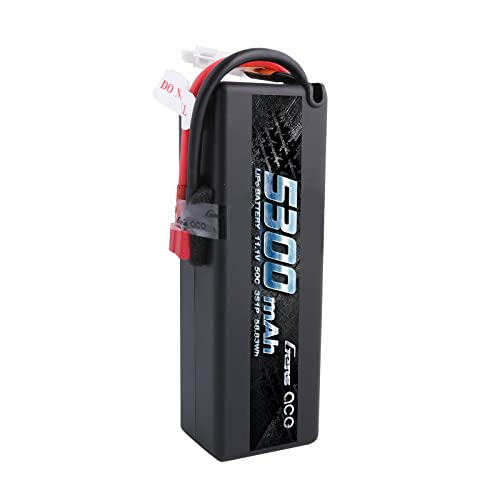
When you upgrade to a brushless motor or move to 1/8 scale, you need 3S (11.1V). Gens Ace is the most trusted quality brand in the enthusiast RC world: consistent cells, reliable discharge, and what experienced drivers recommend for brushless builds. Buy 3S only once your car is spec'd to run it.
What we like
Gens Ace is the most trusted name in enthusiast-grade RC LiPo
3S ready for brushless upgrades: no battery swap mid-build
What to know
Only useful once your car is spec'd for 3S: verify before buying
Overkill and potentially damaging in a brushed 2S starter car
The trickle charger included in most RTR boxes takes 3–4 hours per pack and tells you nothing about cell health. A smart balance charger charges in under an hour, monitors each cell's voltage independently, and stops automatically at full charge, preventing the overcharge that turns LiPo packs into fire hazards. This isn't a luxury upgrade. It's a safety item that pays for itself in time saved and packs not ruined.
Best starter
ISDT
Q6 Plus Smart Balance Charger
$$
★★★★★Our rating
The Q6 Plus charges any LiPo from 1S to 6S at up to 14A, balances every cell independently, and fits in your palm. The RC hobby has broadly standardized on ISDT for entry smart chargers: reliable, fast, and under $50. You'll need a 12V DC power supply to run it from a wall outlet; buy the bundle with the power supply.
What we like
Charges 1S-6S LiPo at up to 14A: works with any future car you buy
Per-cell balance monitoring catches degrading cells before they're a problem
Compact enough to throw in your RC bag for field charging
What to know
DC-input only: needs a separate AC power supply for wall use
Screen has no backlight: hard to read in direct sunlight
SkyRC's entry smart charger handles 1S–4S LiPo at 4A and runs directly from AC wall power, no external power supply needed. It won't win speed contests (90 minutes per standard pack), but it balances cells properly, has auto-stop-on-full, and costs under $30. A real safe charger that plugs into any outlet.
What we like
Plugs into AC wall power: no additional power supply purchase needed
Auto-stop at full charge and per-cell balance: genuinely safe
Under $30: real step up from the included trickle charger
What to know
4A max means ~90 minutes per pack: slow for back-to-back driving
Maxes at 4S; you'll outgrow it if you move to large 6S packs later
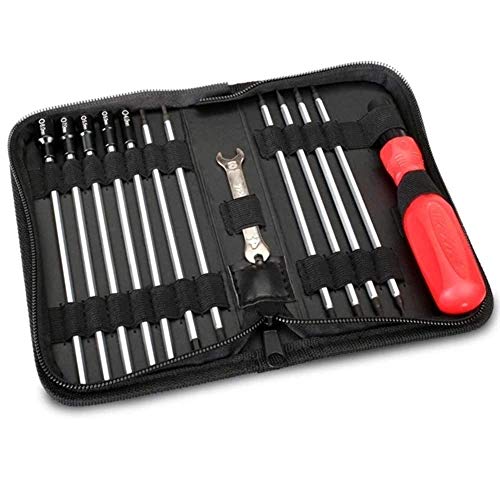
RC cars strip screws and break parts. The hobby is part driving, part maintenance, especially in the first month while you learn your limits. You don't need a full workbench, but you do need a set of metric hex drivers (1.5, 2, 2.5, and 3mm cover most cars) and something to deal with body clips. Buy the right tools before your first drive. You'll need them on your second one.
Best starter
Traxxas
5-in-1 Multi-Tool
$29.99 as of Jun 22, 2026
★★★★★Our rating
Traxxas's all-in-one hobby tool covers the five things you'll actually need at the field: 1.5mm and 2.5mm hex drivers, flathead, Phillips, and body clip pliers. Fits in a pocket, costs under $15, and handles 90% of trackside repairs on Traxxas cars. Non-Traxxas drivers should add a 2mm hex driver separately.
What we like
Five tools in one pocket-sized package: lives in your RC bag
Body clip pliers included: small but essential for trackside work
Under $15 and handles most field repairs on Traxxas hardware
What to know
Missing 2mm hex driver: add one separately for ARRMA and some Traxxas parts
Single-sided handles provide less torque than T-handle drivers
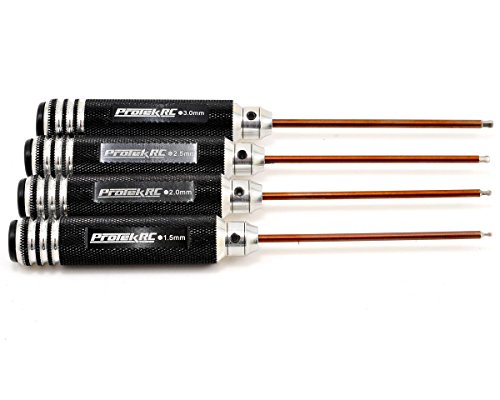
When you're doing real chassis work: swapping suspension arms, adjusting camber, replacing differentials, quality T-handle hex drivers make the difference between doing it cleanly and stripping screws. ProTek's comfort-handle set covers 1.5/2/2.5/3mm and the ergonomics hold up through a full bench session.
What we like
T-handle ergonomics reduce stripped screws during chassis and diff work
Covers 1.5/2/2.5/3mm: the complete metric hex set for RC cars
What to know
Too bulky for a driving bag: bench tool only
Overkill until you're doing real suspension and differential work
Tires are the first performance upgrade and the first consumable. Stock tires on RTR cars handle 20–30 hours of driving before they chunk and wear out, especially on asphalt. When it's time to replace, you'll feel it. For bashing on mixed terrain, Pro-Line all-terrain tires are the community standard. Buy by size (most 1/10 stadium trucks use 2.8" rear) and compound (M2 medium is the all-arounder).
Best starter
Pro-Line
Trencher HP 2.8" Belted Tires
$$
★★★★★Our rating
Pro-Line's Trencher HP Belted in 2.8" is the go-to replacement tire for 1/10 Rustler, Stampede, and similar stadium trucks. Belt-reinforced construction keeps them round at speed, with no wobbling at 40+ mph. The medium compound grips dirt and hard-pack without shredding fast on concrete. The upgrade that immediately makes your car feel better.
What we like
Belt-reinforced to stay round at speed: no wobble above 35 mph
M2 medium compound grips mixed terrain without chunking fast
What to know
Size-specific: verify 2.8" rear hex before ordering
Pre-mounted version adds cost vs. unmounted; check your wheel hex
Trencher 2.8" All-Terrain Tires for Stampede/Rustler
$
★★★★☆Our rating
When your stock tires wear out and you want a proven replacement, the Pro-Line Trencher 2.8" is the standard choice for Rustler and Stampede owners. Pre-mounted on black plastic wheels, fits perfectly, and costs less than specialty belted tires. Pro-Line quality at a budget price.
What we like
Pro-Line quality at budget price: the standard Rustler/Stampede replacement
Pre-mounted on wheels: bolt on and drive without any extra assembly
What to know
Not belted: may wobble above 40 mph compared to HP Belted version
Black plastic wheels may not match your car's color scheme
The most aggressive off-road tire Pro-Line makes for 1/10 scale. For bashers spending time in loose dirt, mud, and grass, the Badlands' deep knobby tread claws through soft ground that stops smoother tires cold. Buy these when you find yourself going off-road and running out of grip.
What we like
Deep knobby tread handles mud and loose dirt that flattens smoother tires
Pro-Line build quality: consistent compound batch to batch
What to know
Aggressive tread kills top speed on pavement: wrong tire for parking lots
Heavier than all-terrain tires; noticeably affects handling at speed
LiPo batteries store enormous energy. A punctured or overcharged cell can catch fire, and it happens fast. A $15 safety bag is not paranoia; it's insurance. Beyond that, a car stand makes maintenance infinitely easier (no more balancing your car on its nose to swap tires), and a small parts organizer pays off the first time you lose a 1.5mm screw on a concrete floor.
Best starter
Bat-Safe
LiPo Charging Safety Bag
$
★★★★★Our rating
The most important $15 you'll spend on this hobby. LiPo fires are rare but fast and they spread. The Bat-Safe contains thermal events in a fireproof hard enclosure, giving you time to react. Charge inside it, store puffed or damaged packs inside it. The Bat-Safe brand has been independently tested, not just marketed.
What we like
Independently tested fire containment: not just a marketing label
Hard-sided enclosure for real protection; fits standard 2S-4S RC packs
What to know
Hard case takes more shelf space than soft safety bags
Sized for one pack at a time: buy two if you're charging multiple packs
A pit stand holds your car stable upside down while you work: swapping tires, accessing the drivetrain, inspecting crash damage. Without one you're balancing the car on its antenna. The Duratrax Pit Tech Deluxe is the most widely available RC stand on Amazon, under $25, and you'll use it every session from day one.
What we like
Holds car stable for tire swaps and drivetrain work: hands-free
Under $25 and you'll use it every single session
What to know
Width-specific: verify 1/10 vs. 1/8 scale before ordering
Budget versions wobble; spend an extra $5 for a stable model
RC cars have a real learning curve in the first hour: setup, LiPo charging, and binding your radio. Once you clear that, the driving part is pure fun. Here's what to expect.
Most hobbies let you ease in. RC cars make you earn it a little. There’s a setup gauntlet between unboxing and driving that catches every first-timer off guard. Work through it once and you never think about it again. Here’s what that gauntlet looks like, what to do on the other side, and how the first weekend actually unfolds.
Before you drive: the setup hour
Your RTR car arrives assembled but not ready to drive. Before the first run, you’ll need to:
Charge the battery. If you bought a smart balance charger (which you should, see the gear guide), set the cell count to 2S, set the charge rate to 1C (so for a 5200mAh pack that’s 5.2A), put the pack in your safety bag, and plug in. An hour later, the charger beeps and cuts off. Never leave it unattended the first few times until you trust the setup.
Bind the radio. RTR cars usually arrive pre-bound from the factory, but not always. Binding takes about 60 seconds: power on the transmitter, hold the bind button, power on the car’s receiver, wait for the LED to stop flashing. Your manual has the exact sequence for your brand.
Check the pinion and spur gears. Not always necessary, but worth one look on a new car: open the motor cover and verify the pinion and spur gears mesh without grinding. Most RTR cars ship correctly set; a handful don’t.
Install the body. Bodies clip onto the chassis with body clips (small R-shaped pins). They always go missing. Buy a small bag of spares.
That’s the whole setup. First-timers spend 45-90 minutes here because they’re nervous and over-read the manual. Once you’ve done it twice, it’s a 10-minute ritual.
Find a flat, open area with no pedestrians and good visibility. An empty parking lot on a weekend morning is ideal. Avoid grass for your first session: it hides rocks, creates unpredictable resistance, and drains your battery 30-40% faster than hard surfaces.
Start on low throttle. This is the part beginners uniformly skip and uniformly regret. Full throttle on an unfamiliar car in a confined space ends with the car in a wall, a curb, or someone’s feet. Give yourself five minutes of slow running to feel the steering response and throttle curve.
What you’ll notice immediately: How fast it feels even at 25% throttle. How wide the turning radius is (tighter than you expect at speed, wider at slow speed). How the car drifts its rear on loose surfaces. These all become second nature within 20 minutes.
The first crash is coming and it’s fine. Modern RTR bashers are built to crash. Traxxas and ARRMA both design their suspension arms to break before the gearbox does. Cheap plastic arms absorb impacts that would otherwise crack expensive metal. Your first broken arm is not a disaster; it’s a $5 part and a 10-minute repair.
When the battery voltage gets low, the car will slow noticeably: that’s the ESC’s low-voltage cutoff protecting your pack. Pull back to the pits, swap in the second battery, and keep going.
Something will break. It might be a body clip, a suspension arm, a steering servo saver, or a wheel hex. This is not a sign that the car is bad. It’s a sign you drove it, which was the point.
The repair process: Go to your car brand’s website and download the exploded-view diagram for your specific model. Every screw, arm, and gear has a part number. Search that part number on Amazon or at your local hobby shop. Most common parts are under $10 and arrive in two days.
The repair itself will take longer than it should the first time, and faster than you expect the second time. Within a month, you’ll be swapping suspension arms in under five minutes without looking up a tutorial.
A few things make repair sessions much smoother:
A pit stand. Flipping the car upside down and having it stay stable is the difference between a relaxed repair and a frustrating one. Under $25.
T-handle hex drivers. The multi-tool in your bag is fine for the field. For bench work, proper T-handle drivers give you the torque to not strip screws.
A parts organizer. The first time you lose a 1.5mm grub screw on a concrete floor you’ll understand why.
When it starts clicking
Most people hit a wall in the second or third session: the car feels squirrely, you keep crashing, and it doesn’t feel as fun as it looked. This is the standard beginner plateau, and it passes quickly.
What’s happening: your throttle control is ahead of your steering control. You’re applying more throttle than the grip level and turning radius can manage. The fix is deliberate: drive slower, use more of the lot, and practice smooth throttle input instead of bang-bang switches between full and zero.
By the end of weekend two, most people feel genuinely in control at moderate speeds. The car goes where you point it. You start setting up jumps. You start eyeing the grass with less dread.
That’s when the hobby takes hold. You start thinking about the next battery, the next upgrade, the next terrain. You join the subreddit and start following people’s build threads. You pull out your hex drivers to adjust something that wasn’t broken, just because you wanted to.
What comes next
Once you have 5-10 hours of driving and a repaired car or two, the hobby opens up in a few directions:
Brushless upgrade. A drop-in brushless motor and ESC combo transforms a 35 mph basher into a 55+ mph machine. About $80-120 depending on the system.
Rock crawling. If bashing feels too fast-twitch, crawlers are the meditative side of RC: slow, technical, obstacle-focused. Totally different gear.
Track racing. Many local hobby shops run weekly oval or off-road track nights. Competitive RC is its own deep rabbit hole.
The car in your garage right now will handle all of these entry points. Don’t buy anything new until you’ve driven what you have for at least a month.
Save your money
What you don't need yet
Beginners get pressured to buy a lot of stuff that doesn't help them play
better. Here's what we'd skip on day one.
Nitro car as a first purchase — Glow plugs, fuel mixing, break-in procedures, and constant tuning. Electric drives in 20 minutes. Nitro is a second hobby.
1/8 scale brushless speed run setup — 60+ mph RC car before you can drive a slow one is a fast way to destroy expensive gear. Learn on 1/10 first.
Racing suspension tuning kit — Camber gauges, ride height tools, and turnbuckle sets are for optimizing a car you can already drive consistently. Learn to drive first.
Gyroscope stabilizer — Stabilizers compensate for driver error. Use them on a crawler in extreme terrain, not as a crutch on a basher you're still learning.
Extra body shells in bulk — Your first body will get scratched but not destroyed. Wait to see what actually breaks before stocking spare parts.
First week
Your first seven days
A short, real plan to get from gear-on-doorstep to actually playing.
Order your RTR car and two battery packs at the same time. Two packs means you drive, swap, drive again: instead of watching a charger. · Buy
Read the LiPo safety section of your charger's manual before your first charge. Ten minutes now prevents the one scenario everyone dreads. · Learn
Find a flat open area: large empty parking lot, quiet cul-de-sac, backyard. Avoid grass for session one: it hides rocks and drains batteries faster. · Action
Join r/rccars. It's the fastest way to get setup help, gear advice, and crash post-mortems from people who have already broken what you're about to break. · Action
r/rccars · Active beginner-friendly community with a wiki and weekly help threads
FAQ
Common questions
Should I start with electric or nitro?
Electric, almost certainly. Nitro cars have real glow-plug engines that sound and smell great, but require break-in procedures, constant needle tuning, glow plug replacement, and fuel mixing before and during every session. Electric charges overnight and drives immediately. Start electric and buy nitro if and when the real-engine experience becomes the point.
What does RTR mean, and should I buy it instead of a kit?
RTR means Ready-to-Run: the car ships assembled with a motor, ESC, radio system, and servo installed. A kit is a box of parts you build yourself, including soldering electronics and programming the ESC. Kits are satisfying if building is part of the hobby for you. Otherwise, buy RTR.
How long does one battery charge last?
A typical 2S 5000-7600mAh LiPo gives 20-30 minutes of bashing. That's per-pack runtime. A full charge takes 60-90 minutes on a smart charger. Two packs is the standard solution: one in the car, one on the charger.
Is it hard to fix when something breaks?
Most common breaks: stripped screws, broken suspension arms, worn tires, are straightforward with the right hex drivers and $5-20 in parts. The RC community is good at documenting repairs, and YouTube has guides for most common Traxxas and ARRMA repair jobs. Fixing the car is actually part of the hobby for most people.
What scale should I start with?
1/10. It has the largest community, the cheapest replacement parts, the most tutorials, and the widest selection of RTR cars. 1/8 scale is bigger, faster, and more expensive across every dimension: fun to aspire to, not where you start.
Can I drive in rain or wet conditions?
Most modern RTR electric cars (Traxxas especially) have waterproof electronics and can handle wet grass, puddles, and light rain. Check your car's spec: 'waterproof receiver box' and 'waterproof ESC' are the key details. Avoid deep water and never submerge the car; salt water is particularly corrosive to metal drivetrains.
r/rccars — The most active beginner community. Read the wiki before posting; it covers most first-timer questions about gear, brands, and LiPo safety.
RCDriver Magazine — Long-running industry publication. Gear reviews, beginner guides, and build tutorials. More depth than YouTube for written reference.
RCTalk Forums — Forum-based community with brand-specific subforums. Good for brand-specific troubleshooting and upgrade advice.
Traxxas Support — If you buy a Traxxas car, their support library has exploded-view diagrams, part numbers, and video repair guides for every model.
ARRMA RC YouTube Channel — Official ARRMA channel: setup guides, feature overviews, and crash footage that tells you what the cars can actually handle.
As an Amazon Associate, JustBeginning earns from qualifying purchases.
We may also earn commission from other affiliate programs linked on this
page. Editorial recommendations are independent; we don't choose
products based on commission rates.
Product prices and availability are accurate as of the date and time
indicated and are subject to change. Any price and availability
information shown on Amazon at the time of purchase will apply.