Welcome to the most gear-intensive hobby on this site. Reef tanks are genuinely complex, expensive, and unforgiving, but the payoff is spectacular: a thriving reef with live coral glowing under your LEDs is one of the most beautiful things you can build in your living room. The community is obsessive and genuinely helpful. You'll fit right in.
By Colin B. · Published May 24, 2026 · Last reviewed June 14, 2026
Coralife BioCube 32 LED Aquarium Kit
— The BioCube 32 is the most reliable all-in-one starter reef: complete filtration, proven design, and room to grow.
AI Prime HD+ Reef LED Light
— AI Prime HD² is the reef world's go-to beginner LED: coral-proven PAR, programmable spectrum, compact footprint.
Reef tanks are among the most expensive hobbies to start. A nano all-in-one setup runs $600–900 all-in. A proper 40-gallon system with good lighting and a skimmer lands at $1,200–2,000. Ongoing monthly costs (salt, additives, testing, livestock) run $50–150.
We earn commission on qualifying Amazon purchases — see our
affiliate disclosure.
Price tiers and budget totals shown above are editorial estimates;
actual Amazon prices vary.
At a glance
Our top pick in each category
The fastest path through this guide — each best-starter pick by category.
Scroll for the budget and upgrade alternatives.
This is not a fast hobby. A new reef tank takes 4–8 weeks to cycle before you can add fish, and another 3–6 months before the chemistry stabilizes enough for sensitive corals. Rushing this is the single most common mistake beginners make, and it kills expensive livestock.
Start with an all-in-one tank in the 25–40 gallon range. Nanos under 15 gallons sound appealing (cheaper, less space) but smaller water volume means chemistry swings harder and faster, which means more deaths. Counterintuitively, a slightly bigger tank is easier for a beginner.
Join Reef2Reef before you buy anything. The community has product-specific advice, tank journals from people who built exactly your setup, and mistakes to avoid. An hour of reading there will save you hundreds of dollars and weeks of frustration.
The gear
What you actually need
Tank System
Your tank is not just a box: it's a complete life-support system. For reef tanks, the choice of tank determines every other purchase. All-in-one systems (AIO) have filtration built into rear or side chambers, making them the right starting point for almost every beginner. Sump-based systems add flexibility and equipment space but require more plumbing knowledge. Start with an AIO in the 25–40 gallon range: big enough to stay chemically stable, small enough to not immediately overwhelm you.
Tank System — what's the difference?
A few common shapes, each making a different trade.
Nano (under 25 gal)
Cheaper entry, but water chemistry swings fast (harder than it looks).
Volume
10–25 gal
Footprint
12–18"
Stability
Low
Best for Experienced reefers who want a desktop display
Tradeoff Chemical swings hit faster and beginner mistakes are amplified
All-in-One (25–60 gal)
The beginner sweet spot: stable chemistry, no sump plumbing needed.
Volume
25–60 gal
Footprint
18–36"
Stability
High
Best for First-time reef builders, soft corals, easy LPS
Tradeoff Less equipment space than a sump system, harder to expand later
★★★★★Our rating· Only 9 left in stock (more on the way).
The BioCube 32 is the reef tank beginners recommend on Reef2Reef almost without exception. Built-in filtration chambers, an included pump, and deep community documentation make it the lowest-friction way into the hobby. The included light won't grow demanding SPS corals, but for your first year of soft corals and easy LPS it's exactly right. Upgrade the light later; keep the tank for years.
What we like
Most well-documented AIO reef tank online, with setup videos for every scenario
Built-in back chambers keep equipment hidden from the display
32 gallons is big enough to absorb beginner chemistry mistakes
What to know
Stock light won't sustain SPS or demanding LPS corals
Return pump is undersized for heavy coral loads; many reefers upgrade it
The Reefer 170 is where experienced reefers say they wish they'd started. Rimless low-iron glass, a real sump with organized equipment space, and Red Sea's tight quality control make it a genuine long-term platform. If you know you'll be in this hobby for years and have the budget, this is the honest recommendation. Buy it once, grow into it forever.
What we like
Rimless low-iron glass is noticeably clearer than standard aquariums
Full sump keeps all equipment hidden below, giving a cleaner look and more flexibility
What to know
Tank-only: add $800–1,200 for light, skimmer, and return pump
Sump plumbing is a real project, not for first-time reef builders
Light is not optional in a reef tank: it's the energy source that keeps coral alive. Reef corals host symbiotic algae (zooxanthellae) that photosynthesize; the right light spectrum and intensity keep them fed and colorful. The wrong light bleaches or starves them. LED fixtures dominate the hobby now: programmable spectrum, low heat, long lifespan. The key metric is PAR (photosynthetically active radiation): soft corals thrive at 50–150 PAR; SPS corals want 200–400+.
Best starter
Aqua Illumination
AI Prime HD+ Reef LED Light
$$$
★★★★★Our rating
The AI Prime HD² is the first LED most serious reefers recommend to beginners. It runs on the MyAI app, schedules sunrise/sunset/cloud cover automatically, and produces genuine reef-grade PAR. For the BioCube 32 or similar AIO, one unit covers the tank well. The community shares proven light schedules online so you don't have to start from scratch.
What we like
Programmable to the hour: sunrise, sunset, and cloud effects included
Genuine reef-grade PAR sustains soft corals and LPS with ease
Huge library of community-shared light schedules to start from
What to know
Pricey for a beginner light at $250–300
Coverage drops on tanks wider than 24 inches; may need two units
If you're not ready to spend $250 on an AI Prime, the NICREW is the honest budget answer for a soft-coral reef. Blue and white channel control, acceptable PAR for mushrooms and zoanthids, and a price that won't sting if you upgrade in six months. Not for SPS or demanding LPS, but a fine training-wheels light while you're mastering the chemistry.
What we like
Keeps soft corals and mushrooms alive at a fraction of AI Prime cost
Good for learning the hobby before committing to premium lighting
What to know
Fixed spectrum with no programmable sunrise/sunset or intensity scheduling
When experienced reefers upgrade from an AI Prime, many land on a Kessil. The A360X's dense matrix LED design creates the shimmering light that mimics a shallow reef, an effect flat-panel fixtures can't replicate. A single unit covers a 24×24" footprint at full reef intensity, and the spectrum is tuned specifically for coral coloration.
What we like
Dense matrix LED creates the shimmering reef effect flat panels can't match
Single unit covers a full 24×24" footprint at reef intensity
What to know
Requires a separate Kessil Spectral Controller for scheduling (+$80)
Single point source creates shadowing that may not suit deep tanks
A protein skimmer pulls dissolved organic waste out of the water before it breaks down into ammonia and nitrate. In a reef tank with corals that need pristine water, a skimmer is nearly non-negotiable. It works by injecting fine bubbles into a reaction chamber, where organic waste clings to the bubble surface and gets collected in a removable cup. Most reefers consider a skimmer the second most important piece of equipment after the light.
Best starter
Reef Octopus
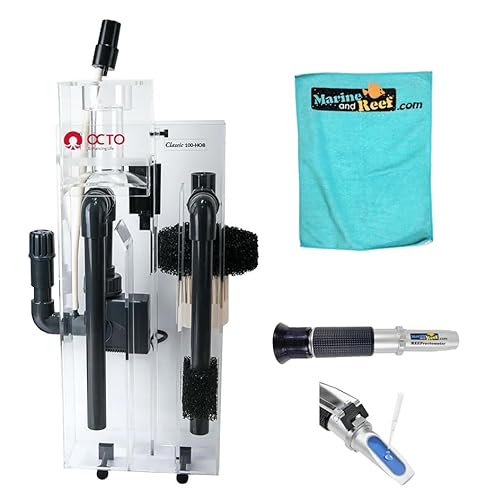
OCTO Classic 100-HOB Protein Skimmer Bundle (3 items)
$342.99 as of Jun 22, 2026
★★★★★Our rating· Only 3 left in stock - order soon.
Reef Octopus makes the protein skimmer that reef forums recommend first for hang-on-back setups. The Classic 100 needs no sump (it clips to the back of your tank) and produces consistent skimmate from week one. It's easier to dial in than most budget skimmers and works well on the BioCube 32 and similar AIOs up to 100 gallons.
What we like
HOB design: no sump required, clips to any standard AIO tank
Consistent skimmate from week one, easier to dial in than budget alternatives
What to know
Occupies space behind the tank; measure clearance before ordering
Louder than in-sump skimmers at equivalent performance
★★★★☆Our rating· Only 2 left in stock - order soon.
Once you have a sump, the Regal 150-S is the upgrade most Reef2Reef members recommend. Quieter than HOB skimmers, rated for tanks up to 150 gallons, and Reef Octopus's build quality is as good as anything at this price. The in-sump design adds water volume for stability and keeps it out of sight below the tank.
What we like
In-sump mount is quieter and more stable than HOB equivalents
Rated to 150 gallons with room to grow if you upgrade your tank
What to know
Sump required; not compatible with AIO tanks without modification
Break-in period of 1–2 weeks before skimmate production stabilizes
Corals need water movement to feed, breathe, and shed waste. Without enough flow, dead spots form where detritus accumulates, oxygen depletes, and corals slowly suffocate. As a rule of thumb, your total flow should turn over your tank volume 20–50 times per hour. Controllable wavemakers that create randomized flow patterns (rather than a constant stream from one direction) are what modern reefers use: corals visibly respond better to natural surge-like movement.
Best starter
Jebao
SLW-10 Sine Wave Pump
$61.88 as of Jun 22, 2026
★★★★★Our rating
Jebao makes the go-to controllable wavemaker for beginners on a budget. The SLW-10 is a sine wave pump (quieter and more natural-feeling than older DC pumps) and its wireless controller lets you dial in flow patterns without getting your hands wet. For a 30–40 gallon reef, one SLW-10 provides excellent circulation at a fraction of the Tunze or EcoTech price.
What we like
Sine wave motor creates more natural flow patterns than standard DC pumps
Wireless controller adjusts flow without disturbing the tank
Fraction of the price of Tunze or EcoTech equivalents
What to know
Build quality is inconsistent; some units fail within 12–18 months
Less precise flow control than premium brands at higher settings
Tunze has manufactured aquarium pumps in Germany for 60 years, and the 6015 shows it. Flow is smooth and adjustable, build quality is noticeably better than Chinese alternatives, and Tunze's customer service replaces faulty units. For a 40–80 gallon tank, one 6015 provides 2,000–4,000 gallons per hour of quiet, reliable flow.
What we like
German-engineered: reliable, quiet, and built to last 10+ years
Adjustable flow rate from 2,000–4,000 GPH on a single compact unit
What to know
Not Wi-Fi controllable without the separate Tunze controller ($80 extra)
About 3× the cost of Jebao alternatives for meaningfully better reliability
The MP10wES is what reefers upgrade to when they want the best. A magnetically mounted wavemaker with EcoTech's Vortech propeller, it moves water dramatically more efficiently than equivalently powered standard pumps. The reef-mode program creates natural surge patterns that corals visibly respond to, and the EcoSmart driver is whisper-quiet.
What we like
Vortech propeller moves more water per watt than any competing design
Reef mode creates natural surge patterns that make corals open wider
What to know
At $350, it costs more than many beginners' full circulation budget
Wet-side unit isn't user-serviceable; factory service if it fails
Reef keeping is chemistry. Corals deplete calcium, alkalinity, and magnesium from the water as they grow, and if those parameters drift outside a narrow window, corals bleach, stop growing, or die. You will test your water more often than you change it. Start with the big four: ammonia, nitrite, nitrate, and pH during the cycle. Add calcium, alkalinity, and magnesium tests when you add your first coral. Precision matters more as your coral collection grows.
Best starter
API
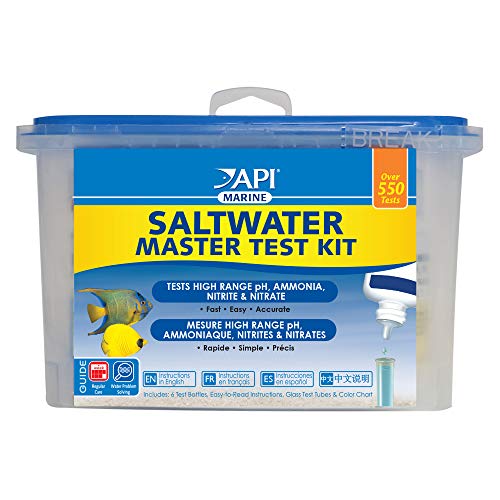
Saltwater Master Test Kit
$35.98 as of Jun 22, 2026
★★★★★Our rating· In Stock
For a new reef tank going through its nitrogen cycle, the API Saltwater Master Kit covers the parameters that matter first: ammonia, nitrite, nitrate, and pH. It's not the most precise test on the market, but it's accurate enough to tell you where you are in the cycle. At $35 it won't break the budget when you're testing every other day for two months.
What we like
Covers the four parameters that matter most in the first 6–8 weeks
Color cards are accurate enough to identify dangerous ammonia/nitrite spikes
One kit covers 100+ tests across all included reagents
What to know
Doesn't test calcium, alkalinity, or magnesium (essential for coral)
Color-matching can be ambiguous at low ammonia concentrations
Calcium and alkalinity are the two parameters that directly drive coral growth. If they're off, corals bleach or stop growing regardless of everything else. Salifert tests are the community standard for precision: sharper color breaks than API, consistent reagent quality, and a clear testing procedure. Get these when you add your first coral.
What we like
Industry-standard precision with sharper color breaks than API alternatives
Consistent reagent quality across batches; results you can trust
What to know
More expensive per test than API (but more accurate where it counts)
Reagents have limited shelf life; buy in smaller quantities
Alkalinity is the one parameter where color-match kits routinely fail reefers: the difference between 8 and 9 dKH matters for SPS corals, and a color card can't reliably tell you which you're at. The Hanna HI755 reads alkalinity digitally to 0.1 dKH precision. Once you add SPS corals, this replaces your drop test permanently.
What we like
Digital precision to 0.1 dKH, eliminating color-matching guesswork entirely
Accepted as the standard by serious SPS reefers and coral farms
What to know
Proprietary reagents at $15/25 tests; expensive if you test daily
Overkill for soft coral setups; worth it only when you add LPS or SPS
Every drop of water in your reef tank starts as tap water mixed with marine salt, but not all salt (or water) is equal. Municipal tap water contains chloramine, phosphates, and silica that fuel nuisance algae and stress corals. An RO/DI (reverse osmosis/deionization) unit removes virtually all of it, producing 0 TDS water that won't sabotage your chemistry. Most serious reefers consider an RO/DI unit a mandatory purchase within the first year.
Best starter
Instant Ocean
Sea Salt (200-gallon bucket)
$$
★★★★★Our rating
Instant Ocean has been the standard reef salt for 40 years, used in public aquariums, university research, and by more beginners than any other brand. The 200-gallon bucket dissolves cleanly, mixes to a consistent specific gravity, and is available at every fish store in the US. It's not the highest-trace-element salt, but it's the reliable, predictable one.
What we like
Used in public aquariums worldwide, the benchmark for salt consistency
200-gallon bucket covers months of water changes for most systems
Available at every fish store, easy to find locally in an emergency
What to know
Lower trace elements than coral-targeted salts like Red Sea Coral Pro
Not ideal for SPS-heavy tanks that rapidly deplete trace minerals
When you add corals that actively consume calcium, alkalinity, and magnesium, your base salt starts to matter. Red Sea Coral Pro mixes to elevated levels of all three, meaning your tank's chemistry is closer to where corals want to be before you even start dosing. The community consensus: stay on Instant Ocean until you have corals, then consider switching.
What we like
Elevated calcium, alkalinity, and magnesium for coral-focused systems
Consistent trace element profile reduces how much supplemental dosing you need
What to know
Roughly 2× the cost of Instant Ocean per gallon mixed
Overkill for soft coral setups; step up when you're adding LPS or SPS
Using tap water in a reef tank feeds algae blooms and corrupts your chemistry. An RO/DI system removes chloramine, phosphate, and silica, producing 0 TDS water that won't fight you. The Spectrapure MaxPure is the unit Reef2Reef recommends most often for beginners: solid components, long warranty, and well-documented setup.
What we like
Produces 0 TDS water, eliminating the top cause of nuisance algae in new tanks
Spectrapure components are reliable with a solid warranty and support
What to know
Wastes 3–4 gallons of tap water per gallon of pure water produced
$150–200 upfront plus ongoing filter and DI resin replacement costs
Nobody starts a reef tank because they want to learn chemistry. They start because they saw a tank somewhere (at a dentist’s office, a friend’s apartment, a YouTube video) and thought: I want that. The coral moving in the current, the fish weaving between branches, the whole ecosystem in a glass box.
That’s still where you’re going. But the path there involves patience you probably haven’t needed for a hobby before.
This is what your first 90 days actually look like: the work, the waiting, the things that will test your patience, and the moments when it starts to feel worth it.
Days 1–7: Setup and the dry run
Before water touches anything, spend a day doing a dry setup. Mount the light, test the pump, verify the skimmer fits where you planned. Reef tanks can run for years without incident, but a leaky bulkhead or a pump that won’t prime is much easier to deal with before the tank is full of salt water.
When you’re ready to fill:
Mix your saltwater first, not in the tank. Use a clean trash can or mixing container with a powerhead. Target specific gravity 1.025–1.026; measure with a quality refractometer, not a swing-arm hydrometer (those drift and lie). Let the water mix for at least an hour before adding it to the tank.
Add your rock and sand, then fill. Dry rock is the better starting point for most beginners; it arrives without pests and starts clean, though it takes longer to colonize with beneficial bacteria. Pour water slowly over the rock to avoid a sand storm.
Turn everything on. Your first objective is equipment running, nothing dead, no leaks. That’s it for week one.
Days 8–45: The nitrogen cycle (the unglamorous wait)
This is the part that separates reef keepers who succeed from those who quit.
The nitrogen cycle is what happens when beneficial bacteria colonize your rock, sand, and equipment. These bacteria convert the waste that animals produce (ammonia) into nitrite first (equally toxic), then into nitrate (much less harmful). Until this cycle completes, your tank will kill any animal you put in it.
The process:
Ammonia rises (from your seeding source: a piece of raw shrimp, bottled ammonia, or die-off from live rock)
Nitrite rises as bacteria process the ammonia
Both drop to zero as a second colony of bacteria processes the nitrite into nitrate
The whole thing takes 4–8 weeks, sometimes longer if your rock is completely dry to start. Test every 2–3 days and log the results.
The mistake everyone makes: Adding fish before the cycle is complete because the water “looks fine.” Water clarity tells you nothing about ammonia levels. Test. Don’t guess.
You’ll know the cycle is done when:
Ammonia reads 0 ppm
Nitrite reads 0 ppm
Nitrate is measurable (which confirms the bacteria are working)
At that point, do a 20% water change to bring nitrate down, and you’re ready for your first animal.
Days 45–90: First livestock, first corals
Start with a cleanup crew, not fish. Snails (nassarius, trochus, cerith) and hermit crabs eat algae and detritus, help process waste, and are much more forgiving of imperfect water than fish or coral. Order 1–2 snails per gallon to start. Watch them work.
Your first fish should be a clownfish. Not because they live in anemones (don’t get an anemone yet; they’re one of the most demanding reef animals) but because clownfish are the hardiest, most forgiving, most commonly kept reef fish. A true percula or ocellaris clownfish will tolerate the minor parameter swings that happen in a new tank. One pair is the right call for a 30–40 gallon system.
Wait at least two weeks after adding fish before thinking about coral.
For your first coral, pick from this list:
Mushroom corals (Discosoma, Rhodactis): Grow fast, tolerate moderate flow and light, come in countless colors. Almost impossible to kill with normal neglect.
Zoanthids: The hobby’s “gateway drug.” Colorful, fast-growing, great starter coral, and the variety of colors and patterns will have you addicted.
Leather corals: Tolerant and forgiving, though they periodically shed a waxy coating (normal, not a disease). Low maintenance.
Avoid acropora, montipora, and other SPS corals until you’ve maintained stable parameters for six months. They have almost no tolerance for chemistry swings, and they’ll teach you expensive lessons while you’re still learning.
Four parameters matter during the cycle: ammonia, nitrite, nitrate, pH. Once you add coral, three more join the list:
Calcium (Ca): Corals build their skeletons from calcium. Target 380–450 ppm. If it drops below 350, coral growth stops.
Alkalinity (dKH): The carbonate buffering that corals also consume for skeleton-building. Target 8–10 dKH. This one swings fastest in a growing tank.
Magnesium (Mg): Keeps calcium and alkalinity stable. Target 1,250–1,350 ppm. Low magnesium lets calcium and alkalinity crash.
You don’t need to understand the chemistry deeply on day one. You need to understand that these three move together: when one drops, the others often follow, and consistent testing is how you catch a swing before it becomes a disaster.
If you’re keeping soft corals and easy LPS, test calcium, alkalinity, and magnesium weekly. If you add SPS corals, test every 2–3 days until you know your tank’s consumption rate.
What to expect when things go wrong
Brown algae (diatoms) in the first 2–4 weeks: Normal. Silica-based algae blooms in new tanks as the substrate leaches silica into the water. It clears on its own. Don’t panic.
Green algae film on the glass: Also normal. Clean it with a magnetic scraper. If it’s growing faster than you can clean it, check your water source (RO/DI water is the fix) and your lighting schedule (12 hours of light is too long; 8–10 is plenty).
A coral turning pale or closing up: This is the coral telling you something is wrong. Check temperature, salinity, and the big three (calcium, alkalinity, magnesium) before assuming disease.
A fish dying suddenly: Usually ammonia or nitrite in a new tank, or an incompatible tankmate. The reef community is generous with help: post to Reef2Reef with your parameters and a photo and you’ll have a diagnosis within an hour.
The first year of reef keeping is full of small crises and course corrections. Every experienced reefer has a list of expensive mistakes. The ones who stay in the hobby are the ones who treat each problem as information rather than failure.
Save your money
What you don't need yet
Beginners get pressured to buy a lot of stuff that doesn't help them play
better. Here's what we'd skip on day one.
Auto top-off (ATO) unit — Convenient once your tank is running, but not for week one. Master manual top-offs first so you understand evaporation rates.
Calcium reactor — Advanced equipment for tanks with heavy SPS coral loads. You need a year of reef experience before a calcium reactor makes sense.
Neptune Apex or similar reef controller — Apex is incredible, but only after you understand what you're monitoring. Beginners who add one before knowing their parameters just have a more expensive source of confusion.
Dosing pumps — Automated two-part calcium/alkalinity dosing is for established tanks with measurable depletion. Test manually for the first 6 months.
Live fish in the first month — Your tank needs to complete the nitrogen cycle before it can support fish. Adding fish to an uncycled tank will kill them and expose you to an ammonia spike that can crash the whole system.
First week
Your first seven days
A short, real plan to get from gear-on-doorstep to actually playing.
Order your tank, light, skimmer, and salt. Delivery time matters: you can't start the cycle without everything in hand. · Buy
Read the Reef2Reef beginner forum before touching anything. Tank journals from people who built your exact setup will save you weeks of mistakes. · Learn
Set up the dry tank and test all equipment. Run the pump, check for leaks, verify the light turns on. Fix problems before there's water and livestock at stake. · Action
Mix your first batch of saltwater. Target specific gravity 1.025–1.026. Use a quality refractometer; the cheap plastic hydrometers are notoriously inaccurate. · Action
Add your live rock and aragonite sand, then fill with saltwater. You don't need a lot of rock; 1 pound per gallon is a common starting point. · Action
Start the nitrogen cycle. Dose ammonia to 2 ppm and let the beneficial bacteria establish. This is the unglamorous wait that all reef tanks require. · Action
Test your water every 2–3 days and log the results. Ammonia rises first, then nitrite, then both drop as bacteria establish. When both read 0 and nitrate is detectable, your cycle is complete. · Action
FAQ
Common questions
How long before I can add fish and coral?
Fish: 4–8 weeks after the tank cycles completely (ammonia and nitrite both at 0 ppm). Soft corals and easy LPS: 3–4 months after the tank is running stably. SPS corals: 6–12 months minimum, once you're hitting consistent calcium, alkalinity, and magnesium targets.
Do I need a sump, or can I use an all-in-one tank?
An all-in-one tank is the right choice for 95% of beginners. It has integrated filtration, no external plumbing, and a huge community support base. Sumps add flexibility and equipment space, but also complexity. Start with an AIO (the BioCube 32 is our pick) and add a sump if you upgrade to a larger tank later.
Can I use tap water for a reef tank?
No. Municipal tap water contains chloramine, phosphate, and silica that drive nuisance algae and stress corals. You need RO/DI (reverse osmosis/deionization) water, either from an RO/DI unit at home or purchased by the gallon from most fish stores. This is one of the non-negotiable costs of reef keeping.
What are the easiest corals for beginners?
Start with soft corals: mushrooms (Discosoma), zoanthids, and leather corals are the most forgiving. They tolerate imperfect water parameters, grow visibly fast, and are sold at most fish stores. Avoid SPS corals (Acropora, Montipora) until you've maintained stable parameters for at least 6 months: they have almost no tolerance for chemistry swings.
How much does a reef tank cost per month?
Budget $50–100/month for an established 30–40 gallon reef: roughly $15–20 for salt, $10–20 for RO/DI membrane replacement and DI resin, $10–15 for test kit reagents, and $20–40 for livestock additions once the tank is established. Equipment upgrades and livestock tend to be the big variable costs.
How hard is reef keeping compared to freshwater?
Significantly harder. The chemistry is more complex (you're maintaining six key parameters instead of one or two), the equipment is more expensive, and the livestock is more sensitive. Most reefers recommend starting with a freshwater tank first to learn the basics of aquarium maintenance, though plenty of people jump straight in and succeed with enough research.
Reef2Reef — The largest and most active reef-keeping forum online. Search before posting; almost every beginner question has a detailed thread. The equipment review section is invaluable.
BRS (Bulk Reef Supply): 52 Weeks of Reefing — The definitive beginner video series for reef keeping. Start with 52 Weeks of Reefing, which covers every aspect of setup and maintenance in 10-minute episodes. Better than any book.
Reef Builders — The industry news site for reef keeping. Equipment reviews, coral coverage, and tank tours. The equipment reviews are thorough and genuinely independent.
r/ReefTank — Active subreddit with build threads, identification help, and advice. The wiki has a solid beginner guide. Coral ID threads are surprisingly useful for verifying what you're about to buy.
CORAL Magazine — The print and digital magazine of record for reef keeping. Deeper than YouTube: long-form articles on tank husbandry, coral science, and equipment testing. Worth a subscription once you're past the basics.
As an Amazon Associate, JustBeginning earns from qualifying purchases.
We may also earn commission from other affiliate programs linked on this
page. Editorial recommendations are independent; we don't choose
products based on commission rates.
Product prices and availability are accurate as of the date and time
indicated and are subject to change. Any price and availability
information shown on Amazon at the time of purchase will apply.

 Best starter