Geocaching is the world's largest treasure hunt, with over three million active caches hidden by strangers, waiting for you to find them. You can start today with nothing but your phone. Here's the gear that takes you from your first find to obsessively hunting puzzle caches on weekends.
By Colin B. · Published May 24, 2026 · Last reviewed June 18, 2026
You can start geocaching for free with just your phone. The typical first upgrade (a Garmin eTrex) costs about $155 and is worth it once you're hooked.
We earn commission on qualifying Amazon purchases — see our
affiliate disclosure.
Price tiers and budget totals shown above are editorial estimates;
actual Amazon prices vary.
At a glance
Our top pick in each category
The fastest path through this guide — each best-starter pick by category.
Scroll for the budget and upgrade alternatives.
Start with the phone app, not a GPS unit. The free Geocaching app (or the $30/year premium subscription) lets you find thousands of traditional caches before you've bought anything. Most beginners find 20–30 caches on their phone before they even think about hardware.
Premium app subscription ($30/year) is the first upgrade worth paying for: it unlocks mystery, multi-stage, and earthcache types, plus offline maps. Do this before you buy a GPS unit.
Your footwear matters more than your GPS. Caches are hidden off-trail in brush, on rocks, and up hills. Proper trail shoes prevent turned ankles and keep you comfortable for the 'just one more' spiral you'll absolutely get into.
The gear
What you actually need
GPS Devices
The free phone app gets you started, but a dedicated GPS unit changes the experience. Dedicated units have 20+ hour battery life, work without cell signal (crucial for rural caches), survive drops and rain, and are more accurate under tree cover. The Garmin eTrex line is what most geocachers eventually own. If you're still deciding, start with the phone app and budget the GPS unit for when you're finding caches every week.
GPS Devices — what's the difference?
A few common shapes, each making a different trade.
Phone App
Free to start; uses cell data and your existing phone.
Cost
Free–$30/yr
Battery
3–5 hrs typical
Signal
Needs cell data
Best for Beginners exploring urban and suburban caches
Tradeoff Battery-hungry and dead in remote areas without offline maps downloaded
Dedicated GPS
Standalone unit; works anywhere with long battery life.
Cost
$150–$400
Battery
20–25 hrs
Signal
No cell needed
Best for Rural, backcountry, or high-volume cachers
Tradeoff Upfront cost; joystick interface is less slick than a smartphone
Best starter
Garmin
eTrex 22x
$199.99 as of Jun 22, 2026
★★★★★Our rating· In Stock
The eTrex 22x is the default first GPS for geocachers: accurate to within 3 meters, runs 25 hours on two AA batteries, and survives use that kills phones. The small screen is fine: you're navigating to a bearing, not reading an article. Geocaching.com integration is plug-and-play. At around $155, it's the sweet spot before upgrades start costing real money.
What we like
25-hour battery on 2 AAs, lasts a full weekend of caching
Works without cell signal in rural and backcountry terrain
IPX7 waterproof, survives creek crossings and heavy rain
What to know
Joystick navigation feels dated compared to a smartphone
Before you spend $155 on a GPS unit, protect the device already in your pocket. Catalyst's Total Protection Case is IP68 rated, survives drops to 6.6 feet, and is the toughest case Catalyst makes. Start geocaching with your phone protected, then buy the Garmin once you're hooked. Verify your iPhone model before ordering.
What we like
IP68 rated: survives drops and water without destroying your phone
Lets you start caching today with what you already own
What to know
Model-specific: verify compatibility before buying
No substitute for a dedicated GPS unit in dead zones or low battery
★★★★☆Our rating· Only 1 left in stock - order soon.
The step up from the eTrex line: multi-band GNSS for 1–2 meter accuracy, a 3″ color display, and topographic maps built in. The GPSMAP 67 is what serious cachers move to once they're hunting puzzle caches in terrain-5 locations where precision matters. Not your first GPS: your second.
What we like
Multi-band GNSS hits 1-2m accuracy, crucial for terrain-5 caches
3″ sunlight-readable color display, actually legible outdoors
Full topo maps built in; Bluetooth for phone syncing
What to know
~$350: too much until geocaching clearly owns your weekends
Geocaches are almost never on perfectly maintained paths. You'll be stepping over roots, scrambling up rocky slopes, and stomping through wet grass hunting a magnetic nano stuck to a guardrail. Trail shoes keep you stable where sneakers slip, and waterproofing keeps your socks dry when the obvious path goes through a puddle. Spend money here before you spend it on a GPS.
Best starter
Merrell
Moab 3 Waterproof
$98.64 as of Jun 22, 2026
★★★★★Our rating· Only 2 left in stock - order soon.
The Moab is the best-selling trail shoe for a reason: fits wide, grips well on mixed terrain, and the waterproof version handles creek crossings and wet brush without soaking your socks. Geocachers who upgrade from sneakers always wish they'd done it sooner. Runs true to size.
What we like
Wide toe box accommodates most foot shapes without breaking in
M Select DRY membrane keeps feet dry through wet brush and puddles
Vibram outsole grips rock, root, and mud reliably
What to know
Waterproof liner reduces breathability on warm hikes
Stiffer than trail runners; less nimble on fast, technical terrain
Columbia's entry-level waterproof trail shoe, regularly available under $90. Not as durable as the Merrell, but a meaningful upgrade over running shoes for someone who wants to try trail use before committing to a premium pair.
What we like
Often under $90 with waterproofing, solid value for a first trail shoe
Lightweight design for a waterproof trail shoe
What to know
Sole wears faster than Merrell or Salomon options
Less ankle support than a mid-cut boot on uneven terrain
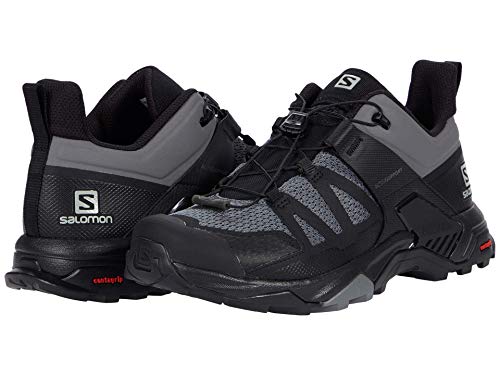
When you're hunting terrain-4 and terrain-5 caches in the backcountry, Salomon's Contragrip outsole and Gore-Tex lining become genuinely worth the extra spend. Noticeably more precise foot placement on technical rock than the Merrell. The kind of shoe that stays with you for years.
What we like
Gore-Tex + Contragrip outsole, proven in backcountry conditions
Precise foot placement on technical rock and steep trails
What to know
Runs narrow: size up a half size if in doubt
~$160+: hard to justify until you're caching weekly on hard terrain
For urban and suburban caching (parking lot micros, trail hides near the trailhead), you don't need a pack at all. But once you're running multi-stage caches or spending a half-day in the woods, a 10–15L daypack makes the experience dramatically better. You need somewhere to put water, a rain layer, your trade items, and the snacks you'll inevitably need when you're 'just doing one more.'
Best starter
Osprey
Daylite 13L
$$
★★★★★Our rating
Osprey packs are built better than the price suggests. The Daylite 13L is the ideal caching size: big enough for water, a layer, and cache tools, small enough that you forget it's there. Multiple pockets keep your gear organized. Osprey's lifetime repair guarantee means this pack will outlast multiple hobby phases.
What we like
Lifetime Osprey guarantee: the last daypack you'll need to buy
Front organizer pocket keeps pens, tweezers, and tools accessible
13L is the sweet spot: enough for a half-day, light enough to forget
What to know
No hydration bladder sleeve; bottle storage only
Minimal frame padding: not ideal for loads over 15 lbs
For summer caching when you're covering serious ground, the ability to drink without stopping is a real quality-of-life upgrade. The Hydrobak is the hydration-pack entry point: minimal, light, and the 1.5L reservoir is enough for a 2–3 hour outing.
What we like
Hands-free hydration: drink without stopping or digging for a bottle
Featherlight design barely registers on your back
What to know
Minimal storage: supplement with a hip pouch for gear-heavy days
Bladder requires cleaning after every use to stay fresh
Signing a paper log is the defining ritual of geocaching. Most logs are in decent condition; a pen works fine. But nano and micro caches have logs so small that tweezers are essential to extract and sign them without shredding the paper. A bright headlamp handles night caches and dark hollows. These three tools fit in your front pocket and cover 90% of caching scenarios.
Best starter
Rite in the Rain
All-Weather Metal Portage Pen, Black Barrel, Black Ink .9mm, Fine Point (No. BK17)
$24.95 as of Jun 22, 2026
★★★★★Our rating· In Stock
Log books in cache containers get wet. Regular ink smears on damp paper. Rite in the Rain makes both the waterproof paper cache owners use and the pens designed to write on it: the two products were literally built for each other. Buy two: one for your pack, one for your car.
What we like
Writes on wet paper: the only pen that works reliably in damp caches
Pressurized cartridge works upside down and in cold temperatures
What to know
More expensive per pen than a ballpoint, but you need one, not a box
Slightly wider line: matters in the smallest nano logs
Nano cache logs (tiny slips of rolled paper inside 1-inch bison tubes) require tweezers to unroll without shredding. These Swiss Army tweezers are short, precise, and have been included in Swiss Army knives for decades. Keep them in your kit and you'll be the person who saves frustrated cachers when nobody else can sign the nano log.
What we like
Precise tips unroll nano logs without tearing the paper
Short profile fits in any pocket or cache kit pouch
What to know
Easy to lose: attach to a keyring immediately
Spring tension is stiff out of the box; loosens with use
Caches hidden inside tree hollows, under bridges, and in culverts require light even in daytime. Night caching is its own compelling category. The Spot 400 throws 400 lumens in a waterproof package and runs 200+ hours on low. It's the standard trail headlamp; every outdoor person ends up with one eventually anyway.
What we like
400 lumens and IPX8 waterproof, handles any caching condition
200+ hours on low: one charge covers a full weekend
What to know
High-burst mode drains fast: use medium for most caching
Lock mode requires a deliberate 3-button press; read the manual
Geocaching has a peculiar learning curve: most people find their first cache within an hour of downloading the app. Then they find 40 more in a week. Here's what you're actually learning, and when the hobby stops being easy and starts being interesting.
Geocaching is one of the strangest onboarding experiences in any hobby: you download an app, tap on a green dot near your house, and there is a physical object hidden there, placed by a stranger months or years ago, with a tiny logbook full of names inside. Your name goes on that list. Then you look at the map and notice there are forty more nearby.
That’s the first hour. This is everything after.
Week 1: Learning what you’re actually looking for
The app shows you coordinates and a rough circle around the cache location. What it doesn’t show you is where: that’s the skill. Geocaches are hidden at the coordinates, but “hidden” covers enormous ground: magnetic key holders stuck to the underside of a guardrail, fake bolts on park benches, small tupperware containers under a pile of sticks arranged just slightly too neatly.
Your first week is pattern recognition. You’re not developing GPS skills yet: the phone is accurate enough for traditional caches. You’re learning to read your environment like a cache hider would: what looks out of place, what’s the only object in the area that a person would have touched, what looks natural but slightly too symmetrical.
D1/T1 caches are designed to be found. The “hint” field exists for people on their first five finds. Use it without guilt. Cache owners want their caches to be found; a zero-found count is a disappointment to them, not a badge of difficulty.
The most important habit to build in week one is logging online. The physical log in the container matters, but the geocaching.com log is where the community lives. Write something, even a sentence. Cache owners read every log. Other cachers read logs to decide whether a cache is worth hunting. Your log is your contribution to the record.
Week 2-3: The app’s limits, and finding micro caches
By week two, you’ll have found a few traditional caches and probably run into your first micro. Micros are the real skill test for new cachers. These are small containers (sometimes just a magnetic screw-top capsule the size of a lipstick tube), hidden in plain sight in urban environments. The log is a tiny strip of paper that requires tweezers to extract without shredding.
A few micro-specific lessons:
Look for anything magnetic near metal. Light poles, guardrails, fence posts, park signs: these are micro habitat.
Look for the anomaly. A bolt that’s slightly different from its neighbors. A rock that’s a slightly different color from the others.
Check for recent activity. If the cache was found three days ago, it’s definitely still there. Read the last few logs to see if anyone mentioned it was difficult: that’s often a hint.
Urban micros can be genuinely hard. A D3/T1 micro in a busy parking lot can take 20 minutes of systematic searching. If you’re coming from D1/T1 caches in parks, this will feel like a different activity entirely; it is.
This is also when the premium subscription starts paying off. Premium unlocks mystery caches (puzzles you solve to get coordinates) and multi-caches (a series of waypoints leading to a final). These categories are where geocaching’s depth lives; the casual map-tap approach doesn’t work on a D4 puzzle cache.
Week 3-4: The GPS upgrade conversation
At some point in your first month, you’ll have a caching experience that makes you wish your phone had more battery, or you’ll be in a spot with no cell signal, or you’ll lose a cache hunt because your GPS circle was 20 feet off under heavy tree cover.
That’s when you think about a Garmin eTrex.
The honest answer: wait until you’ve found 30 caches on your phone before buying. You need enough experience to know what you’re getting in a dedicated GPS unit (better accuracy in tree cover, 25+ hours of battery on AA batteries, no cell signal required) versus what you won’t get: it’s less convenient for looking up cache details, the interface is a joystick not a touchscreen, and it won’t help with puzzle caches at all (that’s still your brain and the app).
Most serious cachers use both: the phone for cache details, hints, and logging; the GPS for navigation to the coordinates. The Garmin is a navigation tool, not a replacement for the app.
When does it get interesting?
The hobby changes character around 50 finds. Before 50, you’re mostly learning to find caches. After 50:
Puzzle caches become accessible. These require solving a puzzle (a cipher, a coordinate math problem, a riddle) to get the actual coordinates. The puzzle is part of the cache. Some are trivial; some take hours; some require knowledge that caches posted nearby. It’s a separate hobby nested inside geocaching.
Terrain 3+ caches are physically interesting. Wading a creek, scrambling up a boulder, finding a cache that requires a short rope. The D/T rating system becomes meaningful once you’re choosing hunts deliberately rather than just tapping the nearest dot.
Events are worth attending. Geocaching.com lists events worldwide: organized group hunts, CITO (Cache In Trash Out) events where cachers clean up parks, and social meetups. The community is unusually friendly and cross-generational in a way you don’t expect from an outdoor activity.
Hiding your own cache is the second half of the hobby. After you’ve found a few dozen, you start noticing locations that would make excellent hides. The hide side has its own skills: choosing a container that survives weather, writing a compelling description, creating a puzzle.
There’s no natural ceiling to geocaching the way there is in, say, a sport where you eventually plateau. The global cache network is genuinely infinite. There are caches on every continent including Antarctica.
Save your money
What you don't need yet
Beginners get pressured to buy a lot of stuff that doesn't help them play
better. Here's what we'd skip on day one.
A dedicated GPS unit on day one — The free phone app finds thousands of caches. Buy the Garmin eTrex after your first 20 finds, when you know geocaching has its hooks in you.
Trade item kits — You can find caches indefinitely without leaving swag. Trade items are fun but strictly optional; most veteran cachers stopped carrying them years ago.
Premium Geocaching app subscription — Free tier unlocks traditional caches, which is most of what you'll find in your first month. Go premium ($30/year) when you want mystery and multi caches.
Cache containers to place your own — Placing caches is a second-phase hobby. Find 50 first: you'll learn what placements you love and hate before designing your own.
Trekking poles — Useful for hard terrain, but unnecessary unless you're deliberately hunting difficult mountain hides. Most beginner caches don't require them.
First week
Your first seven days
A short, real plan to get from gear-on-doorstep to actually playing.
Download the Geocaching app and create a free account at Geocaching.com. · Action
c:geo (Android) · Free open-source alternative with full cache access
Find a Traditional cache rated D1/T1 within a mile of home. That's difficulty 1, terrain 1, meant to be found and won't require any scrambling. · Action
Read the hint before giving up. Cache owners write hints for people exactly like you. There's no shame in using it. · Learn
Log your find online, not just in the paper logbook. The online log is where the community lives and where cache owners get feedback. · Action
Find five caches in your first week. Enough to build pattern recognition: what common hides look like, why every suspicious-looking guardrail skirt is worth checking. · Action
Order a waterproof pen before you hit your fifth cache: wet logs are everywhere. · Buy
No. The free Geocaching app and your phone are all you need to find traditional caches. Most beginners spend $0 in their first month. The premium subscription ($30/year) and a dedicated GPS unit are the two upgrades worth paying for, in that order.
What's the difference between difficulty and terrain ratings?
Difficulty (D) is how hard the cache is to find: 1 is obvious, 5 requires solving a complex puzzle. Terrain (T) is the physical challenge to reach it: 1 is flat ground, 5 might require climbing gear. Start with D1/T1 caches until you have your bearings.
What is a nano cache and why can't I sign the log?
Nano caches are tiny magnetic containers (about the size of a pencil eraser) that hide on metal surfaces in plain sight. The log is a rolled slip of paper inside that requires tweezers to extract without tearing. Buy tweezers. They cost $5 and save enormous frustration.
Is geocaching safe? What about trespassing?
Geocaches are reviewed by moderators before listing, which screens out placements on clearly private or unsafe land. That said, always trust your instincts: if a hide requires going somewhere that feels wrong, skip it and report it. The community takes placement quality seriously.
Do I need a paid GPS or is my phone fine?
Your phone is genuinely fine to start. The official app works, and with offline maps downloaded it works in most areas without cell signal. Dedicated GPS units are more accurate in heavy tree cover and have longer battery life, but buy one after your first 20–30 finds, not before.
What's a Travel Bug and should I pick one up?
Travel Bugs (and Geocoins) are trackable items with unique codes: you can move them between caches and log where they travel worldwide. They're a fun layer of the hobby, but not something beginners need to think about in the first month. Find caches first.
As an Amazon Associate, JustBeginning earns from qualifying purchases.
We may also earn commission from other affiliate programs linked on this
page. Editorial recommendations are independent; we don't choose
products based on commission rates.
Product prices and availability are accurate as of the date and time
indicated and are subject to change. Any price and availability
information shown on Amazon at the time of purchase will apply.

 Best starter