Roller skating is back, and not in a nostalgic way. Quad skates are genuinely everywhere right now: outdoor trails, rinks, skate parks. The tricky part for beginners is deciding quad vs. inline, boot style, and indoor vs. outdoor wheels before you buy anything. Here's what you actually need.
By Colin B. · Published May 23, 2026 · Last reviewed June 5, 2026
Budget skates at $55 pair fine with a decent pad set. A proper beginner quad at ~$100 makes the learning curve noticeably shorter. Add a helmet and you're at $150–220 ready to go.
We earn commission on qualifying Amazon purchases — see our
affiliate disclosure.
Price tiers and budget totals shown above are editorial estimates;
actual Amazon prices vary.
At a glance
Our top pick in each category
The fastest path through this guide — each best-starter pick by category.
Scroll for the budget and upgrade alternatives.
Buy your protective gear before you buy your skates. The instinct is reversed. People rush to order skates and treat the pads as optional. Wrists and knees are the first casualties of learning to stop, and a $35 pad set prevents that.
Decide quad or inline before you buy anything else. Quads (4 wheels in a square) are lower to the ground, more stable laterally, and where the current revival lives (better for rinks, outdoor cruising, and artistic skating). Inlines are faster and better for long distances but harder to balance on at first. If you're not sure, start with quads.
Size your skates to your shoe size, but check each brand's sizing chart; they all differ. Riedell runs true to size. Chicago runs about half a size large. A snug fit means more control; sloppy fit means ankle wobble and slower progress.
Don't buy rental-quality skates. The cheap $30 skates at big-box stores use plastic toe stops, cheap bearings, and hollow plastic boots. They're harder to learn on, not easier. Spend at least $60 for a Chicago Deluxe or $95 for a Riedell R3. The difference in how they skate is significant.
Your skates are the whole game. For quad beginners, you want a boot with real ankle support (leather-look or actual leather, not hollow plastic), a nylon or aluminum plate, and proper toe stops. The $55–100 range is the sweet spot: cheap enough to not commit before you're sure, good enough to actually learn on. Above $150, you're buying aluminum plates and boot leather that won't pay off until you've logged fifty sessions.
Skates — what's the difference?
A few common shapes, each making a different trade.
Quad Skates
Four wheels in a square pattern. More stable, lower center of gravity.
Wheel layout
2×2 square
Stopping method
Toe stop (front)
Best surface
Rinks, smooth trails, parks
Best for Beginners, rink skating, outdoor cruising, artistic/dance skating, roller derby
Tradeoff Slower top speed, wider footprint than inline
R3 Roller Skates for Men and Women - Ultra-Durable Indoor Quad Skate with Sonar Cayman Wheels, Nylon Plate, and Precision Fit
$199.00 as of Jun 22, 2026
★★★★★Our rating
Riedell has been making roller skates in Red Wing, Minnesota since 1945. The R3 is their entry-level quad, and it shows their heritage: real ankle support, a comfortable boot that breaks in without destroying your feet, and a nylon plate that won't snap in your first month. It's the skate we'd hand a friend who wants to actually learn, not just hobble around a rink.
What we like
Genuine ankle support from a brand that has made skates since 1945
Comfortable boot that breaks in without destroying your feet
Nylon plate is durable for the first year of skating
What to know
Stock wheels are mediocre; outdoor upgrade recommended within a month
Chicago Skates makes the rental skates in thousands of rinks across the country, which tells you they're tough enough for daily abuse by strangers. The 116 Deluxe is their consumer version: same durable construction, PVC upper, and workable plate, for around $55. Not glamorous, but a legitimate way in.
What we like
Same durable build as rink rental skates used daily by strangers
Solid entry price around $55
What to know
PVC upper offers less ankle support than leather boots
Runs half a size large; ordering the right size requires care
The Dart is Riedell's step-up model with a die-cast aluminum plate, the upgrade that matters most. Aluminum transfers your push directly into the wheels without flex. The Ombré version fits the quad revival aesthetic, and the 93A wheels handle a variety of surfaces well. Buy this when you're skating several times a week and want to feel the difference.
What we like
Die-cast aluminum plate transfers power directly without flex
93A wheels handle both indoor and outdoor surfaces decently
What to know
93A hardness can feel slippery on very smooth rink wood floors
Overkill for your first month; buy this once you're skating regularly
If you want inlines (for fitness skating, long trails, or speed), the Zetrablade is where most adults start. Active Brake Technology (ABT) makes stopping intuitive, the frame is stiff enough for real control, and Rollerblade's sizing is consistent. Comfortable straight out of the box in a way that not all inlines are.
What we like
Active Brake Technology makes stopping intuitive for new inline skaters
Consistent sizing and comfortable straight out of the box
What to know
Heel brake technique requires real practice before it's reliable
Inline balance is harder to learn than quad from day one
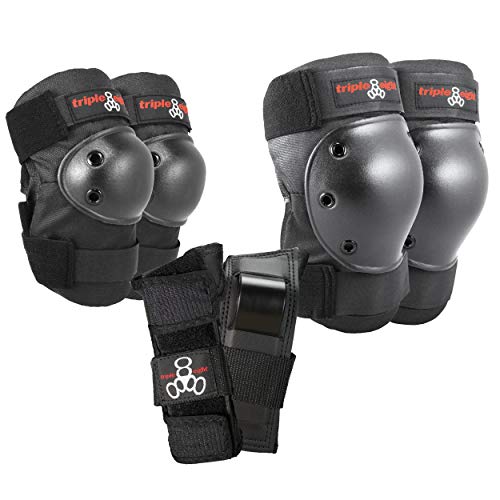
Wrists and knees take every fall. Wear the pads every single session for your first month, no exceptions. Skating outdoors on rough pavement, you'll hit the ground at least a few times while learning to stop. A full set costs $30–50 and prevents injuries that sideline beginners for weeks. The helmet matters most if you're skating at any speed or on any slope; for flat rink sessions it's optional, for outdoor skating it is not.
Best starter
Triple Eight
3-Pack Saver Series Pad Set
$$
★★★★★Our rating
Triple Eight is the brand skate culture trusts. Their gear shows up in skate parks and roller derbies. The 3-Pack gives you wrist guards, knee pads, and elbow pads in one box at a reasonable price. The wrist guards in particular are worth the whole cost; a wrist fracture from learning to fall takes months to heal.
What we like
Trusted by roller derby and skate park communities
Full set covers wrists, knees, and elbows in one purchase
What to know
Sizing chart matters; wrong size means pads shift during falls
Not the cheapest option if you're still testing the hobby
Under $30 for wrist guards, knee pads, and elbow pads. The coverage is adequate, the straps hold, and the padding absorbs falls well enough for learning-speed skating. It won't last as long as Triple Eight gear, but if you're still deciding whether this hobby sticks, it's a reasonable entry ticket.
What we like
Under $30 covers all three critical joints
Adequate protection for learning-speed skating falls
What to know
Straps and padding wear faster than premium options
The Sweatsaver is named for its sweat-absorbing liner, and it's the single most-worn helmet in roller derby, skateboarding, and recreational skating. Dual-certified for both bike and skateboard safety standards. The fit is adjustable, the liner pulls out for washing, and it looks like an actual skate helmet, not a bike helmet. Required for outdoor skating at any real speed.
What we like
Dual-certified for bike and skateboard safety standards
Sweat-absorbing liner pulls out for washing
What to know
Fit dial works within a size range; wrong size can't be dialed in
The wheels that come stock on entry-level skates are mediocre: too hard for indoor floors, too narrow for outdoor pavement. Hardness is measured on the 'A scale': softer wheels (78A–85A) grip outdoor pavement; harder wheels (88A–101A) roll fast and slide smoothly on slick indoor floors. If you skate outdoors, upgrade to outdoor wheels within your first month. If you skate at a rink, the stock wheels are usually fine until you're more advanced.
Best starter
Atom
Outdoor Quad Skate Wheels (62mm, 78A, 4-pack)
$$
★★★★★Our rating
The most popular outdoor wheel upgrade for beginner quad skaters. 62mm diameter rolls over cracks and pebbles without launching you. 78A hardness grips pavement without being sloppy. Comes in a 4-pack so you can replace the stiffest stock wheels on your new skates. The difference on rough outdoor surfaces is immediate and obvious.
What we like
78A hardness grips rough pavement without being sloppy
62mm diameter rolls over cracks without catching
What to know
Outdoor wheels wear faster than indoor wheels
4-pack only covers half your wheels; need two packs for a full swap
If you're skating at a rink, these are the wheels the regulars and derby skaters use indoors. Soft 62A hardness means they grip slick sport-court and wood floors without sliding out. The full 8-pack gives you a complete setup rather than a half-swap. A dedicated rink set is worth it if you skate there weekly; swap them out when you go outside.
What we like
62A softness grips slick rink floors without sliding out
Full 8-pack gives you a complete indoor setup in one purchase
What to know
Wear down very quickly on any outdoor surface
Requires swapping between indoor and outdoor sessions
Two things make a meaningful difference to how your skates roll: bearings and a skate tool. Stock bearings on budget skates are mediocre. Upgrading to ABEC-7 or better smooths out your roll noticeably. A skate tool lets you tighten or loosen your trucks as your skill develops (looser trucks = more agile turns; tighter = more stability for beginners). Budget around $20 total for both.
Best starter
Bones
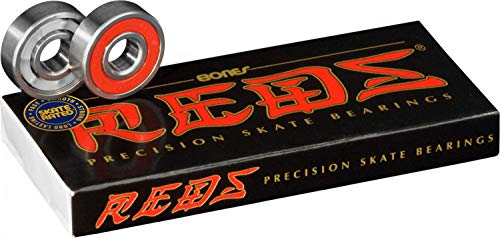
Reds ABEC-7 Bearings (8-pack)
$
★★★★★Our rating
Bones Reds are the benchmark in skate culture: a $20 upgrade that outlasts and outrolls anything stock on entry-level skates. Every skater eventually buys these. The 8-pack covers all 8 wheels on a quad setup (or 8 wheels on a 4-wheel inline frame). Clean them every few months with isopropyl alcohol and they'll last years.
What we like
Measurable improvement over stock bearings on budget skates
Lasts years with basic isopropyl alcohol cleaning every few months
What to know
Need regular cleaning or the roll degrades noticeably
Require a bearing press or careful mallet technique to install
PowerDyne makes most of the plates found in serious roller skates, so they know what the hardware needs. The Y4 covers 1/2", 9/16", and 11/16" sockets plus a 5mm Allen key, which handles axle nuts, kingpin, toe stop, and truck adjustments. Compact enough to toss in a skate bag. At under $15, it's the one tool every skater eventually buys.
What we like
Covers all four key adjustments: axle, kingpin, toe stop, and truck
Compact enough to fit in any skate bag
What to know
No bearing press function; bearings require a separate tool to swap
Short handle limits torque on stubborn kingpin nuts
The first time you stand up on skates, you'll understand why toddlers fall so much. Your brain doesn't know how to move your feet sideways yet. Give it three sessions, though, and something shifts — the wheels stop feeling like obstacles and start feeling like your feet.
Roller skating has a learning curve that’s both shorter and more humbling than people expect. Shorter because the basic mechanics — roll forward, stop, turn — take only a few hours to grasp. More humbling because those few hours involve a lot of standing still, windmilling your arms, and sitting down on the pavement faster than you intended.
This is normal. This is how everyone starts. Here’s what your first month actually looks like.
Sessions 1–3: Standing, rolling, and not dying
Before you do anything else, learn to fall. This sounds absurd. Do it anyway.
Put on all your pads, crouch low on your skates, and practice falling forward onto your knee pads intentionally. Do it ten times. A controlled fall onto knee pads doesn’t hurt. A panic fall onto your hands or tailbone does. The goal here is to short-circuit your brain’s instinct to catch itself — which leads to wrist fractures — and replace it with the habit of folding forward onto padded knees.
Once you’ve practiced falling, practice standing. Stand with your feet shoulder-width apart, toes angled slightly outward in a V. Don’t lock your knees. Bend them slightly — a soft knee is a stable knee. If you lock your knees, you have no shock absorption and you’ll fall backward at the slightest off-balance.
Rolling comes next. Push off one foot at a time, gentle diagonal pushes. Not straight back — sideways, at about a 45-degree angle. You’re pushing against the pavement, not trying to walk with your feet parallel. Skating stride is more like a waddling duck than walking; embrace it.
The first few sessions, focus only on three things:
Rolling forward without panic
Stopping with your toe stop (drag the rubber toe stop on the front of your skate behind you, transferring weight forward)
Surviving your first few falls without injury
Everything else — crossovers, backwards skating, spins — is the second chapter. This is chapter one.
Stopping is the skill most beginners underestimate. Rolling is easy once you start. Stopping is what keeps you from collecting a fence or a slower skater.
Quad skates have two main stops for beginners:
Toe stop drag. Lift one foot slightly, extend it behind you, and drag the rubber toe stop against the pavement. You need to transfer weight onto that trailing foot to create friction. Practice this until it’s automatic — not something you have to think through.
T-stop. Bring one foot perpendicular to your direction of travel, trailing behind your lead foot, and drag the wheels sideways. More graceful than the toe drag, harder to learn, but kinder on your toe stops.
Do not try to stop by grabbing something. Do not try to stop by rolling into the grass. Learn to stop with your skates.
Once stopping feels reliable, crossovers become the first real skill worth learning. A crossover is how you turn without slowing down — you swing your outside foot over your inside foot as you turn, using the weight shift to carve the corner. Start by walking through the motion without skating, then practice it very slowly on a gentle curve.
This is also when most people discover their dominant side. You’ll crossover more easily in one direction than the other. That’s universal. Drill your weaker side twice as much as your strong side for the first month.
Sessions 9–15: When it starts to feel like skating
Somewhere around session ten, something changes. The calculation of every move — push here, shift weight there — starts to fade. You roll. You turn. You stop. Not perfectly, but without narrating each step to yourself.
This is when the hobby becomes fun.
Once rolling and stopping feel automatic, the skills worth adding are:
Skating backward. Start by rocking your weight heel to toe with feet parallel, generating a figure-eight pattern underneath you. You’re not pushing backward yet — you’re coaxing the skates. Once you feel the backward roll start, extend the figure-eight into actual backward strokes. It’s disorienting for the first few attempts and then clicks abruptly.
Jumps and transitions. The simplest transition is a half-turn jump: roll forward, jump and rotate 180 degrees, land rolling backward. It looks hard. At slow speed, with a smooth surface, it’s one of the earlier tricks most skaters land — the rotation is small and forgiving.
Skating at a rink. If you haven’t yet, find open skate at a local rink. The smooth floor, the music, and the presence of other skaters at all levels does something to your progress. The social context accelerates learning. You’ll try things you wouldn’t try alone in a parking lot.
At this point you’re no longer a beginner learning to survive on skates. You’re a skater who is still learning. That’s a meaningful distinction — it means the hobby is yours now, and the question is just where you want to take it.
What trips up beginners
A few patterns come up consistently:
Skating in a straight line and nothing else. Turning requires leaning. Leaning requires trusting the skates. A lot of beginners spend months rolling straight and never commit to a real lean. Practice carving figure-eights in an open space — the motion forces you to lean.
Tight trucks. Your trucks (the axle hardware connecting wheels to plate) come tight from the factory on most beginner skates. Tight trucks give you stability but steal agility. Once you have the basics, loosen them slightly — you’ll feel the difference immediately. Your skate tool does this.
Skipping outdoor wheels. The wheels on most beginner skates are designed for smooth surfaces. They catch every crack and pebble outdoors. Skating outside on stock wheels is genuinely hard in a way that good outdoor wheels eliminate. It’s a $25 upgrade that changes the experience.
Not wearing pads. The falls that happen at session 12 hurt more than the falls at session 2 — you’re moving faster, with more confidence, and less anticipation. Keep the pads on until you genuinely never fall, not until you stop falling in the first week.
What to do at month two
By the end of your first month, you should be able to roll forward with control, stop reliably, turn in both directions, and skate for 20–30 minutes without exhaustion.
From here, the branches split. Rink skating leads you toward artistic skating, rhythm skating, and the social scene of open skate nights. Outdoor skating leads you toward longer distances, trail riding, and skate dancing. Roller derby is a whole culture of its own, competitive and physical and deeply community-driven.
Pick the one that excites you and find its community. In-person skate groups accelerate your learning more than any YouTube video, and the roller skating community is, as a whole, unusually welcoming to newcomers.
Save your money
What you don't need yet
Beginners get pressured to buy a lot of stuff that doesn't help them play
better. Here's what we'd skip on day one.
Carbon-fiber or aluminum dance plates — These $200+ plates are for artistic skaters and roller derby regulars who know exactly what they want from plate flex. You won't feel the difference for at least a year.
Speed boots — Low-cut boots with minimal ankle support are for people who've already built the ankle stability to skate without them. Starting in speed boots is how you get injured.
A full set of different wheel hardnesses — One good all-purpose outdoor wheel and one indoor wheel is all you need. The wheel rabbit hole is deep and mostly theoretical until you're skating 3+ times a week.
Roller derby gear (full protective set) — Mouth guards, wrist braces, and hip pads are for contact sport. If you're just learning to skate, the Triple Eight 3-pack is enough.
Artistic or dance skates — Artistic skates have longer toe stops and different boot profiles optimized for jumps and spins. They're not better skates. They're skates for a specific discipline you haven't started yet.
First week
Your first seven days
A short, real plan to get from gear-on-doorstep to actually playing.
Order your skates and protective gear together; the pads should arrive with the skates, not two days later. · Buy
Order the Triple Eight pad set at the same time as your skates. · Buy
Find a smooth, flat surface for your first session: a basketball court, an empty parking lot, or a quiet sidewalk. Not grass, not gravel. · Action
Learn to fall safely before you learn anything else. Practice falling forward onto your knee pads intentionally. It sounds ridiculous. Do it. Panic falls hurt; controlled falls don't. · Action
Find your nearest roller rink for open skate sessions. · Action
RinkFinder · Directory of roller rinks with open skate schedules
Learn the toe stop brake in your first two sessions. It feels awkward. Practice it until stopping doesn't require conscious thought before you go anywhere with traffic or slopes. · Action
Join r/Rollerskating for gear questions and session tips. · Learn
Quads for most beginners. The wider stance and square wheel layout give you more lateral stability, which is what you need when your feet don't yet know how to move sideways. Inlines are better for speed and long distances, but they're harder to balance on from day one. Try quads first. You can always add inlines later.
Do I really need the protective pads?
Yes, especially wrist guards. Wrist fractures are the most common roller skating injury because your instinct when falling is to catch yourself with your hands. A $15 wrist guard eliminates that injury. Knee pads save you from the scrapes and bruises that make beginners want to quit after their first session. Wear them every time until stopping feels instinctive.
What's the difference between indoor and outdoor wheels?
Hardness. Outdoor wheels are softer (78A–85A) and grip rough pavement; indoor wheels are harder (88A–101A) and roll smoothly on slick rink floors. Using outdoor wheels inside makes you slow and clunky; using indoor wheels outside feels like skating on ice. Match your wheels to your surface.
How long does it take to feel comfortable on skates?
Most beginners can cross a flat parking lot without falling after two or three sessions. Feeling genuinely comfortable (crossovers, basic stops, direction changes) takes closer to 10–15 hours of skating. The curve is steep at the start and then accelerates quickly once it clicks.
Can I skate outside on rough pavement with beginner skates?
With the stock wheels on most beginner skates, rough pavement is genuinely difficult. The wheels catch every crack. Swapping to outdoor wheels (the Atom 78A is our pick) makes an immediate difference. It's a $25 upgrade worth doing in your first month if you plan to skate outside at all.
How much should I spend to start?
Budget around $90–150 for your first setup: $55–100 for skates and $30–50 for protective gear. If you want to skate outdoors, add $25 for outdoor wheels. A helmet adds $35–50. Total for a solid safe outdoor setup: around $180–220. Don't spend more until you know the hobby is sticking.
USA Roller Sports — The national governing body for all roller sports in the US. Official rules, events, and competitive pathways.
Moxi Skates Blog — The brand that led the quad skating revival. Their blog covers technique, gear, and the culture of modern quad skating.
r/Rollerskating — Active, welcoming community. The gear recommendation threads are useful; sort by 'Top - All Time' for the best beginner advice.
Skatefresh (YouTube) — Asha Kirkby's inline skating channel. The clearest technique breakdowns on YouTube for inline skating from beginner to advanced.
Moxi Skates (YouTube) — Beginner quad skating tutorials with real skaters. Covers falls, stops, crossovers, and outdoor skating: the actual first-month curriculum.
RinkFinder — Directory of roller rinks by zip code with open skate schedules. The best way to find where locals actually skate.
Roller Derby Athletics (YouTube) — Focused on quad technique. More advanced than Moxi but excellent for footwork fundamentals once you've got the basics down.
As an Amazon Associate, JustBeginning earns from qualifying purchases.
We may also earn commission from other affiliate programs linked on this
page. Editorial recommendations are independent; we don't choose
products based on commission rates.
Product prices and availability are accurate as of the date and time
indicated and are subject to change. Any price and availability
information shown on Amazon at the time of purchase will apply.
Our top pickRiedell R3 Roller Skates for Men and Women - Ultra-Durable Indoor Quad Skate with Sonar Cayman Wheels, Nylon Plate, and Precision Fit


 Best starter