Cricket is coming to America, and the starter kit is more straightforward than it looks. A bat, pads, gloves, and a helmet cover everything you need on day one. Whether you're joining a local league, playing with family in the park, or riding the MLC wave: here's exactly what to buy first.
By Colin B. · Published May 30, 2026 · Last reviewed August 7, 2026
Cricket has a real gear list: bat, pads, gloves, helmet, and a ball. Budget picks run $350; a quality starter kit runs closer to $500.
We earn commission on qualifying Amazon purchases — see our
affiliate disclosure.
Price tiers and budget totals shown above are editorial estimates;
actual Amazon prices vary.
At a glance
Our top pick in each category
The fastest path through this guide — each best-starter pick by category.
Scroll for the budget and upgrade alternatives.
Don't buy English willow on your first bat. Kashmir willow is heavier but significantly cheaper, and for a beginner still developing timing and technique, you won't feel the weight difference the way a seasoned player does. Spend $80–120 on Kashmir willow now, upgrade to English willow in a year.
Cricket gear is sold in packages, but the quality varies wildly. A full 'kit set' under $150 almost always means thin pads that won't protect and a bat with no pickup. Buy pieces individually from cricket-specific brands like SG, Kookaburra, or SS.
Find out what ball format your local group uses before buying. Most informal US park cricket uses a tennis ball or composition ball, not a hard leather ball. Leather balls are for serious league matches. Buy the right ball for where you're actually playing.
The bat is the center of cricket and the decision that intimidates most beginners. The key split is Kashmir willow vs. English willow. Kashmir is denser, heavier, cheaper, and forgiving, the right choice for 90% of beginners. English willow is lighter, has better pickup, and performs dramatically better, but it costs 2–3x more and needs oiling and knocking-in before use. Don't start with English willow. Within Kashmir, weight and grip are your only real variables. A 2lb 8oz to 2lb 10oz bat works for most adults.
Bat — what's the difference?
A few common shapes, each making a different trade.
Kashmir Willow
Heavier, affordable, and forgiving, the right first bat.
Wood
Kashmir willow
Weight
2lb 8oz–2lb 12oz
Price range
$60–$130
Best for All beginners; informal park cricket; first-year league play
Tradeoff Heavier pickup than English willow; upgrade path shorter
Pro-grade willow; reserve for serious club or rep cricket.
Wood
Premium English willow
Weight
2lb 6oz–2lb 9oz
Price range
$300–$600+
Best for Experienced players competing at club or regional level
Tradeoff Expensive, requires significant prep, wasted on beginners
Best starter
SG
Max Cover Kashmir Willow Cricket Bat
$$
★★★★★Our rating
SG (Sanspareils Greenlands) is one of India's most trusted cricket equipment brands, the same brand used in official Indian domestic cricket. The Max Cover is their entry-level Kashmir willow bat: balanced, properly weighted, and from a real cricket brand rather than a generic Amazon set. It's the bat we'd hand someone on day one.
What we like
From SG, India's leading cricket gear brand
Pre-pressed and ready to play; no knocking-in required
Solid Kashmir willow that survives beginner mistakes
What to know
Heavier pickup than English willow, normal for the grade
Will outgrow it once you play league cricket seriously
Spartan is the brand MS Dhoni famously backed, and their Kashmir willow bats are well-made for the price. Comes with a bat cover included. If you're not sure cricket will stick or you're buying for a teenager, this is the smart way in without sacrificing quality.
What we like
Backed by Dhoni's name, real cricket brand credibility
Good value for a teenager's first bat or trial purchase
What to know
Thin grip out of the box; plan to replace it quickly
Less durable finish than the SS Maxcover at similar price
Kookaburra is used at every level of international cricket, and the Kahuna delivers English willow performance at an accessible entry point. When you're ready to invest (after 6–12 months of league games), this is the bat to step up to. The pickup is noticeably better than Kashmir.
What we like
Kookaburra: the trusted bat brand of international cricket
English willow pickup noticeably lighter and more responsive
What to know
Requires 1–2 hours of knocking-in before first hard leather ball
Grade 3 willow; not pro-grade, but the right step up from Kashmir
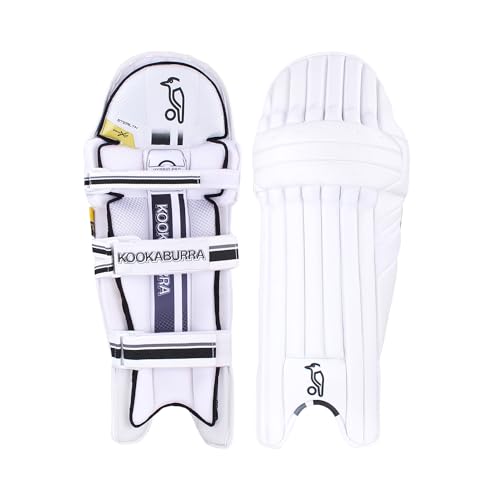
Leg pads protect your shins and knees from a hard leather ball traveling at 60–80 mph. This is not optional safety gear. A cricket ball will bruise bone. Quality pads are lightweight enough not to restrict your movement, strap securely so they don't shift mid-run, and have proper cane-reinforced knee rolls. Don't buy the ultra-cheap sets; the straps fail quickly and the padding thins out fast. Good pads run $60–120 and last years.
Best starter
SG
Super Club Cricket Batting Legguard
$$
★★★★★Our rating
SG (Sanspareils Greenlands) is one of India's premier cricket brands, the same gear used by Indian national team players at practice. The Club leg guards offer proper protection with cane-reinforced rolls, comfortable foam padding, and a secure three-strap fit. Real value at the price.
What we like
SG is India national team gear, proven quality at all levels
If you're looking for a name brand at a lower entry price, Kookaburra's Stealth Pro pads offer the fundamentals without cutting corners on protection. Lighter than the SG Super Club, which some players prefer for quick running between wickets.
What we like
Kookaburra brand credibility at a budget-friendly price
Lighter weight helps with running between wickets
What to know
Velcro straps wear faster than buckle alternatives
Less impact absorption than SG Club on fast deliveries
Batting gloves protect your fingers from a cricket ball deflecting off the bat handle; an ungloved finger can fracture. They also improve grip significantly. The key specs: finger inserts (thicker = more protection), palm material (Pittards leather or microfiber), and fit. Gloves should feel snug with no excess at the fingertips. Buy from a real cricket brand; cheap gloves crack at the wrist seams within a month. Remember: right-hand and left-hand gloves are sold separately in cricket.
Best starter
SG
Test Pro Cricket Batting Gloves
$134.99 as of Jun 22, 2026
★★★★★Our rating· In stock
The SG Test Pro is the glove SG puts on serious club cricketers across India. Leather palm with solid grip, finger inserts for meaningful protection, and a comfortable velcro wrist closure. The right beginner glove at an honest price from a brand that supplies the Indian domestic circuit.
What we like
SG gear worn by serious club players across the subcontinent
Microfiber palm gives genuine grip improvement on the bat handle
Velcro closure adjusts for different wrist widths
What to know
Runs slightly large; if between sizes, go down one
Sold as a single glove; confirm you order the correct hand
When you're playing regular league cricket, Kookaburra's Ghost 2.0 gloves are worth the step up. Better palm grip material gives noticeably improved durability over budget alternatives. The finger protection is also beefier, important once you've taken a hit and want more confidence.
What we like
Kookaburra quality: trusted at every level of the sport
Stronger finger inserts for confidence against fast bowlers
What to know
Leather palm requires break-in period; stiff in first few uses
Two to three times the cost of adequate beginner gloves
A cricket helmet is non-negotiable once you're facing any pace bowling, even in net practice. A cricket ball weighs 5.5 ounces and can travel at 80+ mph; taking it to the head without protection is genuinely dangerous. Look for helmets tested to BS:7928 or equivalent standards. Key factors: steel grill with under-60mm gap (prevents ball penetration), ventilation, and weight. Never use any helmet more than 5–7 years old regardless of condition; the foam degrades.
Best starter
SG
Aero Shield Cricket Batting Helmet
$$
★★★★★Our rating
The SG Aero hits the right notes for a beginner: safety-tested to modern standards, adequate ventilation for long innings, and a steel grill with proper gap clearance. Comfortable foam lining, multiple sizes, and SG's quality control means you're not gambling on protection. The right first helmet.
What we like
Safety-tested to modern cricket helmet standards; not a compromise
Steel grill with proper gap; won't pass a regulation cricket ball
SG quality control: consistent sizing and padding fit
What to know
Heavier than premium helmets at higher price points
Ventilation is adequate but not exceptional in hot conditions
Masuri makes helmets worn at Test match level. The Vision Series delivers the same shell construction and grill engineering as pro helmets at a price club cricketers can justify. Dramatically better ventilation than budget helmets, and the 360-degree adjustment system gets the fit right fast.
What we like
Masuri protects international cricketers; real engineering pedigree
360-degree fit system dials in comfort faster than foam pads
Noticeably better ventilation than budget helmets in hot matches
What to know
Shallower profile than Indian-made helmets; fit check recommended
Higher price requires genuine commitment to league cricket
What ball you need depends entirely on what you're playing. Most US park cricket uses a tennis ball or a composition practice ball (safer for beginners and requiring no special pitch). Leather balls are for formal league matches and nets practice with serious bowlers. If you're starting out, buy a composition or tennis ball first; save the leather ball for when you're playing league games. Leather balls also age; they lose the shine that drives swing bowling, so budget for a fresh one each match.
Best starter
Kookaburra
County Club Cricket Ball
$
★★★★★Our rating
The County Club is Kookaburra's entry-level leather ball; it has a proper raised seam and correct weight, but is less hard than a pro-grade match ball. This makes it ideal for nets and practice against real bowlers when you're ready to step up from composition or tennis balls. Perfect for the transition to serious cricket.
What we like
Real leather and raised seam that teaches proper batting technique
Less hard than match balls, a sensible step up from tennis ball
Kookaburra quality assurance on size and weight consistency
What to know
Requires full protective gear; not for informal no-pads cricket
Leather construction means it can sting on a mistimed shot
When you're ready for actual league cricket or serious nets with hard-ball bowlers, this is the ball. The County Star is Kookaburra's mid-range leather ball with proper seam, real cricket weight, and holds its shape through a full match innings. Buy a pair: one for practice, one kept new for match day.
What we like
Full leather construction for proper swing and seam movement
County Star grade: real match ball at a non-pro price
What to know
Requires full protective gear; not for informal use
Goes soft after 70–80 overs; budget for a replacement each match
Much of US park and informal cricket is played with a tennis ball, and Cosco's dedicated cricket tennis ball is the standard. Heavier and harder than a regular tennis ball, with a better weight for cricket shots. A 6-pack gets a whole session sorted. This is what most US beginners actually play with for their first year.
What we like
The standard ball for most US park cricket; everyone plays with these
No protective gear required; safe for learning cricket fundamentals
What to know
Habits learned with tennis balls can be hard to unlearn on leather
Not accepted in any formal league; a stepping stone, not a destination
Cricket has a lot of gear. A kit bag that fits a bat, two pads, two gloves, a helmet, and a water bottle is mandatory once you're playing regularly; you can't realistically carry this in a backpack. Wheeled kit bags are standard at club level because leg pads are bulky. Most bags have bat sleeves, a shoe compartment, and side pockets for balls and accessories. You don't need a massive professional bag to start; a mid-size duffle with bat sleeve covers a beginner's kit perfectly.
Best starter
SS
Professional Cricket Kitbag
$$
★★★★★Our rating
SS makes the same quality kit bags used across club cricket in South Asia and the UK. Their mid-size kit bag fits a full beginner's kit: bat, pads, gloves, helmet, balls, and accessories, without the bulk of a wheeled pro bag. Durable canvas construction with a dedicated bat sleeve and shoe compartment.
What we like
Fits full beginner's kit: bat, pads, gloves, helmet, and balls
Dedicated bat sleeve protects the bat face from scuffs in transit
SS build quality: sturdy zippers and seams that survive car boots
What to know
Shoulder straps stress under full kit load; use handles instead
Once you're playing league cricket regularly, wheels change everything; a full kit loaded with two bats, pads, and a helmet is genuinely heavy. Kookaburra's Pro 2000 wheelie is the format most serious club players graduate to. Multiple bat sleeves, separate wet gear compartment, and Kookaburra's construction quality.
What we like
Wheels make heavy full kit manageable on matchday
Multiple bat sleeves and a separate wet gear compartment
What to know
Large footprint; verify it fits in your car before ordering
Most beginners overthink the rules and underprepare for the physicality. Here's what actually happens, week by week, between picking up a bat and feeling like a real cricketer.
Cricket has a reputation for being impossibly complicated. The laws of cricket are 42 pages long. Test matches last five days. The scoring sounds like a foreign language.
None of that matters on day one. Most of what you need to understand cricket (the real game, the one you’ll actually play) fits in a fifteen-minute conversation. The rest accumulates over a season the way all sports knowledge does: by playing, losing, asking questions, and playing again.
This is what your first season of cricket actually looks like, phase by phase, with the things that matter and the things you’ll be tempted to study but shouldn’t.
Weeks 1–2: Learning to stand correctly
The single most important thing you do in cricket is nothing, at least at first. Good batting begins with stillness. You stand sideways to the bowler, feet shoulder-width apart, weight balanced over the balls of your feet. Your eyes are level. Your head is still. The bat rests lightly on the ground near your back toe, face toward the bowler.
This is the guard position, and it’s worth getting right before anything else. Grab a bat and stand in front of a mirror if you need to. The body position that feels athletic and balanced when a ball is coming at you is not the same one that feels natural when nothing’s happening.
The grip follows from the stance. Both hands grip the bat handle with the V between thumb and forefinger pointing toward the outside edge. Don’t strangle it. Loose hands = better timing = harder shots, counterintuitively.
Most beginners in the US start with tennis ball cricket in parks or car parks, and this is a fine way to learn the physical vocabulary. Batting a tennis ball teaches you to watch the ball, swing through the line, and trust your timing, the three fundamentals that transfer to leather ball cricket exactly. Don’t be embarrassed by it. Almost every South Asian and Caribbean player learned this way.
Here’s the 20% of cricket law that covers 95% of what you’ll encounter as a beginner:
How you’re out:
Bowled: the ball hits your stumps directly. The most ignominious dismissal. Protect your stumps.
LBW (Leg Before Wicket): the ball hits your leg pad instead of your bat, and would have gone on to hit the stumps. The most argued dismissal. At beginner level, just try not to get hit on the pads in front of your stumps.
Caught: you hit the ball and a fielder catches it before it bounces. Don’t edge behind to the keeper.
Run out: a fielder hits the stumps while you’re running between wickets and you haven’t made your ground. Call clearly with your partner: “yes,” “no,” or “wait.”
Stumped: the wicketkeeper takes the ball and breaks the stumps while you’re out of your crease. Don’t wander out unless you’re driving the ball.
There are more ways to be dismissed (handled the ball, hit the ball twice, obstructing the field), but you won’t encounter them this season. Don’t study them yet.
How scoring works: You score runs by hitting the ball and running between the stumps at each end, or by hitting boundaries (four if it reaches the rope along the ground, six if it clears the rope in the air). Your team bats in “innings”; you bat until ten of your eleven players are dismissed, then you swap.
Formats you’ll actually play: T20 is 20 overs per side (120 balls) and takes about three hours. Most US league cricket and informal cricket is T20. An “over” is six legal deliveries from one bowler. When you hear “we need 30 off 5 overs,” that’s 30 runs in 30 balls, about one run per ball, which is very gettable.
By the time you’ve had a month of practice or informal cricket, you’re ready to play in a proper game. The experience is different enough from practice that you should expect it to feel harder:
The mental load is real. In practice, you’re thinking about your feet and your swing. In a match, you’re also tracking the score, reading the bowler, communicating with your partner, thinking about the field settings. This reduces experienced players to basics, and reduces beginners to survival mode. That’s fine. Survival is the first goal.
Batting tips for your first games:
Play straight. Most beginners get out trying to play across the line of the ball. If the ball is pitched on your stumps, the bat should swing straight. Save the square cuts and pulls for later.
Watch the ball from the bowler’s hand, not from the air. The earlier you pick up the line and length, the more time you have to decide what to do.
Run decisively. Hesitation between wickets causes more run-outs than poor judgment. If you’re going, go hard. Call loudly.
Protect your wicket first, score second. A batter who makes 15 off 25 balls and doesn’t get out is more valuable than a batter who swings wildly for a quick 20 and gets caught on the boundary.
Fielding: You’ll field more overs than you’ll bat. Take it seriously. A sharp fielder who can throw accurately to the keeper’s gloves is valuable even when they’re scoring nothing. Practice catching in the outfield before games; dropped catches are demoralizing and preventable.
Bowling basics: If you’re asked to bowl (and you will be eventually), focus on line and length before pace. A medium-pace ball landing on a good length outside off stump is genuinely dangerous. A fast ball that lands halfway down the pitch and sails over the batsman’s head is not. Consistency beats aggression at beginner level.
Things you’ll fail at (and that’s normal)
Every beginner fails at the same handful of things. You will too:
Getting out for a duck. You’ll face five balls and get caught behind without scoring. It happens to international cricketers. It’s the nature of cricket; one bad shot and it’s over. Don’t dwell on it. Walk off, watch the next batter, and take notes.
Missing the ball completely. The ball moves off the pitch in ways you’re not expecting yet: off the seam, through the air. Your eye calibrates slowly. Accept the first few weeks of miscued shots as the tuition fee.
Overthinking your technique in the middle. The practice cage is where you build technique. The crease is where you play cricket. Trust what you’ve practiced and react to the ball. Analysis is for afterward.
Not calling clearly on runs. “Yes,” “No,” “Wait”: shout it like you mean it. Quiet calls cause run-outs.
Nobody who watches you cares. The other beginners are making the same mistakes. The experienced players remember exactly what it felt like and are mostly hoping you’ll enjoy it enough to keep coming back.
What changes at the one-season mark
After your first full season (roughly 15-20 games), a few things shift:
Your eye genuinely improves. The ball that looked like a blur starts to look like a ball. You start picking up length earlier (full delivery vs. short ball) in time to adjust your shot. This is not something you can rush; it comes from reps, and it does come.
You develop a shot repertoire. In the beginning, you play one or two shots comfortably. After a season, you’ll have an off drive, a cut, a pull, and a defensive prod. You won’t always execute them, but you’ll know which one to attempt. That selection skill is the real game of batting.
Find a regular crew. Two or three players at roughly your level who meet weekly. Cricket is better as a regular practice than an occasional event. The skills accumulate only if you’re playing consistently. A local club’s training night is worth attending even when you don’t feel like it.
Take one coaching session around game fifteen. Not before; you don’t have enough context to use it well. After fifteen games, you know exactly which shots keep getting you out and which deliveries you can’t read. A competent coach will identify the one or two technical adjustments that’ll change your game for the next season.
Save your money
What you don't need yet
Beginners get pressured to buy a lot of stuff that doesn't help them play
better. Here's what we'd skip on day one.
English willow bat (Grade 1–2) — Kashmir willow is the right first bat. You can't feel the performance difference until your timing is developed (typically after 6–12 months of regular play).
Thigh pad and arm guard — Useful at higher levels of pace bowling. For beginner informal cricket, leg pads and gloves are sufficient; adding more protection slows your movement before you need it.
Bowling machine — Great for serious practice. Not the priority when most beginners still need to find their local league and play actual games against real bowlers.
Cricket spike shoes — Grass wickets require spikes; most US beginner cricket is on artificial turf or concrete where spikes are banned. Regular athletic shoes are fine to start.
Wicketkeeping gloves — A specialized position with completely different gear. Focus on batting and fielding first; wicketkeeping is a role you choose, not something all beginners need.
Batting glove inners — A comfort upgrade once you're playing 3+ days per week and sweating through gloves. Not necessary until you've developed the habit.
First week
Your first seven days
A short, real plan to get from gear-on-doorstep to actually playing.
Find your nearest cricket club or local pickup game. MLC has been growing the US cricket community rapidly; local leagues exist in most major metros. · Action
Get to a net session or park game before trying a proper match. Even two hours of throw-downs and batting will make your first game far less overwhelming. · Action
Start with your batting stance: sideways to the bowler, weight balanced, eyes level. Cricket technique starts with feet and balance, not the swing. · Learn
FAQ
Common questions
How much does it cost to start playing cricket in the US?
Expect $350–$500 for a proper beginner kit: bat ($80–$120), leg pads ($60–$80), gloves ($40–$60), helmet ($80–$100), and a bag ($40–$60). Many clubs lend gear to first-timers; ask before buying everything.
Do I need special shoes for cricket?
Not at first. Spike cricket shoes are for grass wickets. Most US beginner cricket is on artificial turf or concrete; plain athletic shoes are fine and often required. Buy spikes only if your league plays on proper turf pitches.
Is cricket hard to learn from scratch?
The basics (how to bat, how to field, how scoring works) can be picked up in an afternoon. The laws of cricket are complex, but beginners only need about 20% of them. The real skill curve is timing, technique, and reading play, which takes a season to develop.
What's the difference between T20, ODI, and Test cricket?
T20 is 20 overs per side, takes about 3 hours, and is what US beginners will play most. ODI cricket is 50 overs per side (about 7 hours). Test cricket is 5 days; you won't play this as a beginner. MLC uses T20. Start there.
Can I play cricket if I'm left-handed?
Yes, left-handed batters and bowlers are common and often valuable. Left-hand batting gloves and pads are sold separately and labeled accordingly. When ordering, specify whether you bat right-hand or left-hand.
Where can I watch cricket to learn the game faster?
Willow TV is the US streaming home of international cricket. MLC games are broadcast free. Watch how batters play off the back foot vs. front foot, and how fielding positions shift by bowler; these patterns make your own game click faster.
USA Cricket — The national governing body for cricket in the US. Find affiliated clubs, leagues, and development programs near you.
Major League Cricket — The professional T20 league launched in 2023, the clearest sign of cricket's US growth. Good for watching the game and finding local community.
As an Amazon Associate, JustBeginning earns from qualifying purchases.
We may also earn commission from other affiliate programs linked on this
page. Editorial recommendations are independent; we don't choose
products based on commission rates.
Product prices and availability are accurate as of the date and time
indicated and are subject to change. Any price and availability
information shown on Amazon at the time of purchase will apply.
Our top pickSG Max Cover Kashmir Willow Cricket Bat


 Best starter