Cross-stitch rewards you faster than almost any craft. A beginner kit gives you everything you need for under $25, and most people finish their first piece in a weekend. Here's exactly what to buy — and the one decision to make before you do.
By Colin B. · Published May 15, 2026 · Last reviewed June 1, 2026
A complete beginner kit is $15–25 and has everything you need. To branch out beyond kits — your own fabric, floss, and hoops — you're still under $60 total.
We earn commission on qualifying Amazon purchases — see our
affiliate disclosure.
Price tiers and budget totals shown above are editorial estimates;
actual Amazon prices vary.
At a glance
Our top pick in each category
The fastest path through this guide — each best-starter pick by category.
Scroll for the budget and upgrade alternatives.
Start with a kit, not loose materials. A cross-stitch kit gives you fabric cut to size, the exact floss you need in the right colors, a needle, and a pattern — all calibrated to work together. No measuring, no guessing, no 'did I buy the right count?' anxiety. Your first project should be a kit; save the standalone supplies for project two.
The main decision is stamped vs. counted. Stamped kits have the pattern printed directly on the fabric — you fill in each symbol. Counted kits give you blank fabric and a chart; you count out where each stitch goes. Stamped is easier to start; counted is what most stitchers move to because it opens up any pattern on the internet.
Don't buy a lot of floss colors upfront. Most beginner kits use 3–8 colors. If you go buy your own floss before you know what you like, you'll end up with 50 skeins and use four. Let the kits teach you what colors you gravitate toward first.
A kit is the best way to start cross-stitch, full stop. Kits give you pre-cut fabric, the right amount of floss in each color, a needle, and a pattern — all calibrated to work together. You skip the 'did I buy the right count?' question and jump straight to stitching. The main choice is stamped (pattern printed on fabric, just fill it in) vs. counted (blank fabric + a chart you work from). Stamped is more beginner-friendly; counted is the technique that lets you stitch any pattern you find online.
Starter Kits — what's the difference?
A few common shapes, each making a different trade.
Stamped Cross-Stitch
Pattern printed on fabric. Fill in each symbol — no counting required.
Difficulty
Beginner
Chart reading
Not required
Design flexibility
Fixed to printed pattern
Best for Absolute beginners, kids, anyone who wants to start stitching immediately without learning chart-reading
Tradeoff Less flexible — you can only stitch the pattern that's printed on the fabric
Learn-A-Craft Hang In There Stamped Cross-Stitch Kit
$11.79 as of Jun 22, 2026
★★★★★Our rating· In stock
Dimensions is one of the most trusted names in needlework, and the Learn-A-Craft series is their beginner line. This stamped kit (pattern printed on the fabric — just fill in each symbol) comes with a 6-inch hoop, pre-sorted cotton floss, a needle, and clear instructions. Approachable design, everything you need, finishable in a weekend. A reliable day-one pick.
What we like
Includes everything — hoop, floss, needle, and pattern in one calibrated kit
Stamped design makes the starting point immediately intuitive
Small enough to finish in a single weekend
What to know
Included hoop is flimsy — worth replacing for a few dollars
Stamped format locks you into that kit's printed pattern only
Under $15 and complete — includes a 6-inch wooden hoop, 14-count Aida fabric, pre-sorted floss, needle, and instructions. A solid 'I'm not sure this will stick' entry: small design, achievable in an afternoon, and nothing's wasted if cross-stitch doesn't click for you.
What we like
Complete for under $15 — nothing else to buy to get started
Small design is achievable in an afternoon
What to know
Wooden hoop grips fabric less securely than plastic options
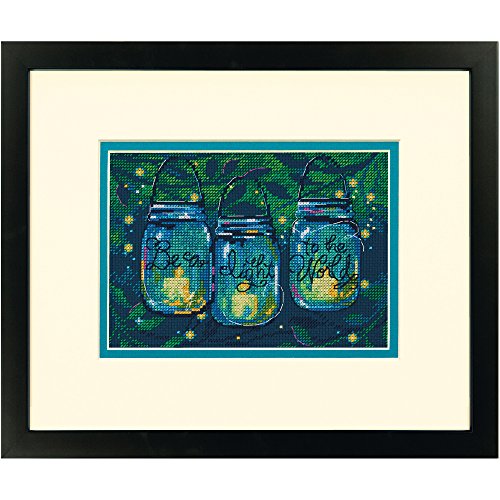
Counted Cross-Stitch Kit for Beginners, Be a Light
$$
★★★★☆Our rating
If you'd rather learn counted cross-stitch from the start, this Dimensions beginner kit is the right on-ramp. You get blank 14-count navy Aida and a printed chart — no pattern on the fabric. The candlelight design finishes at 7"×5" and is achievable in a weekend. The technique you learn here works for any pattern you'll find online or in books.
What we like
Teaches the counted technique that works for any pattern online or in books
Navy Aida gives the candlelight design a dramatic finished look
What to know
Chart-reading takes adjustment — always start from the center and work out
Aida is the fabric made for cross-stitch: it's woven with evenly spaced holes that guide your needle to the right spot. The 'count' refers to stitches per inch — 14-count is the beginner standard, with holes large enough to see clearly and fine enough for detailed patterns. Higher counts (18, 28) produce finer, smaller stitches. Linen and evenweave fabrics exist for advanced stitchers; skip them for now and stick with Aida.
Best starter
Charles Craft
Gold Standard Aida 14-Count, 12×18 White
$9.99 as of Jun 22, 2026
★★★★★Our rating· Only 14 left in stock - order soon.
14-count Aida from Charles Craft (DMC's fabric line) is the universal beginner standard. Consistent weave, holes easy to see under normal light, and virtually every beginner pattern is designed for 14-count. The 12"×18" cut gives you enough fabric for a couple of projects. White is the safe default color.
What we like
Universal beginner standard — virtually every beginner pattern targets 14-count
Consistent weave, easy to see and work under normal light
What to know
White shows handling marks — wash before framing the finished piece
Once you're comfortable with 14-count, 18-count opens up finer, more detailed patterns in a smaller finished size. Charles Craft's Gold Standard line is consistently woven and durable under repeated handling. The step up in detail is real — the same design on 18-count looks noticeably more refined.
What we like
Same reliable quality as 14-count with a noticeably finer finished result
Same design looks meaningfully more refined at 18-count
What to know
Holes are harder to see — good lighting is a requirement, not optional
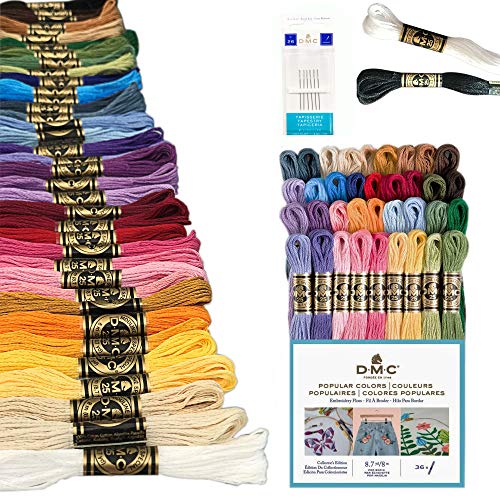
DMC is the industry standard for embroidery floss, and it matters: the colors are consistent batch to batch (so you can always match a number), and every pattern in the world is coded to DMC numbers. A six-strand cotton skein splits into two strands for most 14-count work — you'll learn this fast. Start with an assortment rather than individual colors. Once you know what you actually use, building a real DMC collection becomes satisfying.
Best starter
DMC
Popular Colors Embroidery Floss Pack (36 Skeins)
$42.99 as of Jun 22, 2026
★★★★★Our rating· In Stock
A 36-color assortment covers the core spectrum and gets you through most beginner kits and simple counted patterns. DMC's color consistency is the real value — every skein has the same number as the global DMC chart, so any pattern you find maps directly. Keep them organized from day one (see Accessories).
What we like
Covers the core color spectrum for most beginner kits and patterns
Color-consistent batch to batch — every number maps to the global DMC chart
What to know
36 loose skeins will tangle fast without a bobbin system — organize immediately
100 colors pre-wound on labeled bobbins for under $15. Quality is a step below DMC's, but for practicing stitches or early projects, the difference won't show. A good way to figure out what colors you gravitate toward before committing to building a proper DMC collection.
What we like
Pre-wound on labeled bobbins — organization is solved from day one
100 colors for under $15 covers nearly any beginner project
What to know
Quality a step below DMC — colors can be less consistent between skeins
A hoop keeps your fabric taut so stitches lie flat and even. A 6-inch plastic hoop handles the vast majority of beginner projects and costs about $3 — that's the only hoop you need to start. Plastic hoops grip the fabric more consistently than bamboo hoops, which look prettier but flex and slip. Q-snap frames (plastic clips, not a circle) are popular for larger projects: no hoop marks on the fabric, easier to reposition, and you can attach one to a floor stand.
Best starter
Susan Bates
Super Grip Embroidery Hoop, 6-Inch
$
★★★★★Our rating
Susan Bates makes the most consistently well-regarded beginner hoops. The inner lip is smooth so it doesn't snag fabric, the tension screw holds firmly, and the 6-inch size fits most beginner kit designs. If you only buy one hoop, this is it.
What we like
Smooth inner lip won't snag or distort Aida fabric
Tension screw holds firm through long stitching sessions
What to know
Single size — you'll want additional sizes as your projects grow larger
Once you move to larger projects or want to stitch for hours without repositioning, a Q-Snap frame is the upgrade worth making. No hoop marks on your fabric, easier to reposition, and the 11×11 handles most mid-size patterns comfortably. You can also attach it to a clip stand so both hands stay free.
What we like
No hoop marks on fabric — better for long projects or fine count work
Attaches to a clip stand so both hands stay free while stitching
What to know
Poor hold on small pieces — use a hoop for anything under 5 inches square
Three small purchases that make cross-stitch meaningfully more pleasant: small sharp scissors (the tiny 3–4-inch kind cut floss cleanly right at the fabric surface), a needle minder (two small magnets that grip your needle while you're not using it — prevents the couch-cushion disappearing act), and a floss organizer system (bobbins labeled with DMC numbers, stored in a box you can flip through). Total for all three is under $25, and you'll use them for years.
Best starter
Gingher
Stork Embroidery Scissors, 3.5-Inch
$25.31 as of Jun 22, 2026
★★★★★Our rating· In Stock
Gingher embroidery scissors are one of the few accessories that cross-stitchers genuinely love. Sharp enough to snip floss cleanly right at the fabric surface, small enough to control precisely, and durable enough to last your entire stitching life. The stork-shaped ones are a classic for good reason.
What we like
Sharp enough to snip floss right at the fabric surface without pulling
Built to last — these are effectively a one-time purchase
What to know
More expensive than craft scissors, but the quality difference is real
A needle minder is two small magnets — one on each side of your fabric — that hold your needle when you set it down. Without one, your needle will disappear into a couch at least once per project. They come in hundreds of designs (cats, botanical prints, geometric shapes) and make the perfect $10 gift for anyone getting into needlework.
What we like
Solves the 'needle lost in the couch' problem completely
Hundreds of designs — an easy way to personalize your hoop
What to know
Strong magnets can snag nearby threads if not positioned carefully
As your floss collection grows, this is the system the whole community converges on: plastic bobbins embossed with the DMC logo, labeled with the color number, stored in a shallow box you can flip through. Winding floss onto bobbins takes 30 minutes upfront and saves you hours of untangling later. Start the habit as soon as you own more than one skein.
What we like
The system the entire cross-stitch community converges on — start early
30 minutes to set up prevents hours of future untangling
What to know
Takes time to wind initially — easy to skip, and always worth doing
You can be mid-project by tonight. Cross-stitch has one of the shortest runways of any craft — the basic stitch takes five minutes to learn, a beginner kit has everything pre-measured, and most people finish their first piece in a weekend.
Cross-stitch is one of the few hobbies where the first project genuinely teaches you the whole craft. There’s no months-long ramp-up, no expensive gear to figure out, no “you’ll understand it later.” You open a kit, make a few stitches, and the logic becomes immediately obvious.
This is what your first weekend actually looks like — what’s easy, what trips people up, and when it starts to feel like something you want to keep doing.
The First 30 Minutes: Threading Up
The biggest barrier to starting is the needle, not the stitch.
Threading a cross-stitch needle sounds simple. It is, once you know the trick: fold the floss over the needle, pinch it tightly right at the fold so the loop is barely visible, slip the needle out from between your fingers, and push that tiny folded loop through the eye. The loop start thread-beginning comes from the same principle — loop the floss in half, thread both cut ends through the needle, and when you start your first stitch, pass the needle through the loop on the back. No knots. Clean finish. Takes two minutes to learn and you’ll use it forever.
Once you’re threaded: two strands, 14-count Aida, and the stitch itself. A full cross-stitch is two diagonal stitches, one going bottom-left to top-right, one going top-left to bottom-right. Go down through a hole, come up through a hole, go down again, come up again. The X you make is one complete stitch. That’s the whole technique.
Your first 10 stitches will be inconsistent. That’s fine. By stitch 30, your hand is already settling into a rhythm.
A few things that help immediately: keep your tension even — you want the thread to lie flat on the fabric, not pulled tight or looping loose. And stitch all the crosses in the same direction: all the bottom stitches going one way, all the top stitches going the other. It doesn’t matter which direction you choose. It matters that you pick one and stick to it throughout the piece.
Stamped kits print the symbols on the fabric so you can see exactly where each color goes. Counted kits give you a grid chart where each square represents one stitch — you start at the center of the fabric, match it to the center of the chart, and work outward.
Stamped is easier to see; counted is easier to track. On stamped kits, you’ll sometimes struggle to see where one symbol ends and the next begins under your stitching. On counted kits, you’ll sometimes lose your place in the chart. Both problems have the same fix: work one color at a time, finish a section, mark it done.
The color changes are where cross-stitch starts to feel satisfying. You finish the blue section, cut the thread, knot it off on the back, bring in the next color, and the design starts to take shape. This is the rhythm: one color, a few rows, a visible result. Unlike a lot of crafts, cross-stitch gives you constant, small rewards.
A note on the back of your work: it’ll be messy. That’s normal. The goal is a tidy front, not a perfect back. Experienced stitchers do learn to keep the back neat — it matters if the piece will be framed over a dark background or displayed against light — but for your first project, ignore it completely. Finish the front.
By hour two, most beginners are making consistent stitches and moving between colors without stopping to think about the mechanics. That’s when the project becomes enjoyable rather than effortful. Give it until then before you decide whether you like it.
Most small beginner kits take 4–8 hours to complete. The last section of any cross-stitch project has a specific quality: you’re filling in background or small details, and each stitch brings the whole design into sharper focus. It’s one of the more satisfying finishes in any craft.
When you’re done stitching, there’s usually a small amount of back stitching to add. Back stitch is the outline — a single running stitch that defines edges and adds detail. It’s marked on charts with a solid line rather than a filled square. Run the needle forward one hole, back one hole, forward again. The outline transforms the piece from a collection of colored squares into something that reads as an image.
To finish the piece, you’ll want to gently hand-wash the fabric to remove any handling oils or printed symbols (on stamped kits), press it face-down on a towel to avoid flattening the stitches, and let it dry flat. Then frame it or mount it on a card. Seeing the finished piece on a wall or desk — even a small one — makes the second project feel inevitable.
Most people who start a second cross-stitch project within a week of finishing the first are still doing it six months later. Most people who wait two weeks don’t go back. Set up the next project before you’re done with the first one.
Every beginner makes the same handful of mistakes. You will too. They’re not serious:
Tangled floss. This is the most common source of frustration, and it’s entirely preventable. Wind your floss onto labeled bobbins the moment you open the kit. Don’t stitch from a loose skein. If a strand tangles while you’re working, let the needle dangle and the thread will un-twist itself.
Miscounting on counted kits. The classic mistake is starting too far from the center and running off the edge of the fabric. Always find the center of the fabric (fold it in quarters, mark the intersection) and match it to the center of the chart before your first stitch. Work in small sections and check your position every 10–15 stitches.
Uneven tension. Stitches that look puckered or loose usually come from inconsistent pull on the thread. Practice a few rows until you find the pressure that keeps the fabric flat and the stitches just touching the surface without pulling through.
Too-long thread lengths. Cut your working thread to about 18 inches. Longer threads tangle and fray as they’re pulled through the fabric repeatedly. 18 inches feels short but is actually the right working length.
Nobody’s first piece is perfect. The goal of the first project is to finish it, not to make something flawless. Stitch it, frame it, hang it up, and then make the second one better.
Your Second Project
The first kit teaches you the mechanics. The second project is where you make a real choice.
The most interesting move is switching to counted cross-stitch if you started with stamped — it opens up everything. r/CrossStitch has a wiki full of free patterns, and StitchFiddle can turn any image into a counted chart. People stitch their pets, their favorite buildings, pixel art, vintage botanical prints. The design library is effectively unlimited.
When you choose your second project, pick something slightly more complex than the first: more colors, a slightly larger finished size, or your first counted design if you started stamped. The step up is motivating in a way that a too-easy project isn’t.
A few things that change the slope of your improvement:
Use proper scissors. Embroidery scissors with short, sharp blades make a meaningful difference. Being able to snip thread right at the fabric surface without pulling the stitches is worth the $15.
Wind floss onto bobbins. As your collection grows, labeled bobbins in a shallow box make finding any color by number instant. The stitchers who stick with it all develop some version of this system.
Stitch consistently. An hour of cross-stitch a few times a week produces finished pieces. An occasional marathon session produces stiff hands and abandoned projects. The hobby rewards showing up steadily.
Save your money
What you don't need yet
Beginners get pressured to buy a lot of stuff that doesn't help them play
better. Here's what we'd skip on day one.
A scroll frame or floor stand — These are for large, long-term projects that don't fit in your lap. Your first several kits fit in a 6-inch hoop just fine.
Specialty fabrics — linen, evenweave, or Hardanger cloth — Beautiful materials, but each requires slightly different technique. Get comfortable on 14-count Aida first.
Silk or metallic floss — Metallic floss is notoriously fussy — it tangles, frays, and shreds through the fabric. Get comfortable with cotton before adding it.
Hundreds of individual DMC colors — Let the kits teach you what colors you actually use. A 36-color assortment is plenty for the first few months.
First week
Your first seven days
A short, real plan to get from gear-on-doorstep to actually playing.
Order a complete beginner kit — it arrives with everything you need to finish your first piece. · Buy
Learn the loop start for beginning your thread — cleaner than a knot, takes two minutes, used by everyone. · Learn
Loop start technique · YouTube · the cleanest way to begin a new thread with no knot on the back
Stitch for 30 minutes on your first sitting. Don't try to finish. Get comfortable threading the needle, making the stitch, and moving between colors. · Action
Finish the kit's design by the end of the week. A small kit takes 3–5 hours total. Finishing your first piece — even imperfectly — is worth more than a hundred hours of planning. · Action
Frame or display the finished piece. Seeing it on a wall makes the next project feel real. · Action
FAQ
Common questions
Is cross-stitch hard to learn?
It's one of the easiest fiber crafts to pick up. The basic stitch has two moves and takes five minutes to learn. Most beginners finish a small kit in their first weekend. The learning curve — keeping stitches even, managing thread tension, reading counted charts — is real but gradual and forgiving.
What's the difference between stamped and counted cross-stitch?
Stamped cross-stitch has the design printed directly on the fabric — you fill in each printed symbol with the right color. Counted cross-stitch gives you plain fabric and a chart; you count out where each stitch goes. Stamped is easier to start. Counted is more versatile and opens up any pattern you find online or in books.
What fabric count should I start with?
14-count Aida. The number refers to stitches per inch — 14-count has holes large enough to see and work easily, fine enough for detailed patterns. Once you're comfortable, 18-count is the natural next step for finer, smaller-scale work.
How long does a typical beginner project take?
A small beginner kit (roughly 5×5 inches or smaller) takes 3–8 hours. A medium project (8×10 inches) takes 15–30 hours. The size printed on a kit is the finished design size — a small finished pattern is genuinely achievable in a first weekend.
How many strands of floss should I use?
Two strands over 14-count Aida is the standard. Embroidery floss comes as 6 strands twisted together — separate two strands and stitch with those. Most patterns specify strand count; if yours doesn't, 2 strands over 14-count is the safe default.
Where can I find free cross-stitch patterns?
Everywhere. Pinterest has millions; Etsy has thousands of free downloads alongside paid ones; StitchFiddle lets you convert any image into a counted pattern. The r/CrossStitch community wiki has a curated list of free pattern sources that's worth bookmarking.
r/CrossStitch — 500k+ members, very welcoming to beginners. The Start Here wiki is the single best beginner resource anywhere — pattern sources, technique guides, and a community that posts finished projects daily.
DMC Thread — The floss standard-setter. The DMC color card on their site is the reference every pattern in the world uses. Bookmark it for finding any color by number.
StitchFiddle — Free tool that converts any image into a counted cross-stitch pattern. You can stitch a pet portrait, a map, a logo — surprisingly powerful.
Stitchonomy (YouTube) — Patient, clear beginner tutorials. Best starting point for learning technique from scratch — loop start, back stitch, how to end thread cleanly.
The World of Cross Stitching — Long-running UK magazine (print and digital) with patterns in every issue. More traditional aesthetic — florals, samplers, seasonal designs.
Etsy — Free Cross-Stitch Patterns — Filter results by price to find free downloads. Many independent designers offer one or two patterns free to attract customers — some of the best modern designs come from here.
As an Amazon Associate, JustBeginning earns from qualifying purchases.
We may also earn commission from other affiliate programs linked on this
page. Editorial recommendations are independent; we don't choose
products based on commission rates.
Product prices and availability are accurate as of the date and time
indicated and are subject to change. Any price and availability
information shown on Amazon at the time of purchase will apply.
Our top pickDimensions Learn-A-Craft Hang In There Stamped Cross-Stitch Kit


 Best starter