Macramé is one of the few crafts where the whole hobby is basically one knot. The square knot does 80% of the work in any project you'll make your first year. Here's exactly what you need to start — and the rabbit holes worth skipping until month three.
By Colin B. · Published May 22, 2026 · Last reviewed June 3, 2026
Macramé is one of the cheapest crafts to start. A spool of cord, a few dowels, and scissors you probably already own get you to your first finished piece.
We earn commission on qualifying Amazon purchases — see our
affiliate disclosure.
Price tiers and budget totals shown above are editorial estimates;
actual Amazon prices vary.
At a glance
Our top pick in each category
The fastest path through this guide — each best-starter pick by category.
Scroll for the budget and upgrade alternatives.
Get 3mm single-strand cotton cord and nothing else for your first week. Beginners overbuy — specialty rings, colored dye, a freestanding frame — before they've finished a single project. One 100-meter spool of 3mm natural cotton gets you through three or four beginner pieces and tells you whether you need anything else.
You don't need a macramé stand or frame. A wooden dowel hung from a door handle, a shower curtain rod, or a cup hook in the wall works for every beginner project. Freestanding stands cost $60–150 and are a month-three purchase at the earliest.
Buy more cord than you think you need. Cut each strand four to five times the finished length you want. A 12-inch-wide wall hanging that's 24 inches long needs 12 cords cut to about ten feet each — that's 120 feet of cord from a single design. The math surprises every beginner the first time.
Cord is the whole hobby — everything else is accessories. For beginners, 3mm single-strand (also called twisted or macramé cord) is the right default. It's soft on your hands, fringes beautifully into the brush-like ends you see in every wall hanging photo, and is what 90% of beginner tutorials assume you have. Avoid jute for your first project: it's rough, doesn't fray cleanly, and is hard on your hands for hours of knotting.
Cord — what's the difference?
A few common shapes, each making a different trade.
Single-Strand (Twisted)
Soft, fringes beautifully. The default for wall hangings.
Feel
Softest
Fringes
Yes — brush-like ends
Best thickness
3mm to start
Best for Wall hangings, any piece with decorative fringe ends
Tradeoff Slightly less structural than rope — use 3-ply for heavy plant hangers
Best for Modern, geometric pieces without fringe; keychains; minimal wall art
Tradeoff The least beginner-friendly — knotting is stiffer and you lose the signature macramé fringe look
Best starter
BOCHIKNOT
3mm Macramé Cord, Natural (330yds)
$26.99 as of Jun 22, 2026
★★★★★Our rating· In Stock
The community's go-to brand for a reason: consistent twist, soft on the hands, and the exact cord that most YouTube tutorials film with. 100 meters gets you through a first wall hanging with enough left for mistakes. The natural color works for everything and photographs beautifully.
What we like
Soft on hands — comfortable for long knotting sessions
Fringes into perfect brush-like ends
Consistent twist across the whole spool
What to know
Less structural than 3-ply for plant hangers holding weight
3-ply twisted rope holds its shape better than single-strand, which makes it the right pick for plant hangers — the structure stays clean under the weight of a pot. Doesn't fray into a soft brush, so skip it for wall hangings. Great for anything structural.
What we like
Holds its shape under the weight of a pot
More durable structure than single-strand for functional pieces
What to know
Won't fray into soft fringe — wrong pick for wall hangings
Once you're comfortable with 3mm, 5mm opens up large statement pieces — thick wall hangings and oversized plant hangers with real visual weight. GANXXET's cotton is notably soft and the range of colors is one of the widest available. The 50-yard spool is sized for individual projects, so you can try colors without committing.
What we like
Widest color range available for statement pieces
Noticeably soft cotton — gentler on hands than cheaper brands
What to know
Harder to knot than 3mm; hands fatigue noticeably faster
Most macramé projects need something to hang from — a wooden dowel for wall hangings, a metal ring for plant hangers. Natural wood dowels are the default because they're cheap, easy to find, and suit every aesthetic. You don't need specialty versions: a basic 1/2-inch dowel from any craft store works for every beginner project.
Best starter
Woodpeckers
1/2-Inch × 18-Inch Wooden Dowel Rods (25-Pack)
$17.99 as of Jun 22, 2026
★★★★★Our rating· In Stock
18-inch width is ideal for a first wall hanging — wide enough to show off your knot patterns but not overwhelming. Half-inch diameter has real visual weight on the wall. Woodpeckers dowels are consistently smooth and straight, with no rough spots for cord to catch on. 25 in a pack means plenty of extras.
What we like
Smooth and straight with no rough spots for cord to catch
25-pack means plenty of extras for multiple projects
What to know
Light sanding needed before use — takes about a minute
Metal rings are the mount for plant hangers — you fold your cords over the ring instead of a dowel, then hang from the ring itself. 4-inch is the standard size for pots up to 6 inches. These are solid, rust-resistant, and the clean gold finish photographs beautifully against natural cotton.
What we like
Solid, rust-resistant ring that lasts
Clean finish photographs beautifully against natural cotton
What to know
4-inch size only; buy larger rings for pots over 6 inches
Cotton macramé cord is thicker than it looks, and you'll cut hundreds of strands per project. Cheap scissors drag, fray the cut end, and tire your hand. One good pair of sharp craft scissors is worth more than any specialty macramé tool.
Best starter
Fiskars
RazorEdge Softgrip Fabric Shears, 8-Inch
$23.90 as of Jun 22, 2026
★★★★★Our rating· Only 8 left in stock - order soon.
Sharp enough to cut 5mm twisted cotton cord cleanly in one stroke. The long blade means less hand fatigue when you're cutting 30 strands at the start of a project. Fiskars has been making the same reliable scissors for decades — there's a reason every crafter recommends them.
What we like
Cuts 5mm cotton cord cleanly in one stroke
Long blade reduces hand fatigue on big cutting sessions
What to know
Must be kept cord-only — paper dulls the blade fast
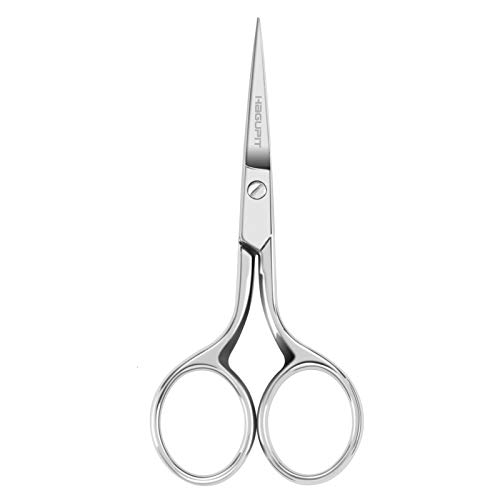
Small scissors for trimming fringe ends to length and cleaning up detail work. Not required for your first project, but once you're fringing out ends and evening them up, a dedicated small pair saves awkward maneuvering with the long blades.
What we like
Precise tips perfect for trimming fringe to length
Small enough to maneuver in tight knot gaps
What to know
Not a day-one essential — buy after your first finished piece
For small projects — keychains, small hangings — you can work directly from a hanging mount. For anything larger on a flat surface, a macramé project board lets you pin your work in progress and maintain tension without fighting the cord. Not required for your first project; useful by month two.
Best starter
Creative Roots
Macramé Project Work Cork Board with Pins (11 × 17 Inch)
$$
★★★★★Our rating
A purpose-built macramé board with a grid for measuring, cork surface for T-pins, and clips for holding work in progress. The 11 × 17-inch size handles most beginner wall hangings flat. Beats improvising with a generic corkboard — the grid lines are the useful part.
What we like
Built-in grid for measuring knot spacing and layout
Cork surface holds T-pins securely throughout a project
What to know
Heavy relative to other options — best as a permanent workstation
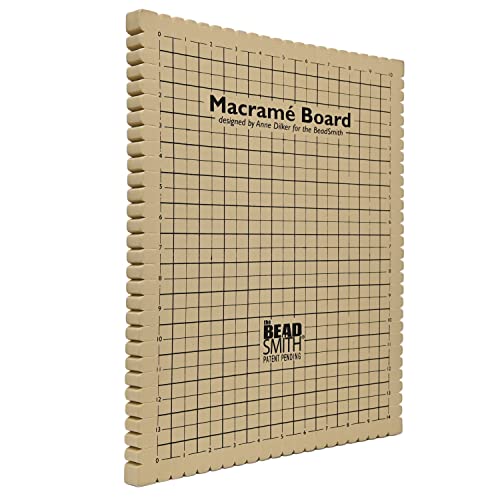
A simpler foam-core option with a printed 10×14 grid for measuring and notched edges that hold cords in place while you work. Good if you mainly do smaller pieces like bracelets and keychains — lighter and easier to move around the table than a cork board.
What we like
Lightweight foam-core — easy to reposition on any surface
Notched edges hold cords in place without clips
What to know
Grid area smaller than cork boards — tight for larger pieces
Fraying cord ends into soft, brush-like fringe is the signature macramé finish — and the tool everyone uses is a regular pet slicker brush. This is not a joke. Unravel the cord plies, then brush with the slicker in one direction and the fibers fluff into a perfect soft finish. A stiff-bristle toothbrush works for small pieces. A dedicated comb or brush makes the difference between a matted end and a clean, professional fringe.
Best starter
Hertzko
Self-Cleaning Slicker Brush
$15.99 as of Jun 22, 2026
★★★★★Our rating· In stock
The pet slicker brush is the macramé community's worst-kept secret. The bent wire bristles separate and fluff cotton cord fibers better than anything marketed specifically for macramé, and the self-cleaning button ejects the fiber quickly. Get one with medium-firm bristles.
What we like
Bent wire bristles separate cotton fibers better than any macramé tool
Self-cleaning button ejects fiber instantly
What to know
Overkill for tiny projects — a stiff toothbrush handles small pieces
★★★★☆Our rating· Only 4 left in stock - order soon.
A wide-tooth stainless comb for working through thicker cord after brushing. Two tooth spacings (fine and wide) handle 3mm and 5mm cord differently. Useful for cleaning up fringe on larger pieces once you've moved past the slicker brush for coarser finishes.
What we like
Two tooth spacings handle 3mm and 5mm cord differently
Stainless steel won't rust from cotton fiber oils
What to know
Redundant if you already own a wide-tooth metal comb
Two knots get you through almost every beginner project. Here's how to go from zero to your first finished wall hanging in a weekend — no experience required.
Macramé has a reputation for being complicated, and that reputation is completely undeserved. The square knot is the whole hobby for your first month. Everything else — the spiral half hitch, the gathering knot, the lark’s head — is just variations on the same idea. Once your hands know the square knot, you can finish a wall hanging in an afternoon.
Here’s what your first weekend actually looks like, from cutting your first cords to fringing your first piece.
Day one, hour one: Set up and learn the square knot
You don’t need to prep your space, build anything, or set up a frame. Tie your dowel to a door handle — that’s your workstation.
Cut 8 cords of 3mm single-strand cotton, each about 5 feet long. Fold each one in half and attach it to the dowel using a lark’s head knot: fold the cord in half, loop it over the dowel, and pull the tails through the loop. That’s your mount. Do it for all 8 cords — now you have 16 hanging strands.
The square knot: Take 4 strands. The two outer strands are your working cords; the two inner strands are your filler (they just hang there). Cross the right working cord over the fillers and under the left working cord. Then bring the left working cord under the fillers and up through the loop created on the right. Pull snug. That’s the first half. Repeat in mirror: left over fillers under right, right under fillers and up through the loop. Pull snug. That’s a complete square knot.
Tie it 10 times in a row. Then tie it 10 more times. Your hands don’t know this motion yet — muscle memory comes from repetition, not from understanding. After 20 square knots your fingers start doing it without checking.
Day one, hours two to four: Your first wall hanging
Now use those 16 strands. Here’s the simplest pattern that looks like a real piece:
Rows of square knots: Working across all 16 strands in groups of 4, tie a row of 4 square knots. Then shift: skip the first 2 strands, tie 3 square knots using strands 3–6, 7–10, and 11–14, skip the last 2. Then shift back and tie 4 square knots again. Repeat these two rows 6–8 times. You now have a diamond lattice pattern — the backbone of most macramé wall hangings — and you haven’t learned a single new knot.
Spacing matters. Tie your knots closer together (about half an inch apart) for a dense look, further apart (one to two inches) for an open, airy piece. Neither is wrong; they’re aesthetic choices. Beginners tend to tie too tight and too close together because it feels more controlled. Give yourself permission to open it up.
Finishing the top and bottom: At the top, you can tie a horizontal half hitch across all cords to create a clean edge. At the bottom, just let the cords hang as fringe — that’s the look.
Fringe the ends: Unravel each strand by untwisting the plies with your fingers. Then take a pet slicker brush and brush each one downward in firm strokes. The fibers will separate and fluff into a soft, feathery brush-like end. This single step transforms the piece from looking like loose cords to looking like a real piece of macramé. Trim the ends to an even length — or a V-shape, or a diagonal — with sharp scissors.
Plant hangers are the second fundamental macramé form, and they use a slightly different approach: you work in the round rather than flat across a dowel.
Cut 4 cords of 3mm (or 3-ply) cotton, each about 8 feet long. Fold them in half and attach all 8 to a metal ring, using lark’s head knots or a gathering knot (loop a separate short piece around all 8 strands and knot it tight to create a neat top).
Separate into 4 groups of 2 strands each. Tie square knots in each group, spacing them about 6 inches down from the ring. Then alternate: tie square knots taking 1 strand from each adjacent pair, 12 inches down from the previous knots. Repeat for one more row at 18 inches. Gather all 8 strands and tie a single large gathering knot or an overhand knot — that’s where the pot sits.
The plant hanger teaches you to work symmetrically without a flat surface to guide you — a different skill from the wall hanging, and the foundation for more complex three-dimensional pieces.
What trips up almost every beginner
Inconsistent tension. Your knots will look uneven for your first few projects because you’ll pull some tighter than others without realizing it. There’s no fix except to finish projects and notice your tendencies. Most people pull too tight when they’re learning and too loose when they’re relaxed — knowing which way you drift tells you how to compensate.
Running out of cord mid-project. The calculation feels right until you tie your first 20 knots and realize you’ve used three feet of working cord already. For any piece over 12 inches wide, cut your working cords longer than you think you need — then trim the excess rather than running short.
Knotting the wrong cords. With 16 or more strands, it’s easy to grab a filler instead of a working cord. Slow down, count your groups of 4, and keep unused strands away from the working area. A binder clip or rubber band on held-aside cords helps.
Not fringing. Skipping the brushing step because it sounds optional. It’s not — the fringe is half the visual impact of the piece.
Once you’re comfortable with the square knot and lark’s head mount, the vocabulary expands quickly:
Spiral half hitch (half square knot column): Tie only the first half of the square knot repeatedly. The cords spiral naturally — it looks complex and takes about five minutes to learn.
Gathering knot: A wrapping knot that bundles multiple strands into a clean transition. Used at the top of plant hangers and wherever you want a tidy cluster.
Diagonal half hitch: The knot that creates angled lines and chevron patterns. It’s a new motion but the same mechanical idea as a square knot — two movements, one from each side.
Macramé is one of those crafts where the repertoire is genuinely small but the combinations are enormous. Most intermediate pieces are built from four or five knot types. The difference between a beginner piece and a complex one isn’t new knots — it’s pattern complexity and spatial planning.
Save your money
What you don't need yet
Beginners get pressured to buy a lot of stuff that doesn't help them play
better. Here's what we'd skip on day one.
A macramé stand or frame ($60–150) — A door handle or curtain rod does the same thing for free. A stand is only worth it if you're working on very large pieces and need your hands fully free — that's a month-three problem.
Dye kits — Learn the knots on natural cord before adding color. Dyeing requires heat, mordants, and workspace planning — a separate skill set from macramé itself. Natural cord looks beautiful and photographs better than most beginner dye jobs anyway.
Jute or sisal rope — They look rustic and appealing in photos, but jute is rough on the hands, difficult to fray cleanly, and harder to work with than cotton for hours at a stretch. Cotton first.
Macramé pattern books — Free YouTube tutorials cover everything through at least month six. Macramé School, Soulful Notions, and a dozen other channels have complete beginner-to-intermediate libraries. Save the books for when you want to go deeper.
T-pins and blocking mats — Useful eventually for flat-surfaced work like table runners. Not needed for wall hangings or plant hangers, which are the natural first projects.
First week
Your first seven days
A short, real plan to get from gear-on-doorstep to actually playing.
Order 100m of 3mm single-strand cotton macramé cord. · Buy
Watch one 20-minute beginner square knot tutorial on YouTube. Search 'macramé beginner wall hanging square knot' — there are dozens of good free ones. · Learn
Tie your dowel to a door handle or hook. Cut 8 cords at 5 feet each. Spend 30 minutes just practicing the square knot — no project, just the motion. Muscle memory comes fast. · Action
Make a simple 4-inch wide wall hanging using only square knots. It doesn't have to be good. It just has to be finished. · Action
Get a pet slicker brush to practice fraying the cord ends into fringe. This is the step that makes the piece look professional instead of rough. · Buy
For a simple 12-inch-wide, 18-inch-long wall hanging, plan on 12 cords each cut to about 8 feet — that's roughly 96 feet total, or just under a 30-meter spool. Buy a 100-meter spool and you'll have plenty for mistakes and a second attempt.
What size cord should I start with?
3mm single-strand cotton. It's what 90% of beginner tutorials use, it's forgiving for learning knots, and it fringes beautifully. Go thicker (5mm) once you're comfortable and want larger, bolder pieces.
Do I need a special frame or stand?
No. A wooden dowel hung from a door handle, curtain rod, or hook in the wall works perfectly for wall hangings. A metal ring hung from the same spot works for plant hangers. You don't need a freestanding frame until you're making very large pieces.
Is macramé hard to learn?
The square knot takes about 30 minutes to get comfortable with. Most beginner projects use only the square knot and the half hitch — two motions. The complexity in advanced pieces comes from patterns, not new knot types. One weekend gets you to your first finished piece.
What's the difference between macramé cord and macramé rope?
Cord (single-strand or twisted) is softer and fringes into a beautiful brush-like end — best for wall hangings. Rope (3-ply) is more structured and holds knots tighter — better for plant hangers that need to support weight. Both are cotton; the difference is how the fibers are twisted together.
Can I use yarn instead of macramé cord?
You can practice knots with yarn, but it stretches under tension, tangles easily, and doesn't hold knot shapes the way macramé cord does. A small spool of proper cord is cheap enough that it's not worth improvising with the wrong material.
r/macrame — Active community with project feedback, pattern recommendations, and beginner advice. The weekly 'show off your work' threads are a good skill benchmark.
Macramé School (YouTube) — One of the most-followed macramé tutorial channels. Start with the beginner wall hanging series — it's methodical and shows the knots from multiple angles.
Soulful Notions (YouTube) — Calm, well-shot tutorials with strong close-ups of hand position. Good for visual learners who want to see exactly where fingers go.
Pinterest — Macramé Patterns — The best visual catalog for design inspiration and free pattern diagrams. Search 'macramé beginner pattern' to filter to your level.
BOCHIKNOT Blog — The cord brand runs a genuine tutorial library — knotting guides, project ideas, and a cord calculator tool that tells you how much to buy for a given project size.
As an Amazon Associate, JustBeginning earns from qualifying purchases.
We may also earn commission from other affiliate programs linked on this
page. Editorial recommendations are independent; we don't choose
products based on commission rates.
Product prices and availability are accurate as of the date and time
indicated and are subject to change. Any price and availability
information shown on Amazon at the time of purchase will apply.
Our top pickBOCHIKNOT 3mm Macramé Cord, Natural (330yds)


 Best starter