Fishkeeping has a steep learning curve disguised as an easy hobby. Once you understand the nitrogen cycle and pick the right tank size, the rest falls into place. This guide cuts through the beginner confusion (tank, filter, heater, lighting, and water care) so your first tank thrives instead of cycling through dead fish.
By Colin B. · Published May 23, 2026 · Last reviewed June 3, 2026
AquaClear 50 Power Filter
— The AquaClear 50: the most recommended HOB filter in the hobby, simple, reliable, and sized with real margin.
API Freshwater Master Test Kit
— You cannot run a healthy tank without knowing your water chemistry. The API Master Test Kit is genuinely non-negotiable.
Budget total
$150
Typical total
$280
A starter kit, test kit, and water conditioner gets you in for around $150. Add a quality hang-on-back filter and beneficial bacteria supplement to hit the $280 typical — money well spent when fish lives are on the line.
We earn commission on qualifying Amazon purchases — see our
affiliate disclosure.
Price tiers and budget totals shown above are editorial estimates;
actual Amazon prices vary.
At a glance
Our top pick in each category
The fastest path through this guide — each best-starter pick by category.
Scroll for the budget and upgrade alternatives.
Bigger tanks are easier for beginners, not harder. A 10-gallon swings from healthy to toxic in hours when overfed or overstocked. A 20-gallon gives you four times more water volume to buffer your mistakes. Don't start smaller than 20 gallons if you want fish that actually stay alive.
Don't buy fish the same day as the tank. The nitrogen cycle — the bacterial process that converts fish waste into safe compounds — takes 2–4 weeks to establish. Skip it and you'll kill fish. Set up the tank, add a bacteria supplement, wait for ammonia and nitrite to spike then crash to zero. Then buy fish.
Starter kits are fine, but their bundled filters are undersized. The filter included in most 20-gallon kits is rated for exactly 20 gallons — no margin whatsoever. Within the first month, swap it for an AquaClear 50 (rated for up to 50 gallons). The extra biological filtration capacity is the difference between a stable tank and a perpetually stressed one.
The gear
What you actually need
Tank & Stand
The counterintuitive truth about tank size: bigger is more beginner-friendly, not less. A larger water volume dilutes mistakes — an extra pinch of food, a missed water change, an overloaded filter — in ways a 10-gallon simply cannot. We recommend 20 gallons as the minimum for a beginner with fish. If you can fit a 29- or 40-gallon, go for it. A purpose-built aquarium stand is worth it too — a full 20-gallon weighs over 200 lbs, and water-damaged floors are expensive.
Tank & Stand — what's the difference?
A few common shapes, each making a different trade.
10 Gallon
Entry-level, fits on a desk. Much less forgiving of beginner mistakes.
Volume
10 gal
Full weight
~110 lbs
Stocking
Betta, shrimp, nano fish only
Best for Space-constrained setups; betta fish; anyone who understands the tradeoffs
Tradeoff Water parameters swing fast — any mistake (overfeeding, skipped water change) can crash the tank within days
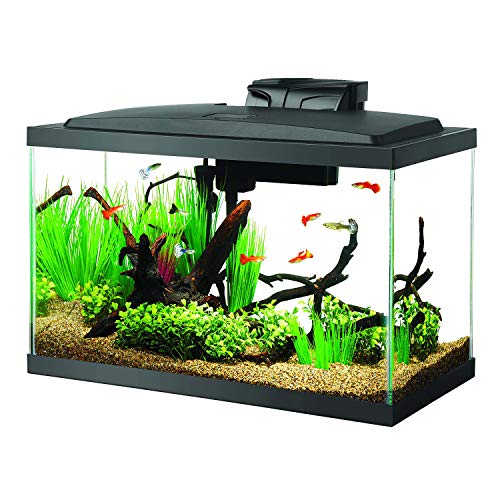
Aquarium Starter Kit with SmartClean Filtration 20 Gallon
$185.31 as of Jun 22, 2026
★★★★★Our rating· In Stock
The 20-gallon Aqueon kit bundles a glass tank, SmartClean internal filter, preset heater, LED hood, fish net, and water conditioner. It gets you unboxed and running in an afternoon. The 20-gallon size gives you real room to work. You'll want to add a hang-on-back filter within the first month for extra biological capacity, but as a starting point this kit removes every excuse for not starting.
What we like
Bundles tank, hood, LED, heater, and filter; everything to get running in one afternoon
20-gallon water volume buffers beginner mistakes in a way a 10-gallon simply cannot
What to know
Bundled filter has zero margin; swap in an AquaClear HOB within the first month
If space is genuinely limited, a 10-gallon can work — but only if you understand what you're signing up for. This size is fine for a betta fish alone, a few shrimp, or a single species of nano fish. Not for community tanks. The parameter swings will humble you. If you have any choice, go bigger.
What we like
Right-sized for a single betta fish or a nano shrimp colony on a desk
Compact footprint works where a 20-gallon would not fit
What to know
Parameters swing fast; one overfeeding can crash a 10-gallon within days
The 40-gallon breeder is the most versatile tank in the hobby — wide, shallow footprint that works for almost any freshwater fish. It's the tank you'll wish you'd bought when you're watching your 20-gallon fill up. Pair it with an Aqueon stand, an AquaClear 110, and a good light and you have a setup that will genuinely last years.
What we like
Wide, shallow footprint works for almost any freshwater fish species
The tank most hobbyists wish they'd started with; easier to manage long-term
What to know
Needs a dedicated stand rated for 450+ lbs; do not place on ordinary furniture
Your filter runs the nitrogen cycle — the biological process that converts toxic ammonia (from fish waste and uneaten food) into relatively safe nitrates. For beginners, a hang-on-back (HOB) filter is the right choice: easy to maintain, effective, and inexpensive. The golden rule: size up. Always buy a filter rated for twice your tank's volume. Over-filtering is a virtue. Under-filtering kills fish.
Best starter
AquaClear
50 Power Filter
$52.99 as of Jun 22, 2026
★★★★★Our rating
The AquaClear 50 is arguably the most recommended filter in the freshwater hobby. Rated for up to 50 gallons, it handles a 20-gallon with real margin. Three-stage filtration (foam sponge, activated carbon, BioMax ceramic rings) is genuinely effective, and the adjustable flow rate lets you dial back current for fish that prefer calmer water. Reliable, easy to maintain, and lasts for years.
What we like
Three-stage media (foam, carbon, BioMax) outperforms most HOBs at this price
Adjustable flow lets you dial back current for fish that prefer calmer water
What to know
Needs re-priming after power outages; use the built-in lever, not siphoning
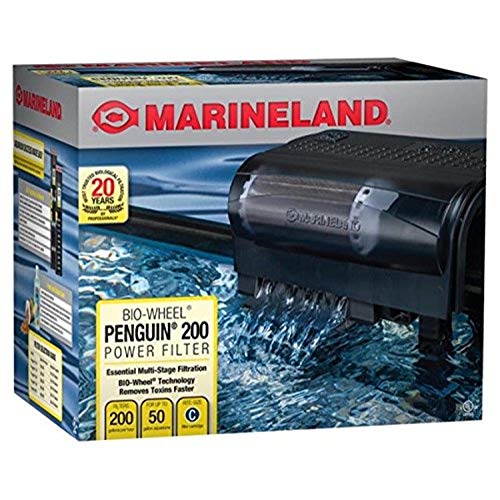
If you want to spend less and still get quality, the Marineland Penguin 200 Bio-Wheel is a solid pick. The rotating bio-wheel provides good biological filtration, and the cartridge-based media is easy to swap. Less customizable than the AquaClear but dependable for a 20-gallon setup.
What we like
Bio-Wheel provides solid biological filtration without extra media to buy
Cartridge-based media makes filter maintenance quick and simple
What to know
Less customizable than the AquaClear; replacement cartridges add ongoing cost
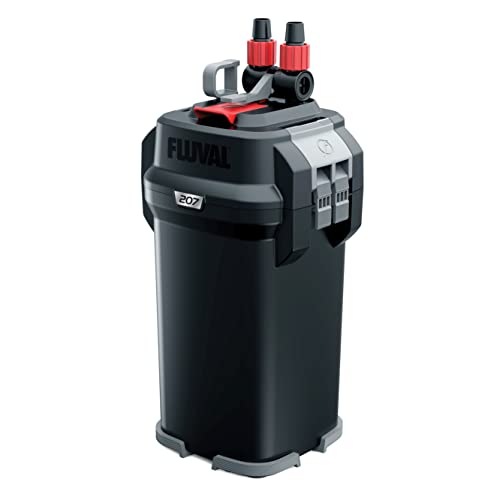
When you're ready to go planted or move up to a 40+ gallon, a canister is the right tool. The Fluval 207 runs nearly silent, handles up to 45 gallons with room to spare, and the multi-stage media baskets let you customize your filtration. Canister filters also hide completely under the stand — no visible equipment hanging off the back of the tank.
What we like
Runs nearly silent; no splash noise from a HOB waterfall
Multi-stage media baskets let you customize filtration for planted tanks
What to know
Priming a canister for the first time is fussier than an HOB; watch a video
Most tropical freshwater fish need water between 75–80°F. Tap water rarely stays in that range year-round, and temperature swings stress fish more than almost anything else. A reliable heater with a separate thermometer to verify it isn't optional — it's the difference between fish that thrive and fish that mysteriously get sick every winter. The heaters bundled in starter kits are preset and drift over time; a quality standalone heater pays for itself.
Best starter
Eheim
Jager Aquarium Thermostat Heater 100W
$$
★★★★★Our rating
The Eheim Jager has been the gold-standard aquarium heater for decades. Fully adjustable from 65–93°F, TÜV/VDE safety certified, and the auto-shutoff when removed from water prevents fires. Most experienced fishkeepers have a story about a cheap heater that failed and killed a tank — the Jager is how you skip that chapter.
What we like
Decades-proven reliability; experienced fishkeepers trust Jager for a reason
Auto-shutoff prevents fires if run dry out of water accidentally
What to know
Calibration dial runs a few degrees off; verify with a separate thermometer
Aqueon's Pro line offers adjustable thermostat control and an LED status indicator at a fair price. Not as proven over decades as the Eheim, but reliable for a beginner 20-gallon setup. The indicator light makes it easy to tell at a glance whether the heater is actively cycling.
What we like
LED indicator shows at a glance whether the heater is actively cycling
Adjustable thermostat and accurate temperature control at a fair price
What to know
Not as field-proven over many years as the Eheim Jager
Fish-only tanks need just enough light to see the fish — the LED hood in most starter kits is adequate. If you want live plants (which we recommend, because they consume nitrates and compete with algae), you need a light rated for plant growth. You don't need the expensive planted-tank light on day one — start with what the kit provides, then upgrade when you've decided plants are part of your plan.
Best starter
Nicrew
ClassicLED Plus Planted Aquarium Light 18-24 in
$31.99 as of Jun 22, 2026
★★★★★Our rating· In Stock
The ClassicLED Plus has built a following among beginners because it reliably grows low-to-medium light plants at a price that doesn't sting. Adjustable brightness, timer-compatible cord, and standard sizing that fits most tanks. If you want live plants but aren't ready to spend $100+ on a light, this is the answer.
What we like
Reliably grows low-to-medium light plants without a $100+ lighting investment
Timer-compatible out of the box; set it and the lights run themselves
What to know
Not powerful enough for high-light demanding plants like carpeting foregrounds
When you're ready to grow demanding plants — carpeting foregrounds, high-light stem plants — the Fluval Plant 3.0 is the hobby benchmark. Bluetooth-programmable sunrise/sunset cycles, a spectrum tuned for aquatic photosynthesis, and 24-hour scheduling means you automate the lighting and stop thinking about it. The most recommended planted-tank light at its price point.
What we like
Bluetooth-programmable sunrise and sunset cycles automate your lighting schedule
Spectrum tuned for aquatic photosynthesis; the most recommended planted-tank light
What to know
High output accelerates algae if CO2 and plant mass are not in balance yet
Tap water contains chlorine and chloramines that are toxic to fish and to the beneficial bacteria running your cycle. A water conditioner neutralizes them instantly. But the real skill in fishkeeping is reading your water chemistry — ammonia, nitrite, nitrate, and pH tell you whether the tank is safe. Test weekly for the first two months. Once you know your tank's rhythm, you can trust it.
Best starter
API
Freshwater Master Test Kit
$35.98 as of Jun 22, 2026
★★★★★Our rating
The standard test kit in the hobby. Tests ammonia, nitrite, nitrate, and pH — the four parameters that tell you whether the tank is safe to stock. Liquid reagent tests are more accurate than test strips and cheaper per test. The kit includes enough reagent for 800 tests; it'll last you two years of regular use.
What we like
Liquid reagents are more accurate than test strips and cheaper per test
Tests all four critical parameters: ammonia, nitrite, nitrate, and pH
What to know
Nitrate test needs vigorous shaking; easy to get false-low readings if rushed
Prime is the water conditioner in the hobby — and it does more than just neutralize chlorine. It also temporarily detoxifies ammonia and nitrite at low concentrations, which is a genuine safety net during the cycling process and whenever you're doing an emergency water change. A 250 mL bottle treats 2,500 gallons. You'll have this bottle for more than a year.
What we like
Temporarily detoxifies ammonia and nitrite during cycling, not just chlorine
250 mL treats 2,500 gallons; a single bottle lasts well over a year
What to know
Can mask ammonia readings; test water first, then treat
FritzZyme 7 Live Nitrifying Bacteria Naturally Removes Amonia & Nitrite for Freshwater Fish (32-Ounce)
$19.79 as of Jun 22, 2026
★★★★☆Our rating· In Stock
A live nitrifying bacteria supplement that meaningfully speeds up the cycling process. Instead of 4–6 weeks of waiting, a heavy dose of FritzZyme 7 combined with an ammonia source can cycle a new tank in 7–10 days. Not magic — you still need to monitor parameters — but it's the best tool to have when you're impatient to get fish in the tank.
What we like
Contains both ammonia and nitrite-consuming bacterial colonies
Can cut cycling time from 6 weeks to about 10 days with heavy dosing
What to know
Requires refrigeration after opening and has a limited shelf life
Fishkeeping is mostly waiting. While your tank cycles, you have three weeks to learn what actually matters: why the nitrogen cycle can't be rushed, which fish are genuinely beginner-proof, and what experienced aquarists do differently.
The most common mistake in fishkeeping is also the most understandable one: you buy a tank, fill it with water, and add fish the same afternoon. A week later, the fish are dead. You assume fishkeeping is harder than it looks. It isn’t — you just skipped the one step that makes everything else work.
That step is the nitrogen cycle, and this guide is built around it. Your first month in the hobby is mostly a waiting game. Here’s how to spend that time well.
Week one: Setting up and starting the cycle
Rinse your substrate thoroughly under tap water until the water runs clear, then add it to the tank. Place your hardscape — rocks, driftwood, decorations. Fill the tank about one-third of the way, then lay a clean plate on the substrate and pour the remaining water onto it to avoid disturbing everything you just arranged. Treat the water with Seachem Prime before adding it.
Connect the filter and heater. Set the heater to 78°F and let it stabilize for an hour before checking actual water temperature with a thermometer — heater dials run a few degrees off and the API test for temperature is your thermometer, not the dial. Once the heater is confirmed and the filter is running, you have a tank.
Now add your bacteria starter (FritzZyme 7 or similar) and an ammonia source — a pinch of fish food, a bottle cap of pure ammonia, or a raw shrimp. The ammonia source feeds the bacteria that will eventually make your tank safe for fish. Without it, the cycle stalls.
Run everything for 24 hours, then take your first water test. You’re establishing a baseline. At this point, ammonia should be low-to-moderate, nitrite at zero, nitrate at zero. Write the numbers down.
Test ammonia and nitrite every other day. What you’re watching for:
Phase one — ammonia rises. As the fish food or ammonia source breaks down, ammonia climbs. This is normal. It might reach 2–4 ppm. That’s fine — there are no fish in the tank yet.
Phase two — nitrite appears. After 5–10 days, a second bacterial colony colonizes your filter media and begins converting ammonia into nitrite. Ammonia starts to drop; nitrite climbs. You’ll see both elevated for a while. Still fine.
Phase three — nitrate appears. A third bacterial colony converts nitrite into nitrate, which is far less toxic. Nitrite starts to drop. Ammonia stays near zero. Nitrate builds.
The cycle is complete when: ammonia reads 0 ppm, nitrite reads 0 ppm, and you’re seeing a small but nonzero nitrate reading. At that point, you have a cycled tank and you can add fish.
With a bacteria supplement and daily ammonia additions, this typically takes 10–21 days. Without a supplement, 4–6 weeks. Be patient. The bacteria won’t be rushed by optimism.
One more thing about Prime: during cycling, add a standard dose every 24–48 hours whenever ammonia or nitrite is elevated. Prime temporarily detoxifies both for about 24 hours. It doesn’t stop the cycle — it just protects the beneficial bacteria and gives you a safety net if anything gets out of hand.
When your parameters have read ammonia 0, nitrite 0 for three consecutive tests over several days, you’re ready.
Buy fewer fish than you think you should. The standard advice is one inch of fish per gallon — but that’s a ceiling, not a target. A 20-gallon can eventually support a modest community; on day one, buy six fish and call it a success. You can always add more later. You cannot un-add fish.
For a 20-gallon beginner tank, these are the easiest choices:
Zebra danios — virtually unkillable, active schoolers, tolerate parameter variation. Six danios is a great first stock.
Cherry barbs — peaceful, a bit of color, not nippy. A school of eight works well.
Cory catfish — bottom dwellers that clean up leftover food and are endlessly entertaining. They need to be kept in groups of three or more.
Guppies and platies — colorful livebearers, very forgiving. The downside is they breed, and then you have a lot of guppies.
Betta fish — the best choice for a 10-gallon tank, alone. Add betta to a community tank only with careful species selection; they don’t tolerate long-finned fish.
To introduce fish, float the bag in the tank for 15 minutes to equalize temperature, then net the fish out and place them in the tank without adding the bag water. Store water is often carrying treatments or pathogens you don’t want in your tank.
Watch the fish for the first 48 hours. Look for: staying near the surface (often a sign of low oxygen or ammonia), rapid gill movement, clamped fins, or erratic swimming. Any of those symptoms warrants a test and possibly a water change. Healthy fish explore, interact, and eat within a day of introduction.
After a month of fishkeeping, the beginner habits that stick are the ones that cost you least:
They test before treating. When something looks wrong, they test ammonia, nitrite, and pH before doing anything else. Most problems trace back to water quality, and a water change is almost always the right first response.
They do weekly water changes without waiting for a problem. 25–30% per week, every week. Not because the tank looks dirty, but because nitrates accumulate silently and cause low-level chronic stress that shortens fish lifespans. Weekly water changes are the most impactful maintenance habit in the hobby.
They don’t overstock or overfeed. Both are ego traps — more fish feels like success, and feeding is the most satisfying daily interaction. But overfeeding is the leading cause of water quality problems in beginner tanks. Feed only what fish can consume in two minutes, once or twice a day.
They stay curious about the cycle. The nitrogen cycle isn’t a one-time event you check off in month one. It’s the ongoing biological system that makes your tank livable. Understanding what disrupts it — antibiotics, overcleaning the filter, temperature crashes — makes you a better fishkeeper for the life of the tank.
The hobby unfolds slowly. A tank that’s running well at month three has a different quality than one at month one — the water is clearer, the fish are more settled, the plants are established, the parameters are stable without daily attention. That state is worth getting to. The nitrogen cycle is the price of admission.
Save your money
What you don't need yet
Beginners get pressured to buy a lot of stuff that doesn't help them play
better. Here's what we'd skip on day one.
A CO2 injection system — CO2 is for serious planted tanks with demanding high-light plants. Start with easy low-light species — java fern, anubias, hornwort — that grow fine without supplemental carbon.
Test strips — Strips are convenient but notoriously inaccurate, especially for nitrate. The API liquid reagent kit costs less per test and gives you results you can actually trust.
Expensive or delicate fish — Discus, fancy goldfish, and large cichlids are for established tanks and experienced keepers. Learn on hardy, forgiving fish — zebra danios, cherry barbs, cory catfish, endlers livebearers. Cheap fish survive beginner mistakes. Expensive fish don't.
An RO/DI water system — Reverse osmosis systems are for specialized fish with narrow water parameter requirements. Conditioned tap water is fine for 95% of freshwater fish. Don't buy one until a specific fish forces you to.
A protein skimmer — That's saltwater equipment. Freshwater tanks have no use for them.
First week
Your first seven days
A short, real plan to get from gear-on-doorstep to actually playing.
Order tank kit, upgrade filter, heater, and test kit so they arrive together. · Buy
Rinse substrate (if using gravel or sand), set up the tank, and fill with water treated with Prime. Do not use soap on anything that touches tank water — ever. · Action
Add a full dose of FritzZyme 7 and a pinch of fish food as an ammonia source. Run the filter and heater. The nitrogen cycle has begun. · Action
Test ammonia, nitrite, and nitrate every other day. You're watching for ammonia to spike, then drop; nitrite to spike, then drop. When both read zero for 3 consecutive tests, you can add fish. · Learn
Research your first fish while you wait. Hardy beginner picks: zebra danios, cherry barbs, endlers livebearers, cory catfish, and nerite snails for algae control. · Learn
FAQ
Common questions
How much does a freshwater aquarium cost to set up?
A basic 20-gallon setup — starter kit, upgrade filter, heater, test kit, substrate, decor, and water conditioner — runs $150–300. Ongoing costs are modest: fish, occasional plants, and roughly $5/month in electricity for a 20-gallon. The equipment lasts years.
How long does the nitrogen cycle take?
4–6 weeks without help. With a live bacteria supplement like FritzZyme 7 and daily monitoring, you can cut it to 1–2 weeks. The cycle is done when ammonia and nitrite both read zero for 3–5 consecutive tests over several days.
What fish are easiest for beginners?
Zebra danios, guppies, platies, cherry barbs, and cory catfish are the classic starter fish — hardy, forgiving of parameter fluctuations, and active enough to be interesting. A betta alone in a 10-gallon is another solid entry. Avoid goldfish in small tanks (they produce massive waste) and anything labeled 'aggressive' or 'sensitive.'
How often do I need to do water changes?
25–30% weekly is the standard. More often while the tank is new or if it's overstocked; less often in a mature planted tank with light stocking. Use a gravel vacuum to pull waste from the substrate while you change water — skipping this is how tanks crash slowly.
Can I skip the cycle and add fish right away?
You can, but fish added to an uncycled tank face toxic ammonia spikes — this is 'new tank syndrome,' and it kills fish. If you add fish before cycling is complete, you need to test daily and do emergency water changes (with Prime) whenever ammonia exceeds 0.25 ppm. Most beginners regret skipping this step.
Do I really need live plants?
Not strictly, but live plants make the tank dramatically more stable. They consume nitrates (the final product of the nitrogen cycle), outcompete algae for nutrients, and give fish behavioral enrichment. Java fern and anubias are nearly indestructible, grow without CO2, and survive beginner lighting. Start with one or two and see how it feels.
Aquarium Co-Op — Cory McElroy's store and content hub — the single best beginner resource in the freshwater hobby. Articles cover cycling, fish compatibility, plant care, and equipment without condescension. Start here.
Aquarium Co-Op (YouTube) — Cory's YouTube channel. A decade of beginner-friendly fishkeeping content. Watch the nitrogen cycle video first, then the 'what fish can I keep together' series.
r/Aquariums — Large, active community. The wiki is excellent for beginners. Ask questions in the daily thread; the community is notably patient with newcomers.
r/PlantedTank — The planted tank subreddit. Best resource for live plant questions, fertilizers, lighting, and CO2 once you're ready to go green.
Aquatic Arts — Online retailer with excellent species-specific care guides. Search any fish name + 'aquatic arts' for a straightforward, trustworthy care sheet before you buy.
Rachel O'Leary (YouTube) — Covers nano fish, invertebrates, and species you won't find at big-box stores. More specialized than Aquarium Co-Op, but her care videos are detailed and honest about difficulty.
As an Amazon Associate, JustBeginning earns from qualifying purchases.
We may also earn commission from other affiliate programs linked on this
page. Editorial recommendations are independent; we don't choose
products based on commission rates.
Product prices and availability are accurate as of the date and time
indicated and are subject to change. Any price and availability
information shown on Amazon at the time of purchase will apply.
Our top pickAqueon Aquarium Starter Kit with SmartClean Filtration 20 Gallon

 Best starter