Koi are the most addictive fish you can keep — and one of the fastest paths to a costly mistake. The good news: nearly every beginner disaster comes down to under-filtered water, and that's completely preventable. This guide covers what to buy, what to skip, and why the filter matters more than the fish you choose.
By Colin B. · Published June 2, 2026 · Last reviewed June 2, 2026
Koi keeping has one of the highest entry costs of any backyard hobby. A minimal starter setup runs $600–$900; a proper beginner pond with good filtration is $1,500–$2,500.
We earn commission on qualifying Amazon purchases — see our
affiliate disclosure.
Price tiers and budget totals shown above are editorial estimates;
actual Amazon prices vary.
At a glance
Our top pick in each category
The fastest path through this guide — each best-starter pick by category.
Scroll for the budget and upgrade alternatives.
Overfilter, don't underfilter. The standard rule: buy a filter rated for twice your pond volume. Koi produce far more waste per pound than other pond fish, and the biological bacteria colonies in your filter are what convert toxic ammonia into safe nitrate. Skimp here and you'll lose fish.
Cycle the pond before any fish go in. Beneficial bacteria need 4–6 weeks to colonize your filter media before the system can handle fish waste. Either wait out the nitrogen cycle or use a bacterial starter and test daily — ammonia and nitrite should both read zero before your first koi goes in.
Koi grow to 24 inches and live 20–30 years. A pond that looks big enough for two small koi today will be dangerously overcrowded in three years. The minimum for a proper koi pond is 1,000 gallons; serious keepers build 3,000–5,000 gallons. The fish grow to fill the space — plan accordingly.
The gear
What you actually need
Filtration System
Filtration is the single most important investment in a koi pond — more critical than the fish, the liner, or the design. Koi are heavy feeders and produce enormous amounts of ammonia-rich waste. Without a biological filter maintaining beneficial bacteria colonies, ammonia spikes kill fish within days. Buy a filter rated for twice your pond volume, and include UV clarification to control green water algae.
Filtration System — what's the difference?
A few common shapes, each making a different trade.
Pressure Filter
Hides in the landscape; best for ponds up to 4,000 gallons.
Best for
Ponds under 4,000 gal
Install
Buried or hidden
Backwash
Easy valve
Best for Beginners wanting a hidden, low-maintenance setup
Tradeoff Less biological capacity per gallon than gravity box filters
Maximum bio capacity; best choice for serious koi loads.
Best for
Ponds over 3,000 gal
Install
Sits above waterline
Backwash
Manual cleaning
Best for Experienced keepers with heavy koi stocking
Tradeoff Sits above ground — harder to hide in landscaping
Waterfall / Bio-Falls
Doubles as a water feature; the easiest first install.
Best for
Ponds under 2,000 gal
Install
Overflow / cascade
Look
Natural waterfall
Best for Beginners who want a natural aesthetic with built-in cascade
Tradeoff Lower filtration capacity than pressure or box alternatives
Best starter
Aquascape
UltraKlean 3500 Pond Filter
$417.59 as of Jun 22, 2026
★★★★★Our rating· In Stock
Handles ponds up to 3,500 gallons with mechanical and biological filtration plus a built-in UV clarifier. Everything you need in one unit — no separate UV purchase required. Aquascape is the brand serious pond keepers trust, and this model has earned it.
What we like
All-in-one unit — UV clarifier included, no separate purchase
Aquascape build quality holds up through full outdoor seasons
Gravity-return design installs with most waterfall setups
What to know
Rated capacity assumes light fish load — oversize by 2x for koi
Larger than expected; plan the install footprint before buying
TetraPond's pressure filter handles ponds up to 1,250 gallons with UV clarification included. Backwash cleans without disassembly — a real convenience win. The right entry-level filter for a modest first pond of 500–800 gallons.
What we like
Backwash cleans filter without opening or disassembling the unit
UV clarifier keeps green water under control in modest ponds
What to know
Too small for serious koi ponds over 1,000 gallons
Flow rate drops noticeably when biological media starts to clog
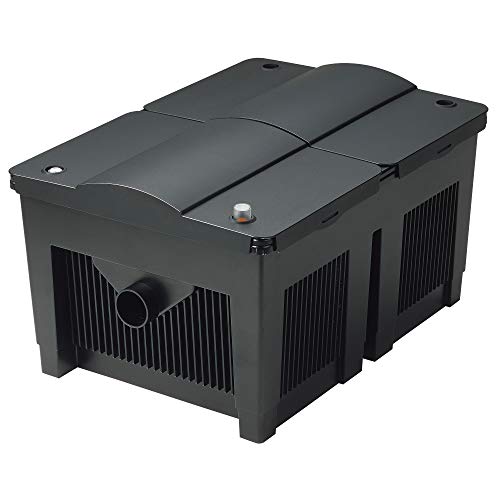
OASE is the European koi-filter benchmark, and the BioSmart 10000 handles ponds to 10,000 gallons via gravity-fed flow-through filtration. Foam chambers provide true multi-stage biological filtration. The built-in cleaning indicator tells you exactly when to backwash. Worth every penny once your pond grows past 3,000 gallons.
What we like
Multi-stage foam filtration removes fine particles thoroughly
Built-in cleaning indicator removes guesswork on maintenance day
Handles ponds to 10,000 gallons — grows with your build
What to know
Expensive — save it for year two when you're committed
Requires a compatible high-volume pump; factor both into cost
The liner is your pond's permanent foundation — get this wrong and you're rebuilding everything. For a koi pond, 45-mil EPDM rubber is the material of choice: fish-safe, flexible enough to conform to any shape, UV-resistant, and rated for 20+ years. Size matters more than most beginners expect: plan for at least 1,000 gallons minimum, and always buy more liner than you think you need.
Best starter
Aquascape
45-Mil EPDM Pond Liner
$146.99 as of Jun 22, 2026
★★★★★Our rating· Only 4 left in stock - order soon.
The Aquascape EPDM liner is fish-safe, UV-stabilized, and durable enough to outlast your filtration system. Available in multiple sizes with underlayment — one order covers what you need. The material stretches around rocks and irregular shapes without tearing.
What we like
45-mil EPDM is the industry standard for longevity and safety
Stretches without tearing — fits irregular shapes and rock work
Fish-safe material; no off-gassing concerns in warm water
What to know
Heavy — large liners need two people to position
Order with margin; liner can't be extended if cut too small
Firestone's PondGard is the original EPDM pond liner and still the cost benchmark. The same 45-mil thickness as premium brands at a better price per square foot. The right choice if you're digging a large pond and watching material costs.
What we like
Best price per square foot of any fish-safe EPDM liner
Industry-proven brand with decades of use in koi ponds
What to know
No underlayment included — add it to your order separately
Liner and underlayment together in matched sizes — no separate ordering, no sizing guesswork. The underlayment protects against root and rock puncture. Ideal for first-timers who want one less decision during the build.
What we like
Matched liner and underlayment in one order — no sizing guesswork
Underlayment adds puncture protection against roots and rocks
What to know
More expensive than buying liner and underlayment separately
Every gallon in your koi pond needs to circulate through the filter once per hour — minimum. A 2,000-gallon pond needs a pump rated at least 2,000 GPH. Undersizing is the second most common beginner mistake. During hot summers, oxygen levels drop as water temperatures rise — a dedicated aeration kit keeps dissolved oxygen high enough to prevent stress and overnight fish loss.
Best starter
Aquascape
AquaForce 2149 Solids-Handling Pump
$287.99 as of Jun 22, 2026
★★★★★Our rating· In Stock
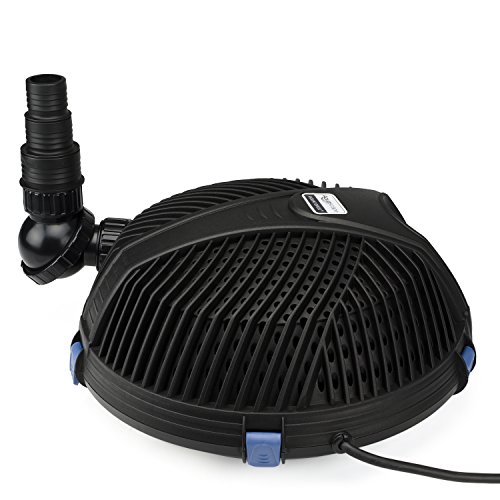
The AquaForce is built to pass solid waste and debris without clogging — critical in a koi pond where uneaten food and fish waste enter the system constantly. Rated 2,000 GPH, energy-efficient for 24/7 use, and backed by Aquascape's warranty. The right pump for a 1,500–2,000-gallon starter koi pond.
What we like
Solids-handling design passes debris without clogging the impeller
Energy-efficient for continuous 24/7 use — low operating cost
Aquascape warranty and parts support is the best in the category
What to know
Submersible only — not for dry-mount pump chambers
Higher upfront cost vs. generic pumps; pays back in longevity
For a smaller starter pond under 800 gallons, TetraPond's entry pump gets the job done without overkill spending. Reliable brand, straightforward setup, adequate flow for a modest beginner setup.
What we like
Affordable entry point for ponds under 800 gallons
Simple installation — no extra fittings or adapters required
What to know
Impeller clogs more easily than solids-handling models
Outgrown fast — plan to upgrade when the pond expands
Koi need 7+ ppm dissolved oxygen — which drops fast when water temperatures exceed 70°F in summer. This dedicated air pump and diffuser adds dissolved O2 independent of your main pump. Cheap insurance against summer oxygen crashes, which can kill an entire pond overnight.
What we like
Adds critical dissolved oxygen independent of the main pump
Cheap insurance against summer oxygen crashes — a real kill risk
What to know
Supplemental only — does not replace proper pump sizing
Air tubing needs weighting to stay on the pond bottom
You cannot see ammonia or nitrite. You cannot smell a nitrogen cycle crash until fish are already dying. A test kit is not optional — it's the instrument that tells you what's happening in the water before it becomes a crisis. Test ammonia and nitrite twice a week during your first month, then weekly. Goal: ammonia and nitrite both at zero, pH steady between 7.0 and 8.0.
Best starter
API
Pond Master Test Kit
$$
★★★★★Our rating
The API Pond Master tests the four parameters that matter most: ammonia, nitrite, nitrate, and pH. Liquid drop tests are more accurate than test strips and cost less per test over a full season. This is the kit every koi keeper references in every forum and Facebook group.
What we like
Tests all four critical parameters: ammonia, nitrite, nitrate, pH
Liquid drop tests more accurate than strip tests at low levels
More tests per dollar than strips over a full season
What to know
Slower than strips — 5–10 minutes per full panel
Color matching can be tricky in bright outdoor light
Quick-dip strips that give a 30-second read on six parameters. Not as precise as liquid tests on ammonia and nitrite, but useful for routine monitoring between full test-kit sessions. Keep a roll by the pond for fast daily checks.
What we like
30-second read — fast daily check without setting up reagent vials
Compact; keep a tube in your pocket during pond work
What to know
Less accurate than liquid tests, especially for ammonia
Neutralizes chlorine, chloramine, and heavy metals instantly when you add tap water to the pond. Also contains aloe vera that promotes the natural slime coat koi need to resist infection and recover from handling. Add it every time you top off or do a water change.
What we like
Neutralizes both chlorine and chloramine — tap water safe instantly
Aloe vera aids slime coat recovery after fish handling or stress
What to know
Some keepers prefer plain dechlorinators without the aloe
Large ponds consume it fast — buy the biggest bottle available
What you feed directly determines your water quality. Low-quality food means more waste in the water, which means higher ammonia loads on your filter. Use a high-protein floating pellet in warm months (water above 60°F) and wheat-germ formula in spring and fall when water drops to 50–60°F. Stop feeding entirely below 50°F — koi digestion shuts down in cold water and uneaten food becomes toxic waste.
Best starter
Blue Ridge
Koi and Goldfish Growth Formula
$30.40 as of Jun 22, 2026
★★★★★Our rating· In Stock
The food serious koi keepers fall back on after trying the competition. 35% protein, floating pellets, digested cleanly so less waste enters the system. Blue Ridge is what comes up when you ask any experienced keeper for a single honest answer on staple food.
What we like
35% protein formula promotes healthy growth with minimal waste
Floating pellets make it easy to spot and remove uneaten food
The staple food experienced keepers recommend without hesitation
What to know
Bags don't reseal well; transfer to an airtight container
Not a wheat-germ cold-water formula — switch in fall
The most widely available koi food in the US. A reasonable everyday option when budget matters — won't match Blue Ridge for growth or waste efficiency, but it won't hurt your fish either. Good emergency backup to keep on hand.
What we like
Available everywhere — hardware stores, Walmart, pet chains
Stick format is easy to portion and slow to sink
What to know
Higher filler content produces more ammonia-heavy waste
No wheat-germ cold-water variant in this product line
★★★★☆Our rating· Only 8 left in stock - order soon.
Hikari is the Japanese koi food benchmark — developed alongside championship nishikigoi breeders. The Gold formula enhances color and contains probiotic bacteria that improve digestion and reduce waste. When you're ready to care about fish quality and presentation, this is the upgrade.
What we like
Japanese-developed formula used by championship koi breeders
Probiotic bacteria aids digestion and reduces ammonia production
Color-enhancing pigments deepen reds and whites in show varieties
What to know
Costs 2–3x more per pound than staple foods
Overkill for young fish still developing in a new pond
A good net handles two jobs: skimming leaves and debris before they sink and become ammonia, and catching fish safely when you need to inspect them. Equally important: heron predation is the number-one cause of mysterious fish disappearances, and a single bird can empty a pond in one morning. A surface net or deterrent is cheap insurance against the most heartbreaking experience in koi keeping.
Best starter
Aquascape
Pond and Fish Net
$34.92 as of Jun 22, 2026
★★★★★Our rating· Only 10 left in stock - order soon.
Two-net system with a large-mesh debris net for leaves and surface material, and a fine-mesh sock net for safely moving fish. Koi need to be handled rarely, but when you do — for disease inspection or treatment — a proper sock net avoids damaging their protective slime coat.
What we like
Two-net system covers debris removal and safe fish handling
Fine mesh sock net protects koi slime coat during handling
What to know
Handle extension may need separate purchase for larger ponds
Fine net catches algae — rinse thoroughly after each use
★★★★☆Our rating· Only 2 left in stock - order soon.
A floating protective netting system that physically prevents herons from wading in and fishing out your koi. Most keepers lose their first fish to a heron before taking predator protection seriously — don't be that person. Stretched over the pond surface, this netting is your most reliable physical barrier.
What we like
Physical barrier prevents herons from wading into shallow areas
Floats on the surface — no frame or stakes needed for basic setup
What to know
Visually intrusive; remove during entertaining, replace at night
Persistent herons may reach through floats — layer with other deterrents
The first season is where most people either fall completely in love with koi — or lose their fish and give up. Here's what actually happens, and how to make sure it's the first thing and not the second.
Koi keeping has an unusual learning curve. Unlike most hobbies where you improve gradually through repetition, koi keeping has a sharp early phase — the first few months — where the consequences of getting things wrong are immediate and irreversible. Fish die. Ponds crash. Systems fail in ways that aren’t obvious until the morning you find something floating.
This guide is about making sure that doesn’t happen to you.
The first season breaks into three distinct phases: the build and cycle (before any fish), the introduction phase (first fish, first tests), and the settled rhythm of a running pond. Each has its own learning, its own hazards, and its own satisfaction.
Phase 1: Build and cycle — weeks 1–6
Before a single koi goes in, you need a functioning nitrogen cycle. This is the most important thing to understand about koi keeping, and the step most beginners want to skip.
Koi produce ammonia constantly — in their waste, through their gills, and from uneaten food. Ammonia is toxic to fish even at low concentrations. The nitrogen cycle converts ammonia to nitrite (also toxic) and then nitrite to nitrate (relatively harmless) through colonies of beneficial bacteria that live in your filter media.
The problem: those bacteria need 4–6 weeks to establish from scratch. They need a nitrogen source to grow, but they can’t handle the full waste load of living fish while they’re developing. The solution is to cycle your pond before fish go in.
How to do it:
Fill the pond, add dechlorinator, and run the pump and filter continuously.
Add a bottled bacterial starter (e.g., Dr. Tim’s Aquatics or Microbe-Lift) to seed the filter.
Add a small ammonia source — either a few hardy feeder goldfish, or pure ammonia (2–4 ppm).
Test daily with your API Pond Master kit. Watch ammonia rise, then nitrite rise, then both fall to zero.
When ammonia and nitrite both read zero on back-to-back days, the cycle is complete.
This process takes 4–6 weeks and cannot be meaningfully rushed. Patience here pays dividends for the lifetime of the pond.
What to test and what the numbers mean:
Ammonia: Should hit zero and stay there in a cycled pond. Anything above 0.25 ppm is dangerous; above 2 ppm is an emergency.
Nitrite: Same as ammonia — zero in a healthy pond. Spikes indicate the cycle isn’t complete or the filter is overwhelmed.
Nitrate: Normal accumulation between water changes. Harmless up to 40 ppm; do partial water changes to keep it down.
pH: Should stay between 7.0 and 8.0. Swings are more dangerous than a stable value outside the ideal range.
Don’t rush the fish purchase. The pond isn’t ready when you feel ready — it’s ready when the readings say it’s ready.
Phase 2: Introduction — first fish, first lessons
Your first koi should be small (4–6 inches), inexpensive, and few (2–3 fish). Not because small fish are less impressive, but because they give the bacterial colony time to grow to handle the load, and because you will make mistakes with water chemistry, feeding, and equipment in the first months that are far better made with $15 fish than with $200 ones.
Start with hardy, colorful varieties. Kohaku (red and white), Taisho Sanke (red, white, and black), and Showa are all good entry-level choices available at any koi dealer. Avoid the temptation to start with tosai (young-of-the-year Japanese-import fish) — they’re inexpensive but require more consistent water quality than a new pond can reliably provide.
The first two weeks with fish:
Feed sparingly — once daily, only what the fish eat in 3–4 minutes. Remove any uneaten food immediately. New keepers almost universally overfeed in the first month, and uneaten food is the leading cause of ammonia spikes in new ponds.
Test the water every day for the first two weeks. You’re verifying that the cycled filter can handle the actual fish load (it often needs a few weeks to fully adjust to live fish waste vs. the ammonia source you used to cycle). Watch for nitrite — a brief nitrite spike is common when fish are first added and usually resolves in 7–10 days.
Temperature and feeding seasons:
Koi metabolism tracks water temperature directly. This isn’t optional biology — it determines what you feed and when.
A water thermometer in the pond is not optional — it’s the instrument that tells you what season the fish are in.
Phase 3: The settled rhythm
By month three or four, the pond has found its rhythm. The filter is established, the fish are growing, and the water parameters are stable. This is when koi keeping becomes genuinely enjoyable rather than anxious.
The fish begin to recognize you. Koi are genuinely intelligent for fish and learn to associate your presence with feeding. By month two, they’ll rush to where you stand. By month six, some will take food from your hand. This is not an accident — it’s why people become obsessed with this hobby.
Water changes become routine. A partial water change (10–20% of pond volume) every 1–2 weeks keeps nitrate down and refreshes trace minerals. Always dechlorinate new water before adding it, and match temperature if possible to avoid cold shock.
The filtration maintenance schedule. Rinse mechanical filter media monthly, or when flow rate noticeably drops. Never use tap water — always rinse in pond water to protect the bacteria colony. Never clean all filter chambers in the same session; leave half undisturbed to maintain biological capacity.
Seasonal transitions. The spring warm-up and fall cooldown are when koi are most vulnerable. As temperatures rise in spring, metabolism wakes up faster than the immune system, making koi more susceptible to bacterial infections. Have salt on hand (pond salt, not table salt) and know the signs of common koi diseases: flashing (rubbing against surfaces), lethargy, fin fraying, white spots. Most spring illness is preventable with stable water quality.
What separates successful first-season keepers
The difference between people who lose fish in year one and people who don’t is almost never technique — it’s patience with the process.
They let the pond cycle completely before adding fish.
They start with fewer fish than they think they want.
They test the water before acting, not after something looks wrong.
They don’t add new fish without a quarantine period (2–3 weeks in a separate tank).
Koi keeping rewards investment in fundamentals. Get the filtration right, cycle the pond properly, stock conservatively, and the fish will thrive in ways that make the upfront effort feel trivial.
Save your money
What you don't need yet
Beginners get pressured to buy a lot of stuff that doesn't help them play
better. Here's what we'd skip on day one.
Show-quality nishikigoi — Collector-grade koi run $100–$1,000 per fish and require perfect water chemistry. Nail the pond fundamentals first with $15–$40 starter fish.
UV sterilizer — A UV clarifier (built into your filter) handles green water algae. UV sterilizers go further but are overkill until you have disease problems.
Bottom drain system — Bottom drains make water changes cleaner and more efficient in large ponds. Great for year two, but adds cost and complexity to an already involved first build.
Pond heater — Koi overwinter just fine in most of the US. A de-icer to keep a hole open in the ice is all you need in most zones — a full heater is for Zone 5 and colder only.
Waterfall or stream feature — Adds significant cost and planning complexity. Build the pond correctly first; add the waterfall in year two when you understand the water flow needs.
First week
Your first seven days
A short, real plan to get from gear-on-doorstep to actually playing.
Dig and install the liner with a minimum depth of 3 feet — koi need deep water to escape predators and regulate temperature through the seasons. · Action
Fill the pond and add dechlorinator before anything else goes in. This is non-negotiable — chloramine in tap water kills gill tissue within hours. · Buy
Add 2–3 small koi only after ammonia and nitrite have held at zero for one full week. Don't rush this — it's the step that kills the most fish. · Action
Feed sparingly the first two weeks — once daily, only what the fish eat in 3 minutes. Overfeeding crashes new ponds fast. · Action
FAQ
Common questions
How big does a koi pond need to be?
The minimum for a koi pond is 1,000 gallons, with 3,000–5,000 gallons for a serious setup. Koi grow to 24 inches and live 20–30 years — a pond that looks right-sized today will be dangerously overcrowded in three years. When in doubt, go bigger.
How many koi can I have?
A rough rule: 250–500 gallons of well-filtered water per koi. A 2,000-gallon pond with excellent filtration can support 4–8 koi. Most beginners overstock in year one and pay for it in water quality crashes — stock conservatively and let the fish grow into the space.
Do koi need a heater?
Not in most of the US. Koi are cold-hardy and go dormant below 50°F — they stop eating and don't need supplemental heat. You need a de-icer to keep a small hole open in the ice for gas exchange. Only in USDA Zone 5 and colder do you need a full pond heater.
How often do I clean the filter?
Monthly during the growing season, or when flow rate visibly drops. Never fully clean a biological filter — rinse media in pond water (not tap), leave some undisturbed, and never clean all chambers at once. You're protecting the bacteria colony, not sterilizing the filter.
What kills koi most often?
In order: ammonia poisoning from insufficient filtration, heron predation, oxygen depletion in summer heat, and disease introduced via new fish added without quarantine. All four are preventable with the right setup and basic care protocols.
How much does a proper starter koi pond cost?
Budget $600–$1,000 for a minimal setup (small liner, basic filter, pump). A proper beginner pond with good filtration runs $1,500–$2,500 installed. Annual running costs — food, electricity, water treatments — are modest, typically $200–$400 per year.
Koivet.com — Dr. Erik Johnson's veterinary resource on koi health, disease diagnosis, and treatment. The most clinical and authoritative koi health site in English.
r/KoiPond — Active community with solid troubleshooting threads. Search before posting — most beginner questions are answered in the wiki.
All Koi Club of America — Federation of koi clubs across the US. Find a local club — seeing real ponds and talking to experienced keepers beats any YouTube video.
Next Day Koi (YouTube) — One of the most practical YouTube channels for beginners — pond building, filtration setup, fish health. Honest about cost and what goes wrong.
Koi Story (YouTube) — Documentary-style channel following a competitive koi keeper. Excellent for understanding fish quality, bloodlines, and what the hobby looks like at a serious level.
As an Amazon Associate, JustBeginning earns from qualifying purchases.
We may also earn commission from other affiliate programs linked on this
page. Editorial recommendations are independent; we don't choose
products based on commission rates.
Product prices and availability are accurate as of the date and time
indicated and are subject to change. Any price and availability
information shown on Amazon at the time of purchase will apply.

 Best starter