Building a home sauna is one of the highest-return wellness investments you can make — if you pick the right type for your space. The infrared versus traditional decision confuses most beginners, and it matters far more than any accessory you'll buy. Here's what you need to know before spending $300 to $5,000, and the gear to get your first session going this week.
By Colin B. · Published May 24, 2026 · Last reviewed June 15, 2026
ASKOLD Wool Sauna Hat
— The one accessory every regular sauna user swears by — keeps your head comfortable at temperature.
Budget total
$250
Typical total
$1700
Depends almost entirely on sauna type — a blanket starts ~$200, an infrared unit runs $1,000–2,000, and a barrel sauna is $2,500+.
We earn commission on qualifying Amazon purchases — see our
affiliate disclosure.
Price tiers and budget totals shown above are editorial estimates;
actual Amazon prices vary.
At a glance
Our top pick in each category
The fastest path through this guide — each best-starter pick by category.
Scroll for the budget and upgrade alternatives.
The infrared-versus-traditional decision is the only research that actually matters before you spend money. Infrared saunas (120-160°F, dry, indoor, plug-in) are easier to start with. Traditional barrel saunas (160-195°F, steam, usually outdoor) are better if you want the full Finnish experience. Neither is wrong — they're different products.
Measure your space before ordering an infrared unit. A 2-person cabin is roughly 47 x 39 inches at the base. You need clearance on all sides, a 120V outlet nearby, and a non-carpeted floor. Most people's garages work; most bedroom closets don't.
Electric is almost always the right heater choice over wood-fired. Wood saunas smell amazing and feel authentic, but they require a chimney, exterior wall access, and in many places a permit. Your first home sauna should be something you can actually use every week — electric gets you there.
This is the only decision that actually matters. Infrared saunas heat your body directly with carbon or ceramic panels at 120–160°F — easy to install, plug-and-play, ready in 15 minutes. Traditional barrel saunas run 160–195°F and need outdoor space or a dedicated room. The sauna blanket option exists for apartments and budget-first experiments. Pick the type that fits your space, then stop researching and order.
Sauna Units — what's the difference?
A few common shapes, each making a different trade.
Infrared Panel
Indoor pick. Plugs into 120V, heats in 15 min, dry heat at 120–160°F.
Heat type
Infrared panels
Temperature
120–160°F
Install
120V outlet, indoors
Best for Most beginners, indoor spaces, no-contractor setups
Tradeoff Lower humidity — no steam (löyly) experience
★★★★★Our rating· Only 20 left in stock - order soon.
JNH makes the most approachable entry into home infrared sauna. The Joyous fits in a corner of a garage or spare room, plugs into a standard 120V outlet, and heats in about 15 minutes. Canadian hemlock interior, seven carbon fiber heating panels, and enough room for two without feeling cramped. If you're unsure which infrared unit to buy first, start here.
What we like
Plugs into standard 120V — no electrician required in most setups
Seven carbon fiber panels heat the full body evenly
Ready to use in 15 minutes — no preheating hour like traditional
What to know
Takes 1-2 hours to assemble — bring a second person
Lower humidity than traditional steam — some users miss the löyly
At around $180, this is the right way to test whether daily sauna actually fits your life before committing $1,000+. You sit inside a fabric enclosure with your head sticking out, infrared panels heat your body, and the whole thing collapses for storage under a bed. Not what purists describe, but the health benefits are real and the price makes it a no-risk experiment.
What we like
Under $200 — lowest-cost real infrared entry point
Folds for storage, no dedicated space required
Actual infrared panels, not just steam heat
What to know
Head stays outside the enclosure — not a full immersive sauna
If you have outdoor space and want the authentic Finnish experience, this is the entry point. The barrel shape is efficient — it heats faster than a rectangular cabin and holds heat longer. Precut Canadian hemlock panels, enough room for two, and quality that's immediately apparent when you're inside at 185°F with a proper löyly. This is a multi-year purchase, not a starter experiment.
What we like
Barrel design heats faster and holds heat better than a cabin shape
Full steam (löyly) — the authentic Finnish sauna experience
Durable Canadian hemlock weathers outdoor use for decades
Skip this section if you bought an infrared unit — it has heaters built in. If you're setting up a barrel sauna or converting a room, you need a standalone electric heater. Match kilowatts to cubic footage: roughly 1kW per 45 cubic feet of sauna space. Electric is safer, simpler, and legal everywhere; wood-fired heaters need a chimney and are often restricted in HOAs. Go electric first.
Best starter
Harvia
Spirit SP90E 9kW Electric Sauna Heater
$3,430.00 as of Jun 22, 2026
★★★★★Our rating· Only 5 left in stock - order soon.
Harvia is the Finnish benchmark in sauna heaters — the brand you'll find in hotel spas from Helsinki to New York. The Spirit is their workhorse: sturdy, precise, and sized to handle most home barrel saunas and DIY rooms up to about 600 cubic feet. If you want the sauna to actually perform the way you imagined, this is the heater that does it.
What we like
Finnish engineering — Harvia heats hotel saunas worldwide
Handles up to 600 cubic feet — right-sized for most barrel saunas
Rock tray holds enough stones for multiple rounds of löyly
What to know
Requires 240V dedicated circuit — electrician required for most homes
Pricier than budget heaters, but the build quality is obvious
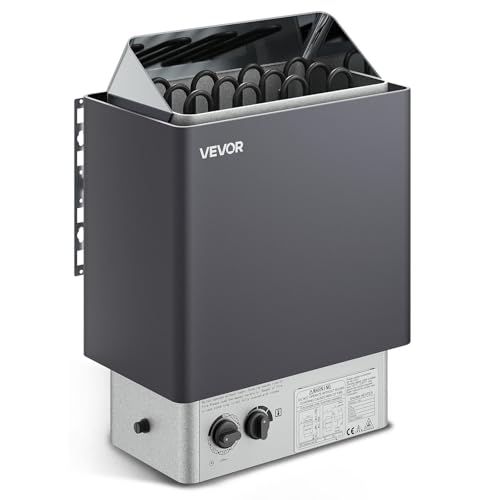
A fraction of the Harvia's price with most of the same function for smaller spaces. The VEVOR handles barrel saunas and DIY rooms up to about 350 cubic feet. Controls are basic — manual dial, no programmable timer — but for a budget entry into traditional sauna heating, it delivers. Upgrade to a Finnish brand once you know the setup works for your space.
What we like
Significantly cheaper than Finnish brands for smaller saunas
Manual controls are simple — no app or programming needed
Includes sauna stones — ready to use out of the box
What to know
Sized for smaller saunas only — up to 350 cubic feet max
Build quality is noticeably lower than European alternatives
Regardless of which sauna type you choose, a handful of small accessories make sessions meaningfully more comfortable. A wool hat protects your hair and ears from the intense heat at bench level — often 20–30°F hotter than waist height. A thermometer tells you your actual temperature. And for traditional saunas, a bucket and ladle are how you pour the löyly. None of these cost much. All of them matter.
Best starter
ASKOLD
Wool Sauna Hat
$19.49 as of Jun 22, 2026
★★★★★Our rating· In Stock
The one accessory every regular sauna user swears by that beginners always skip. A thick wool hat traps a thin air layer that shields your hair and ears from the dry heat at the top of the bench. Cotton towels don't work as well — they absorb moisture and conduct heat. Wool stays dry and insulating through a full session. Get one before your first real session.
What we like
Thick wool insulates without absorbing moisture like cotton does
Protects ears from the hottest zone — the top of the bench
Universal sizing fits most adults; lasts years with hand-washing
What to know
Hand-wash only — shrinks in a dryer
Looks odd to first-timers; feels essential after two sessions
For traditional and barrel sauna users, löyly — the burst of steam from pouring water over hot rocks — is the heart of the experience. A wooden bucket and ladle let you control that moment: how much water, how fast, where it lands. Plastic holds water fine; cedar smells right and feels right at temperature. This is the ritual object of sauna — worth owning a real one.
What we like
Cedar aroma enhances the steam experience during löyly
Proper ladle size — not too small for real use
Looks good in the sauna; easy to explain to guests
What to know
Traditional sauna only — infrared users don't need this
Requires hand-washing and occasional oiling to prevent cracking
You'll want to know your actual temperature, especially as you're learning your limits. This combo shows both temp (°F and °C) and relative humidity — which matters more than most beginners realize. A humid sauna at 175°F is a different experience than a dry one at the same temp. Clip it to the upper bench where you can glance at it mid-session. Under $25 and genuinely useful.
What we like
Shows both temperature and humidity — the two numbers that matter
Digital display is easy to read from the upper bench
Under $25 — absolutely no reason to guess your sauna temperature
What to know
Must be mounted at bench height — floor placement gives false readings
Accuracy drifts over time in high-humidity saunas; recalibrate yearly
Wooden benches get harder and hotter after 15 minutes. A backrest keeps your spine from complaining, and a cushion or mat lets you stay in for the full 20–30 minute session you came for. These are inexpensive, last forever, and make the difference between a session you tolerate and one you actually look forward to.
Best starter
Sauna Space
Sauna Backrest and Headrest Set
$$
★★★★★Our rating
The first thing you'll notice after a few sessions on a bare wooden bench is that you need back support. A folding wooden backrest tilts you into a comfortable recline, and the matching headrest keeps your head off the hot upper bench. Pine or aspen is standard — both breathe well and don't trap heat. This set covers both needs for under $50.
What we like
Folding design stores flat when the sauna isn't in use
Natural wood breathes and stays cooler than solid panels
Covers both back support and head comfort in one purchase
What to know
Measure your bench depth first — sizing varies by sauna brand
Needs occasional sanding as wood grain raises with moisture cycling
If the backrest is the comfort upgrade that changes your sessions, the floor mat is the one that protects your feet between the bench and the door. Wet, hot feet on a bare wooden floor is a splinter risk and general unpleasantness. This set combines a seat pad (softens the bench) and a floor mat for under $35. Useful for both infrared and traditional setups.
What we like
Seat pad softens the bench; floor mat covers the splinter zone
Machine washable — keeps the sauna hygienic with regular use
Works in both infrared and traditional sauna setups
What to know
Cotton absorbs sweat quickly — wash after every 2-3 sessions
Floor mat slides on smooth wood without anti-slip backing
What you do in the 10 minutes after a session is almost as important as the session itself. A cold shower, proper hydration, and wrapping up in absorbent cotton are the habits that make home sauna sustainable. Cold contrast — alternating heat and cold — is the part most beginners skip and the part they later wish they hadn't. Start it in week two, even if it's just a cold shower.
Best starter
GLAMBURG
Turkish Cotton Peshtemal Towels (4-pack)
$
★★★★★Our rating
Standard bath towels stay wet and heavy. Turkish peshtemal towels are thin, absorbent, quick-drying, and they don't take up a drawer. A 4-pack covers you for a week of daily sessions without doing laundry every day. Use one as a bench towel in the sauna, one as a wrap afterward. They're also just nicer to use than a bath towel — a quiet upgrade most people don't expect.
What we like
Thin and quick-drying — won't mold in a humid sauna environment
Gets more absorbent with each wash for the first few cycles
Doubles as bench towel in the sauna and wrap towel after
What to know
Less plush than bath towels — different texture takes getting used to
Fringed edges tangle in the dryer; air-dry when possible
Between the sauna and the cold shower, you need something. A dedicated robe you grab only for sauna sessions signals to your brain that this is a ritual, not a chore — a small trick that makes the habit stick. The Boca Terry waffle-knit is lightweight enough to not feel heavy when you're still warm, and it dries fast hanging in the sauna room.
What we like
Waffle-knit stays light even when slightly damp from sauna heat
Quick-drying — hang it in the sauna room and it's ready tomorrow
Having a dedicated robe reinforces the sauna-as-ritual habit
What to know
Too light for outdoor cold plunge in sub-60°F weather
Waffle weave shows wear faster than terry cloth alternatives
Cold contrast — 15-20 minutes of heat followed by 2-3 minutes of cold — is the protocol most home sauna converts eventually adopt. It's uncomfortable the first week and quietly transformative after that. A dedicated cold plunge tub lets you control water temperature and makes the habit sustainable. The cold-hot combination changes the entire sauna experience.
What we like
Purpose-built tub insulates cold water longer than a bathtub full of ice
The first session feels awkward. By week two, it's a ritual. Here's what to expect — and the habits that separate people who stick with it from the people who let the sauna collect dust.
Most people buy a sauna thinking about the health benefits and end up keeping it for the ritual. The research on cardiovascular outcomes, recovery, and sleep is real — but it’s the 25 minutes of forced stillness at the end of a busy day that actually changes how you live.
This is what your first month looks like. What temperatures to start with, when to introduce cold contrast, and the two or three habits that separate people who still use their sauna in year two from the people who list it on Facebook Marketplace.
Week 1: Getting comfortable with the heat
Your first instinct will be to turn the temperature up as high as it goes. Don’t. The goal in your first week is not heroics — it’s building familiarity with how the heat actually feels on your body.
For infrared saunas: Start at 130–140°F for your first session. Set a timer for 15 minutes. Sit there. That’s it.
For traditional barrel saunas: 160–165°F is a reasonable starting temperature. Same instruction — 15 minutes, no drama.
You’ll sweat more than you expected. Your heart rate will rise, which is entirely normal (it’s mild cardiovascular exercise). You might feel a wave of light-headedness when you stand up after — stand slowly, wait for it to pass. It goes away after a few sessions as your body adjusts to the vasodilation.
What you’re learning this week: how your body responds to heat, how long 15 minutes actually feels (longer than you think), and where to position yourself in the sauna. The upper bench runs significantly hotter than the lower. Most beginners are more comfortable starting on the lower bench and working their way up.
Drink a large glass of water before each session. Drink another one after. You will lose a noticeable amount of fluid through sweat, and most people underestimate how dehydrated they are at baseline.
By week two, 15-minute sessions at starter temperatures feel manageable. This is when two things happen: you’ll want to push the temperature up, and you’re ready to try cold contrast.
On temperature: Bump it by 10°F. Infrared users can work toward 150–160°F. Traditional users can push to 175–185°F. You’ll find a temperature band where the heat feels productive rather than just uncomfortable — that’s your working range. Most experienced sauna users land somewhere between 160°F and 185°F depending on type and personal preference.
On cold contrast: This is the change that most home sauna users say completely transformed their practice. The protocol is simple: finish your hot session, immediately step out, and take a 30–60 second cold shower. Or if you have an outdoor setup, a cold plunge.
The first time is jarring. The second time is slightly less so. By the end of week two, the cold shower after the sauna is the part you’ll actually look forward to — it produces a clarity and calm that a hot session alone doesn’t quite match.
You don’t need a dedicated cold plunge tub to start this. Your shower on the coldest setting is sufficient. The temperature shock is what matters, not the depth of the cold.
Week 3: Session length and the löyly ritual
At this point you’re probably doing 20-minute sessions comfortably. This is when you start to understand why Finnish sauna culture involves multiple rounds rather than one long session.
The round system: Instead of one 25-minute session, try two 15-minute rounds with a 5-minute break (cold contrast or just cooling down) between them. This is more sustainable, more interesting, and — per most sauna research — produces better physiological outcomes than one equivalent-length single session.
For traditional sauna users: Week three is when the löyly becomes intuitive. You’ll find your rhythm for pouring — a slow, controlled pour from about 12 inches above the rocks, targeting the center of the heater, while leaning slightly to the side to avoid the immediate steam burst. About a third to half a ladle at a time. Let the steam dissipate before the next pour. The humidity jump changes the perceived temperature significantly — a 170°F sauna with two good ladles of löyly feels like 195°F. Adjust your temperature accordingly as you learn your preferences.
For infrared users: There’s no löyly, but there is positioning. Experiment with how close you sit to the panels. Closer to the front or back panels intensifies the infrared; the center bench position gives more even exposure.
Week 4: The habit is the point
By week four, the sauna isn’t something you’re experimenting with — it’s something you miss when you skip it. This is the point.
Here’s what a sustainable home sauna practice looks like:
3-5 sessions per week, 20-30 minutes per session (or 2-3 rounds). Daily use is fine and common in Finnish culture; 3 times a week shows meaningful benefit in the research.
Consistent timing: Most people find evening sessions work best — the heat raises core body temperature, which then drops after the session, signaling sleep onset. Morning sessions are energizing but can leave you foggy for 30 minutes after.
The ritual matters. Towel, hat, water, no phone. Treat the 25 minutes as unavailable time. The forced disconnection is half the benefit.
Going too hard too soon. Your first week in a 200°F sauna impresses nobody and just makes your sessions miserable. Build up over the first two weeks.
Skipping the cold. The contrast is not optional if you want the full practice. A cold shower costs you 90 seconds and changes the quality of what follows significantly.
Ignoring hydration. You can lose half a liter of fluid in a 20-minute session. Most people go in mildly dehydrated because they didn’t drink enough during the day. The headache you get an hour after a session is almost always dehydration, not heat sensitivity.
Treating the sauna like a passive activity. The people who stick with home sauna are the ones who give the session their full attention — no podcasts, no email, just heat and stillness. It’s not a place to be productive. Let it be boring. The boring is the point.
What to expect at month two
You’ll have a protocol you’ve arrived at through experience, not reading. You’ll know your temperature, your session length, your round structure, and whether cold contrast is something you do or something you avoid. You’ll know if you’re a morning or evening sauna person.
The health outcomes that researchers measure — lower resting heart rate, better sleep, faster muscle recovery — show up in most people who use regularly within the first four to eight weeks. They’re not dramatic. They’re the quiet background of feeling better than you did.
The sauna that seemed like an extravagant purchase in month one will feel like the most sensible thing in your house by month three.
Save your money
What you don't need yet
Beginners get pressured to buy a lot of stuff that doesn't help them play
better. Here's what we'd skip on day one.
Wood-fired (kiuas) heater — Romantic idea, but it needs a chimney, exterior wall access, and often a building permit. Go electric first — you can always upgrade once the sauna is built.
Custom cedar-lined sauna room build — Enormous project for year two or three. Start with a freestanding unit; live with the practice for a year before committing to construction.
Chromotherapy (color light) upgrade — Upsell feature offered on most infrared saunas. The light doesn't meaningfully change the session. Skip and save the money.
Smart sauna controller or WiFi timer — Adds a connectivity failure point to a simple appliance. A mechanical timer and a 15-minute preheat walk from the other room is all you actually need.
Essential oil diffuser add-on — For traditional saunas, a few drops of eucalyptus in the löyly water does the same thing better. For infrared, the heat isn't hot enough to volatilize most oils properly.
Infrared sauna blanket warmer or pre-heat bag — An accessory for a blanket that is itself already a budget workaround. Not a thing real sauna people use.
First week
Your first seven days
A short, real plan to get from gear-on-doorstep to actually playing.
Decide on your sauna type before touching the cart. Infrared or traditional, indoor or outdoor — that one decision drives everything else. · Action
Measure your space and verify your electrical. Infrared units need a 120V outlet nearby; barrel saunas need 240V. Know what you have before you order. · Action
Order your sauna unit — factor in 1-3 week shipping for larger units, and clear a path to the installation spot. · Buy
Assemble with a partner — every infrared unit comes flat-packed and benefits from a second set of hands. Budget a full afternoon. · Action
First session: 15-20 minutes at moderate heat (150°F for infrared). Hydrate before, shower after. Don't push past comfortable on day one. · Action
On day two or three, try finishing with a cold shower — even 30 seconds. It's the single habit most sauna converts wish they'd started sooner. · Action
FAQ
Common questions
Infrared or traditional sauna — which is better for beginners?
Infrared for most people. They're easier to install (120V plug-in, no chimney), cheaper to start with, and ready to use in 15 minutes. Traditional barrel saunas run hotter, produce real steam, and feel more authentic — but they require more setup and outdoor space. Neither is wrong. Pick based on your living situation, not on which sounds cooler.
How much does a home sauna actually cost?
A sauna blanket is $150-200 and is the lowest-risk entry. A quality 2-person infrared unit runs $800-2,000. A barrel sauna with heater and installation is $3,000-6,000 depending on size. Budget an extra $200-400 for accessories (hat, thermometer, towels, comfort gear) regardless of which path you choose.
Is daily sauna use safe?
Yes, for most healthy adults — Finnish research (and Finnish practice) strongly supports it. Start with 15-20 minute sessions at moderate temperatures, hydrate well before and after, and listen to your body. People with heart conditions, low blood pressure, or who are pregnant should check with a doctor first. If you feel dizzy or uncomfortable, get out.
Do I need an electrician for an infrared sauna?
Often no. Most 1-2 person infrared saunas run on a standard 120V/15A household outlet — the same as any other appliance. Some larger 2-person units draw 20A and need a dedicated circuit. Read the specs before you order, and check your breaker panel. Traditional and barrel saunas always need a 240V dedicated circuit — budget for an electrician.
How long should my first sessions be?
15-20 minutes. The goal on day one is to get comfortable with the heat, not to push limits. Most experienced sauna users do 20-30 minute sessions with a cold break in between. Work up to that over the first two weeks. The instinct to go longer immediately is real and mostly unhelpful.
What temperature should I set for a beginner sauna session?
Infrared: 130-145°F for your first few sessions, working up to 150-160°F as you adapt. Traditional: 160-175°F to start, up to 190°F if you want the full Finnish experience. Humidity matters too — adding a small amount of löyly (water on the rocks) makes a traditional sauna feel significantly hotter without changing the thermometer reading.
Finnish Sauna Society — The original authority on sauna practice, culture, and research. Rules of the sauna, history, health claims. Bookmark this if you want to go deep.
Sauna Times — Glenn Auerbach's long-running sauna advocacy blog. Research roundups, heater reviews, and sauna culture writing that's more useful than most commercial review sites.
r/Sauna — Active community of enthusiasts from beginners to purists. The buying-advice threads are genuinely good; the wiki covers setup questions comprehensively.
Harvia Academy — Harvia is the benchmark Finnish heater brand — their blog covers heater sizing, installation basics, and sauna culture. Manufacturer content but high quality.
NCBI — Sauna and Health Research — The primary research literature — Laukkanen's Finnish cohort studies on cardiovascular outcomes are the most-cited. Skip the abstracts and read the summaries at Sauna Times instead.
As an Amazon Associate, JustBeginning earns from qualifying purchases.
We may also earn commission from other affiliate programs linked on this
page. Editorial recommendations are independent; we don't choose
products based on commission rates.
Product prices and availability are accurate as of the date and time
indicated and are subject to change. Any price and availability
information shown on Amazon at the time of purchase will apply.
Our top pickJNH Lifestyles Joyous 2-Person Infrared Sauna


 Best starter