Dog training is the only hobby where the payoff is a calmer, happier life with your best friend. Modern positive reinforcement works for any dog at any age, and the gear costs almost nothing. A clicker, some treats, and a long line cover 90% of what you need — here's exactly what to buy and what to skip.
By Colin B. · Published June 2, 2026 · Last reviewed June 2, 2026
Core tools (clicker, treats, treat pouch, long line) run $60–80. A quality no-pull harness pushes a full starter kit to around $130.
We earn commission on qualifying Amazon purchases — see our
affiliate disclosure.
Price tiers and budget totals shown above are editorial estimates;
actual Amazon prices vary.
At a glance
Our top pick in each category
The fastest path through this guide — each best-starter pick by category.
Scroll for the budget and upgrade alternatives.
Start with positive reinforcement. Every major veterinary and training organization now recommends reward-based methods as the most effective and least harmful starting point. If someone tells you 'your dog needs to know who's boss,' find a different trainer.
Keep sessions short. Five minutes twice a day beats a 30-minute marathon. Dogs lose focus fast, especially puppies. End every session on a win — if the last rep went badly, ask for something easy before stopping.
What you reward is what you build. If you click and treat the moment your dog's backside hits the floor, you're building a snappy sit. If you wait for three seconds of sitting, you're building duration. Be intentional about timing.
The gear
What you actually need
Long Lines
A long line is a lightweight leash on a snap — 15 to 50 feet long — that gives your dog freedom while keeping you connected. It's the most important tool for teaching reliable recall, because it lets you enforce the come command before your dog has truly learned it. Without a long line, you either let your dog ignore you (and learn that ignoring is fine) or you never let them practice off-leash at all. Neither builds real obedience. Get one before you start recall work.
Long Lines — what's the difference?
A few common shapes, each making a different trade.
Short (10–20ft)
For backyard drills and tight spaces. The right start for puppies.
Length
10–20ft
Best use
Yards, small parks
Best for Puppies, backyard recall foundations, smaller training spaces
Tradeoff Not enough distance to proof recall in open environments
The all-around length most trainers recommend as a first long line.
Length
30ft
Best use
Parks, trails, most scenarios
Best for Parks, trails, and the majority of recall training scenarios
Tradeoff Can tangle in thick brush — manage it actively
Distance (50ft+)
For advanced recall proofing in open fields.
Length
50ft+
Best use
Open fields only
Best for Open-field recall proofing, dogs already solid on a 30ft line
Tradeoff Heavy and tangles easily — requires active rope management
Best starter
Mendota Products
Check Cord, 20ft
$24.99 as of Jun 22, 2026
★★★★★Our rating· Only 8 left in stock - order soon.
Mendota has made braided cotton check cords for decades and they're what professional trainers reach for first. The 20ft length is the right starting point — long enough to teach recall, short enough to manage. Cotton stays lighter than nylon when wet and doesn't cut your hands if the dog charges through it.
What we like
Professional trainers' first recommendation above all other brands
Cotton stays light and flexible — doesn't rope-burn hands on a charge
20ft suits most backyard and park recall training sessions
What to know
Needs rinsing and drying after wet or muddy sessions
Less durable than biothane in heavy water or saltwater conditions
Under $15 and well-reviewed for backyard and park training. Nylon is stiffer and rougher on hands than cotton if the dog charges through it, but at this price it's a sensible way to try long-line work before committing to a premium cord.
What we like
Under $15 — the lowest-risk way to try long-line training
30ft length gives solid recall distance for most open spaces
What to know
Nylon edges cut hands when a dog sprints through a full charge
Hardware is lighter duty than Mendota — check the snap weekly
Biothane is coated webbing that behaves like leather but doesn't absorb water, mud, or odor. It's what hunt-test and sport handlers use when a check cord takes daily hard use. Heavier than cotton, but rinses clean in seconds and lasts years instead of seasons.
What we like
Rinses clean in seconds — fully waterproof and odor-resistant
Lasts years of hard daily use without stiffening or cracking
What to know
More expensive than cotton or nylon at the same length
Heavier feel — some dogs notice the drag more than on cotton
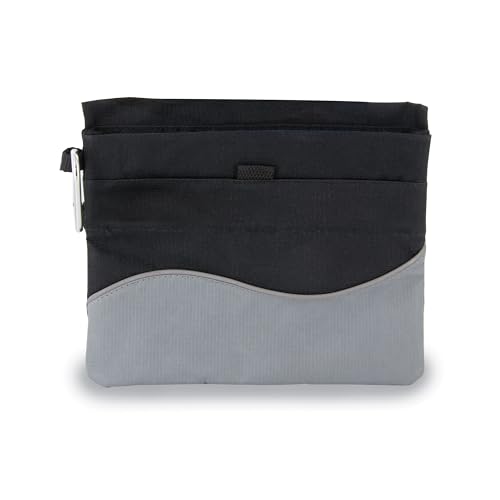
A treat pouch keeps your hands free so you can deliver reinforcement the instant the behavior happens. Timing is everything in clicker training — a two-second delay between click and treat starts to erode the signal. Digging in your pocket blows your timing. A good pouch opens one-handed, closes so treats don't spill on a walk, and clips to your waistband. Spend $15–25 here and you'll never think about it again.
Best starter
PetSafe
Treat Pouch Sport
$17.99 as of Jun 22, 2026
★★★★★Our rating· In Stock
The Treat Pouch Sport has been the go-to in training circles for years. Magnetic closure pops open and snaps shut one-handed, so you never fumble. There's a main treat pouch and a zippered front pocket for keys and cards. Belt clip and carabiner both included — wear it whichever way works for you.
What we like
Magnetic closure flicks open one-handed without fumbling
Zippered front pocket keeps keys and cards out of the treat compartment
Belt clip and carabiner both included — use it your way
What to know
Deep main pouch makes tiny treats hard to grab with cold hands
Fabric absorbs treat smell — hand-wash monthly or it gets pungent
A dead-simple drawstring bait bag for under $10. Open, grab, close. It's slower than a magnetic pouch so timing takes a small hit, but for casual backyard sessions the simplicity is fine. Good placeholder until you know you want the Sport model.
What we like
Under $10 — lowest-risk way to discover if you want a treat pouch
Machine washable without fussing over hardware or closures
What to know
Drawstring is slower than magnetic closure — timing takes a hit
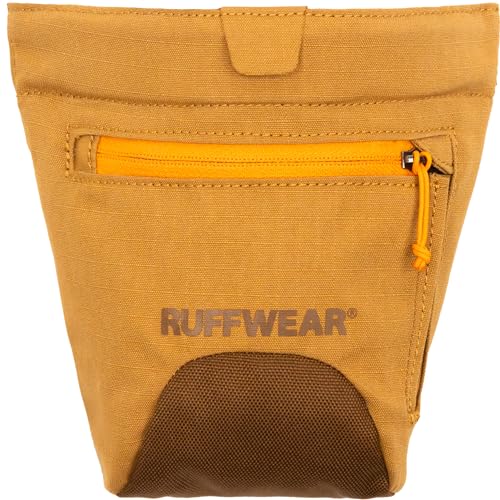
Ruffwear's pouch stays fully open while you work, which is useful in rapid-fire trick sessions where you're delivering treats in quick succession. Built with the same hardware quality as their hiking gear. Overkill for sit-stay practice, but if you train on the trail, this is the one.
What we like
Stays fully open mid-session — no fumbling during fast treat delivery
Ruffwear construction built to the same standard as their hiking gear
What to know
Larger profile feels bulky compared to the PetSafe on a waist belt
Overkill for basic obedience — not worth the cost for most beginners
A clicker is a small mechanical marker — it makes a precise double-click the instant you press it. That sound becomes deeply meaningful fast because it's always followed by a treat. The advantage over saying 'yes!' is mechanical consistency: the click is identical every time, regardless of your stress level or emotional tone. Most dogs are responding to their first clicker behavior within ten minutes. A clicker costs $5–10 and transforms your timing immediately.
Best starter
Karen Pryor Clicker Training
Karen Pryor i-Click
$5.25 as of Jun 22, 2026
★★★★★Our rating· In Stock
Karen Pryor literally wrote the book on clicker training, and the i-Click is her ergonomic take on the classic box clicker. It's quieter than a standard clicker (better for sensitive dogs and indoor work) and fits in your palm so you can click without shifting your grip. Buy the 2-pack — you'll want a spare.
What we like
Quieter click than a box clicker — less startling for sensitive dogs
Palm-fit ergonomic shape — click without shifting grip mid-session
From the trainer who popularized modern clicker work — widely trusted
What to know
Quieter click takes one extra loading session for some dogs
★★★★☆Our rating· Only 10 left in stock - order soon.
A classic box clicker — loud, distinct, and under $4. The volume is a real advantage outdoors or at distance. If you're new to training and unsure whether you'll stick with it, this is the right $4 experiment before committing to anything more.
What we like
Under $4 — the lowest-risk first clicker to try
Louder click carries well outdoors and at distance
What to know
Box shape is awkward in-hand during fast training sequences
Loud click can startle noise-sensitive dogs — test indoors first
The Clik-R sits on a finger ring so your clicking hand stays free for leash management, treat tossing, or holding a target stick. Useful in complex trick chains or any scenario where you're juggling three things at once. Overkill for basic sit-stay, but makes advanced multi-step work noticeably smoother.
What we like
Finger ring frees your palm for leash, treats, or a target stick
Consistent click tone comparable to the i-Click
What to know
One-size ring gets uncomfortable on larger hands in long sessions
No real advantage over the i-Click until you're doing trick chains
Training treats need to be small (pea-sized or smaller), soft (no crunching delays), smelly (high value to the dog), and low calorie (you'll deliver 30–50 per session easily). Most kibble fails on all four. Specialty training treats aren't a luxury — they're what separates a dog who tolerates working from one who actively wants to train. Zuke's Mini Naturals are the industry standard; the other options here fill specific niches.
Best starter
Zuke's
Mini Naturals Training Treats, Salmon
$26.37 as of Jun 22, 2026
★★★★★Our rating· In Stock
The industry standard for real reasons: pea-sized, 3.5 calories each, and soft enough to grab and deliver in a single motion. Salmon flavor works on dogs that turn their nose up at chicken. A bag lasts 2–3 weeks of daily sessions, and the scent in your pouch motivates from the moment you unzip it.
What we like
3.5 calories each — do 40-rep sessions without blowing the day's diet
Soft and pliable — grabs and delivers in one motion with no crumbling
Salmon flavor works on many dogs that reject chicken-based treats
What to know
High volume causes loose stools if sessions run too long
Bag tears at the seal — transfer to a ziplock container after opening
One ingredient: freeze-dried chicken breast. The drying process intensifies smell and flavor — these are your high-value treats for introducing scary environments, proofing recall under distraction, or breaking through a training plateau. Use them sparingly or they lose their motivating power.
What we like
Single ingredient freeze-dried chicken — no fillers or preservatives
Intense smell equals high-value motivation for difficult behaviors
Safe for dogs with grain or multi-protein sensitivities
What to know
Crumbles to dust in a soft treat pouch — use a rigid container
Overuse kills their high-value status — reserve for proofing sessions
For dogs with food allergies or digestive sensitivities, WellBites offer limited-ingredient recipes in training-friendly sizes. The Lamb & Salmon formula covers most common protein alternatives. Soft, smelly, and available in a size that works for quick single-rep delivery.
What we like
Limited ingredients — good for dogs with chicken or grain sensitivities
Lamb & Salmon formula covers the most-requested protein alternatives
What to know
Slightly larger than Zuke's — break in half for toy breeds
Higher calories require mealtime reduction on heavy training days
For training walks, use a front-clip no-pull harness rather than a flat collar. A flat collar on a pulling dog creates a feedback loop — the dog pulls, gets choked, associates the pressure with whatever's exciting ahead, and pulls more. A front-clip harness redirects momentum back toward you when the dog pulls, naturally interrupting the behavior without aversive pressure. E-collars (electronic remote trainers) are also on this list, but read the editorial note before buying — they are not a beginner tool.
Best starter
PetSafe
Easy Walk Harness
$19.95 as of Jun 22, 2026
★★★★★Our rating· In Stock
The Easy Walk is the most-recommended front-clip harness for one reason: it works immediately. The front D-ring redirects a pulling dog without any learned skill on your part. Fits most breeds, the chest strap adjusts for deep-chested dogs, and it won't restrict shoulder movement the way some competitors do. First intervention for any dog that drags you.
What we like
Front D-ring interrupts pulling without any aversive collar pressure
Chest strap adjustable for barrel-chested and deep-chested breeds
First-recommendation by professional trainers for leash-pulling dogs
What to know
Requires 10 minutes of careful fitting — too loose and it migrates
Not suitable for dogs that have learned to back out of harnesses
Dual clip points (front and back), padded straps, and a grab handle on the back for moments you need physical control. The build quality is noticeably better than the PetSafe — less chafing on long hikes, more secure fit across body types. Once your dog stops pulling, switch to the back clip and use it for everything.
What we like
Dual clips — front for training, back for hiking once pulling stops
Top handle gives physical control in tight or reactive situations
Padded straps eliminate chafing on multi-hour hikes
What to know
More complex harness — adds time to daily pre-walk routine
Higher price is harder to justify if you're not also hiking with your dog
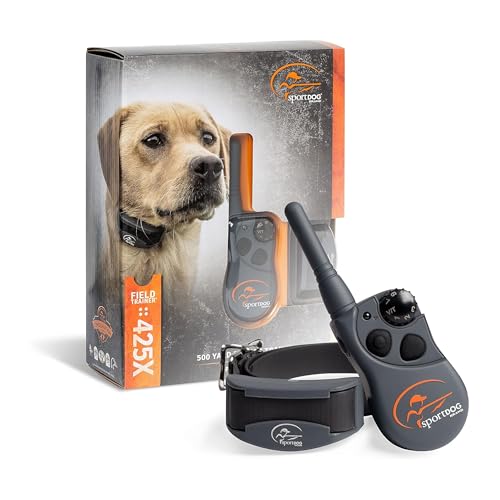
E-collars are real tools used by professional trainers, but not for beginners. This editorial note matters: only use an e-collar after your dog already knows the behavior reliably off-leash. Never use it to teach a new skill. The 425X is the entry-level SportDog unit most recommended for obedience work — 500-yard range, 21 stimulation levels, waterproof.
What we like
21 stimulation levels — find the lowest effective setting for your dog
500-yard range covers most park and trail training environments
What to know
Not for beginners — the behavior must already exist before introducing
Misuse causes lasting anxiety and fear responses — not a shortcut
Most people make training harder than it needs to be. Here's what actually matters — the first behaviors, the common mistakes, and when things finally start clicking.
Dog training has a reputation for being complicated. You’ll find books arguing opposing methods, YouTube channels with contradictory advice, and well-meaning strangers at the dog park who’ll tell you everything you’re doing is wrong. Most of it is noise.
The foundation is simple: mark the behavior you want the instant it happens, then reinforce it. A clicker makes the mark precise. A treat makes it worth repeating. Everything else — recalls, stays, loose-leash walking, trick chains — is a variation on that same loop.
This is what your first month actually looks like.
Week 1: The fundamentals of the mark-and-reward loop
Before you teach anything, you need to “load” the clicker. Your dog needs to understand that the click sound means a treat is coming, no matter what.
Do this: click once, deliver a treat. Click, treat. Ten times in a row over two minutes. Don’t ask your dog to do anything. You’re just establishing the association. Within one or two short sessions, most dogs will visibly perk up at the click sound. That’s the signal — you’re ready to start.
Teach sit first. Hold a treat at your dog’s nose and slowly arc it back over their head toward their tail. Most dogs will naturally plant their rear end to follow the treat with their eyes. The instant the backside hits the floor: click. Treat. That sequence — the exact moment of the behavior, click, then treat — is everything. Practice ten reps, then stop. End on a success.
Two things to get right immediately:
The click marks the moment. If you click one second late, you’re marking whatever happened in that second — standing up, looking away, shifting weight. Precise timing is the entire skill.
Sessions are short. Five minutes twice a day. Dogs learn faster in short, frequent sessions than in long ones. This isn’t a human gym workout. Stop before your dog stops caring.
Once your dog is sitting reliably on the first cue (not the fifth), start building duration. Ask for a sit, wait one second before clicking, then two seconds, then five. You’re teaching the dog that sitting longer earns the reward — not just sitting once.
Add ‘down.’ From a sit, move a treat straight down between your dog’s front paws. Most dogs will follow it into a down to reach it. Click the instant elbows hit the floor. Same ten-rep, five-minute session format.
Start name recognition. Say your dog’s name once. The instant they look at you — any flick of the eye or ear toward you counts — click and treat. This sounds trivial but it’s foundational. A dog that reliably orients to their name is a dog you can reach anywhere.
This week is also the right time to start loose-leash walking in low-distraction environments. The goal is not to stop pulling with force — it’s to make staying near you more rewarding than racing ahead. Start in the backyard. Mark and treat any moment of slack in the leash. Take one step at a time. If the dog pulls, stop. Wait. Mark the moment they return their attention to you and try again.
The two hardest things in week two: You’ll be tempted to repeat the cue when your dog doesn’t respond. Resist this. One cue, wait, reset. Repeating cues teaches your dog that ‘sit sit sit’ is the real command. You’ll also be tempted to extend sessions when things are going well. Don’t. End on a win while your dog still wants more.
Week 3: Proofing starts now
“Proofing” means the behavior works outside your living room. A dog that sits reliably at home and completely ignores you at the park hasn’t learned sit — they’ve learned “sit in this specific context.” This distinction catches most beginners off guard.
Start introducing distractions systematically. Go to a parking lot with low foot traffic. Ask for a sit. Add one person walking nearby. Add a dog at a distance. Each new distraction level is a new version of the behavior to build.
Begin recall on a long line. Attach a 20–30ft check cord and take your dog to a field or large park. Let them wander. Call once, enthusiastically: “Fido, come!” The moment they turn toward you, start backing up — you’re the target, and movement makes the come game more exciting. When they reach you: jackpot treat (five treats delivered one at a time), big praise, then release back to sniffing.
This is the most important behavior you’ll ever teach, and the long line is what makes the lesson possible: if your dog ignores the recall, a gentle pressure on the line brings them back without a chase (a chase teaches your dog that ignoring you is fun).
Never call your dog for anything they won’t like. Nail trimming, the end of a play session, a bath — all these can happen on your terms by moving to the dog rather than calling them. If you call your dog for something unpleasant thirty times, you’ve built thirty reps of “come means bad things happen.” You cannot undo that through repetition.
Week 4: Making it real
By the end of week four, a consistent trainer with a motivated dog should have solid sit, down, and duration-stay indoors; a developing recall on a long line; and the beginning of loose-leash walking.
What you won’t have: reliability in genuinely distracting environments. That comes from the next month of proofing — taking the behaviors you’ve built in low-distraction settings and systematically adding stimulation until the behavior holds everywhere.
A few things that dramatically accelerate the curve:
Find a group class. The classroom environment provides distraction proofing you cannot replicate at home. Other dogs, other people, an instructor watching your timing. A good six-week beginners’ obedience class will identify the two or three mechanics errors that are costing you, and your dog will work harder because they’re used to non-distraction training.
Stop rewarding after a session ends. Some owners reward from the treat pouch during training and then randomly toss treats on the couch. Predictable rewards during sessions are good. Random rewards outside sessions turn into begging, counter-surfing, and confusion about when the training game is active.
Your emotional state is loud. Dogs read arousal and frustration clearly. If you’re tense, your dog reads that tension as a signal that something uncertain is happening and gets cautious. Keep sessions light, keep your energy consistent, and if you’re frustrated — stop. Come back in an hour. The five-minute session you end early is worth more than the fifteen-minute session you push through badly.
Month two is where training gets genuinely interesting: adding cues under distraction, starting heel work, building stay to 30 seconds and 20 feet, and introducing more complex behaviors. The foundation from month one is what all of it rests on.
The dogs that fail basic obedience don’t fail because they’re stubborn or stupid. They fail because their owners got bored in month two and stopped practicing. Five minutes a day, every day, for sixty days: that’s the whole system.
Save your money
What you don't need yet
Beginners get pressured to buy a lot of stuff that doesn't help them play
better. Here's what we'd skip on day one.
A training platform or place board — Useful for teaching 'place' and body awareness, but a folded bath mat does the same job until you know you want a structured platform program.
A prong collar — Modern trainers achieve every obedience goal without one. Not banned everywhere, but there's no beginner case for adding pressure tools before you've run out of positive methods.
A remote automatic treat dispenser — Replaces the timing skill you actually need to build. Learn to mark and reward manually first — the tools aren't a shortcut around the fundamentals.
A sniff mat or lick mat — Great enrichment — but enrichment is not training. Buy one when your dog needs mental stimulation, not as a substitute for working behaviors.
A head halter — Works for some dogs, but many dogs hate them and desensitization takes months. Try the Easy Walk harness first — it fixes pulling for most dogs without a lengthy conditioning process.
First week
Your first seven days
A short, real plan to get from gear-on-doorstep to actually playing.
Buy a clicker and your first bag of training treats — these two items are all you need to start. · Buy
Teach 'sit' in your first session. Lure with a treat, click the instant the backside hits the floor, reward immediately. Ten repetitions, then stop. That is a complete training session. · Action
Practice 5 minutes, twice a day, every day this week. Consistency beats duration every time. · Action
Add a treat pouch so your hands stay free during sessions and your timing improves. · Buy
Once sit is solid, add 'down.' Lure straight down from sit, between the paws. Same click-treat timing as sit. · Action
Find and book a group obedience class. You don't need it week one, but booking it creates accountability and gives you a trainer's eyes on your mechanics. · Action
AKC Club Finder · AKC's directory of obedience clubs offering group classes
APDT Trainer Search · Association of Professional Dog Trainers — find a CPDT-KA certified trainer
FAQ
Common questions
Is positive reinforcement enough for every dog?
Yes, for the vast majority. Modern reward-based training (mark and reinforce the behaviors you want) is sufficient to teach everything from basic obedience to complex tricks in almost all dogs. Balanced methods that add aversive pressure have their place but are not a starting point. Learn the method first; escalate tools only if a certified trainer tells you you've reached a genuine ceiling.
My dog already knows 'sit' without a clicker. Do I still need one?
No — a consistent verbal marker ('yes!') works fine if your timing is sharp. The clicker's advantage is mechanical consistency: it's identical every rep regardless of your stress or tone. If you're new to marker training, the clicker makes it easier to build precise timing. Many trainers fade the clicker and switch to a verbal marker once behaviors are installed.
When should I start recall training?
Day one. Come is the most important behavior your dog will ever learn, and most owners wait too long. Start in the yard on a long line, make yourself thrilling when they reach you (jackpot treats, genuine enthusiasm), and never call your dog for anything unpleasant. Calling a dog to clip nails or end a play session thirty times in a row destroys a recall faster than anything else.
How long until I have reliable basic obedience?
Realistic timeline for solid sit, down, stay, come, and loose-leash walking: 2–3 months of daily 5-minute sessions with a motivated dog and consistent owner. 'Reliable' means it works in new environments with distractions — that proofing phase is what most beginners skip. Your dog will sit in the living room far sooner, but that's not reliability.
Do I need a professional trainer?
Not to start, but a group class (6–8 weeks, $150–250 typically) provides two things YouTube can't: real distraction proofing with other dogs and people, and a professional watching your mechanics. Tutorials teach the theory; a trainer finds the timing error you don't know you're making. Book one after your first month of solo sessions.
What's the actual difference between training treats and regular treats?
Training treats are pea-sized, soft (no crunching), smelly, and low-calorie — you'll deliver 30–50 per session. Standard treats broken small often work, but the soft texture matters: crunching adds a half-second of eating that blurs the timing signal you're building. Zuke's Mini Naturals are the default recommendation for a reason — they hit every spec.
Karen Pryor Clicker Training — The definitive positive-reinforcement resource. Free tutorials, articles, and the online ClickerExpo community. Start with the 'Getting Started' section.
AKC Canine Good Citizen Program — A structured 10-behavior test that gives beginners a concrete training goal. Most dogs are CGC-ready after 3–4 months of basic obedience.
Kikopup (Emily Larlham) — YouTube — One of the most-watched positive trainers on YouTube. Clear, step-by-step tutorials for every foundational behavior. Start with her sit, recall, and loose-leash videos.
"Don't Shoot the Dog" by Karen Pryor — The foundational text on operant conditioning. Not a dog-training manual — a framework for understanding how all learning works. Read once the basics are solid.
r/Dogtraining — Active community with a strong positive-methods culture. Read the wiki before posting — most beginner questions are answered there with sourced recommendations.
As an Amazon Associate, JustBeginning earns from qualifying purchases.
We may also earn commission from other affiliate programs linked on this
page. Editorial recommendations are independent; we don't choose
products based on commission rates.
Product prices and availability are accurate as of the date and time
indicated and are subject to change. Any price and availability
information shown on Amazon at the time of purchase will apply.

 Best starter