Pet birds are among the most rewarding pets you can own — social, intelligent, and far more bonded than most people expect. Beginners get three things wrong: cage bar spacing (a safety hazard), perch variety (affects foot health), and diet (most birds eat seeds alone, which shortens their lifespan). Get those three right and your bird thrives for decades.
By Colin B. · Published May 30, 2026 · Last reviewed August 7, 2026
Booda Comfy Perch
— Soft rope perch that becomes your bird's favorite sleeping spot and rests joints that hard wood fatigues.
Budget total
$350
Typical total
$600
The cage is the biggest purchase — a good cockatiel cage runs $150-250. Everything else (perches, food, toys) adds another $150-200 for the first year. Ongoing costs are mainly food ($15-25/month) and toy replacements ($20-30/month).
We earn commission on qualifying Amazon purchases — see our
affiliate disclosure.
Price tiers and budget totals shown above are editorial estimates;
actual Amazon prices vary.
At a glance
Our top pick in each category
The fastest path through this guide — each best-starter pick by category.
Scroll for the budget and upgrade alternatives.
Super Bird CreationsSuper Bird Creations SB699 Activity Wall Toy - Ideal for Parrots, Ringnecks, Conures - Perfect for Chewing, Foraging, and Boredom Relief, Safe and Engaging Design - Medium Bird Size, 12" x 14" x 3"
Don't buy a cage 'to grow into' without checking bar spacing first. A cage sized for a conure can be dangerous for a parakeet — the bars are wide enough for a small bird to get its head stuck. Match the cage to the species you're actually getting, and know the bar-spacing numbers before you order.
Find an avian vet before you bring the bird home. Not every vet treats birds, and emergency appointments are hard to get at 2 a.m. on a Saturday. The Association of Avian Veterinarians has a locator at aav.org. Book a well-bird checkup for the first month.
Your bird will be stressed for the first 48-72 hours in a new home. This is normal. Resist the urge to handle constantly — let the bird settle, observe, and come to you on its own schedule. Birds that are rushed into handling often become cage-aggressive; birds that are given space first almost always come around within two weeks.
The single most important purchase — and the easiest place to make a safety mistake. Bar spacing is the issue beginners miss: too wide and your bird can trap its head between bars. Bigger is always better; the cage sizes listed here are minimums, not targets. Look for horizontal bars on the side panels (your bird will climb them), powder-coated non-toxic paint, and a removable tray for daily cleaning. Avoid round cages — they disorient birds — and check that hardware is zinc- and lead-free before buying.
Cage — what's the difference?
A few common shapes, each making a different trade.
Parakeet / Budgie
Min 18×18×24 inches. Bar spacing under half inch.
Min size
18×18×24 in
Bar spacing
≤ 0.5 in
Bar orientation
Horizontal sides
Best for Budgies, English budgies, small parakeets
Tradeoff Smallest footprint; bird will outgrow it if you upgrade species
Cockatiel
Min 22×22×30 inches. Bar spacing 0.5 to 0.625 inch.
Min size
22×22×30 in
Bar spacing
0.5–0.625 in
Bar orientation
Horizontal sides
Best for Cockatiels, lovebirds, small parrotlets
Tradeoff Too wide for parakeets; bird needs to be able to spread wings fully
Small Conure
Min 24×24×36 inches. Bar spacing under 3/4 inch.
Min size
24×24×36 in
Bar spacing
≤ 0.75 in
Bar orientation
Horizontal sides
Best for Green-cheek conures, maroon-belly conures, small Pyrrhuras
Tradeoff Too wide for budgies and small parakeets — don't size up species
Best starter
Prevue Pet Products
Wrought Iron Flight Cage
$239.99 as of Jun 22, 2026
★★★★★Our rating· Only 7 left in stock - order soon.
The go-to cockatiel cage for a reason: horizontal bars on all sides for climbing, a full-width pull-out tray for daily cleaning, and 1/2-inch bar spacing that works for both cockatiels and large parakeets. Comes with two wood perches, two swing hooks, and four stainless cups. Not the cheapest option, but it's the one you won't need to replace when you realize the $60 cage you bought was too small.
What we like
Half-inch bar spacing safe for cockatiels and large parakeets
Horizontal bars on all sides — birds climb the walls for exercise
Pull-out tray and wire grate make daily cleaning under 60 seconds
What to know
Assembly is involved — plan 45 minutes and read the manual first
Plastic cups included are small; stainless steel dishes are an easy upgrade
★★★★☆Our rating· Only 16 left in stock - order soon.
The Vision's standout feature is its high-walled base — deep sides on the tray that catch seed shells and feathers before they scatter to your floor. A genuine quality-of-life upgrade for anyone living in a small space. Designed for parakeets and small birds, with 5/8-inch bar spacing appropriate for budgies. No-tool assembly clips together in minutes.
★★★★☆Our rating· Only 2 left in stock - order soon.
If you're getting a conure or an active cockatiel, you need a larger footprint. This cage gives birds room to move, spread wings, and actually fly short distances between perches. Three-quarter-inch bar spacing is safe for green-cheek conures. The playtop feature — a built-in perch platform on the roof — gives you a designated out-of-cage hangout spot without needing a separate play stand.
What we like
Large footprint lets active conures spread wings and fly between perches
Built-in playtop platform replaces a separate play stand
Three-quarter-inch bar spacing correct for green-cheek and similar conures
What to know
Heavy when assembled — commit to a placement before you build it
Bar spacing too wide for parakeets and budgies — species-specific purchase
Your bird spends its entire life on its feet. Perch variety is a welfare issue, not decoration. You need at least three textures: a smooth hardwood perch for regular use, a soft rope perch for sleeping (gentler on joints), and a rough cement or sandy perch for passive nail trimming. Perches that are one uniform diameter cause foot pressure sores within months — the same way standing in one position all day exhausts a human. Place perches at different heights, but keep them away from food dishes (birds defecate from above).
Best starter
Booda
Comfy Perch
$20.99 as of Jun 22, 2026
★★★★★Our rating· Only 2 left in stock - order soon.
A braided cotton rope perch that birds gravitate to for sleeping — the soft texture conforms to feet and rests joints that hard perches fatigue. It bends and holds shape, so you can position it wherever the cage layout needs it. Machine-washable when it gets grimy; the medium size works for cockatiels and small conures. Most birds adopt this as their go-to napping spot within a week.
What we like
Soft braided cotton is gentle on joints — becomes the favorite sleep spot
Bends to fit any cage configuration without wire or tools
What to know
Needs washing every 2-3 weeks or bacteria accumulates in fibers
Loose threads must be trimmed — a toe-snag hazard if neglected
A sandpaper-textured perch that passively files down nails and beak as your bird walks around — reducing how often you need to wrangle a panicking bird for professional grooming. Place it near a food dish so the bird visits it frequently. One rough perch per cage is the right amount; too many rough surfaces fatigue feet. This is a supplement to smoother perches, not a replacement.
What we like
Passively files nails and beak — fewer stressful grooming sessions
Concrete-textured surface wears slowly; lasts longer than sandpaper covers
What to know
Only one per cage — too abrasive if it's the main landing surface
Replace when the grit is worn smooth; inspect monthly
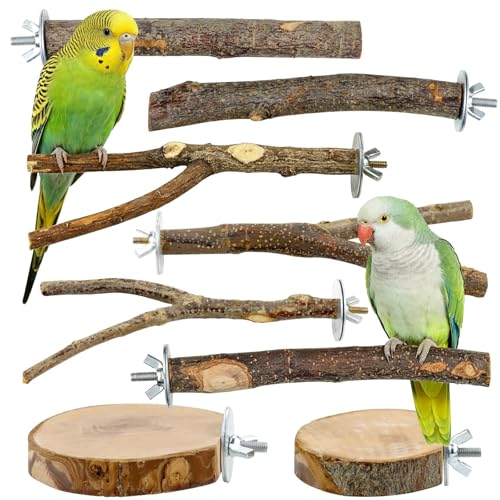
Natural wood perches in different diameters exercise different foot muscles — variable grip keeps feet healthy in a way a uniform dowel never will. CZWESTC's 8-piece set includes perches, platforms, and climbing branches in multiple widths, plus mounting hardware. Non-toxic wood is safe for chewing and lasts for years. A variety pack gives your bird the foot workout it needs.
What we like
Different diameters exercise different foot muscles — the key to foot health
Natural hardwood lasts years and won't fray or absorb bacteria like rope
What to know
Avoid wild-harvested wood of unknown origin — pesticide or parasite risk
Harder to sanitize than plastic — wipe down regularly, replace when soiled
Seed mixes are the bird equivalent of junk food — birds eat around the nutritious bits and binge on fat-rich sunflower seeds. Veterinary consensus is clear: a pelleted diet should make up 60-70% of what your bird eats, with fresh vegetables making up most of the rest. Seeds as an occasional treat, not the main event. The seed-to-pellet transition is real work; birds resist change. Start with a flavored pellet and mix it gradually into current food, allowing 2-4 weeks for full conversion.
Best starter
ZuPreem
FruitBlend Cockatiel Pellets
$33.27 as of Jun 22, 2026
★★★★★Our rating· In Stock
ZuPreem FruitBlend is the easiest pellet to transition seed-addicted birds to — the fruit flavoring and bright colors make reluctant birds curious enough to try it. Not the most nutritionally pure option, but a bird on FruitBlend is dramatically better off than a seed-only diet. Start here and upgrade to Roudybush at the six-month mark when the bird is a confirmed pellet-eater.
What we like
Fruit flavor and color attract birds that ignore plain pellets
Sized for every species from parakeet through conure
Far better than seeds-only diet — a major lifespan improvement
What to know
Artificial dyes stain droppings — alarming-looking but harmless
Not the cleanest formulation available; upgrade to Roudybush later
Roudybush is what avian vets recommend when they recommend pellets. No artificial colors, no added sugar, consistent nutritional formula across every batch. Birds already converted to pellets switch to Roudybush easily — the transition is usually just mixing bags over a week. The best long-term diet for a bird that's already accepted pellet eating.
What we like
No artificial colors or sugar — the formulation avian vets recommend
Consistent across every bag; no batch variation in nutritional content
What to know
Plain color makes it unappealing to birds still converting from seeds
Costs slightly more per pound than ZuPreem for comparable serving size
Avi-Cakes are a compressed seed-and-pellet blend in a cake format — a legitimate nutritional step up from pure seed mix, and one that seed-addicted birds will eat willingly because of the seed content. Not a complete pelleted diet, but a useful bridge food for stubborn seed-eaters who refuse pellets outright. Pick up a small bag to try before committing to a full pellet routine.
What we like
Seed-reluctant birds accept it readily because of the seed content
Foraging format — birds pick it apart, which counts as enrichment
What to know
Seeds let birds cherry-pick favorites — not a full diet replacement
Crumbles scatter across the cage bottom; messier than round pellets
Parrots are intelligent, social animals — in the wild they spend hours foraging, exploring, and interacting. A lone bird in a bare cage gets bored, and boredom leads to screaming, feather-plucking, or both. Foraging toys (ones the bird has to work to get food from) are the single best enrichment investment. Rotate toys every 1-2 weeks; the same toy in the same spot becomes invisible background noise within days. Budget $15-25/month for new shreddable and foraging toys — cheaper than a vet bill for a psychologically distressed bird.
Best starter
Super Bird Creations
SB699 Activity Wall Toy - Ideal for Parrots, Ringnecks, Conures - Perfect for Chewing, Foraging, and Boredom Relief, Safe and Engaging Design - Medium Bird Size, 12" x 14" x 3"
$25.99 as of Jun 22, 2026
★★★★★Our rating
Parrots are built to forage — shred leaves, strip bark, break open seed pods. Super Bird's Activity Wall Toy delivers: seagrass mat, vine chain, cardboard birdie bagels, pine slices, and straw beads on a hanging panel. Birds spend 20 minutes dismantling it — that's the enrichment point. Medium bird size is right for cockatiels and small conures. A destroyed toy is a sign of a happy bird.
What we like
Satisfies foraging instinct — shredding is enrichment, not destruction
Natural balsa wood and palm fronds are non-toxic and bird-safe
Disposable by design — replace monthly as part of the enrichment rotation
What to know
Creates mess — expect shredded material across the cage and floor below
Needs monthly replacement; ongoing cost to account for in the budget
A rotating wheel foraging toy with compartments the bird must spin and open to access food — real puzzle enrichment, not just chewing. Stuff the compartments with pellets, millet, or small treats. A bored bird that finds a foraging wheel will work it for 20-30 minutes straight. One of the more effective investments for a caged bird's mental health, at a budget-friendly price.
What we like
Puzzle format engages problem-solving — real cognitive enrichment
Refillable with different treats to keep the bird guessing
What to know
Moist treats rot quickly — inspect and clean daily when food is inside
Some birds ignore it entirely; depends on the individual bird's personality
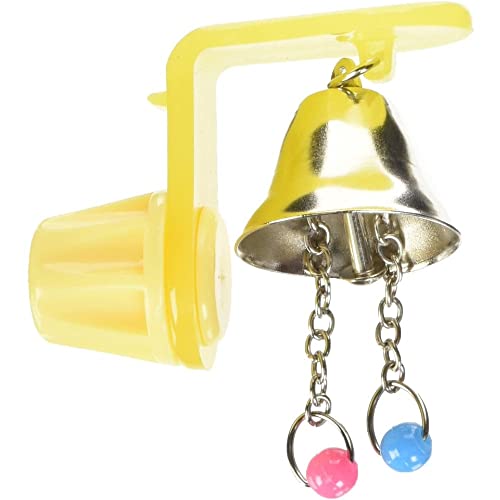
Simple, inexpensive, and frequently the toy birds prefer over elaborate ones. A stainless steel bell with pull chain and colorful beads gives a bird something to ring, pull, and carry. Good for filling out the cage with interactable objects between monthly toy rotations. Buy three or four and rotate them — familiarity kills engagement fast, and these cost under $5 each.
What we like
Inexpensive — stock several and rotate them to maintain novelty
Bell sounds encourage interaction; ringing is self-reinforcing play
What to know
Less enriching than foraging toys — stimulates but doesn't engage mentally
Mirror variants cause obsessive behavior in cockatiels — avoid those
Bird droppings are mildly acidic and accumulate fast — daily spot cleaning is non-negotiable. The most dangerous mistake beginners make is reaching for household cleaners: Lysol, Febreze, air fresheners, scented candles, and non-stick cookware fumes are all acutely toxic to birds. Avian respiratory systems are extremely sensitive to aerosols and VOCs. Use only enzyme-based or bird-safe cleaners. Change the cage liner paper daily. Find an avian vet before you need one — not every vet treats birds, and emergency appointments are hard to get.
Best starter
Poop-Off
Bird Poop Remover Spray
$
★★★★★Our rating
An enzyme-based cage cleaner that breaks down bird droppings without harsh chemicals or aerosols that damage avian lungs. Safe to use around caged birds — which matters when you're cleaning bar perches while the bird watches from two feet away. Far less irritating than any bleach solution, and more effective than water alone on dried droppings. The spray bottle makes bar-by-bar cleaning fast.
What we like
Enzyme formula safe to spray near caged birds — no toxic aerosols
Works on dried droppings without soaking; daily cleaning is fast
What to know
Not a disinfectant — won't kill pathogens from a sick bird
Mild odor that some sensitive birds notice and dislike initially
Pre-cut kraft paper liners sized for medium bird cages make the daily tray swap a 30-second job instead of a scissors-and-newspaper wrestle. Made from raw kraft paper with no ink, gravel, grit, or dyes — safe if the bird drops food on the tray. Stack seven sheets and peel one off each morning. The 100-sheet pack ships flat. Simple, effective, worth the cost premium over newspaper.
What we like
Pre-cut for common cage sizes; daily tray swap takes under 30 seconds
Unbleached and ink-free — no chemical risk if the bird forages on the tray
What to know
May need trimming for non-standard cage trays — measure before ordering
More expensive than plain newspaper, which works equally well
A broken blood feather is a genuine emergency for small birds — the shaft bleeds freely and a budgie can lose dangerous amounts quickly. Styptic powder stops the bleeding in seconds. Every bird owner should have a container on the shelf before they ever need it; the first time a blood feather breaks, you'll be grateful it was there. One container lasts for years.
What we like
Stops blood feather bleeding in seconds — can prevent a vet emergency
Inexpensive and lasts years; buy it before you think you need it
What to know
Only useful for broken blood feathers — not general wound care
Applying to a panicked bird is stressful; practice calm handling first
Getting a bird home is the easy part. The first month — settling it in, converting it to pellets, earning enough trust for step-up training — is where first-time owners either build a lifelong companion or create a bird that hates being touched. Here's what that month actually looks like.
Pet birds are sold in pet stores like impulse purchases — a colorful creature behind glass, friendly with the employees who see it every day, looking like it might be easy to own. It is not hard to own. But the first month shapes everything: the bird’s relationship with you, its acceptance of a healthy diet, its willingness to be handled. Get the first month right and you’re building a 10-20 year relationship with a genuinely engaging animal. Rush it and you spend years trying to undo what you set in the first few weeks.
This is what the first month actually looks like, week by week.
Days 1–3: The settling-in window
The day you bring your bird home, set up the cage before the bird goes in it. Cage placement matters: put it in a high-traffic room — living room, kitchen — at eye level or slightly above. Birds are prey animals with a hard-wired fear of being approached from above. A cage at floor level stresses them. A cage in a back bedroom produces a bird that spends most of its life alone and learns to fear people who only appear occasionally.
Once the bird is in the cage, stop.
Resist every impulse to handle it, show it off, or reach in. Talk normally in the room. Go about your life. The bird is calibrating: figuring out whether this space is dangerous, whether you’re a threat, what the sounds and rhythms of this household are. This calibration takes 48-72 hours. Birds that are handled constantly in the first two days often become cage-aggressive — they associate the cage with safety and the human hand with stress. Birds that are given space first almost always come around on their own within a week.
Offer food and water normally. Don’t change brands yet — wait until the bird is settled to start the pellet conversion.
By day four, most birds are eating normally, moving around the cage freely, and watching you with curiosity rather than alarm. This is when you start the next phase.
Step-up training starts on a flat surface, not in the cage. Open the cage door and let the bird walk out voluntarily. Don’t reach in and grab — that’s a capture, not an invitation. Once the bird is out on top of the cage or on a perch, hold your finger horizontally just above the bird’s feet and say “step up” in a calm, flat voice. Press gently against the lower chest. Most birds will step onto the finger within a few sessions. Some take longer. The point is consistency: same cue, same pressure point, same calm voice every time.
Keep first sessions short — five minutes maximum. Always end on a positive moment, not a biting one. If the bird is getting agitated (feathers slicked down, head lowering, tail fanning), stop before it bites. Stopping before the bite means the session ends on your terms, not the bird’s. Over time, the bird learns that calm behavior extends the session; agitation ends it.
Pellet conversion starts now. Serve the bird’s current food (whatever the pet store or previous owner was feeding) but mix in 20% pellets. Over the next 10-14 days, shift the ratio gradually: 80/20 food-to-pellets, then 60/40, then 40/60, then 20/80, then full pellets. Monitor weight — a bird that isn’t eating will get lighter. If the bird is losing weight noticeably, slow the transition. Never remove all seeds in one day and replace with pellets; birds sometimes refuse unfamiliar food to the point of starving.
By week two, most birds have a handle on where things are and who you are. This is when daily routine starts to matter.
A consistent daily schedule reduces stress significantly in parrots. Same wake time, same out-of-cage time window, same bedtime (covered cage at the same hour each night). Ten to twelve hours of covered, quiet darkness is non-negotiable — chronically under-slept birds are cranky, hormonal, and harder to work with.
Out-of-cage time should be at least one to two hours per day in a bird-safe room. Bird-safe means: no ceiling fans running, no open windows, no other pets loose, no scented candles or non-stick cookware on the stove (PTFE fumes from overheated non-stick pans kill birds quickly). These sound like overkill until they’re not. The canary-in-the-coal-mine wasn’t a metaphor.
During out-of-cage time, let the bird come to you rather than pursuing it. Put your arm out; let it climb. Move slowly. Parrots read body language the way dogs read tone — your tension is their tension. Calm handlers produce calm birds.
By week three, most cockatiels and parakeets will step up reliably and tolerate short periods of gentle head scratching. This varies widely by individual bird — some are naturals, some need six weeks. The mistake is expecting the timeline to match what you read on a forum. Read your specific bird.
Week 4: The bird you’re going to have
By the end of the first month, you have a bird that knows your face, knows its routine, and is (hopefully) eating at least 50% pellets. This is not the finished bird — tame, bonded, fully transitioned to a pelleted diet — but it’s the foundation.
The bond from here builds slowly through repetition. Daily handling. Talking during chores. Bringing the bird into the room where you spend time. Not because the bird needs to be entertained every second, but because proximity is how parrots learn that humans are their flock.
What still takes time:
Full pellet conversion: Some birds take 2-3 months, not 4 weeks. That’s fine. Keep the ratio moving in the right direction.
Voluntary step-up without hesitation: Reliable recall and step-up on cue usually click around the 6-8 week mark.
Tolerance of novel things: Parrots are suspicious of new objects, new people, new rooms. Introduce gradually — let the bird see new things from a distance before expecting it to approach them.
The bird bites you. This will happen. Bird bites are information, not aggression: the bird is telling you it’s at its limit. Read the warning signs — slicked feathers, pinning eyes (pupils rapidly contracting and dilating), tail fanning — and stop before the bite. If you get bitten, don’t pull away sharply; that teaches the bird that biting works to end things. Stay calm, say “no” quietly, and put the bird down calmly.
The bird screams when you leave the room. Contact calls are normal. A bird calling out when you disappear is saying “where are you?” — it’s a social animal doing a social animal thing. Don’t rush back in response to every call (that teaches the bird screaming summons you), but do call back occasionally from the other room. The bird needs to know you’re there, not that silence is the price of your presence.
The pellet conversion stalls. Some birds are stubborn. If you’re three weeks in and the bird still won’t touch pellets, try a different brand (flavored pellets like ZuPreem FruitBlend work when plain pellets don’t). Eat a pellet in front of the bird — parrots are social eaters and often try food they’ve seen their flock member consume. Leave pellets out in the morning when the bird is hungriest.
Save your money
What you don't need yet
Beginners get pressured to buy a lot of stuff that doesn't help them play
better. Here's what we'd skip on day one.
A DNA sexing test — Most beginner-friendly species (parakeets, cockatiels) can't be reliably sexed visually until after the first molt, and behavioral differences between sexes are subtle for new owners. Not urgent.
A second bird right away — Two birds bond with each other and largely ignore you. Get one bird, tame it and build a relationship, then consider a second at the 6-12 month mark once the first is handleable.
Breeding or nesting supplies — Responsible breeding requires species-specific knowledge, proper nutrition, DNA sexing, and a plan for the offspring. Not a beginner undertaking. Skip the nest box.
Supplement powders or vitamin drops — A bird eating a pelleted diet is nutritionally complete and doesn't need supplements. Adding vitamins to water or food can cause imbalances. Skip unless an avian vet specifically prescribes them.
An expensive travel carrier — A basic small carrier works for vet trips. Upgrade to a ventilated backpack carrier if you start traveling with your bird regularly — that's a year-two decision.
First week
Your first seven days
A short, real plan to get from gear-on-doorstep to actually playing.
Set up the cage in a high-traffic room — living room, kitchen — so your bird habituates to human activity and voices from day one. A cage in a back bedroom produces a skittish bird. · Action
Leave the bird alone for the first 48-72 hours. Talk softly when you're nearby, but don't force handling. Let it settle, observe, and approach on its own terms. · Action
Start the pellet conversion: serve your current food as normal but mix in 20% pellets. Increase the pellet ratio by 10% every 3-4 days over the next few weeks. · Buy
Find an avian vet using the Association of Avian Veterinarians locator at aav.org — book a well-bird checkup for the first month. Don't wait until the bird is sick to find one. · Action
AAV vet locator · Association of Avian Veterinarians — find a certified avian vet near you
Cover the cage each night with a light cloth to establish a consistent 10-12 hour sleep routine. Tired, under-slept birds are stressed birds. · Action
Once the bird is eating normally and seems settled (usually day 4-7), start short 5-minute handling sessions. Stop before the bird gets agitated — quit on a calm moment, not a biting one. · Action
FAQ
Common questions
Parakeet, cockatiel, or conure — which is best for a first bird?
Parakeets (budgies) are the easiest entry: small, affordable, and gentle. Cockatiels are the most popular first 'real' parrot — affectionate, whistling, and manageable. Green-cheek conures are louder and need more enrichment but bond extremely tightly. Match to your space and noise tolerance. All three make excellent first birds with the right setup.
How much time outside the cage does a pet bird need?
At minimum, 1-2 hours of out-of-cage time daily in a bird-safe room (no open windows, ceiling fans off, other pets secured). More is better. Birds left in cages 22+ hours a day develop behavioral problems. If your schedule doesn't allow daily out time, a bird isn't the right pet right now.
Can I just feed my bird a seed mix instead of pellets?
You can, but it shortens their life. Seeds are high in fat, low in protein and vitamins, and birds selectively eat their favorites — essentially eating junk food exclusively. Pellets provide complete nutrition in every bite. The conversion takes a few weeks and some patience, but it's the single highest-impact thing you can do for your bird's long-term health.
Should I get two birds so mine won't be lonely?
If you want a bird that bonds tightly with you, get one and spend time with it daily. Two birds raised together bond to each other and often become much harder to handle. If you want a hands-off display pair, two birds are fine. Decide which experience you want before you decide how many birds to buy.
How long does it take to tame a new bird?
Most parakeets and cockatiels accept step-up training (stepping onto a finger from a flat surface) within 2-4 weeks of daily 5-minute sessions. Some are ready in days; some take months. Consistency matters more than session length. Work with the bird's pace, not yours.
My new bird screams constantly. Is that normal?
Some vocalization is normal and healthy, especially in the morning and evening (flock contact calls). Excessive screaming usually means the bird is bored, under-stimulated, or learned that screaming gets your attention. Add enrichment, increase out-of-cage time, and don't respond to screaming — go to the bird only when it's quiet.
World Parrot Trust — Conservation and welfare organization for parrots worldwide. Strong species-specific husbandry guides, particularly for diet and enrichment.
Association of Avian Veterinarians — Professional organization for bird vets. Use the member directory to find a certified avian vet near you — not every vet treats birds.
Lafeber Company — Bird Health — Extensive, vet-reviewed guides on diet, behavior, and species selection. More reliable than most pet-store advice or forum anecdotes.
r/parrots — Active community covering all parrot species. Search before posting — diet and taming questions have thorough threads already. Skip the gear recommendation threads.
Avian Avenue Forum — Long-running forum with species-specific boards. Better than Reddit for deep-dive species husbandry questions; slower-paced and more thorough.
BirdTricks (YouTube) — Training and behavior content focused on parrots. Practical step-up, recall, and enrichment tutorials. Good starting point for taming a new bird.
As an Amazon Associate, JustBeginning earns from qualifying purchases.
We may also earn commission from other affiliate programs linked on this
page. Editorial recommendations are independent; we don't choose
products based on commission rates.
Product prices and availability are accurate as of the date and time
indicated and are subject to change. Any price and availability
information shown on Amazon at the time of purchase will apply.
Our top pickPrevue Pet Products Wrought Iron Flight Cage


 Best starter