Ferrets are mischievous, endlessly curious, and genuinely funny to live with — but they need the right setup before day one. The right cage, food, and enrichment essentials make the difference between a ferret that thrives and one that's bored and stressed. Here's exactly what you need.
By Colin B. · Published June 13, 2026 · Last reviewed June 13, 2026
A good multi-level cage runs $100-200 and lasts for years. Food is the main ongoing cost: $20-40/month for one ferret.
We earn commission on qualifying Amazon purchases — see our
affiliate disclosure.
Price tiers and budget totals shown above are editorial estimates;
actual Amazon prices vary.
At a glance
Our top pick in each category
The fastest path through this guide — each best-starter pick by category.
Scroll for the budget and upgrade alternatives.
Ferrets are expensive long-term, not just upfront. Budget $200-500/year for vet care — ferrets are prone to adrenal disease and insulinoma, both requiring ongoing treatment. The cage and food are predictable costs; the vet bills are the real financial commitment you need to plan for.
You almost certainly want two ferrets, not one. Ferrets are intensely social and sleep 18 hours a day — without a cage mate, a single ferret gets bored and depressed. Two is not twice the work; same daily routine, healthier animals.
Ferret-proof your home before the ferret arrives. They squeeze into any gap wider than their skull (roughly the size of a quarter), can open unlocked cabinets, and will eat foam, rubber, and soft plastic. Walk your space at floor level before letting them roam.
The cage is your most important purchase. Ferrets sleep up to 18 hours a day but need room to climb and play during their active windows. Minimum floor space is about 3 cubic feet per ferret. Multi-level cages deliver more enrichment in a smaller footprint. Look for: half-inch bar spacing (ferrets squeeze through one-inch gaps), sturdy latches (they learn to open simple ones), and solid or coated wire floors — bare wire injures their feet.
Cage & Housing — what's the difference?
A few common shapes, each making a different trade.
Single Unit
Fits 1-2 ferrets. Good starter footprint, easier to move.
Levels
1
Floor space
~4 sq ft
Best for
1-2 ferrets
Best for First-time ferret owners, smaller living spaces
Tradeoff You'll likely want a second unit eventually as your ferret count grows
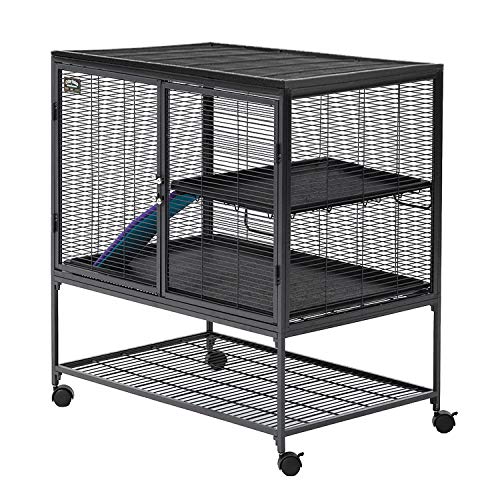
The Critter Nation Single is the cage most ferret communities recommend without hesitation. Wide double doors swing open flat — you can reach every corner without disassembling anything. Bar spacing is correct at half-inch, the base pan slides out for cleaning, and the build is solid enough to last a decade. Add the double unit later when you add a second ferret.
What we like
Double doors swing fully open — easiest cage to clean in its class
Half-inch bar spacing keeps ferrets in without being cramped
Modular: stack a second unit later when your ferret count grows
What to know
Heavy (38 lbs) and wide; plan your room layout before ordering
Pricier than Kaytee options, but the build quality justifies the gap
If the Critter Nation is out of budget, the Kaytee Multi-Level is the next acceptable option. Two levels, solid plastic ramps, and a front door large enough to get your arm in for cleaning. Not as well-built as the MidWest, but functionally adequate for a single ferret. Upgrade when your ferret count grows.
What we like
Affordable entry point at $80-120, available at most pet chains
Two levels give adequate enrichment space for a single ferret
Solid plastic ramps are gentler on ferret feet than bare wire
What to know
Smaller footprint; inadequate long-term for two or more ferrets
Plastic components crack faster than the MidWest's wire-frame build
★★★★☆Our rating· Only 18 left in stock (more on the way).
The Double is what most serious ferret owners end up with. Two full levels, each with wide double doors, a center shelf, and removable ramps. The right home for a pair of ferrets for their entire lives. If you're starting with two ferrets, skip the Single and buy this from day one.
What we like
Two full levels fit 2-3 ferrets with real enrichment space to spare
Each level has wide double-door access — cleaning is effortless
Comes with wheels; rolls out from the wall for full cleaning access
What to know
Expensive ($200+) and large; not practical for small apartments
Heavier than advertised when loaded with hammocks and accessories
Ferrets are obligate carnivores — they need high-protein, high-fat, low-carbohydrate food, and their gut can't process grains, fruits, or vegetables. Choose a kibble with chicken or turkey as the first ingredient and no corn or wheat fillers. Feed ad libitum: keep the bowl full, since ferrets eat 8-10 small meals a day and naturally self-regulate. One practical note: ferrets imprint on specific foods early, so introduce variety while they're young.
Best starter
Zupreem
Grain Free Ferret Food
$19.96 as of Jun 22, 2026
★★★★★Our rating· In Stock
Chicken is the first ingredient, there's no grain in the formula, and it's available at most pet retailers and online. Most ferret rescues and vets in the US consider Zupreem a solid baseline kibble. It's not the most glamorous option, but it's consistently correct nutritionally and ferrets eat it reliably.
What we like
Chicken is first ingredient — passes the obligate carnivore test
No grains, fruits, or vegetables in the formula
Widely available at pet chains; easy to restock without waiting
What to know
Some ferrets are picky about texture; mix with a second brand early
Bags can stale if not sealed after opening; store in an airtight bin
Marshall's formula has been trusted by ferret breeders and rescues for decades. Feed it alongside Zupreem as a second rotation brand — ferrets that eat two kibbles from kithood handle a supply disruption without going on a hunger strike. Any ferret owner who's had their main brand go out of stock learns this lesson the hard way.
What we like
Trusted by breeders and rescues for decades of ferret keeping
Ideal rotation partner with Zupreem to prevent food imprinting
What to know
Contains more carbohydrates than Zupreem; not ideal as a solo diet
Smaller bag sizes cost more per pound than bulk Zupreem
Ferrets love exploring outdoors, but a standard cat or dog harness won't hold them. Ferrets have an unusual body — long torso, flexible spine, narrow shoulders — and can reverse out of most vest-style harnesses in seconds. The H-harness is the only reliable design: two straps crossing the chest and back in an H pattern, making it anatomically impossible to back out of. Buy ferret-specific and size at the narrowest point of the chest, not by weight.
Best starter
Marshall Pet Products
Marshall Ferret Harness and Lead Set
$12.99 as of Jun 22, 2026
★★★★★Our rating· In Stock
Marshall designed this H-harness specifically for ferrets, and it shows. The fit is correct for ferret proportions, the snap buckles are secure without being fiddly, and the included lead is short enough to keep your ferret close on sidewalk walks. It's the harness you'll see at ferret shows and in vet waiting rooms.
What we like
H-style design is anatomically impossible for ferrets to reverse out of
Sized for ferret proportions, not adapted from cat harnesses
Snap buckles hold securely without being difficult to close
What to know
Runs small; measure chest girth, don't guess by weight
Fabric wears faster than leather alternatives at higher price points
Available in a 2-pack for roughly the price of one Marshall harness — sensible if you have multiple ferrets or want a backup. Soft mesh construction fits snugly around the chest; the attached leash is longer than Marshall's if you want more slack on outdoor walks.
What we like
Often sold as a 2-pack, ideal for multi-ferret households
Longer leash gives more slack for explorative ferrets
What to know
Stitching quality is inconsistent; inspect on arrival
Less precise fit than Marshall for smaller ferrets under 1.5 lbs
Ferrets are crepuscular — most active at dawn and dusk — with enormous energy during their 2-4 hour active windows. Without enrichment, they'll dig, chew, and find trouble. The standbys every owner ends up with: a crinkle tunnel (ferrets treat these as a life necessity), a hanging hammock for napping, and toys that make noise or move unpredictably. Avoid soft rubber toys — ferrets chew and swallow rubber, which causes intestinal blockages requiring emergency surgery.
Best starter
Marshall Pet Products
Marshall Double Fun Ferret Tunnel
$
★★★★★Our rating
If ferrets are awake and bored, they'll find trouble. A crinkle tunnel solves this every time. Ferrets race through it, sleep in it, and carry it around the room. Marshall's double-tube design connects at the middle so ferrets can enter from either side, doubling the play options in the same footprint.
What we like
Crinkle noise and enclosed space are genuinely irresistible to ferrets
Collapses flat for easy storage or travel
Doubles as a nap spot when your ferret is ready to settle
What to know
Replace when inner lining tears — exposed plastic is a swallowing risk
Single-tube design is simpler than multi-piece tunnel sets
Ferrets sleep 18 hours a day and strongly prefer sleeping off the cage floor. Marshall's Deluxe Leisure Lounge clips to any wire cage at four corners, holds up to 4 lbs, and the fleece is machine washable. Buy two: one in use, one in the wash. A hammock is the first thing experienced owners tell new keepers to add.
What we like
Fleece is machine washable — critical since ferrets sleep here daily
Four-point clip system holds up through rough ferret wrestling
Fits any wire cage with bar gaps over half an inch
What to know
Buy two; single hammock creates a washing-timing problem
Fleece pills after repeated washing but stays fully functional
A longer, wider crinkle tunnel than the Marshall — 39 inches fits adult ferrets fully extended and has enough room for two ferrets to chase each other through it. The Niteangel is the upgrade when one standard tunnel isn't keeping your pair entertained during free-roam time.
What we like
Longer and wider than standard tunnels — fits two ferrets chasing each other
Zipper pockets support treat-hiding and foraging enrichment
What to know
Bulkier than a shorter tunnel; requires more floor space during free-roam
Premium price; single-ferret households can start with something simpler
Ferrets need less grooming than cats but more than you'd expect. Their ears accumulate dark brown wax every 2-4 weeks and need regular cleaning. Their nails grow fast and curve sharply — untrimmed nails catch in cage bars and tear. Over-bathing makes their natural musk worse: more than one bath a month strips coat oils, triggering more odor production. Keep it simple: a good ear cleaner, sharp nail clippers, and a mild ferret shampoo used sparingly.
Best starter
Marshall Pet Products
Marshall Ferret Ear Cleaner
$9.99 as of Jun 22, 2026
★★★★★Our rating
Ferret ears fill with dark brown wax every few weeks. A 10-minute cleaning session monthly prevents impaction and the ear infections your vet would otherwise charge to treat. Marshall's formula is gentle, works without sedating your ferret, and doesn't require probing past the outer ear. This is the most important grooming habit you'll build.
What we like
Formulated for ferrets — gentler than dog ear cleaners on their ears
Monthly use prevents the impaction that's one of the top ferret vet visits
What to know
Your ferret will hate this at first; pair with a treat to build the habit
Doesn't treat ear mites — see a vet if wax turns black and gritty
Ferret nails grow fast and curve sharply — bi-weekly trimming keeps them from snagging in cage bars or carpet. Any sharp small-pet clipper works; the Hertzko's circular blade and safety lock make it easier to control on a wriggling ferret. The trick: dab salmon oil on your wrist while they lick, then clip.
What we like
Small jaw sized for ferret nails, not the larger blades of cat clippers
Safety lock prevents accidental cuts when storing between sessions
What to know
Needs sharpening or replacement after several months of regular use
Squirmy ferrets make any nail tool a two-person job at first
When you do bathe your ferret (no more than monthly), use a shampoo that won't strip coat oils. Marshall's formula is mild, ferret-specific, and available everywhere ferret supplies are sold. Skip human shampoo and dog shampoo — both are too alkaline and make the natural musk worse, not better.
What we like
pH-balanced for ferrets; won't trigger the overproduction that backfires
Mild enough for monthly use without drying out their coat
What to know
Scented version can irritate sensitive ferrets; unscented is safer
Small bottle goes quickly if you're bathing two or more ferrets
Most new ferret owners are surprised by how much personality fits in two pounds of mischief. Here's what actually happens in your first month — the setup, the surprises, and when it stops feeling chaotic.
Ferrets look like easy pets at the pet store. Small, cute, seemingly simple. Then you bring one home and discover that a ferret is basically a very fast, very opinionated mammal with a talent for finding every gap in your house, stealing your socks, and sleeping in the most inconvenient location possible.
The first month is mostly about calibrating your expectations — down on complexity, up on personality. Here’s what it actually looks like.
Week 1: Setup and first contact
Before the ferret comes home, the cage needs to be ready. Not “mostly assembled” — completely set up with bedding, a litter box in a corner, a hammock clipped in, and a water bottle or heavy bowl that won’t tip. Ferrets handle the transition better when they have a finished space to retreat to.
The first 24-48 hours, let the ferret explore the cage on their own terms. Resist the urge to hold them constantly. They’re doing a sniff survey of their new territory, establishing mental maps, and deciding if they’re safe. You’ll see a lot of sleeping — ferrets sleep 18 hours a day, which shocks almost every first-time owner. This is normal. They’re not sick; they’re just ferrets.
By day three, most ferrets will approach you on their own, which is the right time to start handling. Pick them up from below (not above — predators strike from above), support their weight along your forearm, and keep the session short. If they wriggle insistently, put them down rather than restraining them. Trust builds faster through released pressure than through holding on.
Ferrets thrive on schedule. They’ll quickly learn when you open the cage for free-roam time and will be awake and ready at the latch before you touch it. This is endearing until it’s 5am.
The first thing every new owner gets wrong is litter box training. Ferrets choose corners instinctively — they’ll back up to a corner and go regardless of whether there’s a box there. The fix: put litter boxes in the corners they choose, not the corners you prefer. You’re negotiating with the ferret’s instinct, not overriding it. Three small boxes work better than one large one.
Food management is simpler than expected: keep the bowl full. Ferrets eat small amounts constantly and don’t overeat. The bigger mistake is variety. Ferrets imprint on specific foods early and will refuse anything new after a few months. Introduce two brands of kibble right away, alternating between them, so you’re not trapped if one goes out of stock.
Out-of-cage time should be at minimum 4 hours a day once your ferret is comfortable. This doesn’t require your active participation — they’ll explore, nap, explore again. Your job is making sure the room is ferret-proofed: cables secured, gaps blocked, rubber and foam objects removed. A ferret will eat the foam backing off your couch if given the opportunity.
Week 3: Nipping and the dook
At some point in week two or three, you’ll get nipped. It probably won’t hurt much, but it’ll startle you. Ferrets nip for a few reasons: overstimulation, rough play, asking you to put them down, or leftover bite inhibition issues from poor early socialization. The correct response is a firm, calm “no” and a brief time-out — return to the cage for 5 minutes. What doesn’t work: yelping, jerking your hand away (this looks like prey behavior and escalates play), or scruffing repeatedly.
Most ferrets with nipping habits improve dramatically within a few weeks of consistent responses. Ferrets from good breeders or rescues that handled kittens regularly are much less likely to nip at all.
The other thing that happens around week three: you’ll hear a dook for the first time. A dook is a clucking, chattering sound ferrets make when they’re happy — during play, when they catch a toy, when they’re doing a weasel war dance (a sideways, bouncing sprint that means pure joy). It’s the ferret’s version of a laugh. The first time your ferret dooks, you’ll understand why people keep ferrets.
Week 4: Health baseline and costs
By the end of month one, you should have had your first vet visit if you haven’t already. Find an exotic animal practice — ferrets require distemper and rabies vaccines, and not every general-practice vet is comfortable examining a ferret or reading their bloodwork. Having an established relationship with a ferret-savvy vet before an emergency matters.
The main health habits to establish early:
Ear cleaning every 2-4 weeks. Ferret ears fill with dark brown wax. Clean with a ferret-specific ear cleaner and a cotton ball; don’t go past the outer ear. Black or crumbly wax with odor may indicate ear mites — call the vet.
Nail trimming every 2-3 weeks. Ferret nails grow fast and curve. Untrimmed nails catch in cage bars, carpet, and fabric. The distraction method works: dab salmon oil on your wrist while they lick, then clip.
No baths more than monthly. Over-bathing triggers oil glands to overproduce and makes the natural musk worse. When you do bathe, use ferret-specific shampoo and dry them completely before returning to the cage.
The real financial surprise of ferret ownership isn’t the monthly food cost ($20-40) — it’s the vet bills starting around age 3-5, when adrenal disease and insulinoma become common. Both are treatable, both cost real money. The owners who are happiest with ferrets long-term are the ones who budgeted for this before it happened.
What you’ll know by month two
At the end of the first month, a few things will be obvious that weren’t before you started:
You needed two ferrets. A single ferret is manageable but spends a lot of time looking for something to do. Two ferrets entertain each other and show you what ferret play actually looks like — which is chaotic, fast, and ridiculous in the best possible way.
Ferret-proofing is ongoing. You’ll find a new gap every week for the first two months. This isn’t failure; it’s ferret-keeping. Add another door stop, block another cabinet gap, move another cable.
The smell is manageable. Most people who visit your house won’t notice it if you’re cleaning the litter regularly. You’ll stop noticing it entirely within three weeks.
What you’ll have by month two: a ferret (or two) that knows your schedule, comes to your name, dooks when you open the cage, and has stolen something you can’t find. That’s the job. It’s a good one.
Save your money
What you don't need yet
Beginners get pressured to buy a lot of stuff that doesn't help them play
better. Here's what we'd skip on day one.
A dedicated ferret room — Supervised free-roam in a ferret-proofed room is ideal, but you don't need a whole dedicated space. Start with one room at a time.
A raw meat diet — Prey-model raw is nutritionally superior but requires research and meal balancing. Start with quality kibble and switch later once you understand ferret nutrition.
A hospital cage — A separate small cage for sick or post-surgery ferrets is useful eventually, but a cardboard box with bedding works in the short term. Get one after your first vet visit.
Ferret vitamins and supplements — If you're feeding quality kibble, your ferret doesn't need them. Supplements are mostly for ferrets on inadequate diets.
A ferret stroller — A fun accessory some owners love, but a harness and leash serves the same purpose and builds better ferret behavior outdoors.
First week
Your first seven days
A short, real plan to get from gear-on-doorstep to actually playing.
Order the cage before the ferret arrives. It needs to be assembled, loaded with hammocks and a litter box, and ready to go before your ferret comes home. · Action
Find a ferret-savvy vet before you need one urgently. Call local exotic animal practices and ask specifically about ferret experience — not all vets are comfortable with ferrets. · Action
Order the MidWest Critter Nation Single Unit cage. · Buy
Ferret-proof one room for out-of-cage time. Block gaps under furniture, remove rubber and foam objects, and check that cabinets can't be opened from inside. · Action
Buy two hammocks when you buy your first. One will always be in the wash — one hammock means you're hand-washing at awkward times. · Action
Give your ferret at least 4 hours of out-of-cage time daily once they're settled. Ferrets confined 24 hours a day develop behavioral problems quickly. · Action
FAQ
Common questions
Do ferrets smell?
Yes, somewhat. Ferrets have a natural musky odor from skin glands — this doesn't go away with bathing, and over-bathing makes it worse by triggering oil gland overproduction. Most owners stop noticing within a few weeks. Clean the cage litter 2-3 times weekly; that's where the real smell lives.
Are ferrets good pets for families with young children?
With supervision, yes — but they're better suited to families with children over 8 who can understand how to hold and read an animal. Ferrets nip when startled or handled roughly. Ferrets that are handled regularly from kithood are much less prone to nipping.
How much out-of-cage time do ferrets need?
At minimum 4 hours daily in a ferret-proofed area. Ferrets kept in cages all day become lethargic and develop behavioral problems. The good news: they spend most of that time sleeping near you, not requiring active entertainment.
Do ferrets need vaccinations?
Yes. Ferrets in the US need annual distemper and rabies vaccines — both are legally required in some states and genuinely protective. Find an exotic animal vet before you need one in an emergency. Not all general-practice vets are comfortable with ferrets.
How long do ferrets live?
Typically 6-10 years, with 8 being a reasonable expectation for a well-cared-for ferret. Adrenal disease and insulinoma affect the majority of ferrets over age 5. Budget for increased vet care as your ferret ages — the last 2-3 years often involve ongoing treatment.
Can ferrets get along with cats or dogs?
Often yes, with careful introduction. Ferrets and cats typically reach a tolerant standoff. Dogs with strong prey drive are riskier — a quick shake from a terrier can kill a ferret. Supervise all interactions until you're confident in your specific animals' behavior together.
American Ferret Association — The main US ferret organization. Shelter directory, care guides, vet referrals, and ferret show listings. Start here for local resources.
r/ferrets — Active community of ferret owners at every experience level. Search before posting — most beginner questions have detailed existing threads.
The Holistic Ferret Forum — Deep dives into ferret nutrition, raw diet research, and illness management. More opinionated than AFA but worth reading when choosing a diet.
Ferret Universe — Long-running ferret care reference. Health section covers adrenal disease, insulinoma, and other common conditions every owner will eventually encounter.
As an Amazon Associate, JustBeginning earns from qualifying purchases.
We may also earn commission from other affiliate programs linked on this
page. Editorial recommendations are independent; we don't choose
products based on commission rates.
Product prices and availability are accurate as of the date and time
indicated and are subject to change. Any price and availability
information shown on Amazon at the time of purchase will apply.


 Best starter